Sara Buonocore, Francesca Massa, Lisa Guadagno, Giuseppe Di Gironimo (2024). Reflections and Insights on Haptics’ Influence on Human Factors Within Virtual Environments. In: Human Factors in Design, Engineering, and Computing. AHFE Open Access, vol. 159, pp. 1128–1138. https://doi.org/10.54941/ahfe1005680
The present work discusses the influence of different haptic feedbacks and devices on two selected Human Factors (Motion Sickness and Technology Acceptance) that are strongly relevant for User Experience analysis in Virtual Environments. With this work, we aim to stimulate: (i) practitioners to consider human factors in the selection of the right type of haptic feedback and device; (ii) researchers for future in-depth studies by highlighting some grey areas of current literature about haptics and their influence on Human Factors.
In the field of virtual experiences, both academic and industrial communities have already recognized the importance of simulating “sense of touch” while users are immersed within Virtual Environments (VEs) (Bravo, 2020; Chardonnet, 2015; Chen, 2011; Garcia-Canseco, 2013; Limerick, 2019; Liu, 2019; Rodrigues, 2022; Rutten, 2020; Yeom, 2013). However, considering that the haptic technology is still in a development phase, the process of choosing the type of haptic device and feedback to achieve the objectives set for the specific virtual simulation may be often too complex and long. On one hand, it is complex for industrialists and practitioners, since the lack of knowledge of haptics’ influence on one or more Human Factors (HFs) causes a lack of proper control on the production process, and may translate into waste of time, energy and human resources for the design and development of a non-optimal Virtual Reality (VR) applications. On the other hand, whether literature does not offer a satisfying knowledge about haptics’ influence on HFs, researchers could struggle to properly conduct human-subject experiments, misjudging the outcomes or wrongly attributing unexpected events to some bias.
The objective of this paper is therefore twofold, aiming to provide: (i) a guide for practitioners to introduce HFs in the selection of right type of haptic feedback and device for different kind of human-product interaction in VEs, (ii) a photography of the current knowledge of the relationship between the
Reflections and Insights on Haptics’ Influence on Human Factors 1129
type of haptic feedback and device and one or more HFs, stimulating ideas for future in-depth studies on the grey areas of the current literature.
The remainder of the paper is structured as follows: Section 2 provides a brief overview on haptic technology, starting from the different types of feedback provided to the user, and secondly describing the main classification of haptic devices based on their wearability level. Section 3 discusses main subjective and objective measurements and haptics’ influence on two selected HFs: Motion Sickness and Technology Acceptance, while conclusions are given in Section 4.
CLASSIFICATION OF HAPTIC TECHNOLOGY Humans’ somatosensory system is physiologically classified into kinaesthetic and tactile perception (i.e., feedback), based on the location of the sensory receptors (Wee, 2021):
Tactile perception relies on cutaneous receptors in the skin that can perceive mechanical stimuli, such as high/low frequency vibrations, pressure, and shear deformation, as well as electrical stimuli and temperature.
Kinaesthetic perception relies on sensory receptors in muscles, tendons, and joints that reflect the operational state of the human locomotor system, such as joint positions, limb alignment, body orientation and muscle tension.
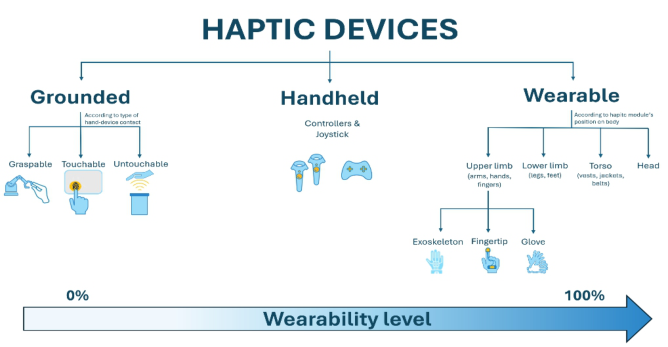
Further to the so-called “handheld” haptic devices (i.e., haptic graspable and portable devices, generally known as the traditional VR controllers and joysticks as HTC Vive, Play Station an Xbox ones), current literature divides haptic devices into two main categories, according to their wearability level (Fig. 1): Grounded devices (0% wearable) and (100%) Wearable devices (Adilkhanov, 2022; Basdogan, 2020; Pacchierotti, 2017; Tanaka, 2007; Van Wegen, 2023).
Grounded devices are non-wearable systems, designed to be like an additional tool (placed on a table or on the ground) that the user can grasp to interact with VE. They are generally divided into: (i) Graspable, (ii) Touchable, and (iii) Untouchable. (i) Graspable are very accurate haptic grounded devices, able to provide a wide range of forces; their movements are accomplished thanks to several Degrees of Freedom (DoFs) with small backlash in the joints (Adilkhanov, 2022). (ii) Touchable Grounded Devices are interactive displays that allow the user to tactilely interact with objects displayed on the screen, whether active movements or high-precision control are not strictly required. These devices typically provide pure cutaneous feedback through vibrotactile or electrostatic methods (Basdogan, 2020). (iii) Untouchable Grounded Devices are generally identified as “Mid-air interfaces”, as they eliminate the need to wear, hold or set up external props and devices to receive haptic feedback (Wee, 2021). They are mainly employed to stimulate hands, as the most sensitive parts of the human body are the glabrous parts, in other words, the non-hairy parts (Wee, 2021).
Figure 1: Modern classification of haptic devices based on their wearability.
Wearable devices are designed to be worn on a specific part of the user’s body; according to their position, they have been historically classified into four subcategories (Han, 2023; Pacchierotti, 2017): (i) devices for arms, hands and fingers; (ii) vests, jackets, and belts; (iii) devices for legs and feet; (iv) head-worn devices (Fig. 1). The main design requisite of such devices is the type of stimuli that they must give to specific receptors, further to the specific zone of human’s body to be stimulated. In the last years, the need of a modular, scalable haptic solution has led both scientific and industrial research on wearable haptics to focus on the design, implementation and test & validation of the so-called haptic “module” or “modular system”. Such haptic module is intended to be above the 4 mentioned categories (Fig. 1), becoming a basic haptic system that can be appropriately integrated into different garments dedicated to the specific area of interest of the body (e.g., bracelets, gloves, shoes, etc., according to the specific human body zone of interest). Research is still on progress on it, but some interesting works about prototypes or almost commercial haptic modules are already available in current literature (Gabardi, 2018; Lind, 2020; Maeda, 2019; Malvezzi, 2021; Pacchierotti, 2017). With reference to the first subcategory, three technologies can be individuated: Exoskeletons, Gloves and Fingertips. Despite the first two are often used in jargon as interchangeable terms, not necessarily all haptic gloves have an exoskeletal structure, and not necessarily all exoskeletal systems are in the form of a glove. These devices are designed to render kinesthetic and/or tactile haptic feedback on the user’s body, considering the widest freedom for users’ movements within VE. Fingertip (or finger-worn) haptic devices mostly focus on the tactile stimulation not on the whole hand, but only on (all or some) finger pads, aiming to give more importance to aspects as lightweight and physical stress for long-term use. Indeed, it has been found that finger pad is one of the highest densities of tactile receptors within the human body, and most dexterous manipulation activities (actions, gesture, etc.) involve fingertips (Pacchierotti, 2017).
Reflections and Insights on Haptics’ Influence on Human Factors 1131
As evinced from the classifications provided in this section, haptic technology is extremely broad and, although this makes it very versatile and suitable for many applications, it also makes it incredibly complex to decide the right combination of haptic feedback and device, based on the objectives of the specific project/research or task to be simulated. In this paper, we propose to select the influence of haptics on human factors as a decision criterion.
THE INFLUENCE OF HAPTICS ON HUMAN FACTORS In this work, we describe main subjective and objective measurements of two well-known Human Factors: Motion Sickness and Technology Acceptance. For both, we also discuss how a specific type of haptic feedback and device can influence these factors, as summarized in Table 1 at the end of the Section.
Motion Sickness Humans perceive their orientation and self-motion through various sensory organs and use information from the vestibular, visual, and proprioceptive senses to acquire a coherent perception of self-motion in a three-dimensional space, processing them all simultaneously. When the visual information does not match with the dynamic vestibular input, sensory conflicts occur between afferent signals of the current state and the user may experience the “Motion Sickness” (MS) (Sherman, 2002). Various studies have shown that MS can happen in vision, locomotion, tracking, object manipulation, and reaction time tasks (Gianaros, 2001; Lampton, 1997) and its causes in VE can be often traced to hardware technologies, content rendering and individual differences for each user (Duh, 2004). Regardless of the cause, MS is to be considered a priority HF, i.e., a parameter to be evaluated in any human-subject experience/experimental campaign, to guarantee the safety and well-being of users during and after the experience. In fact, in presence of severe MS symptoms, the experience should be stopped immediately. The most widely used methods for measuring MS in VEs are questionnaires based on self-reporting. The questionnaire method is intuitive and easy to describe one’s current state and that is why this remains the most used measurement in experiments; however, the severity of users’ discomfort is usually collected after the VR experience, which does not reflect MS in real-time.
Objective Measurement. Postural sway, specifically the user’s axial movements or changes in the Center Of Pressure (COP), has demonstrated to be an interesting parameter to detect MS symptoms (Chardonnet, 2015; Chen, 2011). These changes can be easily measured whether the participant stands on a motion platform during the VR exposure. The study of Kim et al. (2005) is a representative study investigating physiological correlates of VR sickness. Electrogastrogram (EGG), eye blink, heart period, and the delta and beta power bands (further to the ratio of Low Frequency to High Frequency) of Electroencephalogram (EEG) showed VR sickness-specific responses (Kim, 2005). Despite these measurements are more realistic than questionnaires, the collected data may be often contaminated by inaccuracies in the calibration of the instrument or in the execution of the experiment. In light of this, such
instruments can be employed only by highly qualified personnel, and this obstructs a large-scale use.
Subjective Measurement. In literature, various types of questionnaires have been used for self-reporting of the MS severity by participants; among them, the most widely used measurement is the Simulator Sickness Questionnaire (SSQ), developed by Kennedy et al. (Saredakis, 2020). The SSQ consists of 16 items and answers from 0 to 3, depending on the severity of participant’s symptoms, mainly divided into three subscales (i.e., Nausea (N) as burping, sweating, increased salivation; Oculomotor (O) as eyestrain and blurred view; and Disorientation (D) as difficulty concentrating and fullness of head) (Saredakis, 2020). For each symptom, the participant must report its severity (whether experienced) as a single number based on a rating scale from 0 (not experienced at all) to 3 (highly severe). Whether the total SSQ score is higher than 33.3 points, the participant has experienced high severity of discomfort, and the experimental campaign or application deployment must be immediately interrupted (Saredakis, 2020). Other SM subjective measures less used than the SSQ but still known are the Fast Motion sickness Scale (FMS) (Keshavarz, 2011), that requires the participant to verbally report the level of discomfort every minute during the experience, and the Augmented reality sickness questionnaire (ARSQ) (Hussain, 2023), that is a customized version of SSQ for Augmented Reality (AR) experiences.
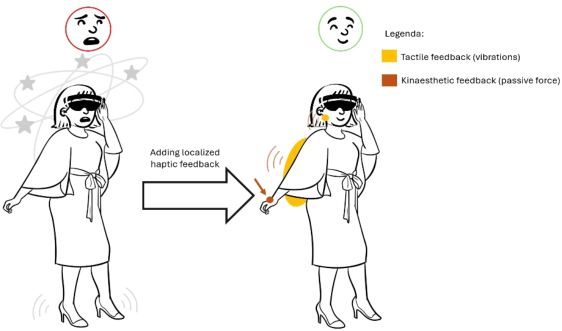
Haptic feedback to reduce/ influence on Motion Sickness. In light of what has been said so far, it is intended that MS during VR exposure is absolutely unwanted and a strong commitment from both VE’s designers and developers is required to minimize the probability of MS symptoms manifestation. Since around 20 years ago, several studies have started focusing on exploiting haptic feedback to reduce MS symptoms, giving strongly positive results; the most interesting and significative are summarized in Figure 2. From the study conducted in the literature, it emerged that haptic technology can be used not only to create engaging multisensory experiences, but also to lower MS levels during and after VR exposure. With this regard, two main lines of research have been noted, consistently with the two types of haptic stimuli based on the receptors that are stimulated: tactile and kinaesthetic. In their work (Liu, 2019) Liu et al. proposed a new system to reduce VR sickness, that applies alternating haptic cues that are synchronized to users’ footsteps in VR. The system was made of two servos with padded swing arms, one set on each side of the head (below ears), that lightly taps the head as users walk in VR. Users used VR controllers to virtually navigate within VE, while being physically seated. The experiments have demonstrated that vibrational haptic feedback on users’ head is able to allow the visual and vestibular systems’ recoupling, thus to lower MS symptoms. Moreover, experiments conducted in (Jalgaonkar, 2023) are another example of the positive effect of tactile (vibrational) feedback to reduce MS; in this case vibrations were located on users’ backs and triggered right before starting locomotion. Also, passive haptic feedback (i.e., haptic feedback provided by devices that are constantly active, thus do not need any user’s movement to be activated (Rodriguez, 2019)) to the hands has demonstrated to lower VR sickness, as showed in (Yi, 2020). From experiments described in (Yi, 2020), it resulted
Reflections and Insights on Haptics’ Influence on Human Factors 1133
that VR locomotion tasks resulted more pleasant for users whether passive haptic feedback was introduced. The experiments have been conducted on both grounded and handheld version of the same haptic device, by adding an elastic rope around the VR controller. In order to navigate in the VE, the user pulls the VR controller and, consequently, tightens the elastic rope, sensing its resistance to carry out the movement. Compared to the absence of passive haptic feedback, both the experiments confirmed to positive effect on users’ MS, as it helped to increase users’ postural stability.
Technology Acceptance “Accepting means willingly taking something that is offered and is not always simple” (Loeng, 2020; McAlinden, 2022; Moll, 2006). According to literature, Technology Acceptance (TA) is mainly made of two key parameters: Perceived Usefulness (PU) (i.e., the extent to which a user believes that using an application will help them perform tasks more effectively) and Perceived Ease of Use (PEU) (i.e., the extent to which a user believes that using an application will be effortless). The higher are the PU and PEU values perceived by the user about the tested device or technology, the higher is the probability that such system will be accepted. As well as Sickness, TA can influence significatively every measurement and answer that users may give to primary aspects as Usability and should be evaluated before, during and after the User Experience (UX). Whether not considered, a significative bias could affect any kind of evaluation on the VR experience, leading to wrong conclusions (e.g., encountering many mistakes in the VE does not necessarily mean that the implemented framework is not effective in terms of simulated realism, immersivity or knowledge-transfer in case of learning applications; it may hide user’s non-acceptance of the system (McAlinden, 2022)).
Figure 2: Pictorial representation of which type of haptic feedback and where it should be located on user’s body to reduce MS, according to current literature.
Objective Measurement. The main instrument to objectively measure TA is EEG (specifically from human scalp), as TA is linked to a series of
factors that fall within emotional sphere (e.g., cognitive effort, satisfaction or engagement). Some studies have demonstrated that EEG correlates of emotional and motivational states by differences in alpha band power between the right and left hemispheres (Sun, 2017). Moreover, EEG is also used to measure and calculate scores for frontal alpha asymmetry (i.e., the result of the subtraction of left frontal alpha power from right frontal alpha power after log-transforming the values to normalize distributions): high scores indicate more positive or approaching attitudes, while lower scores indicate more negative or withdrawal attitudes (Wen, 2020). In addition, EEG is also employed to classify mental states or cognitive processes from relaxed to alerted or stressed states, by comparing the ratios of higher frequency (beta, gamma) and lower frequency (alpha, theta) powers (Lee, 2020). For example, higher relative gamma is generally detected by EEG during user’s enhanced attention and concentration, meaning that the system/technology currently tested may be not so easy to use and, consequently, potential not so easily accepted by the user (Hoffman, 2007; Lee, 2020).
Subjective Measurement. It is commonly made using a questionnaire based on Technology Acceptance Model (TAM), that evaluates the tested systems in terms of PU and PEU (Lewis, 2019). The TAM-based questionnaire is made of 12 agreement sentences (the first 6 and the last 6 assessing respectively PU and PEU), with an answer system based on a 7-Likert scale. Currently, no established benchmark exists for PU and PEU total scores, as this questionnaire is used only for qualitative assessment (Lewis, 2019).
Haptic feedback influence on Technology Acceptance. Adult users, rather than children, may sometimes struggle to interact with new devices, new people or new environments, as may happen for a VR system (e.g., the headset with its controller, the immersive interface, the innovative interaction modes by gestures or voice commands) or even more if a haptic device is added (Moll, 2006). This means that the introduction of haptics in VE may probably decrease users’ TA, negatively affecting the whole VR experience and users’ performances. Starting from this hypothesis, the conducted study in current literature has given different answers, based on the specific haptic device. With this regard, two main lines of research have been noted, consistently with the haptic devices’ classification based on wearability level (grounded and wearable).
Several works in literature have been focusing on users’ TA towards grounded graspable haptic devices (Bravo, 2020; Garcia-Canseco, 2013; Rodrigues, 2022; Yeom, 2013), often used for future surgeon and dentists’ training or physics and chemistry teaching in VEs. In the cited works (Bravo, 2020; Garcia-Canseco, 2013; Rodrigues, 2022; Yeom, 2013), the recorded values of TA without and with grounded graspable haptic device are practically unchanged, sometimes slightly better in the second case, as the users recognized the PU of the system, believing and demonstrating that they have learned more thanks to the addition of the tactile stimulus. Whether these results are positive but also quite predictable, more interesting discoveries have been done on the use of mid-air (grounded) haptic devices. In this case, the researchers even demonstrated the power of the degree
Reflections and Insights on Haptics’ Influence on Human Factors 1135
of novelty of the system and its influence on users’ TA (Limerick, 2019; Rutten, 2020). Going beyond the concepts of PE and PEU, it seems that the perception of novelty particularly strikes users and pushes them to accept this technology faster and more easily. Therefore, mid-air haptics may be an excellent instrument to boost users’ TA towards an entire VR system (software and hardware). Further to the novelty, mid-air haptics is considered an unobtrusive and natural haptic interface (Kim, 2021), highlighting the importance of users’ comfort during VR and haptics exposure and its significant influence on TA. Actually, comfort and natural interactions are among the main objectives of wearable haptics’ design. Despite this, unexpectedly, wearable haptics has demonstrated not to be the best choice to boost users’ TA. The reason is that many related experiments found in literature are focusing on other human factors, probably considered “priority” (i.e., usability, physical effort, embodiment). In fact, exoskeletons and especially gloves are often wrongly compared to handheld haptics (as tablets and smartphones), affirming that they are “on the way to popular acceptance” (Danieau, 2013). Instead, it is definitely premature to consider them already an integral part of human life, especially in light of a large- scale diffusion. Furthermore, TA becomes crucial for wearable haptics as the probability that the user may not accept the new system is also increased by the fact that such systems must be worn on the whole body or a part of it, as they may be perceived as a sort of “personal space invasion”. Considering the lack of sufficient human-subject studies on wearable haptics’ TA, we suggest employing other haptic technologies (e.g., grounded graspable and untouchable) at this stage, and we aim to stimulate the academic community to deepen this topic.
Table 1. Summary of the selected Human Factors main measurement methods, including main references about haptic influence on them. HFs: Human Factors; MS: Motion Sickness, TA: Technology Acceptance; KF: Kinaesthetic Feedback; TF: Tactile Feedback; GGH: Graspable Grounded Haptics; WH: Wearable Haptics, MAGH: Mid-Air Grounded Haptics.
Table available in the original PDF paper.
Human Factors Objective Measures Subjective Measures Haptics Influence on HFs Motion Sickness
-TF: vibrations on head (Liu, 2019) and vibrations on back (Jalgaonkar, 2023) can decrease MS. -KF: passive force on hands (Yi, 2020) can decrease MS. Technology Acceptance
-TAM (Lewis, 2019). -GGH: slightly increases TA (Bravo, 2020; Garcia- Canseco, 2013; Rodrigues, 2022; Yeom, 2023). -WH: not defined (Danieau, 2013). -MAGH: increases TA (Kim, 2021; Limerick, 2019; Rutten, 2020).
CONCLUSION
In this work, we have discussed how determinant can be the selection of a specific haptic feedback (tactile or kinesthetic) and device (wearable or not) on Human Factors’ measurement in VEs. First, we have provided a brief overview of haptic technology; secondly, we have discussed its influence on two specific HFs: Motion Sickness and Technology Acceptance. With this regard, it has resulted that little vibrations on users’ hands and/or back allow visual and vestibular systems’ recoupling, thus lowering MS symptoms, as well as passive kinesthetic feedback. Regarding TA,mid-air (grounded) haptic devices have resulted to contribute positively to users’ acceptance towards VR experiences, as they are perceived as unobstructive interfaces, with an interesting novelty perception that contributes to create curiosity and boosts users’ interest in future use of such technology. On the other hand, it has resulted that current literature lacks satisfying studies on TA of wearable haptic devices.
With this work, we aim to support practitioners to choose the optimal haptic feedback and device, focusing on the influence that these may on the whole UX within VE. We also aim to have highlighted some grey areas of current literature about haptics and their influence on HFs, to stimulate researchers on future in-depth studies. We are already planning to focus on other fundamental HFs, as Embodiment, Physical and Cognitive Workload, Satisfaction and Engagement and collect current literature knowledge about haptic influence on them.
REFERENCES
Adilkhanov, A., Rubagotti, M., & Kappassov, Z. (2022). Haptic Devices: Wearability-Based Taxonomy and Literature Review. IEEE Access, 10, 91923– 91947. Basdogan, C., Giraud, F., Levesque, V., & Choi, S. (2020). A review of Surface Haptics: Enabling Tactile effects on touch surfaces. IEEE Transactions on Haptics, 13(3). Bravo, L. G., Sagredo, M. F., Martínez, P. T., Penna, C. B., Molina, J. F., Stanciu, I.
D., & Nistor, N. (2020). Psychometric analysis of a measure of acceptance of new technologies (UTAUT), applied to the use of haptic virtual simulators in dental students. European Journal of Dental Education, 24(4), 706–714. Chardonnet, J.-R., Mirzaei, M. A., & Merienne, F. (2015). Visually induced motion sickness estimation and prediction in virtual reality using frequency components analysis of postural sway signal. Proceedings of the International Conference on Artificial Reality and Telexistence, 1–8. https://sam.ensam.eu/handle/10985/ 10420 Chen, W., Chen, J., & So, R. H. Y. (2011). Visually induced motion sickness:
Effects of translational visual motion along different axes. Proceedings of the International Conference on Ergonomics & Human Factors, 2011, 281–287. Danieau, F., Lecuyer, A., Guillotel, P., Fleureau, J., Mollet, N., & Christie, M. (2013).
Enhancing Audiovisual Experience with Haptic Feedback: A Survey on HAV. IEEE Transactions on Haptics, 6(2), 193–205. Duh, H. B.-L., Parker, D. E., & Furness, T. A. (2004). An independent visual background reduced simulator sickness in a driving simulator. Presence: Teleoperators and Virtual Environments, 13(5), 578–588.
Reflections and Insights on Haptics’ Influence on Human Factors 1137
Gabardi, M., Leonardis, D. D., Solazzi, M., & Frisoli, A. (2018). Development of a miniaturized thermal module designed for integration in a wearable haptic device. 2018 IEEE Haptics Symposium (HAPTICS), 100–105. Garcia-Canseco, E., Karlstrom, L. F., Moran, A. L., Aragon, J. R. L., & Meza-Kubo,
V. (2013). Development of tangible haptic interfaces for use in physics instruction. Gianaros, P. J., Muth, E. R., Mordkoff, J. T., Levine, M. E., & Stern, R. M. (2001).
A questionnaire for the assessment of the multiple dimensions of motion sickness. Aviation, Space, and Environmental Medicine, 72 (2), 115–119. https://www.nc bi.nlm.nih.gov/pubmed/11211039 Han, V. Y., Boadi-Agyemang, A., Lin, Y., Lindlbauer, D., & Ion, A. (2023). Parametric Haptics: Versatile Geometry-based Tactile Feedback Devices. In UIST ‘23: The 36th Annual ACM Symposium on User Interface Software and Technology. Hoffman, H. G., Richards, T. L., Van Oostrom, T., Coda, B. A., Jensen, M. P., Blough,
D. K., et al. (2007). The analgesic effects of opioids and immersive virtual reality distraction: evidence from subjective and functional brain imaging assessments. Anesth. Analg. 105, 1776–1783. Hussain, M., Park, J., & Kim, H. K. (2023). Augmented reality sickness questionnaire (ARSQ): A refined questionnaire for augmented reality environment. International Journal of Industrial Ergonomics, 97, 103495. Jalgaonkar, N., Schulman, D., Kim, A., Chen, J., & Awtar, S. (2023). Preemptive
Haptic Stimuli to Mitigate Car Sickness and its Influence on Task Performance: A Pilot Study. In 2023 IEEE 26th International Conference on Intelligent Transportation Systems. Keshavarz, B., & Hecht, H. (2011). Validating an efficient method to quantify motion sickness. Human Factors, 53(4), 415–426. Kim, Y. Y., Kim, H. J., Kim, E. N., Ko, H. D., & Kim, H. T. (2005). Characteristic
changes in the physiological components of cybersickness. Psychophysiology, 42(5), 616–625. Kim, W., & Xiong, S. (2022). Pseudo-haptics and self-haptics for freehand mid-air text entry in VR. Applied Ergonomics, 104, 103819. Lampton, D. R., Knerr, B. W., Goldberg, S. L., Bliss, J. P., Moshell, J. M., & Blau,
B. S. (1994). The virtual environment performance assessment battery (VEPAB): Development and evaluation. Presence: Teleoperators and Virtual Environments, 3(2). Lewis, J. R. (2019). Comparison of four TAM item formats: effect of Response Option labels and Order - JUX. JUX - The Journal of User Experience. https: //uxpajournal.org/tam-formats-effect-response-labels-order/ Lee, J., & Yang, J. H. (2020). Analysis of Driver’s EEG given Take-Over Alarm in SAE
Level 3 Automated Driving in a Simulated environment. International Journal of Automotive Technology, 21(3), 719–728. Limerick, H., Hayden, R., Beattie, D., Georgiou, O., & Müller, J. (2019). User engagement for mid-air haptic interactions with digital signage. In the 8th ACM International Symposium on Pervasive Displays. Lind, C. M.; Diaz-Olivares, J. A.; Lindecrantz, K.; Eklund, J. (2020). A Wearable Sensor System for Physical Ergonomics Interventions Using Haptic Feedback. Sensors, 20. Liu, S., Yu, N., Chan, L., Peng, Y., Sun, W., & Chen, M. Y. (2019). PhantomLegs:
Reducing Virtual Reality Sickness Using Head-Worn Haptic Devices. In 2019 IEEE Conference on Virtual Reality and 3D User Interfaces (VR). Loeng, S. (2020). Self-Directed learning: a core concept in adult education. Education Research International, 2020, 1–12.
Maeda, T., & Kurahashi, T. (2019). TherModule: Wearable and Modular Thermal Feedback System based on a Wireless Platform. Proceedings of the 10th Augmented Human International Conference 2019. Malvezzi M, Chinello F, Prattichizzo D, Pacchierotti C. (2021). Design of Personalized Wearable Haptic Interfaces to Account for Fingertip Size and shape. IEEE Trans Haptics.14(2): 266–272. McAlinden, D., (2020). How To Learn Better What We Want To Do Well: A head, heart, and body approach. https://www.linkedin.com/pulse/how-learn-better-wh at-we-want-do-well-dave-mcalinden/. Moll, H., Koring, C., Carpenter, M., & Tomasello, M. (2006). Do children and adults
learn differently? Journal of Cognition and Development, 7(3), 279–293. Pacchierotti, C., Sinclair, S., Solazzi, M., Frisoli, A., Hayward, V., Prattichizzo, D.
(2017). Wearable Haptic Systems for the Fingertip and the Hand: Taxonomy, Review, and Perspectives. IEEE Trans. Haptics 10 (4), 580–600. Rodrigues, P., Esteves, A., Botelho, J., Machado, V., Zagalo, C., Zorzal, E. R., Mendes, J. J., & Lopes, D. S. (2022). Usability, acceptance, and educational usefulness study of a new haptic operative dentistry virtual reality simulator. Computer Methods and Programs in Biomedicine, 221, 106831. Rodríguez, J., Velázquez, R., Del-Valle-Soto, C., Gutiérrez, S., Varona, J., &
Enríquez-Zarate, J. (2019). Active and passive haptic perception of shape: Passive haptics can support navigation. Electronics, 8(3), 355. Rutten, I., & Geerts, D. (2020). Better Because It’s New. In 2020 CHI Conference on Human Factors in Computing Systems. Saredakis, Dimitrios & Szpak, Ancret & Birckhead, Brandon & Keage, Hannah
& Rizzo, Albert & Loetscher, Tobias. (2020). Factors Associated With Virtual Reality Sickness in Head-Mounted Displays: A Systematic Review and Meta- Analysis. Frontiers in Human Neuroscience. 14. Sherman, C. R. (2002). Motion sickness: Review of causes and preventive strategies.
Journal of Travel Medicine, 9(5), 251–256. Sun, L., Peräkylä, J., & Hartikainen, K. M. (2017). Frontal Alpha Asymmetry, a Potential Biomarker for the Effect of Neuromodulation on Brain’s Affective Circuitry—Preliminary Evidence from a Deep Brain Stimulation Study. Frontiers in Human Neuroscience, 11. Tanaka, Y.; Smith, S. P. (2007). Exploring the Specification of Haptic Interaction.
In: Doherty, G., Blandford, A. (eds) Interactive Systems. Design, Specification, and Verification. DSV-IS 2006. Lecture Notes in Computer Science, vol 4323. Springer, Berlin, Heidelberg. Van Wegen, M., Herder, J. L., Adelsberger, R., Pastore-Wapp, M., Van Wegen, E. E.
H., Bohlhalter, S., Nef, T., Krack, P., & Vanbellingen, T. (2023). An overview of wearable haptic technologies and their performance in virtual object exploration. Sensors, 23(3), 1563. Wee, C., Yap, K. M. and Lim, W. N. (2021) ‘Haptic interfaces for virtual reality: Challenges and research directions’, IEEE Access, 9, 112145–112162. Wen, T. Y., Bani, N. A., Muhammad-Sukki, F., & Aris, S. a. M. (2020). Electroen-
cephalogram (EEG) Human Stress Level Classification based on Theta/Beta Ratio. International Journal of Integrated Engineering, 12(6). Yeom, S., Choi-Lundberg, D., Fluck, A., & Sale, A. (2013). User acceptance of a haptic interface for learning anatomy. International Association for Development of the Information Society, 1, 239–246. Yi, D. C., Chang, K., Tai, Y., Chen, I., & Hung, Y. (2020). Elastic-Move: Passive
Haptic Device with Force Feedback for Virtual Reality Locomotion. 2020 IEEE Conference on Virtual Reality and 3D User Interfaces Abstracts and Workshops (VRW).
LISTED IN THE AHFE DIGITAL BOOKSTORE CATALOGUE
Explore the complete digital volume
Human Factors in Design, Engineering, and Computing
Read this individual research paper free through the original publisher, or explore the full digital proceedings book.
ISBN 978-1-964867-35-9
Explore this ISBN in the AHFE Bookstore ↗Listed in the July 2026 bookstore catalogue; search by ISBN to confirm current availability · Digital book purchase optional