Chiu-hua Chen, Chien-Hsiung Chen (2026). Toward Human-Centered Immersive Media Design: Comparative Insights from VR and Television Cultural Experiences. In: Usability and User Experience. AHFE Open Access, vol. 232, pp. 387–398. https://doi.org/10.54941/ahfe1008067
The rapid development of immersive technologies has transformed how cultural content is experienced, highlighting the need to examine how different media interfaces shape user experience from a human factors perspective. This study compares Virtual Reality (VR) and Television (TV) in presenting identical cultural content, focusing on usability and multidimensional user experience. Participants experienced the content via either a VR head-mounted display or a large-screen TV and completed the System Usability Scale (SUS) and a user experience questionnaire based on Preece et al. (2007).Results show that VR significantly outperformed TV in usability, learnability, satisfaction, enjoyment, entertainment, perceived helpfulness, and perceived gain. VR’s immersive and embodied interaction enhanced engagement and emotional involvement while reducing cognitive effort in understanding cultural information. Across all experience levels, VR received consistently higher evaluations, with novice users showing particularly strong positive responses, indicating high accessibility and intuitive interaction.From a human factors perspective, the findings underscore the importance of immersion and interactivity in cultural content design. VR demonstrates strong potential for enhancing cultural understanding and engagement, while the results also suggest opportunities for cross-media strategies that integrate VR’s immersive strengths with TV’s narrative accessibility.
With the rapid advancement of digital technologies, the production and consumption of cultural content are increasingly shifting from physical to digital formats. Among contemporary media platforms, Virtual Reality (VR) and Television (TV) represent two distinct paradigms of cultural dissemination: immersive, interactive exploration versus passive, narrative- driven viewing. While both serve as important channels for cultural communication, their interface characteristics create fundamentally different user experiences.
VR, as an emerging immersive medium, employs head-mounted displays and spatial tracking to generate a strong sense of presence, or “place illusion” (Slater, 2018). This immersive capability supports embodied interaction, Received January 21, 2026; Revised April 4, 2026; Accepted April 23, 2026; Available online July 20, 2026
388 Chen and Chen enabling users to actively explore virtual environments through natural movements and multisensory engagement (Riva et al., 2021). As a result, VR has been widely adopted in cultural heritage and digital museum applications, offering enhanced interactivity and experiential depth beyond traditional media (Bekele et al., 2018; Lugmayr & Sutinen, 2017).
In contrast, Television remains one of the most accessible and widely used media forms. Although it lacks spatial immersion, TV excels in low entry barriers and well-structured narrative presentation. Traditional TV viewing is characterized by a passive, “lean-back” mode of consumption that emphasizes storytelling while imposing relatively low cognitive demands on viewers (Kubey & Csikszentmihalyi, 1990). Despite improvements in visual quality, TV maintains a perceptual distance between users and content, distinguishing it from the immersive experience of VR.
Despite the growing interest in immersive media, direct empirical comparisons of the human factors implications of VR and TV in cultural contexts remain limited. Few studies have quantitatively examined how these interfaces, when presenting identical cultural content, differentially influence usability, emotional engagement, and overall user experience (Dalgarno & Lee, 2010; Preece et al., 2007).
Therefore, this study aims to empirically compare VR and TV as cultural media interfaces, focusing on how immersion and interactivity shape user experience. By identifying the respective strengths and limitations of each medium, this research provides human-centered design insights for future cultural content systems and highlights opportunities for cross-media integration in an evolving digital landscape.
LITERATURE REVIEW
Virtual Reality: Immersion and Embodied Cognition Virtual Reality (VR) has rapidly developed with advances in computing power and real-time graphics, offering highly immersive and interactive experiences through head-mounted displays. Early VR research conceptualized its core as telepresence, defined as the perception of being present within a mediated environment (Steuer, 1992). Slater (2018) further distinguished immersion as an objective system property from presence as a subjective psychological experience, both of which have been shown to enhance user engagement and emotional response (Riva et al., 2021).
Beyond traditional button-based interaction, VR relies on embodied cognition, enabling users to acquire knowledge through natural bodily movements and sensorimotor experiences (Tuena et al., 2020). Such interaction has been associated with improved learning, memory retention, and skill acquisition across educational and applied domains (Schoenfelder et al., 2019).
However, VR also presents design challenges. While immersive environments can increase presence, poorly designed systems may impose excessive extraneous cognitive load, negatively affecting learning and usability (Makransky et al., 2019). Balancing immersive richness with cognitive load management therefore remains a key concern in human- centered VR experience design.
Toward Human-Centered Immersive Media Design: Comparative Insights 389 The Evolution of Television: From Passive Viewing to Smart Interaction
Television (TV), as a long-established mass communication medium, maintains a broad audience base and a well-developed narrative structure. Traditional TV viewing is typically characterized as a lean-back experience, in which viewers consume pre-produced linear content in a relaxed and largely passive manner. Kubey and Csikszentmihalyi (1990) describe television viewing as emphasizing narrativity and entertainment, often involving co-viewing practices that support social bonding and shared cultural experience.
In recent years, Smart TVs and streaming platforms have introduced greater interactivity and personalization through algorithmic recommendations and second-screen social engagement. However, despite these advancements, TV remains constrained by the physical boundaries of the screen. Viewers continue to occupy the role of observers rather than participants, maintaining a perceptual distance from the content. Compared to the enveloping nature of VR, the level of immersion and embodied interaction supported by TV remains limited.
Digital Transformation of Cultural Heritage and Metaverse Trends Cultural content experience has become an important interdisciplinary field spanning cultural communication, tourism, and digital technology. Contemporary cultural heritage preservation increasingly emphasizes digital contextual reconstruction rather than solely physical restoration. Trunfio and Campana (2019) note that immersive and interactive systems, particularly those enabled by mixed reality, can significantly enhance museum visitor satisfaction and revisit intention.
Through high-fidelity digital documentation, intangible cultural heritage can be preserved as digital twins, supporting long-term transmission (UNESCO, 2013). As immersive technologies evolve toward the Metaverse, virtual ecosystems are expected to play a central role in future cultural dissemination (Dwivedi et al., 2022), enabling the reconstruction of inaccessible or lost historical environments, such as digital recreations of Notre Dame de Paris. Virtual museums further support first-person exploration, enhancing cultural understanding, emotional engagement, and users’ sense of connection with heritage artifacts (Lugmayr & Sutinen, 2017). Collectively, these studies highlight the transformative role of immersive technologies in reshaping cultural heritage experiences.
RESEARCH METHODS Experimental Design
This study employed a between-subjects experimental design to examine the effects of media interfaces on user experience. The independent variable was media modality, consisting of two levels: (1) a Virtual Reality (VR) condition, in which participants engaged in
embodied interaction using a head-mounted display (HMD); and (2) a Television (TV) condition, in which participants passively viewed the same content on a large-screen display.
390 Chen and Chen A between-subjects design was selected to minimize potential carryover and learning effects and to ensure that the novelty of the cultural content did not influence subsequent viewing experiences across conditions.
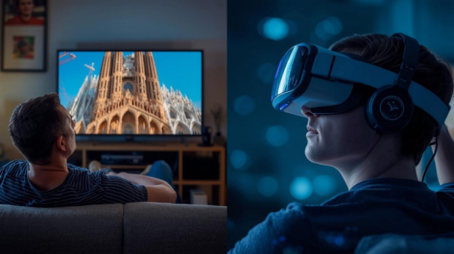
Figure 1: Experimental setup illustrating the two viewing conditions: passive television (TV) viewing and immersive virtual reality (VR) viewing using a head-mounted display (HMD).
Participants A total of 60 participants (N = 60) were recruited using convenience sampling and randomly assigned to either the Virtual Reality (VR) group (n = 30) or the Television (TV) group (n = 30). All participants were adults with at least a university-level education, and the majority (65%) were aged between 30 and 49. Based on self-reported immersive technology experience, participants were classified into three groups: low (0–1 prior uses), moderate (2–6 prior uses), and high experience (7 or more prior uses). To control for familiarity effects, participants confirmed they had no prior exposure to the cultural content used in the study, specifically the virtual experience of Notre Dame de Paris.
Experimental Materials and Apparatus The experimental stimulus consisted of a high-fidelity immersive virtual tour of Notre Dame de Paris. This cultural heritage content was selected due to its architectural complexity and historical significance, making it particularly suitable for differentiating between spatial exploration in VR and visual observation in TV-based viewing conditions.
In the VR condition, participants experienced the content using a six- degrees-of-freedom (6-DoF) head-mounted display (HMD) (e.g., Meta Quest 2). The system provided full 360-degree visual freedom and supported natural bodily movements such as walking and turning, thereby facilitating a strong sense of embodied presence and spatial immersion.
In the TV condition, participants viewed the same cultural content on an 80-inch 4K ultra-high-definition television. The viewing distance was set at approximately 2.5 meters, simulating a typical living-room environment. Interaction was limited to basic navigation using a standard remote control, representing a non-immersive, third-person viewing perspective.
Figure 2: Representative scenes from the immersive virtual tour of Notre Dame de Paris used as experimental stimuli.
Procedure and Measures Upon arrival, participants were informed about the study purpose, provided informed consent, and completed a pre-experiment questionnaire on demographics and prior immersive technology experience. They then engaged in approximately 15 minutes of exploration of the Notre Dame de Paris content. Participants in the VR condition remained standing and were allowed to move freely, whereas those in the TV condition remained seated throughout the session.
After the experience, participants completed two post-experiment measures. Usability was assessed using the System Usability Scale (SUS), a standardized 10-item questionnaire measuring perceived usability and ease of interaction. User experience was evaluated using a questionnaire adapted from Preece, Rogers, and Sharp (2007), assessing ten dimensions: satisfaction, enjoyment, fun, entertainment, helpfulness, motivation, aesthetics, creativity, emotional fulfillment, and perceived gain.
Equation reproduced from the original PDF.
RESULTS
Participants A total of 60 participants (N = 60) were recruited and randomly assigned to either the Virtual Reality (VR) group (n = 30) or the Television (TV) group (n = 30). The sample consisted primarily of male participants (73.3%, n = 44), with females accounting for 26.7% (n = 16). Most participants were aged between 30 and 49 years (61.7%), followed by those aged 50 years and above (23.3%) and 20–29 years (15.0%).
All participants held at least a university degree, with 55.0% holding a bachelor’s degree and 45.0% possessing a master’s or doctoral degree. Based on prior immersive technology experience, participants were categorized as low (48.3%), moderate (18.3%), or high experience (33.3%). A chi-square analysis revealed no significant differences between the VR and TV groups across all demographic variables (p > 0.05), indicating successful randomization and baseline equivalence.
Table 1: Participant demographics (N = 60).
Table available in the original PDF paper.
Equation reproduced from the original PDF.Equation reproduced from the original PDF.Equation reproduced from the original PDF.
Medium (2-6 times) 6 (20.0%) 5 (16.7%) 11 (18.3%) High (7+ times) 8 (26.7%) 12 (40.0%) 20 (33.3%)
System Usability Scale (SUS) Analysis To compare the perceived system usability of the VR and TV interfaces, an independent samples t-test was conducted. The results revealed a statistically significant difference between the two conditions, t(58) = 4.40, p < 0.001.
Participants in the VR group reported a significantly higher mean SUS score (M = 77.68, SD = 16.21) than those in the TV group (M = 58.28, SD = 17.90), indicating that the VR interface was perceived as having superior subjective usability compared to the television-based interface.
Table 2: Independent samples t-test results.
Table available in the original PDF paper.
Equation reproduced from the original PDF.
Standard Deviation (SD) 16.21 17.90 t-value 4.40
Degrees of Freedom (df) 58 p-value < 0.001***
Note. ***p < .001 User Experience Analysis
Independent samples t-tests were conducted to compare the VR and TV conditions across the ten user experience dimensions proposed by Preece et al. (2007). As shown in Table 3, the VR group scored significantly higher than the TV group on all dimensions, indicating a consistently superior overall user experience (all p < 0.01).
The largest differences were observed in hedonic and emotional dimensions. Participants in the VR condition reported significantly higher Enjoyment (t = 13.73, p < 0.001) and Emotional Fulfilment (t = 8.54, p < 0.001), suggesting that immersive interaction elicited stronger positive emotions and a greater sense of presence than TV-based viewing. Although
Toward Human-Centered Immersive Media Design: Comparative Insights 393 the TV condition received relatively high ratings for Fun, the VR condition remained significantly higher, indicating deeper engagement beyond passive entertainment.
VR also outperformed TV in pragmatic and instrumental qualities, with higher ratings for Helpfulness (t = 4.55, p < 0.001), Perceived Gain (t = 2.80, p = 0.007), and Overall Satisfaction (MVR = 6.60 vs. MTV = 5.06). These findings indicate that VR was perceived not merely as entertaining but as genuinely beneficial for understanding cultural content. In addition, VR received significantly higher evaluations in Aesthetics (t = 6.09, p < 0.001) and Motivation (t = 6.89, p < 0.001), highlighting its ability to enhance visual appreciation and stimulate sustained interest in cultural heritage experiences.
Table 3: Summary of independent samples t-tests for user experience dimensions between VR and TV groups (N = 60).
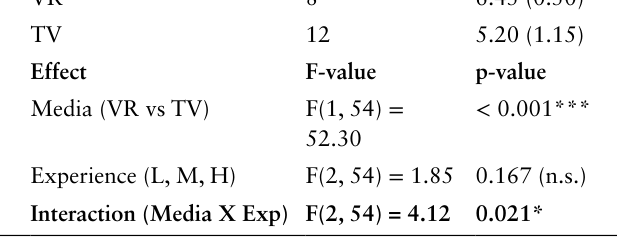
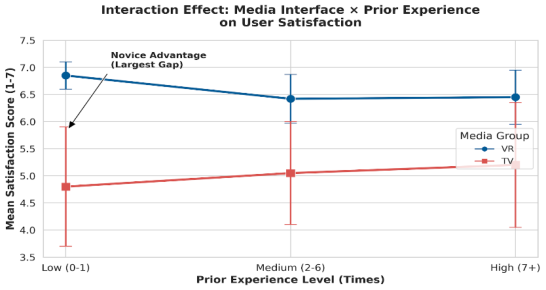
Impact of Prior Experience: The Novice Advantage A two-way ANOVA examined the effects of media interface (VR vs. TV) and prior experience level (low, moderate, high) on user satisfaction. A significant main effect of media interface was found, F(1, 54) = 52.30, p < 0.001, indicating higher overall satisfaction in the VR condition than in the TV condition. The main effect of prior experience was not significant (p > 0.05); however, a significant interaction between media interface and prior experience level was observed, F(2, 54) = 4.12, p = 0.021.
As shown in Table 4, low-experience users reported the highest satisfaction in the VR condition (M = 6.85) and the lowest satisfaction in the TV condition (M = 4.80), demonstrating a clear “novice advantage” for VR. While high-experience users also reported high satisfaction in VR (M = 6.45), their ratings were slightly lower than those of novice users, potentially reflecting higher expectation baselines among experienced immersive technology users.
Table 4: Descriptive statistics and two-way ANOVA summary of the effects of media interface and prior experience on user satisfaction (N = 60).
Table available in the original PDF paper.
Prior Experience Level Group N Mean (SD) Low (0-1 times) VR 16 6.85 (0.25)
TV 13 4.80 (1.10) Medium (2-6 times) VR 6 6.42 (0.45)
TV 5 5.05 (0.95) High (7+ times) VR 8 6.45 (0.50)
Equation reproduced from the original PDF.
Note. * p < .05, *** p < .001
Figure 3 illustrates clear differences in user satisfaction across prior experience levels. The VR condition shows a pronounced ceiling effect, with consistently high satisfaction across all experience groups (M > 6.4). The largest divergence between media modalities occurs at the low-experience level, where VR users reported substantially higher satisfaction (M = 6.85) than TV users (M = 4.80), providing strong visual evidence of a “novice advantage” in VR.
As prior experience increases, satisfaction in the TV condition shows a modest upward trend, reducing the gap between the two interfaces. Nevertheless, VR consistently maintains higher satisfaction across all experience levels. This pattern suggests that TV-based experiences may depend more on familiarity or narrative engagement to enhance satisfaction, whereas VR delivers immediate and highly engaging experiences from the initial interaction.
Figure 3: Interaction effect of media interface (VR vs. TV) and prior experience level on mean satisfaction scores. Error bars represent standard deviation (SD). The annotation highlights the significant “novice advantage,” where the gap between VR and TV is most pronounced among users with low prior experience.
DISCUSSION
Embodied Presence as a Catalyst for Cultural Engagement The results of this study (N = 60) provide strong empirical evidence that VR significantly outperforms television across both hedonic dimensions (e.g., enjoyment and fun) and pragmatic dimensions (e.g., helpfulness and perceived gain). This superiority can be fundamentally attributed to differences in embodied cognition (Tuena et al., 2020).
Unlike the television-based lean-back experience where users remain external observers viewing cultural content through a framed display (Kubey & Csikszentmihalyi, 1990) VR situates users within the content itself. Our findings indicate that this place illusion (Slater, 2018) does more than enhance entertainment value. This aligns with findings by Sylaiou et al. (2010), who demonstrated a positive correlation between presence and enjoyment in virtual museum contexts. It substantially increases the perceived educational utility of the experience. By enabling bodily movement and spatial navigation within Notre Dame de Paris, VR transforms abstract architectural knowledge into spatially grounded memory. This aligns with Dalgarno and Lee’s (2010) argument that the spatial affordances of 3D environments reduce the cognitive effort required to construct mental models of complex structures, thereby allowing users to focus more directly on cultural meaning and narrative.
The “Novice Advantage”: Intuitive Interaction Overcomes Technological Anxiety One of the most significant contributions of this study is the identification of a clear “novice advantage” (Figure 3). Contrary to the common assumption that immersive technologies impose steep learning curves or excessive cognitive load (Makransky et al., 2019), our interaction analysis demonstrates that low-experience users reported the highest levels of satisfaction in the VR condition, significantly exceeding their counterparts in the TV condition.
From a human–computer interaction (HCI) perspective, this phenomenon can be explained through the principle of natural mapping (Steuer, 1992). Television interfaces rely on symbolic mediation, such as abstract buttons on remote controls that require cognitive translation between action and outcome. In contrast, VR relies primarily on proprioceptive and sensorimotor cues, where simply turning one’s head results in a corresponding change in viewpoint. For novice users, this “body-as-interface” paradigm eliminates the need to learn abstract control schemes, fostering immediate feelings of competence, agency, and control.
This finding suggests that VR is not merely a tool for technology enthusiasts, but rather a powerful medium for democratizing access to digital cultural experiences, regardless of users’ prior technological literacy.
Balancing Hedonic and Pragmatic Experience Qualities Museums and cultural institutions often struggle to balance entertainment and education. The UX analysis in this study (Table 3) indicates that VR successfully bridges this divide. Extremely high levels of enjoyment (t = 13.73)
396 Chen and Chen coexisted with strong perceived learning gains, supporting the concept of “edutainment” in the emerging Metaverse era (Dwivedi et al., 2022).
Immersion functions as a motivational gateway: once users are emotionally captivated by the awe-inspiring visual scale of the virtual cathedral reflected in elevated emotional fulfilment, they become more receptive to historical and cultural information. While Trunfio and Campana (2019) demonstrated that mixed reality can increase revisit intention in museum contexts, the present study extends this insight by showing that fully immersive VR experiences can generate a “peak experience” one that traditional media cannot replicate and thereby foster deeper, long-term emotional connections with cultural heritage.
Practical Implications for Future Cultural Platform Design From a Human factors and ergonomics perspective, these findings offer several actionable design guidelines:
(1) Prioritize Natural Interaction: Given that novice users benefit most from intuitive controls, future VR cultural applications should minimize complex controller-based inputs and maximize gaze-based, body-based, or simple gesture interactions to preserve the novice advantage. (2) Scaffold the Experience: Although expert users still reported high
satisfaction, their ratings were slightly lower than those of novices, suggesting that long-term users may require deeper interactivity or layered informational content to maintain engagement. Progressive disclosure strategies can effectively accommodate both novice and experienced users. (3) Hybrid Deployment Strategies: Considering the accessibility of television and the experiential intensity of VR, a multi-platform ecosystem may represent the most effective strategy for cultural dissemination. Television can support broad narrative outreach, while VR enables deep spatial exploration together forming a complementary system for safeguarding and communicating cultural heritage (UNESCO, 2013).
CONCLUSION
Summary of Findings This study provides empirical evidence of the Human factors differences between Virtual Reality (VR) and Television (TV) in the context of cultural heritage experiences (N = 60). The results clearly demonstrate that VR outperforms traditional television interfaces in both system usability and multidimensional user experience outcomes. By activating embodied interaction, VR successfully transforms cultural content from a mode of passive consumption into one of active spatial exploration, thereby significantly enhancing enjoyment, emotional fulfilment, and perceived educational gain.
Toward Human-Centered Immersive Media Design: Comparative Insights 397 Theoretical and Practical Contributions
A key contribution of this study is the identification of a “novice advantage.” Contrary to the assumption that immersive technologies impose high entry barriers, the interaction analysis showed that low-experience users reported the highest satisfaction in the VR condition, suggesting that VR’s natural mapping—where “what you see is what you explore”—is cognitively more intuitive than the abstract control mechanisms typically used in television interfaces. This finding has important implications for the design of digital museums and cultural platforms, indicating that immersive systems should prioritize gesture- and gaze-based interactions to maintain intuitive accessibility and ensure that complex cultural heritage content remains approachable regardless of prior technological experience.
Future Directions While the present study focused on immediate experiential differences, future research should investigate the long-term retention of cultural knowledge acquired through VR and TV experiences. Furthermore, as the development of the Metaverse accelerates, exploring multi-user social interaction within virtual heritage environments may help bridge the gap between solitary immersion and collective cultural engagement. In summary, this study argues that VR is not merely a technological novelty, but a transformative medium capable of democratizing access to cultural heritage through embodied presence and intuitive interaction.
REFERENCES
Bekele, M.K., Pierdicca, R., Frontoni, E., Malinverni, E.S., & Gain, J. (2018). A survey of augmented, virtual, and mixed reality for cultural heritage. Journal on Computing and Cultural Heritage (JOCCH), 11(1), 1−36. Dalgarno, B., & Lee, M.J. (2010). What are the learning affordances of 3-D virtual
environments? British Journal of Educational Technology, 41(1), 10−32. Dwivedi, Y.K., Hughes, L., Baabdullah, A.M., et al. (2022). Metaverse beyond the hype: Multidisciplinary perspectives on emerging challenges, opportunities, and agenda for research. International Journal of Information Management, 66, 102542. Kubey, R., & Csikszentmihalyi, M. (1990). Television and the Quality of Life: How
Viewing Shapes Everyday Experience. Lawrence Erlbaum Associates. Lugmayr, A., & Sutinen, E. (2017). Immersive Interactive Technologies for Cultural Heritage. Springer. Makransky, G., Terkildsen, T.S., & Mayer, R.E. (2019). Adding immersive virtual
reality to a science lab simulation causes more presence but less learning. Learning and Instruction, 60, 225−236. Preece, J., Rogers, Y., & Sharp, H. (2007). Interaction Design: Beyond Human-Computer Interaction. John Wiley & Sons. Riva, G., Wiederhold, B.K., & Mantovani, F. (2021). The Psychology of Immersive
Experiences in Virtual Reality: From Theory to Practice. Frontiers in Psychology, 12, 695567. Schoenfelder, N., et al. (2019). Enhancing Memory Retention through Virtual Reality-Based Learning Environments. Computers & Education, 128, 75–89.
398 Chen and Chen Slater, M. (2018). Immersion and the Illusion of Presence in Virtual Reality. British
Journal of Psychology, 109(3), 431–433. Steuer, J. (1992). Defining virtual reality: Dimensions determining telepresence.
Journal of Communication, 42(4), 73–93. Sylaiou, S., Mania, K., Karoulis, A., & White, M. (2010). Exploring the relationship between presence and enjoyment in a virtual museum. International Journal of Human-Computer Studies, 68(5), 243−253. Trunfio, M., & Campana, S. (2019). Drivers and emerging role of mixed reality in
the museum experience. Journal of Service Theory and Practice, 29(4), 406−444. Tuena, C., Pedroli, E., Trimarchi, P.D., et al. (2020). Embodied Cognition and Virtual Reality in Neurorehabilitation. Frontiers in Psychology, 11, 598765. UNESCO. (2013). Convention for the Safeguarding of the Intangible Cultural
Heritage. UNESCO.
LISTED IN THE AHFE DIGITAL BOOKSTORE CATALOGUE
Explore the complete digital volume
Usability and User Experience
Read this individual research paper free through the original publisher, or explore the full digital proceedings book.
ISBN 979-8-950676-08-6
Explore this ISBN in the AHFE Bookstore ↗Listed in the July 2026 bookstore catalogue; search by ISBN to confirm current availability · Digital book purchase optional