Shao-nung Chang, Chien-Hsiung Chen (2026). When Seeing Isn't Believing: How Prior Immersion History Dissociates Perceptual from Evaluative Responses to Immersive Displays. In: Metaverse, Virtual Environments and Game Design. AHFE Open Access, vol. 217, pp. 72–85. https://doi.org/10.54941/ahfe1007656
As virtual exhibitions increasingly incorporate costly, large-scale immersive technologies, understanding the complex human factors that influence user experience becomes critical to justify such investments. While hardware specifications, such as spatial enclosure, are recognized determinants of immersion, their interaction with users' prior experience remains underexplored. This study employed a between-subjects factorial design (N = 60), combining quasi-experimental user stratification based on self-reported prior experience levels (Low, Medium, High) with randomized assignment to two contrasting display modalities: a custom-built, high-fidelity immersive LED booth versus a standard 4K television display. Results from 2 × 3 factorial ANOVAs revealed a critical divergence. Although the LED interface consistently demonstrated an absolute advantage in perceptual metrics like Spatial Presence across all user groups (an ordinal interaction), evaluative metrics such as Satisfaction exhibited a disordinal (crossover) interaction. Specifically, the significant evaluative advantage of the LED interface disappeared entirely among medium-experience users. We interpret this perceptual-evaluative dissociation through an expectancy-based framework, positing a psychological evolution wherein the initial "novelty effect" that drives novices has diminished, yet the critical "connoisseurship" characteristic of experts has not fully developed in medium-experience users, rendering them less evaluatively sensitive to hardware fidelity. This study proposes a dual-layer framework distinguishing between perceptual constancy and evaluative contingency, advocating for audience-segmented design strategies for experiential virtual exhibitions that align hardware investment with target audience expectation thresholds rather than relying on universal technological determinism.
Recent advancements in display technologies have fundamentally altered the landscape of digital exhibitions, transitioning experiences from screen- based interactions to fully immersive environments such as Cave Automatic Virtual Environments (CAVE) and large-scale LED walls. Within the field of Human Factors and Ergonomics, this technological shift necessitates a deeper Received November 17, 2025; Revised April 7, 2026; Accepted April 22, 2026; Available online July 20, 2026
When Seeing Isn’t Believing: How Prior Immersion History Dissociates Perceptual 73 examination of “Presence”, defined as the subjective sensation of “being there” in a mediated environment (Slater, 2009). While technological determinants of presence, including Field of View (FOV), stereoscopy, and tracking latency, are well-documented in existing literature (Witmer & Singer, 1998), the role of the user’s internal state, specifically their prior accumulated experience and resulting expectations, has received comparatively less attention.
A prevalent assumption in current design practice often leans towards “Technological Determinism”, positing that higher fidelity hardware universally yields a superior user experience. However, established perspectives in human-computer interaction suggest that maximizing hardware immersion does not guarantee a superior user experience and may not always be necessary for specific applications (Bowman & McMahan, 2007). Theoretical frameworks such as Expectancy-Violation Theory (EVT) (Burgoon, 1993) provide a useful lens, implying that users evaluate systems against a baseline of expectation. Consequently, a user familiar with high- end VR may judge a standard TV display harshly (“Negative Violation”), whereas a novice might find the same display surprisingly engaging if it exceeds their low expectations (“Positive Violation”).
The present study seeks to bridge the disconnect between objective hardware performance and subjective psychological reception by proposing a dual-layer framework that distinguishes between perceptual and evaluative outcomes. By comparing a custom-built immersive LED booth (representing high spatial enclosure) against a standard 4K Television (representing low spatial enclosure), we investigate two primary research questions: First, regarding main effects, to what extent does display modality influence objective usability (SUS), subjective presence (IPQ), and hedonic user experience? Second, regarding interaction effects, does the user’s level of prior immersion experience (Low, Medium, High) moderate their evaluation of these displays differently across perceptual and evaluative dimensions? We hypothesize that while perceptual metrics will show a consistent advantage for high-fidelity hardware (ordinal interaction), evaluative metrics will demonstrate a user-dependent pattern (disordinal interaction) driven by expectancy violations.
LITERATURE REVIEW
Technological Determinants of Presence and Immersion The foundation of immersive experiences lies in the user’s responses to technological stimuli, commonly conceptualized as “Presence.” Presence is a multi-dimensional construct comprising Spatial Presence (the sense of being physically located in a place), Involvement (attention allocation), and Realism (Schubert et al., 2001). In HCI research, objective hardware characteristics are traditionally considered primary drivers of these dimensions. A seminal comprehensive meta-analysis by Cummings and Bailenson (2016) established a strong causal link, confirming that technological immersion factors, such as wide field of view (FOV) and stereoscopy, have a significant positive effect on the user’s sense of presence. More recent empirical studies reinforce these findings in modern contexts, demonstrating that higher resolution and faster refresh rates significantly enhance spatial presence and perceived realism
74 Chang and Chen (Weber et al., 2021). Furthermore, “Spatial Enclosure”—the extent to which displays physically surround the user—is crucial for triggering what Slater (2009) terms “Place Illusion,” offering superior cues compared to flat-panel displays bounded by a visible border (Grassini, 2023). The consensus in this domain suggests a direct, positive relationship between hardware fidelity and perceptual immersion metrics.
The Role of Prior Experience and Expectation in Subjective Evaluation However, moving beyond measures of presence to broader subjective evaluation (e.g., Satisfaction, Enjoyment) introduces psychological complexity. Crucially, recent empirical work specifically situated within the domain of immersive art exhibitions—the precise context of this study—has challenged simple hardware determinism. Luo et al. (2025) demonstrate that while sensory intensity (derived from hardware capabilities) is foundational, translating it into final visitor satisfaction is complex and mediated by psychological factors like attention and accumulated experience. This suggests that maximizing hardware fidelity does not guarantee superior evaluation across all user groups.
This discrepancy can be explained by theories regarding how users form evaluative standards. Adaptation Level Theory suggests that individuals judge current stimuli not in isolation, but against an internal reference point formed by past experiences (Sacau et al., 2008). This implies that users with extensive prior exposure establish higher internal “expectation baselines,” whereas novices hold lower baselines. The Expectation-Confirmation Model (ECM) widely used in Information Systems and HCI posits that satisfaction is primarily determined by the “confirmation” or “disconfirmation” of these pre-trial expectations (Bhattacherjee, 2001). Therefore, an experienced user encountering a low-fidelity display may experience negative disconfirmation, leading to poor evaluation despite accurate perception of presence cues. This dynamic view is supported by recent research indicating that prior exposure significantly influences evaluations of emerging immersive platforms (Lee & Kim, 2023; Shin, 2022).
RESEARCH METHODS Participants and Design
The study employed a 2 (Display Modality) × 3 (Experience Level) between-subjects factorial design. A total of 60 participants (N = 60) were recruited from a university population and the general public. To examine the moderating role of experience, participants were stratified into three groups based on their self-reported frequency of prior engagement with immersive technologies (e.g., VR headsets, CAVE systems, IMAX): the Low Experience Group (n = 21) reported zero prior experiences; the Medium Experience Group (n = 20) reported 1 to 6 prior experiences, representing occasional users; and the High Experience Group (n = 19) reported 7 or more prior experiences, representing frequent or expert users. Participants within each experience level were then randomly assigned to one of the two experimental display conditions (LED or TV). The demographic composition
When Seeing Isn’t Believing: How Prior Immersion History Dissociates Perceptual 75 was balanced across gender (39 males, 21 females) and age range (20–59 years, M = 34.5, SD = 11.2). All participants provided informed consent prior to the experiment. These thresholds were selected to balance cell sizes and maintain an interpretable distinction between first-time, occasional, and frequent exposure groups; nevertheless, experience frequency should be regarded as a proxy rather than a direct measure of expertise.
Apparatus and Stimuli The study compared two experimental conditions (n = 30 per group). In Condition A (LED Group), participants viewed content in a custom-built three-sided immersive LED booth with a pixel pitch of 1.2mm. The booth measured 3m (W) × 3m (D) × 2.5m (H). Due to its three-sided configuration enveloping the participant at the standardized viewing position, this setup provided a wide horizontal field of view (>120 degrees) and high spatial enclosure. In Condition B (TV Group), participants viewed the same content on a standard 65-inch 4K LED Television mounted on a wall. This setup represented a “window-on-the-world” metaphor with a restricted horizontal field of view (approximately 45 degrees at the standardized viewing distance). This specific FOV was chosen to simulate a typical high-quality domestic viewing environment, providing clear central vision while deliberately lacking the peripheral stimulation characterizing the LED condition. To isolate the effects of display interface and minimize confounding factors related to narrative interpretation, both groups viewed the exact same 5-minute immersive digital content titled “Offline Time Zone”. This content was specifically chosen for its abstract, non-narrative nature, focusing on strong visual and auditory sensory engagement through abstract visuals and ambient soundscapes, rather than realistic narrative representation or detailed artifact inspection. This controlled stimulus selection ensures that observed differences are driven primarily by the display modality’s affordances for sensory immersion, rather than the content’s informational requirements. Experimental conditions, including viewing distance (approximately 2m), ambient lighting (dimmed), and audio volume, were held constant across both groups. Because the LED booth and TV conditions constitute ecological display configuration packages that may differ on multiple correlated parameters (e.g., spatial enclosure, apparent size, luminance, viewing geometry, and surrounding context), we interpret the manipulation as an enclosure-dominant configuration versus a screen-based configuration rather than isolating any single hardware parameter.
Measures Three primary measures were employed. First, the System Usability Scale (SUS), a 10-item standardized questionnaire, assessed perceived usability (Bangor et al., 2008). Second, user perceptions of the immersive environment were assessed using an adapted version of the Igroup Presence Questionnaire (IPQ) (Schubert et al., 2001). The instrument included the original subscales for Spatial Presence (SP), Involvement (IN), and Realism (RE), supplemented by additional items measuring Perceived Interaction (INT) and Willingness to Continue (CE) to capture broader experiential dimensions. All items were rated on a 7-point Likert scale. Reliability analysis indicated acceptable to good internal consistency for all multi-item subscales in the present sample:
76 Chang and Chen Spatial Presence (α = .887), Involvement (α = .862), Realism (α = .909), Perceived Interaction (α = .841), and Willingness to Continue (α = .729). The single-item General Presence measure was included but not subjected to reliability analysis. Third, evaluative User Experience (UX) metrics were assessed using two primary indicators, Satisfaction and Enjoyment, measured via single-item 7-point Likert scales derived from broader UX frameworks (e.g., Preece et al., 2007), serving as key dependent variables for the analysis of perceptual-evaluative dissociation.
Statistical Analysis Although the cell sizes (n ≈10) were relatively small for formal normality testing, ANOVA is known to be robust to deviations from normality, especially when sample sizes are equal across groups (Glass et al., 1972). Therefore, parametric analyses were deemed appropriate. Homogeneity of variance was assessed using Levene’s test; when heteroscedasticity was suspected (e.g., for SUS), sensitivity analyses were conducted using Welch’s correction. When a Display × Experience interaction was significant, planned simple main effects comparisons between the LED and TV conditions were performed within each Experience level. To control the family-wise error rate for the three planned comparisons per outcome, a Bonferroni-adjusted alpha of .017 (α’ = .05/3) was applied. Effect sizes are reported as partial eta squared (ηp²)) for ANOVA effects. To maintain inferential clarity, Spatial Presence, Involvement, Satisfaction, and Enjoyment were designated as the primary outcomes for hypothesis testing.
System Usability (SUS) A 2 (Display Modality) × 3 (Experience Level) ANOVA revealed a significant main effect of Display Modality on SUS, F(1, 54) = 57.94, p < .001, ηp² = .518. Participants reported higher usability in the LED condition (M = 77.50, SD = 4.91) than in the TV condition (M = 55.42, SD = 15.38). The main effect of Experience Level and the Display × Experience interaction were not significant (ps > .05). Because variance differed between display conditions (Levene’s test p < .001), a Welch’s t-test was used as a sensitivity check and yielded the same inference, t(34.85) = 7.49, p < .001. It is worth noting that the standard deviation in the TV condition (SD = 15.38) was notably larger than in the LED condition (SD = 4.91). This heterogeneity likely reflects individual differences in susceptibility to low-immersion displays, whereas the high-fidelity LED enclosure elicited a more uniform ceiling effect in usability perceptions.
Presence and User Experience Metrics Descriptive statistics indicated a general trend favoring the LED condition across most perceptual and evaluative dimensions. To evaluate the central moderation hypothesis rigorously, inferential analyses focused on key validated outcomes spanning perceptual presence (Spatial Presence, Involvement) and evaluative user experience (Satisfaction, Enjoyment). The corresponding 2 × 3 ANOVA results for these primary outcomes are summarized in Table 1.
Note. N = 60. *p < .05, **p < .01, ***p < .001. Effect sizes are reported as partial eta squared (ηp²).
Table 1: Summary of results from 2 × 3 ANOVAs for perceptual and evaluative metrics.
Table available in the original PDF paper.
Source df F p η²p F p η²p F p η²p F p η²p
78 Chang and Chen As shown in Table 1, Display Modality yielded significant main effects for all four metrics (ps ≤ .001), indicating higher overall scores in the LED condition. The main effect of Experience Level was significant for Satisfaction (p = .002) but not for Spatial Presence, Involvement, or Enjoyment. Importantly, Display × Experience interactions were observed across all four outcomes (ps ≤ .020), indicating that the magnitude, and for evaluative metrics potentially the direction, of display effects varied by prior immersion experience. Accordingly, these interactions were decomposed using simple main effects tests with Bonferroni correction (α′ = .05/3 = .017) for the three planned LED vs. TV comparisons within each experience level.
Analysis of Interaction Effects To investigate the core interplay between display modality and user experience, the analysis focused on four key dependent variables representing perceptual dimensions (Spatial Presence, Involvement) and evaluative dimensions (Satisfaction, Enjoyment).
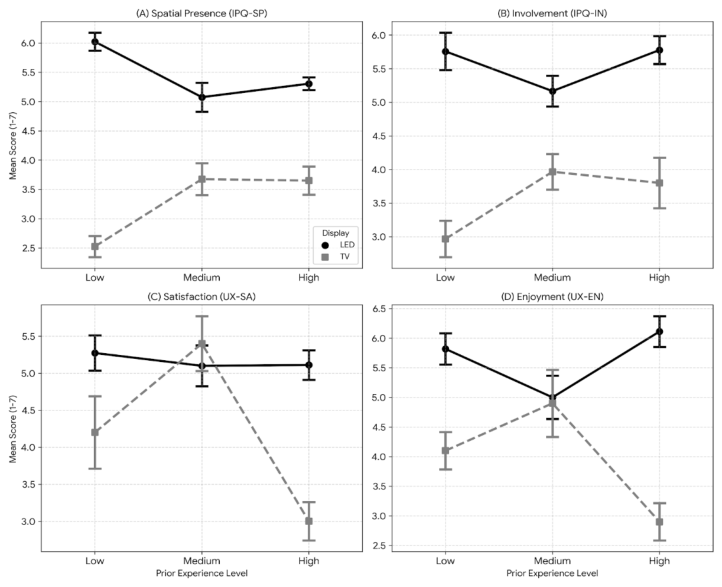
Perceptual Metrics (Spatial Presence and Involvement) For the perceptual metrics, the analysis revealed an ordinal interaction pattern. As indicated in Table 2, the LED condition significantly outperformed the TV condition across all three experience levels for both Spatial Presence and Involvement (ps ≤ .003) under the Bonferroni-corrected threshold (p < .017). The interaction reflects differences in effect magnitude, with the LED advantage largest among low-experience users and narrower among medium- experience users, while the direction of the effect remained consistent (see Figure 1A and 2B).
Table 2: Simple main effects of display modality across experience levels for perceptual metrics (spatial presence and involvement).
Table available in the original PDF paper.
Bonferroni-adjusted α′ = .017 (three planned comparisons per outcome).
t(df) p
Experience Level
N (LED)
N (TV)
SP M(SD) LED
SP M(SD) TV
t(df) p IN M(SD) LED
IN M(SD) TV < .001
Low 11 10 6.02 (0.51)
2.53 (0.57)
14.90 (19)
< .001 5.76 (0.92)
2.97 (0.85)
7.19 (19)
.003
Medium 10 10 5.08 (0.78)
3.68 (0.86)
3.81 (18)
.001 5.17 (0.72)
3.97 (0.84)
3.43 (18)
< .001
High 9 10 5.31 (0.33)
3.65 (0.77)
6.00 (17)
< .001 5.78 (0.62)
3.80 (1.19)
4.46 (17)
Note1: Spatial Presence (SP); Involvement (IN).
Note2: All p-values indicate statistical significance based on a Bonferroni-corrected alpha level of .017 (p < .017).
When Seeing Isn’t Believing: How Prior Immersion History Dissociates Perceptual 79 Evaluative Metrics (Satisfaction and Enjoyment)
In contrast, evaluative metrics exhibited a disordinal (crossover) interaction pattern. As detailed in Table 3, high-experience users rated the LED Condition significantly higher than the TV Condition across both Satisfaction and Enjoyment (ps < .001). Low-experience users showed a mixed pattern, rating the LED Condition significantly higher in Enjoyment (p < .001), whereas for Satisfaction, the difference (p = .057) was marginally significant before correction and thus did not meet the stringent Bonferroni-corrected threshold (α = .017). The evaluative advantage of the LED Condition disappeared among medium-experience users: for this group, no statistically significant differences were observed between the LED Condition and the TV Condition for either Satisfaction (p = .525) or Enjoyment (p = .884). Although TV Condition scores were numerically higher in some instances, these differences were not statistically meaningful.
Table 3: Simple main effects of display modality across experience levels for evaluative metrics (satisfaction and enjoyment).
Table available in the original PDF paper.
Bonferroni-adjusted α′ = .017 (three planned comparisons per outcome).
t(df) p
Experience Level
N (LED)
N (TV)
SA M(SD) LED
SA M(SD) TV
t(df) p EN M(SD) LED
EN M(SD) TV
Low 11 10 5.27 (0.79)
4.20 (1.55)
2.03 (19)
0.057 5.82 (0.87)
4.10 (0.99)
4.22 (19)
< .001
0.884
Medium 10 10 5.10 (0.88)
5.40 (1.17)
−0.65 (18)
0.525 5.00 (1.15)
4.90 (1.79)
0.15 (18)
< .001 6.11
High 9 10 5.11 (0.60)
3.00 (0.82)
6.35 (17)
(0.78)
2.90 (0.99)
7.76 (17)
< .001 Note: The low-experience Satisfaction contrast did not reach the Bonferroni-adjusted threshold (α′ = .017)
and is therefore interpreted as not reliable.
Summary of Interaction Patterns Across all four dependent variables, perceptual metrics (Spatial Presence and Involvement) exhibited consistent LED superiority—an ordinal interaction, meaning higher hardware fidelity led to greater presence for all users. Evaluative metrics (Satisfaction and Enjoyment) instead revealed a crossover pattern: medium-experience users reported comparable or slightly higher satisfaction with TV, while high-experience users showed the strongest preference for LED. This divergence between perceptual and evaluative responses underscores the dual-layer interpretation developed in the Discussion section.
This critical divergence between the consistent perceptual advantage of LED and the attenuation of its evaluative advantage in the medium- experience group is visually summarized in Figure 1.
Figure 1: Interaction plots for (A) Spatial Presence, (B) Involvement, (C) Satisfaction, and (D) Enjoyment across display modality (LED vs. TV) and prior immersion experience (Low, Medium, High). Perceptual outcomes (A–B) show an ordinal interaction pattern in which LED consistently yields higher ratings across experience levels, with the magnitude of the LED advantage varying by experience. Evaluative outcomes (C–D) show attenuation in the medium-experience group, including a numerical crossover, while strong LED advantages remain for the high-experience group.
Statistical Reliability and Assumption Checks Model assumptions were inspected prior to inferential testing. For most outcomes, no critical departures were observed that would materially affect inference. For SUS, however, variance differed between display conditions (Levene’s test p < .001). Accordingly, we conducted a sensitivity analysis using Welch’s correction, which yielded the same substantive conclusion regarding the display effect. Effect sizes are reported as partial eta squared (ηp²) for ANOVA results.
DISCUSSION
The findings provide compelling evidence that user experience in virtual environments is a dynamic interplay governed by distinct mechanisms at perceptual and evaluative levels. This study reveals a critical dissociation
When Seeing Isn’t Believing: How Prior Immersion History Dissociates Perceptual 81 between perceptual constancy and evaluative contingency. While users across all experience levels consistently perceived the superior immersion of the high-fidelity hardware, their final satisfaction did not uniformly follow this perceptual lead, demonstrating that user evaluation is contingent upon internal reference points rather than being solely determined by external technological stimuli.
Perceptual Presence as a Robust Benefit of Enclosure-Dominant Configurations Unlike perceptual outcomes, evaluative outcomes did not show a uniformly increasing benefit of higher display fidelity across all experience groups. For high-experience participants, Satisfaction and Enjoyment showed a pronounced advantage for the LED configuration, consistent with a stricter evaluative standard for immersion-relevant cues. For medium-experience participants, however, LED advantages in Satisfaction and Enjoyment were attenuated and were not statistically reliable under the corrected planned- comparison threshold, despite clear perceptual differences favoring LED. This dissociation between perceptual presence and evaluative appraisal indicates that “more immersive” is not always equivalent to “more satisfying” for all audiences. One plausible interpretation is that evaluative judgments are shaped not only by perceived immersion cues but also by users’ expectations calibrated through prior exposure to immersive media. In this view, medium- experience participants may evaluate the TV condition relative to a lower baseline expectation, yielding satisfaction and enjoyment levels comparable to the LED condition despite lower perceived presence. This dissociation highlights that users are not passively guided by sensory input; instead, their evaluative responses are contingently moderated by their prior experience, even when perceptual differences are clearly recognized. Importantly, this expectation-based account is offered as a plausible interpretation rather than a validated mechanism, because pre-exposure expectations and perceived confirmation were not directly measured in this study. Future work should operationalize expectations explicitly, for example pre-exposure expectation scales, perceived confirmation measures, or framing manipulations that prime high versus low expectations, to test whether expectation confirmation mediates the relationship between display modality and evaluative outcomes across experience strata.
Evaluative Experience Depends More on User Background than Perceptual Presence Alone Unlike perceptual outcomes, evaluative outcomes did not show a uniformly increasing benefit of higher display fidelity across all experience groups. For high-experience participants, Satisfaction and Enjoyment showed a pronounced advantage for the LED configuration, consistent with a stricter evaluative standard for immersion-relevant cues. For medium-experience participants, however, LED advantages in Satisfaction and Enjoyment were attenuated and were not statistically reliable under the corrected planned- comparison threshold, despite clear perceptual differences favoring LED. This
82 Chang and Chen dissociation between perceptual presence and evaluative appraisal indicates that “more immersive” is not always equivalent to “more satisfying” for all audiences.
One plausible interpretation is that evaluative judgments are shaped not only by perceived immersion cues but also by users’ expectations calibrated through prior exposure to immersive media. In this view, medium-experience participants may evaluate the TV condition relative to a lower baseline expectation, yielding satisfaction and enjoyment levels comparable to the LED condition despite lower perceived presence. This “medium experience anomaly” might also be understood through the lens of the “novelty effect” and developing “connoisseurship.” Low-experience users may be driven by the sheer novelty of the LED immersion, while high-experience users possess the connoisseurship to appreciate its technical superiority. Medium- experience users, having lost the initial novelty but not yet developed critical connoisseurship, may find themselves in a transitional phase where they are less sensitive to high-fidelity advantages, especially when content is engaging on standard displays. This suggests that for occasional users, immersive technology might still be perceived as a “novelty,” and they may not yet have formed strong expectations for high-fidelity performance, leading to a “positive violation” or at least confirmation of moderate expectations when encountering a standard display with engaging content. This is consistent with the concept of content-hardware fit, where abstract, non-narrative content may not demand high photorealism to be enjoyable. This dissociation highlights that users are not passively guided by sensory input; instead, their evaluative responses are contingently moderated by their prior experience, even when perceptual differences are clearly recognized. Importantly, this expectation-based account is offered as a plausible interpretation rather than a validated mechanism, because pre-exposure expectations and perceived confirmation were not directly measured in this study.
Applied Implications for Virtual Exhibition Design and Deployment From an applied human factors perspective, the results motivate audience- aware deployment strategies that align technology investment with the primary experience objective.
First, when the primary goal is to increase perceptual immersion, such as strengthening presence cues and sustained involvement, enclosure-dominant configurations offer robust benefits across user experience levels. This supports the use of LED booth style setups for exhibitions that prioritize spatial presence as a central outcome.
Second, when the primary goal is evaluative acceptance among general audiences, the findings suggest that display fidelity alone may not guarantee higher Satisfaction or Enjoyment, particularly for mid-level prior experience groups. In these settings, expectation management and content framing may be as critical as the physical display configuration. Practically, this can be addressed through pre-briefing that calibrates audience expectations, narrative framing that matches the intended interaction mode, and interaction simplicity that reduces interpretive burden during short exposures.
When Seeing Isn’t Believing: How Prior Immersion History Dissociates Perceptual 83 Third, for high-experience audiences, lower-fidelity screen-based configurations may carry a higher risk of evaluative penalties, even when the content itself is identical. For expert or highly exposed users, design decisions should prioritize immersion-relevant cues and reduce mismatches between expected and delivered sensory affordances.
Limitations and Directions for Future Work Several limitations bound the interpretation of the present results. First, the total sample size (N = 60), yielding approximately 10 participants per cell, is relatively small for detecting interaction effects. However, despite the application of a rigorous Bonferroni adjustment (α = .017), the perceptual metrics still showed highly significant effects (p ≤ .003) and extremely large effect sizes (e.g., η²p = .756 for Spatial Presence), suggesting that the experimental manipulation was robust enough to overcome power limitations in key comparisons. A critical limitation regarding internal validity is that “Experience Level” was a quasi-experimental subject variable based on self-reporting, not a randomly manipulated factor. Therefore, the observed interactions should be interpreted as correlational associations, and we cannot rule out the influence of unmeasured confounding variables (e.g., critical thinking ability, technology readiness) that may covary with prior experience. Future work could complement frequency-based grouping with broader measures of expertise.
In addition, the LED Condition (enclosure-dominant) and TV Condition (screen-based) represent ecological display configuration packages that differ on multiple correlated parameters. Accordingly, findings should be interpreted as effects of these holistic configurations rather than isolating any single hardware parameter.
Finally, the study employed a single exhibition content stimulus featuring abstract, non-narrative immersive art presented in a brief exposure format. Although this approach was deliberately chosen to control for narrative confounds, the use of abstract content defines the boundary conditions of the study. Consequently, the findings, particularly the consistent perceptual advantage observed in the LED condition, are likely most applicable to “experiential” or “atmospheric” exhibitions, where sensory immersion is paramount, rather than to “informational” exhibitions (e.g., detailed artifact inspection), where high visual resolution may be more critical than spatial enclosure. Future research should investigate the generalizability of these results across diverse content genres. Additionally, incorporating direct measures of expectation, perceived confirmation, and other human factors outcomes such as workload or discomfort would further strengthen causal interpretations and enhance design recommendations.
CONCLUSION
This study examined how display modality and prior immersion experience jointly shape user responses in a virtual exhibition setting. Across experience levels, the enclosure-dominant LED configuration yielded consistently higher ratings on perceptual presence outcomes, Spatial Presence and Involvement,
84 Chang and Chen suggesting a robust advantage when the design goal is to strengthen “being there” sensations. In contrast, evaluative outcomes, Satisfaction and Enjoyment, revealed a critical dissociation, being more contingent on users’ prior experience: the LED advantage remained strong for high-experience participants, whereas it attenuated in the medium-experience group. From an applied human factors perspective, these findings suggest that display investments should be aligned with the primary UX objective and target audience. When the objective is perceptual immersion, enclosure- dominant configurations provide reliable benefits; when the objective is evaluative acceptance among general audiences, expectation management and content framing may be as critical as display fidelity. Practically, these findings suggest a segmented strategy for design investments, particularly for experiential exhibitions where sensory engagement is primary over informational extraction. For expert audiences, high-fidelity hardware is likely necessary. However, for general audiences (medium experience), costly installations may not yield higher satisfaction, provided content quality is high.
REFERENCES
Bangor, A., Kortum, P. T., & Miller, J. T. (2008). An empirical evaluation of the System Usability Scale. International Journal of Human-Computer Interaction, 24(6), 574–594. Bhattacherjee, A. (2001). Understanding information systems continuance: An
expectation-confirmation model. MIS Quarterly, 25(3), 351–370. Bowman, D. A., & McMahan, R. P. (2007). Virtual reality: how much immersion is enough?. Computer, 40(7), 36–43. Burgoon, J. K. (1993). Interpersonal expectations, expectancy violations, and
emotional communication. Journal of Language and Social Psychology, 12(1-2), 30–48. Cummings, J. J., & Bailenson, J. N. (2016). How immersive is enough? A metaanalysis of the effect of immersive technology on user presence. Media Psychology, 19(2), 272–309. Glass, G. V., Peckham, P. D., & Sanders, J. R. (1972). Consequences of failure to meet
assumptions underlying the fixed effects analyses of variance and covariance. Review of Educational Research, 42(3), 237–288. Grassini, S. (2023). Shaping the experience of reality in virtual environments: A review of the psychological determinants of presence. Journal of Cognitive Enhancement, 7(2), 121–134. Hassenzahl, M. (2003). The thing and I: Understanding the relationship between
user and product. In Funology (pp. 31–42). Kluwer Academic Publishers. Lee, M., & Kim, M. (2023). Factors Influencing the Intention to Continue Using the Metaverse: Focusing on the Influence of Social Norms. International Journal of Internet, Broadcasting and Communication, 15(4), 51–60. Luo, D., Doucé, L., & Nys, K. (2025). Immersive Art Exhibitions: Sensory Intensity
Effects on Visitor Satisfaction via Visitor Attention and Visitor Experience. Visitor Studies, 28(2), 272–293. Preece, J., Rogers, Y., & Sharp, H. (2007). Interaction design: Beyond humancomputer interaction (2nd ed.). John Wiley & Sons. Sacau, A., Laarni, J., & Hartmann, T. (2008). Influence of individual factors on
presence. Computers in Human Behavior, 24(5), 2255–2273.
When Seeing Isn’t Believing: How Prior Immersion History Dissociates Perceptual 85 Schubert, T., Friedmann, F., & Regenbrecht, H. (2001). The experience of presence:
Factor analytic insights. Presence: Teleoperators and Virtual Environments, 10(3), 266–281. Shin, D. (2022). The actualization of meta affordances: Conceptualizing affordance actualization in the metaverse games. Computers in human behavior, 133, 107292. Slater, M. (2009). Place illusion and plausibility illusion. Philosophical Transactions
of the Royal Society B: Biological Sciences, 364(1535), 3549–3557. Stanney, K. M., Mourant, R. R., & Kennedy, R. S. (1998). Human factors issues in virtual environments: A review of the literature. Presence: Teleoperators and Virtual Environments, 7(4), 327–351. Weber, S., Weibel, D., & Mast, F. W. (2021). How much is enough? The influence of
field of view, resolution, and refresh rate on presence and cybersickness in virtual reality. Virtual Reality, 25(4), 1093–1104. Witmer, B. G., & Singer, M. J. (1998). Measuring presence in virtual environments: A presence questionnaire. Presence, 7(3), 225–240.
LISTED IN THE AHFE DIGITAL BOOKSTORE CATALOGUE
Explore the complete digital volume
Metaverse, Virtual Environments and Game Design
Read this individual research paper free through the original publisher, or explore the full digital proceedings book.
ISBN 978-1-964867-93-9
Explore this ISBN in the AHFE Bookstore ↗Listed in the July 2026 bookstore catalogue; search by ISBN to confirm current availability · Digital book purchase optional