Akgün Tokatlı (2026). A Conceptual Human Factors Mapping Model for VR Design Education: Examining Awareness of Ergonomic Criteria in Design Decision-Making. In: Metaverse, Virtual Environments and Game Design. AHFE Open Access, vol. 217, pp. 144–152. https://doi.org/10.54941/ahfe1007661
In VR systems designed for diverse users and purposes ergonomic prioritization necessarily varies. Systematic reviews highlight the need for human factors–based design models that can support contextual interpretation rather than fixed prescriptions. In the field some approaches group ergonomics under broad experiential constructs, while others propose extensive lists of specific variables. Both strategies challenge design education: broad categories can hide root causes, while detailed criteria increase cognitive load and hinder learning for novices. To address these challenges, this study proposes a conceptual VR Human Factors Mapping Model designed to function as a cognitive bridge between theoretical ergonomic knowledge and practical VR design reasoning. An exploratory and iterative study was conducted with undergraduate design students. Participants were given VR design problem scenarios linked to ergonomic criteria and asked to match each problem with relevant human factors criteria. The resulting dataset was analysed in terms of clustering density, cross-criterion overlap, and conceptual dispersion in order to evaluate the clarity with which each criterion was distinguished cognitively. Findings reveal that students more easily recognize physically grounded and technically observable criteria, while struggling to distinguish experiential and conceptual constructs. These findings suggest that the main challenge in VR human factors education is not recognizing criteria, but distinguishing overlapping concepts and linking them accurately to design problems. The study therefore emphasizes the importance of defining a balanced number of criteria and explicitly modelling their relationships through relational matrices, providing a scalable framework for improving root-cause reasoning in VR design.
VR designs constitute a network of problems that simultaneously affect multiple interrelated human factors. As immersive technologies increasingly move beyond entertainment toward education, training, healthcare, and collaborative work environments, the need for robust ergonomic design frameworks has become more pronounced. Ergonomic guidance for immersive systems has established a number of important principles
A Conceptual Human Factors Mapping Model for VR Design Education 145 related to user comfort, usability, cognitive load, and physical well-being. Standards and guidelines provide general recommendations concerning issues such as visual comfort, motion sickness, spatial interaction and system responsiveness (LaViola, 2000; Stanney et al., 2003; Jerald, 2016). However, these frameworks generally describe ergonomic considerations at a conceptual level and rarely indicate how different human factors should be prioritized in relation to specific design contexts. (Souchet et al., 2023).
Systematic reviews in the field emphasize that human-centered design approaches are necessary to interpret ergonomic principles within specific contexts of use rather than applying them as universal prescriptions (Radianti et al., 2020). Consequently, researchers increasingly argue for design frameworks that can support contextual decision-making by designers rather than checklists.
At the same time, the academic literature presents a fragmented landscape of ergonomic taxonomies and terminology. Numerous models have been proposed to describe the human factors that shape immersive experiences, including frameworks focusing on presence and immersion (Slater, 2009; Bowman & McMahan, 2007), cognitive workload and attention (De Witte, 2025), motion and physical ergonomics (LaViola, 2000, Bourdin et al., 2019), and interaction design principles in three-dimensional environments (Jerald, 2016). While these frameworks provide valuable perspectives, they often emphasize different conceptual structures and terminologies. Some approaches categorise ergonomic considerations under broad experiential constructs such as presence, immersion and engagement, while others provide detailed lists of specific usability or performance variables. While this diversity contributes to the richness of the field, it also introduces conceptual ambiguity, particularly in educational contexts where novice designers are expected to interpret and apply these concepts during the design decision making process.
From a design education perspective, this conceptual fragmentation creates two challenges. When ergonomic knowledge is framed through overly broad experiential constructs, the root causes of design problems may remain obscured, making it difficult for students to connect theoretical concepts to specific design decisions. Conversely, when ergonomics is presented as an extensive list of highly specific variables, the resulting complexity may increase cognitive load and make it difficult for learners to internalize relationships between criteria. Cognitive load theory suggests that learners struggle to process and integrate multiple interacting variables when conceptual structures are not clearly organized (Sweller, 1988). In immersive system design, where experiential, technical, and psychological factors are tightly interconnected, this challenge becomes particularly pronounced.
Several researchers have therefore emphasised the importance of developing conceptual models that help designers understand how different human factors interact within immersive experiences. In design education, there is a growing need to move beyond presenting ergonomic knowledge as a simple list of criteria toward contextual approaches that make the relationships between criteria visible. Garcia and Verlinden (2022) emphasize that mapping approaches which explicitly relate design situations to ergonomic criteria can support deeper understanding in design learning. Similarly, studies using VR-based
146 Tokatlı educational platforms suggest that immersive environments can help learners recognize ergonomic risks and develop greater awareness of human factors considerations (Freire et al., 2023). For design students in particular, the ability to map design problems to multiple interacting human factors may represent a critical step in developing ergonomic awareness and reflective design reasoning.
METHOD
The ergonomic criteria used in this study build upon a previously proposed framework developed by Tokatlı (2025), which identified eleven ergonomic criteria addressing the technical, experiential, and psychological dimensions of VR design. In the present study, these criteria serve as a conceptual foundation to investigate how design students interpret and associate design problems with human factors considerations. At the beginning of the study, eleven ergonomic criteria were defined based on this framework. Participants were presented with a list of 32 VR design problems that could be observed either during user testing sessions or while users interact with the system. For each problem scenario, participants were asked to determine which of the listed ergonomic criteria were related to the problem. The definitions of all eleven criteria were provided to the participants as a reference list during the task.
The first stage of the study involved 18 undergraduate design students. All participants had previously taken a course related to VR design and had completed at least one VR design project.
Based on the responses obtained in the first study, a relationship matrix was generated to analyze the associations between design problems and ergonomic criteria. A criterion was considered correctly understood when more than 50% of participants associated the correct ergonomic criterion with the corresponding problem scenario. Higher percentages were interpreted as stronger confirmation of conceptual clarity. In addition to correct matches, the analysis also examined cross-criterion overlaps. When participants associated another criterion with a problem scenario at a rate close to the correct criterion, this was interpreted as conceptual confusion between criteria. Such overlaps indicated that certain ergonomic concepts were either weakly defined or interpreted too broadly by participants.
Based on the findings, a second exploratory study was designed. In this phase, the criteria that were weakly identified or conceptually ambiguous were reframed and refined in order to test whether clearer definitions would improve participants’ ability to correctly associate problems with ergonomic criteria.
The second study was conducted using the same research procedure with 7 additional participants. In this phase, participants were asked to match 39 VR design problems with an expanded set of 13 ergonomic criteria. The aim of this second stage was to examine whether refining the conceptual definitions of certain criteria would increase the accuracy of problem– criterion associations and improve the differentiation between closely related ergonomic concepts.
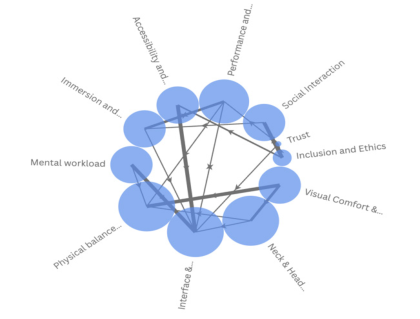
Figure 1: Map of the first study (larger nodes represent more clearly defined criteria, while thicker edges indicate higher levels of confusion between criteria).Table 1: Conceptual clarity and cross-criterion confusion patterns among VR ergonomic criteria for Study 1.
Table available in the original PDF paper.
Ergonomic Criterion Conceptual Clarity
Overlapping Criteria Level of Confusion Physical balance& movement o Very High
Visual Comfort & Clarity
Moderately identifiable Neck & Head Ergonomics High Interface & Interaction Design Low
Neck & Head Ergonomics
Very clearly identifiable Physical balance& movement o Low Performance and response time Low Interface & Interaction Design Very clearly identifiable
-
Physical balance & movementoptimisation
Very clearly identifiable Interface & Interaction Design Very high Mental workload Moderately identifiable
Physical balance& movement o Low Performance and response time High
Immersion and presence Moderately identifiable
Interface & Interaction Design Low Interface & Interaction Design Very high
Accessibility and adaptability
Moderately identifiable Physical balance& movement o Low Performance and response time Strongly identifiable
Interface & Interaction Design Low Immersion and presence Low
Inclusion and Ethics Low
Social Interaction Moderately identifiable
Immersion and presence Low Trust Not identifiable Performance and response time Low
Interface & Interaction Design Low Social Interaction High
Inclusion and Ethics Very weakly identifiable
Accessibility and adaptability Moderate Trust High
The analysis of the first study revealed two critical findings.
1. Students were able to identify physical and technical ergonomic criteria relatively easily. However, they experienced greater difficulty distinguishing experiential and conceptual criteria. In particular, participants struggled to clearly interpret and identify the criteria Trust and Inclusion and Ethics when matching them with the given design problems. 2. Students tended to interpret some criteria more broadly than intended, resulting in a large number of incorrect problem–criterion associations. As shown in Table 1, several criteria exhibited high or very high levels of conceptual confusion with other criteria. For instance, Interface & Interaction Design, which had a significantly lower correct matching rate compared to the overall average, was frequently associated with many unrelated problems.
Participants evaluated 32 VR design problems, each corresponding to one predefined ergonomic criterion, resulting in 32 correct problem–criterion pairs. Because participants were allowed to associate multiple criteria with each problem, a total of 846 associations were recorded. Out of these responses, 310 selections corresponded to the intended correct problem– criterion pairs, yielding an overall correct association rate of 36.64%. The remaining 536 selections corresponded to incorrect associations, distributed across 320 alternative problem–criterion combinations. Among all criteria, Interface & Interaction Design showed the highest level of incorrect associations. This criterion was both the most frequently selected criterion overall and the one with the lowest correct matching rate (23.57%). Out of the 536 incorrect associations, 132 were linked to this criterion.
Further analysis of the association patterns indicates that certain criteria become dominant during the matching process. Even when these criteria were correctly identified in certain cases, they were also frequently applied to unrelated problems. This suggests that students tend to overgeneralise certain criteria, leading them to interpret many design problems in the same way. Consequently, when analysing the root causes of design problems, the focus may become disproportionately centred around these dominant criteria. Reducing this effect and clarifying the boundaries between criteria will be an important future research objective. As well as addressing cases where criteria are poorly understood, it is also necessary to examine situations where certain criteria are perceived as having overly broad conceptual scopes. This can lead to confusion with other ergonomic factors in the mapping process. Based on these findings, the next stage of the research will focus primarily on students’ difficulties in distinguishing between experiential and conceptual ergonomic criteria.
Second Study The conceptual structure of the ergonomic criteria was revised in the second study based on the findings of the first study. The initial analysis revealed that
A Conceptual Human Factors Mapping Model for VR Design Education 149 certain criteria, particularly Trust and Inclusion and Ethics, were difficult for students to interpret clearly. To address this, concepts were restructured into more specific criteria. The original Trust criterion was divided into two separate dimensions: Trust and Digital Security, and Transparency. Similarly, the original ‘Inclusion and Ethics’ criterion was divided into ‘Inclusion’ and ‘Ethical Design’.
The purpose of these modifications was to examine whether refining the conceptual definitions of the criteria would improve students’ ability to correctly interpret and associate ergonomic factors with VR design problems. Additionally, the study aimed to determine whether this conceptual refinement would reduce the number of incorrect problem–criterion associations identified in the initial study.
Table 2: Conceptual clarity and cross-criterion confusion patterns among VR ergonomic criteria for Study 2.
Table available in the original PDF paper.
Ergonomic Criterion Conceptual Clarity
Overlapping Criteria Level of Confusion Physical balance& movement o High
Performance and response time High identifiable Interface & Interaction Design Low
Interface & Interaction Design Very high
Accessibility and adaptability
Moderately identifiable Physical balance& movement o Moderate Performance and response time Moderately identifiable
Interface & Interaction Design Modarete Immersion and presence Modarete
Social Interaction Moderately identifiable
Physical balance& movement o High
Trust Weakly identifiable
- -
Digital security and transparency
Clearly identifiable Accessibility and adaptability Very high Inclusion Veryweakly identifiable
Trust High
Ethical design Veryweakly identifiable
Social Interaction High
1. When the experiential and conceptual criteria were divided into more specific sub-criteria, which increased the total number of criteria by two,
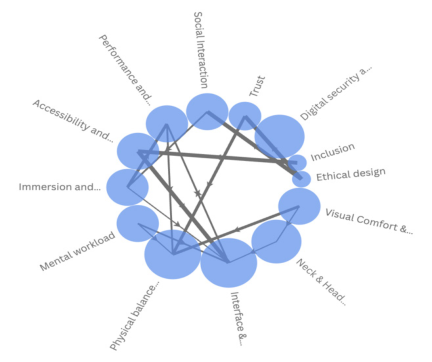
150 Tokatlı students demonstrated an enhanced capacity to recognise and distinguish between them. In the previous version, the Trust criterion could not be clearly identified; after the revision, however, no criterion remained completely unidentifiable. As shown in Figure 2, Trust, Inclusion, and Ethics became more visible in the mapping, and the privacy-related dimension became clearly identifiable. However, students still experienced some difficulty in clearly defining Trust, Inclusion, and Ethics. 2. Increasing the number of criteria reduced the level of cross-criterion confusion. The number of confusion relationships decreased from 20 to 15. On average, each criterion was confused with 1.8 other criteria previously, but this decreased to 1.15 in the second study. While this represents an improvement, confusion between criteria remains relatively high. 3. Broadly interpreted criteria continued to show similar patterns of confusion. As presented in Table 2, criteria with high or very high confusion levels remain visible. When Table 2 is compared with Table 1, several similarities and minor changes can be observed. For instance, Neck & Head Ergonomics decreased from “very strongly identifiable” to “strongly identifiable.” Similarly, Performance & Response Time shifted from “strongly identifiable” to “moderately identifiable.” Criteria such as Physical Balance & Movement Optimization and Interface & Interaction Design continue to be interpreted with overly broad conceptual scopes and remain associated with problems outside their intended scope. 4. When the number of criteria increased from 11 to 13, the overall correct matching rate decreased from 37% to 31%. This result raises the possibility that increasing the number of criteria may have increased the cognitive load experienced by students.
Figure 2: Map of the second study.
Future studies should focus particularly on criteria that students interpret with overly broad conceptual scopes, such as Interface & Interaction Design, which continues to dominate incorrect associations. Additionally, future
A Conceptual Human Factors Mapping Model for VR Design Education 151 iterations should examine whether keeping the number of criteria fixed while refining definitions can reduce cognitive load and clarify the trade-off between conceptual differentiation and correct problem–criterion identification. The rate of incorrect associations should be monitored in subsequent iterations.
DISCUSSION & CONCLUSION The results of the second study provide initial evidence in support of the validity of the iterative method employed in this research. The findings suggest that the primary challenge in VR design education is not only recognising ergonomic criteria, but also students’ ability to distinguish between overlapping experiential and conceptual constructs. When ambiguous criteria were divided into more specific dimensions, students demonstrated a clearer ability to interpret and associate them with design problems. However, some criteria continue to be interpreted with overly broad conceptual scopes, leading to associations with multiple design situations. Rather than proposing a finalized model at this stage, this ongoing research aims to iteratively develop a conceptual framework for VR human factors mapping. The objective is to identify a set of ergonomic criteria that can be clearly interpreted, create minimal conceptual overlap between criteria, and reduce the cognitive load experienced by design students. The envisioned framework follows a cyclical process that includes problem identification, ergonomic criterion mapping, construction of a conceptual map, holistic analysis of the design problem, redesign, re-testing, and remapping. By comparing successive mapping results across iterations, the research aims to refine the criteria set and establish a holistic analytical structure that can support both design reasoning and human factors education in immersive system design. Ultimately, the study aims to establish a structured human factors mapping cycle that supports designers in systematically connecting VR design problems with ergonomic reasoning.
REFERENCES
Bourdin P. Martini M. Sanchez-Vives M. V. (2019). Altered visual feedback from an embodied avatar unconsciously influences movement amplitude and muscle activity. Sci. Rep.9, 19747. 10.1038/s41598-019-56034-5 Bowman, D.&McMahan, R. (2007). VR: How Much Immersion Is Enough?.
Computer. 40. 36 - 43. 10.1109/MC.2007.257. De Witte B., Reynaert V., Kieken D., Jabbour J., Demarey C., DumoulinA. & Possik J., (2025). “Immersive Virtual Reality Learning and Cognitive Load: A multiple- Day Field Study”, Computers in Human Behavior, https://doi.org/10.1016/j. chb.2025.108853. Freire, J., Meyer, F., Maureira, F., Espinoza, J., Brito, K., Estrada, C. (2023). Virtual
reality platform applied to Ergonomics teaching. In: Tareq Ahram and Waldemar Karwowski (eds) Augmented, Virtual and Mixed Reality Simulation. AHFE (2023) International Conference. vol. 118. AHFE International, USA. http://doi. org/10.54941/ahfe1004446
designs. In: Tareq Ahram and Christianne Falcão (eds) Human Factors in Virtual Environments and Game Design. AHFE (2022) International Conference. AHFE Open Access, vol 50. AHFE International, USA. http://doi.org/10.54941/ ahfe1002063 Jerald, J. (2016). The VR Book: Human-Centered Design for VR. Morgan & Claypool. LaViola J. J.. (2000). A discussion of cybersickness in virtual environments. SIGCHI
Bull. 32, 1 (Jan. 2000), 47–56. https://doi.org/10.1145/333329.333344 Radianti J., Majchrzak T. A., Fromm J., Wohlgenannt I., (2020). A systematic review of immersive virtual reality applications for higher education: Design elements, lessons learned, and research agenda, Computers & Education, Volume 147, 103778, ISSN 0360-1315, https://doi.org/10.1016/j.compedu.2019.103778. Slater, M. (2009). Place illusion and plausibility can lead to realistic behaviour in
immersive virtual environments. Philosophical Transactions of the Royal Society B: Biological Sciences. 364. 3549-3557. 10.1098/rstb.2009.0138. Souchet AD, Lourdeaux D, Burkhardt JM, Hancock PA. (2023) Design guidelines for limiting and eliminating virtual reality-induced symptoms and effects at work: a comprehensive, factor-oriented review. Front Psych.. 2023 Jun 9;14:1161932. doi: 10.3389/fpsyg.2023.1161932. Erratum in: Front Ps. doi: 10.3389/ fpsyg.2023.1261103. Stanney, K. M., Hale, K. S., Nahmens, I., & Kennedy, R. S. (2003). What to Expect
from Immersive Virtual Environment Exposure: Influences of Gender, Body Mass Index, and Past Experience. Human Factors: The Journal of the Human Factors and Ergonomics Society, 45(3), 504-520. https://doi.org/10.1518/hfes.45.3.504.272 Sweller, J. (1988), Cognitive Load During Problem Solving: Effects on Learning.
Cognitive Science, 12: 257-285. https://doi.org/10.1207/s15516709cog1202_4 Tokatli A (2025) A multi-criteria framework for the holistic ergonomic design evaluation of VR products. Front. Virtual Real. 6:1549963. doi: 10.3389/ frvir.2025.1549963
LISTED IN THE AHFE DIGITAL BOOKSTORE CATALOGUE
Explore the complete digital volume
Metaverse, Virtual Environments and Game Design
Read this individual research paper free through the original publisher, or explore the full digital proceedings book.
ISBN 978-1-964867-93-9
Explore this ISBN in the AHFE Bookstore ↗Listed in the July 2026 bookstore catalogue; search by ISBN to confirm current availability · Digital book purchase optional