Su Qian Yu, Chen Chen (2026). Chu-Han Treasure Keepers: AR Board Game Design Based on Cultural Translation Theory - Case Study of Xuzhou Museum and Intangible Cultural Heritage. In: Metaverse, Virtual Environments and Game Design. AHFE Open Access, vol. 217, pp. 108–120. https://doi.org/10.54941/ahfe1007659
The Han Dynasty culture of Xuzhou, centered in the city of Xuzhou, encompasses the material and spiritual civilization of the Western and Eastern Han periods, including a wealth of cultural relics, intangible cultural heritage (ICH) skills, and a unique historical spirit. Its digital preservation and innovative revitalization are of great significance for the living inheritance of regional culture. In this context, board games, with their inherent interactivity and narrative qualities, have become an innovative vehicle for cultural dissemination. However, many current cultural-themed board games face challenges such as superficial cultural expression and didactic, knowledge-instilling experience design. Concurrently, common digital display technologies often remain at the level of static presentation, failing to support deep cultural immersion and interactive exploration. This study introduces cultural translation theory, constructs a three-tiered progressive cultural translation model of "Material—Behavioral—Spiritual," and deeply integrates augmented reality (AR) technology to design and develop the Chu-Han Treasure Keepers AR board game. Through AR, players can scan physical cards to trigger historical demonstrations and cultural knowledge displays, creating an immersive, interactive experience. Preliminary results indicate that AR technology effectively enhances the transmission of cultural connotations. This research provides a new design pathway and theoretical support for the digital preservation of cultural heritage and the design of cultural and creative products.
With the growing emphasis on inheriting traditional culture and enhancing urban cultural soft power, the methods of disseminating traditional culture within the contemporary design context are undergoing a profound shift. In recent years, cultural-themed board games have emerged as a popular medium for cultural communication. The Opinions on Promoting the Implementation of the National Cultural Digitalization Strategy encourages innovative cultural expression and immersive experiences, suggesting that Received February 1, 2026; Revised March 31, 2026; Accepted April 17, 2026; Available online July 20, 2026
Chu-Han Treasure Keepers: AR Board Game Design Based on Cultural Translation Theory 109 board games should achieve a “living” transformation of culture through interactive narratives (General Office of the CPC Central Committee & General Office of the State Council, 2022). Similarly, the “Fourteenth Five- Year Plan” for Cultural Development supports the creation of cultural and creative products with rich cultural meaning, providing policy support for board games to become an effective form of cultural industry empowerment and consumption promotion (“Fourteenth Five-Year Plan” for Cultural Development, 2025). As a crucial cradle of Han culture, the dissemination of Xuzhou’s culture has garnered significant attention. Universities in Xuzhou have organized historical and cultural activity months, featuring knowledge contests and innovative forms like ICH inheritance workshops, to help students understand Xuzhou’s culture and inspire patriotism (Guo et al., 2023). Geographic study tours on Xuzhou’s Han culture, relying on museums and other study sites, aim to cultivate students’ cultural confidence and comprehensive literacy from a geographical perspective through field research (Huang and Shi, 2022). Meanwhile, the city is actively constructing a visual identity and wayfinding system, attempting to integrate elements of the “three wonders of the Han Dynasty”—the terracotta warriors, Han tombs, and Han stone reliefs—into design to showcase the Han cultural lineage through systematic visual symbols (Qiu, 2020).
Current explorations in disseminating Xuzhou’s culture are multifaceted, covering campus popularization, practical study tours, and urban visual presentation, with a focus on enhancing participation and experience. However, this dissemination still faces several challenges: Superficial Cultural Expression and Didactic Knowledge Transfer: This leads to a thin cultural message and an imbalance with entertainment, resulting in deficiencies in interpreting cultural meaning and interacting with the audience.
Limited Reach of Deep Cultural Engagement: The implementation of study tours and ICH activities depends heavily on resource integration and pedagogical guidance, limiting their coverage and hindering the deep and widespread transmission of Han culture.
Static Digital Technology: Traditional digital technologies often remain at a surface-level display, failing to integrate deeply with gamification design, which makes it difficult to support the profound delivery of culture and immersive experiences.
Therefore, to address the dilemmas in the contemporary dissemination of Xuzhou’s Han Dynasty culture, this study proposes three core research questions:
1. How can a three-tiered progressive “Material–Behavioral–Spiritual” cultural translation model, adapted to Xuzhou’s Han Dynasty culture, be constructed to systematically extract and transform traditional cultural connotations for design? 2. How can a scientific gamification design (e.g., task-based challenges, social collaboration, reward incentives) achieve an organic balance between entertainment and cultural transmission, enhancing users’
110 Qian and Chen motivation for active exploration and their cognitive understanding of Xuzhou’s Han Dynasty culture (Pyae, 2018)? 3. How can AR technology be deeply integrated with the physical components of a board game to create a dual-experience scenario of physical interaction and digital immersion through a scan-to-activate mechanism, thereby enhancing the vividness and depth of cultural transmission (Shih et al., 2020) ?
To address these questions, this research uses artifacts from the Xuzhou Museum and local ICH as core cultural materials. It introduces cultural translation theory to construct a three-tiered progressive translation model, systematically extracting cultural elements such as artifact forms, ICH craft processes, and historical spiritual cores. This informs the design of a system of physical game components, including character cards, landmark cards, and ICH energy tokens, along with a companion AR mobile application. Through a scan-to-activate mechanism, players can scan physical cards to trigger multidimensional digital content, such as 3D model displays, dynamic demonstrations of ICH skills, and historical micro-documentaries. Combined with gamification mechanics like task-based challenges and teamwork, this approach upgrades the experience from passive, static viewing to active, dynamic exploration.
RELATED WORK
Application of Cultural Translation in Design Cultural translation, as a core methodology connecting traditional culture with modern design, is a key process of interpreting and reconstructing the material symbols, behavioral rituals, and spiritual core of a specific cultural system into expressive forms that a contemporary audience can perceive and experience. With the revival of traditional culture and the integration of culture and tourism, market demand for creative products with cultural depth, modern esthetics, and practical value is growing. Luo Xinru and Deng Lili applied cultural translation to the design of tourism products for Shanxi Wenxi decorative steamed buns (Huamo), extracting elements from the three dimensions of “form,” “context,” and “meaning” to create IP images that retain the essence of the ICH while appealing to modern consumer tastes (Luo & Deng, 2024). Xu Xialin used the Double Diamond model in lamp design, combining various methods to translate auspicious symbols into product forms and functions, integrating cultural meaning with household needs (Xu, 2025). In his research on digital game localization, Aung Pyae proposed that cultural translation must adapt to the audience’s language, norms, and values, using a graded transformation to make the game culturally resonant.
Currently, the application of cultural translation in design has expanded across various fields, including cultural and creative products, home goods, and digital entertainment, with its methodology becoming more systematic. However, in terms of theoretical implementation and practical application, the current design systems face several bottlenecks: some designs translate cultural elements superficially without delving into their deeper meanings,
Chu-Han Treasure Keepers: AR Board Game Design Based on Cultural Translation Theory 111 resulting in products that lack cultural depth; a balance in cultural translation is difficult to strike, with some designs overemphasizing modern esthetics or rigidly adhering to traditional forms; and the lack of unified standards and intellectual property protection systems leads to severe homogenization and a failure to protect high-quality original designs.
Effectiveness of Gamification Design Gamification design uses elements such as task mechanisms, social interactions, and reward systems to motivate user participation, infusing cultural dissemination with entertainment and immersion. It is widely used in education, business, and other fields. The SDGs, for a Greater World board game, developed by Cheng Xinlu’s team based on the ATMSG framework, allows players to absorb knowledge about sustainable development through resource accumulation and card exchange mechanisms, gaining user approval (Cheng & Ding, 2024). Guess the Animal, designed for children aged 7–12 with autism, cultivates their theory of mind abilities through role-playing and clue-based reasoning, catering to the needs of a special group (Liu et al., 2025). In the business sector, companies like Amazon and the State Bank of India use points and badges to enhance user stickiness with significant results (Sharma et al., 2024).
At present, gamification design is characterized by diverse application scenarios and systematic design frameworks. However, behind its rapid development, this design model also reveals several deep-seated issues: some designs prioritize form over substance, neglecting the achievement of core objectives and leading to superficial user engagement; one-size-fits-all designs fail to meet the needs of different groups, lacking personalization; and in some scenarios, the integration of gamification with real-world contexts is poor, making skills difficult to transfer and limiting the long-term value of gamification.
Application and Practical Paths of AR Technology in Cultural and Creative Products Augmented Reality (AR) technology, with its characteristics of virtual-real integration and real-time interaction, has broken through the spatio-temporal limitations and static display bottlenecks of traditional cultural dissemination, becoming a core technological enabler for the digital preservation and innovative revitalization of cultural heritage. Numerous domestic and international research cases have explored the application and practical paths of AR in cultural and creative products. Ma Shuang and Chu Xiaobing developed creative products based on the traditional brewing techniques of Lianma Town in Conghua, using AR to achieve virtual reenactment and interactive experiences of the brewing process, promoting the fusion of ICH with modern consumption (Ma & Chu, 2025). Yu-Chen Liang, Hao-Chiang Koong Lin et al. designed an AR temple culture board game for the Yinghai Temple in Tainan, using AR to present temple culture knowledge and providing new ideas for religious cultural and creative development (Liang et al., 2022). Jiarui Liu, Cheng-Hung Lo et al. focused on the Fengxiang
112 Qian and Chen clay sculpture ICH project, designing AR handheld tools and color interfaces based on children’s characteristics, combining traditional crafts with AR to create an immersive creative experience, offering a path for the dissemination of ICH cultural products among children (Liu et al., 2025).
Currently, the application of AR in cultural and creative products shows significant innovative value. By blending the virtual and real, it overcomes the limitations of traditional cultural dissemination, enhances the fun and immersion of cultural communication, and aids in the inheritance of regional culture and ICH. However, this application also faces challenges. Some AR cultural products suffer from a superficial integration of technology and culture, lacking in-depth exploration of cultural connotations, which constrains their commercialization and sustainable development.
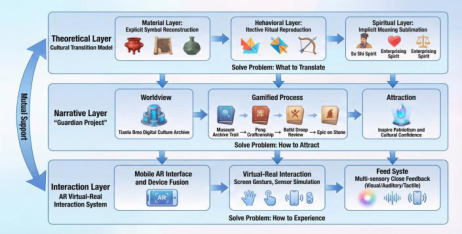
AR Board Game Design Solution Based on Cultural Translation Addressing the core pain points in the digital dissemination of Xuzhou’s Han Dynasty culture—namely static displays, shallow experiences, and didactic content delivery—this study proposes a systematic AR board game design solution based on cultural translation theory. The solution aims to construct a tangible, interactive, and perceptible immersive cultural space through a hybrid model of a physical board game and a mobile AR application (see Figure 1). This solution is composed of three interconnected layers:
1. Theoretical Layer: Proposing a “Material–Behavioral–Spiritual” three- tiered progressive cultural translation model adapted to Xuzhou’s Han culture to address what to translate. 2. Narrative Layer: Designing a gamified experience flow and worldview based on a “Treasure Keepers Program” to address how to attract users. 3. Interaction Layer: Establishing a virtual-real interaction and feedback system based on mobile AR to address how to experience the culture.
Figure 1: The solution strategy.
Cultural translation refers to the process of decoding and reconstructing the symbols, meanings, and behavioral patterns from a specific cultural context into a form that can be carried and understood by audiences in
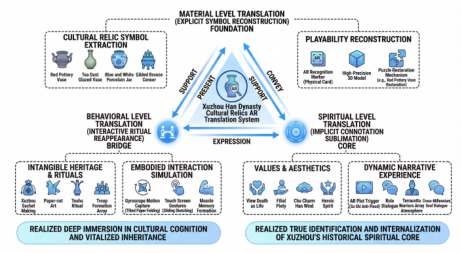
Chu-Han Treasure Keepers: AR Board Game Design Based on Cultural Translation Theory 113 another cultural context or medium. In the field of digital art design, this theory emphasizes extracting traditional motifs and cultural cores and combining them with modern digital technology and esthetic demands to achieve a living expression and dissemination of traditional culture (Zhu et al., 2025). From this theoretical perspective, this study conducts its design practice focusing on the museum collections and local ICH of Xuzhou, the cradle of Han culture. Xuzhou boasts a splendid material and spiritual civilization, with not only precious relics like the Han terracotta warriors and Han stone reliefs but also profound craftsmanship and historical spirit, holding immense value for cultural revitalization. However, existing dissemination methods are mostly static and one-way, leading to superficial cultural expression that fails to effectively spark audience interest or achieve deep transmission of meaning. Therefore, this study, based on cultural translation theory, constructs a “Material–Behavioral–Spiritual” three-tiered progressive model (see Figure 2) and designs the Chu-Han Treasure Keepers AR board game. By introducing AR real-world interaction, the solution aims to guide players to actively decode artifact information and learn ICH skills in a blended virtual-real exploration, upgrading the experience from static viewing to dynamic inheritance and achieving the goal of effective Han culture dissemination.
Figure 2: The “Material—Behavioral—Spiritual” three-tiered progressive model.
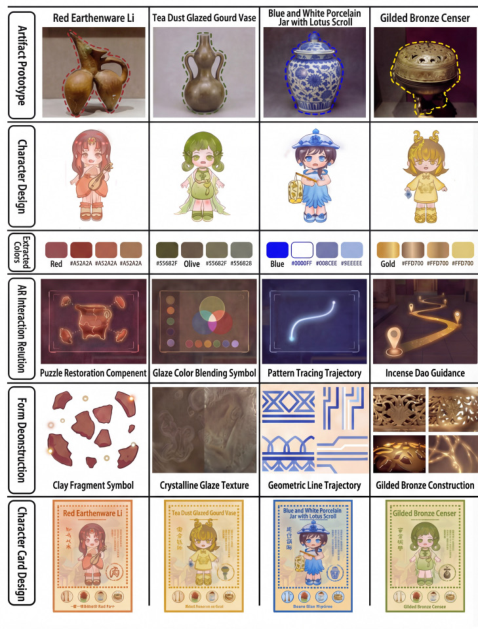
To break the cognitive barrier caused by physical separation in traditional exhibitions, this study adopts a gamified reconstruction strategy at the material layer. The visual symbols of four representative artifacts from the Xuzhou Museum—a red pottery gui (ewer), a tea-dust-glazed double-handled gourd vase, a blue-and-white porcelain jar with a lid and scrolling lotus motif, and a gilt-bronze incense burner—are systematically deconstructed. Their core forms, textures, and craft DNA are extracted and then creatively translated into physical game cards and high-fidelity 3D models using AR interactive language. First, during the collection and deconstruction process, the focus is on the artifacts’ morphological features and core visual genes. For the red pottery gui, we extracted its iconic bird-beak-like spout and tripod- bag-belly shape, analyzed its coarse ceramic texture, and deconstructed it into scattered pottery shard symbols. By simplifying the silhouette and reinforcing connection points, it was transformed into a visual component for
114 Qian and Chen a jigsaw-style restoration, allowing players to perceive the structural beauty of the original pottery art during reconstruction. A similar translation was applied to the other artifacts: the deep color and crystalline texture of the tea-dust-glazed vase were reconstructed as color-mixing symbols for glaze preparation; the continuous geometric lines of the blue-and-white porcelain jar were extracted and transformed into dynamic trajectories for pattern tracing; and the intricate openwork and metallic luster of the gilt-bronze incense burner were designed as guide nodes for an incense-path-finding task. This reconstruction phase successfully transforms static object symbols into exploratory task carriers by creating new digital visual identities. It shifts the experience from passively viewing artifacts to actively restoring them, imbuing the material symbols with an exploratory task attribute and thus achieving deep cultural cognitive immersion (see Figure 3).
Figure 3: The translation process of artifacts.
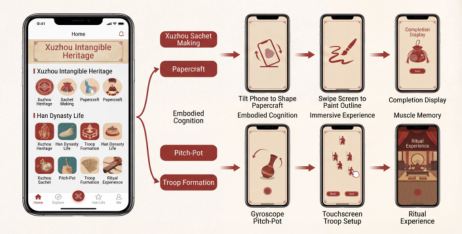
To address the experiential cognitive gap in traditional exhibitions caused by “seeing but not doing,” this study employs a strategy of embodied ritual reconstruction at the behavioral layer (Liang et al., 2025). Unlike the static reproduction of visual symbols at the material layer, the behavioral layer aims to reconnect the physically isolated craft processes and behaviors. This system treats Xuzhou’s ICH (such as Xuzhou sachet making and paper sculpture) and Han Dynasty life rituals (such as Touhu or pitch-pot, ritual
Chu-Han Treasure Keepers: AR Board Game Design Based on Cultural Translation Theory 115 music, and military formations) as dynamic cultural samples. It systematically deconstructs and extracts their core motor logic, force application methods, and procedural timing. These are then creatively translated into screen gesture interactions and spatial operational language using the mobile device’s gyroscope, touchscreen, and other sensors. For instance, in the paper sculpture creation segment, the player needs to tilt their phone to simulate the control of gravity during “pasting and shaping” and use delicate screen slides to replicate the brushstrokes of “outlining with a colored pen.” This design transforms abstract cultural knowledge into a concrete, embodied cognitive experience, allowing the player’s body to directly participate in the process of cultural production (see Figure 4). By simulating realistic physical feedback, players not only develop muscle memory for the difficulty of the craft but also break down psychological barriers, viscerally perceiving the subtlety of ICH skills and the solemnity of Han rituals, ultimately achieving the internalized inheritance of traditional skills and historical spirit.
Figure 4: Crafting experience.
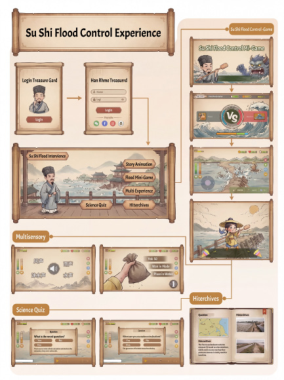
The spiritual layer of translation focuses on conveying intangible cultural connotations of the Han Dynasty, such as its values, cosmology, and esthetic tastes (e.g., “treating death as life,” filial piety, and the “Chu-style, Han- spirit” esthetic). As the highest level of the translation model, its goal is to transform these abstract concepts into experiences that players can perceive and empathize with. The strategy for this layer is to construct contextualized, dynamic narratives, using AR technology to trigger plot segments and immersive audiovisual atmospheres based on historical archetypes. For example, a dynamic reenactment of Su Shi’s efforts to control floods (see Figure 5) conveys to the player the spiritual quality of heroic righteousness. The majestic aura of the terracotta army formation transmits the enterprising spirit of the great Han Dynasty. Through this reconstruction at the spiritual level, the game is no longer limited to a one-way, instructional delivery of information but becomes a medium for heartfelt interaction across millennia. This path effectively dissolves the rigidity of didactic text, using concrete, immersive narrative experiences to foster genuine identification with and internalization of the core spirit of Xuzhou’s history through emotional resonance.
Figure 5: Animation of Su Shi fighting the flood.
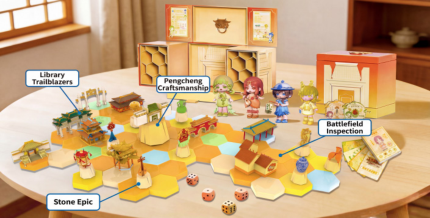
The story is set in the near-future Tianlu Pavilion Digital Cultural Archive, where a sudden data turbulence shatters the memory crystals carrying the civilization of Xuzhou’s Han Dynasties. Players take on the role of “Time Treasure Keepers,” tasked with traveling back two thousand years to Pengcheng to reconstruct historical memory. In the subsequent plot development, players progress through four chapters: “A-Bo’s Library Quest,” “Pengcheng Craftsmanship,” “Rallying the Troops,” and “Epic on Stone.” By interacting with virtual artifacts and historical scenes, they gradually uncover the deep connotations of Han culture. Specifically, in the museum scene, players assist in restoring fragments of artifacts like the S-shaped jade dragon pendant. In the bustling market streets, they experience paper sculpture and sachet making firsthand. On the ancient battlefield, they use troop cards to arrange formations and counter enemy forces. In the depths of a Han tomb, they interpret mythological stories on stone reliefs and engage in a cross- temporal dialog with the ancients (see Figure 6).
Figure 6: Game storyboard design.
Ultimately, through wisdom and collaboration, the players collect all the cultural fragments, synthesize a complete “Han Culture Memory Crystal,” and receive an exclusive completion certificate. In the process, they deeply comprehend the Han Dynasty’s value of “treating death as life” and its grand, enterprising spirit. This process not only transforms the experience from knowledge instillation to active exploration but also effectively stimulates the patriotism and cultural confidence of the youth.
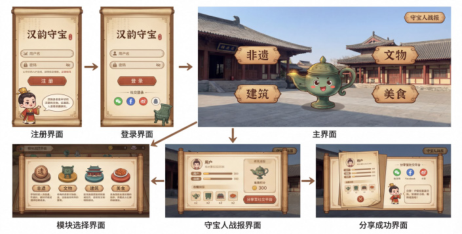
Chu-Han Treasure Keepers: AR Board Game Design Based on Cultural Translation Theory 117 To ensure the usability and inclusivity of the AR board game, the interface design must fully consider the device habits and cognitive load of the target users (youth and parent-child families) (Tompkins et al., 1978). For example, a playful and historical UI layout is adopted to maximize the AR viewing area. The mobile interface of this AR board game deeply integrates Han Dynasty esthetics with modern interaction logic (Huang et al., 2025). The main interface not only includes the basic game entry point but also features a cultural IP guide. Here, players can access four modules—ICH, artifacts, architecture, and cuisine—and generate a personalized “Treasure Keeper’s Report” to share on social media, enhancing both the fun of the game and social interaction and cultural dissemination among players (see Figure 7).
Figure 7: Main interface and social achievement system of the mobile AR App.
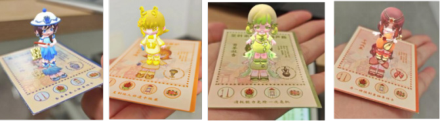
During the game’s interaction onboarding phase, the system establishes an intuitive “screen-as-lens” operational logic to help players quickly build a mapping relationship between physical cards and digital content. Before players enter segments like military formation or artifact restoration, the system provides dynamic guidance and error correction feedback. For instance, before a player begins an artifact restoration, a “Guardian Spirit’s Aid” prompt animation appears. This type of guidance design, which merges physical character cards with AR technology, compensates for the experiential shortcomings of purely virtual operations with the tangible feel of holding a card, while the dynamic prompts in the AR interface spark the player’s interest in restoring the artifact. Through a dual model of physical card operation and AR digital feedback, a fluid and engaging interactive experience is achieved (see Figure 8).
Figure 8: AR guidance design.
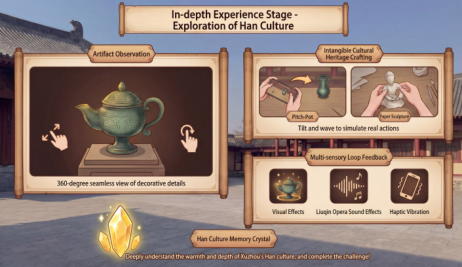
118 Qian and Chen In the deep experience phase, players interact with virtual artifacts through multi-modal interactions, completing various challenges to earn “Erudition Points (Zhang Y et al., 2025)” In the artifact observation segment, they use two-finger pinch-to-zoom and single-finger rotation gestures to examine intricate patterns, invisible to the naked eye, from a 360-degree perspective. In the ICH crafting segment, they utilize the phone’s accelerometer and gyroscope, simulating the real physical actions of Touhu (pitch-pot) or paper sculpting by tilting and waving the device. To enhance the depth and stickiness of the interaction, the system constructs a multi-modal sensory feedback loop. This mechanism coordinates visual-level particle effects for restoration, auditory-level Liuqin opera (an ICH) sound effects, and tactile-level linear motor vibrations to form a real-time “action-trigger → sensory-response → psychological-immersion” interactive circuit, effectively maintaining the player’s flow state during exploration (Liang et al., 2025). Building on this, the experience logic progresses from sensory stimulation to cognitive sublimation. Ultimately, upon completing all chapters, players not only obtain the complete Han Culture Memory Crystal but also deeply understand the connotations of Xuzhou’s Han Dynasty culture through embodied participation (see Figure 9).
Figure 9: Multi-sensory immersive feedback and embodied ICH interaction experience.
DISCUSSION AND LIMITATIONS This study explores the value of cultural translation theory in digital cultural and creative applications, confirming the key role of the “physical components + AR interaction” model in enhancing the effectiveness of cultural dissemination. The discussion indicates that the embodied interaction design at the behavioral layer is a core solution to the difficulty of conveying deep meaning. By using sensors to simulate the physical logic of actions like paper sculpting and pitch-pot, users can form profound muscle memory, an experiential learning method far superior to mere visual reception. Simultaneously, the contextualized AR narrative mechanism effectively bridges the gap between modern audiences and the historical spirit of the Han Dynasty, enhancing emotional engagement. The physical cards, acting as a connecting medium, retain the unique social ritual of board games while
Chu-Han Treasure Keepers: AR Board Game Design Based on Cultural Translation Theory 119 extending their information capacity through digital overlays. This model provides a design paradigm for regional cultural revitalization that is both entertaining and profound.
Limitations include the fact that current screen interactions cannot fully replicate the tactile feedback of real materials in ICH crafting (e.g., the texture of clay). Furthermore, holding a device for extended periods can cause fatigue. These aspects require further optimization in future research.
CONCLUSION
This project, based on cultural translation theory, constructed a “Material–Behavioral–Spiritual” three-tiered progressive model and successfully developed the Chu-Han Treasure Keepers AR board game. By digitally reconstructing artifacts from the Xuzhou Museum and ICH skills using AR technology, players interact with physical cards via a mobile device to complete artifact restoration and craft experiences in a virtual space. This virtual-real, embodied interaction not only breaks the static limitations of traditional displays but also stimulates users’ motivation for active exploration through gamified narratives, achieving deep transmission of cultural meaning and emotional resonance. It validates the effectiveness of this design model in the revitalization of regional culture.
Future work will focus on optimizing the recognition stability and rendering precision of the mobile AR, introducing more natural gesture interactions and haptic feedback to enhance the fluidity of the immersive experience. Additionally, we will further expand the application boundaries of the cultural translation model, exploring its universality in the commercialization of cultural products and cross-cultural communication, thereby providing more sustainable solutions for the digital preservation of cultural heritage.
REFERENCES
Cheng, X., & Ding, Z. (2024). Board Game Product Design Based on the ATMSG Framework. Design Arts Research, 14(06), pp. 77–83. General Office of the CPC Central Committee & General Office of the State Council.
(2022). Opinions on Promoting the Implementation of the National Cultural Digitalization Strategy. Radio & TV Network, 29(06), p. 6. Guo, Q., Zhao, C., Du, P., et al. (2023). Research on the Patriotic Education Model of University Libraries—A Case Study of the Xuzhou Historical and Cultural Activity Month for University Students. Library and Information Service, 67(23), pp. 58–68. Huang, Y., & Shi, C. (2022). A Preliminary Exploration of the Han Culture
Geographical Study Tour Course in Xuzhou City. Teaching Reference for Middle School Geography, (06), pp. 87–88, 91. Huang, Y. T., Hsu, C. C., & Wang, T. H. (2025). Effects of Interactive Loading Interfaces for Virtual Reality Game Environments on Time Perception, Cognitive Load, and Emotions. Frontiers in Virtual Reality, 6, p. 1540406. Liang, C., Zhi, J., Su, C., et al. (2025). A Study on the Effects of Embodied and
Cognitive Interventions on Adolescents’ Flow Experience and Cognitive Patterns. Behavioral Sciences, 15(6), p. 768.
120 Qian and Chen Liang, Y. C., Lin, H. C. K., & Lin, Y. H. (2022). “The Effectiveness of Incorporating
Augmented Reality Board Game into Temple Culture”, in: Proceedings of the International Conference on Innovative Technologies and Learning, Cham: Springer International Publishing, pp. 454–460. Liu, J., Huang, Y., & Lee, J. (2025). “Game-Based Learning for Autism: A Tabletop Approach to Theory of Mind”, in: Proceedings of the European Conference on Games Based Learning, Academic Conferences International Limited, Vol. 2, pp. 1084–1090. Liu, J., Lo, C. H., & Wei, J. (2025). “Designing Augmented Reality-Based Tools
for Enhancing Children’s Art Learning of Intangible Cultural Heritage”, in: Proceedings of the International Conference on Human-Computer Interaction, Cham: Springer Nature Switzerland, pp. 114–127. Luo, X., & Deng, L. (2024). Tourism and Cultural Creative Design of Shanxi Wenxi Huamo Based on Cultural Translation Method. Design, 37(23), pp. 16–20. Ma, S., & Chu, X. (2025). Discussion on the Application of AR Technology
Empowering Cultural and Creative Design—A Case Study of Traditional Brewing Techniques in Lianma Town, Conghua. Art Education, (19), pp. 221–224. Ministry of Culture and Tourism of the People’s Republic of China. (2025). “The ‘Fourteenth Five-Year Plan’ for Cultural Development.” Digital Communication, (07), p. 2. Pyae, A. (2018). Understanding the Role of Culture and Cultural Attributes in Digital
Game Localization. Entertainment Computing, 26, pp. 105–116. Qiu, C. (2020). A Study on the Construction of Urban Visual Identity and Wayfinding Systems in the Context of Han Culture—A Case Study of the Historical and Cultural City of Xuzhou. Journal of Nanjing Arts Institute (Fine Arts & Design), (01), pp. 148–150. Sharma, W., Lim, W. M., Kumar, S., et al. (2024). Game on! A State-of-the-Art
Overview of Doing Business with Gamification. Technological Forecasting and Social Change, 198, p. 122988. Shih, N. J., Chen, H. X., Chen, T. Y., et al. (2020). Digital Preservation and Reconstruction of Old Cultural Elements in Augmented Reality (AR). Sustainability, 12(21), p. 9262. Tompkins, B. M., & Olejnik, A. B. (1978). Children’s Reward Allocations: The
Impact of Situational and Cognitive Factors. Child Development, pp. 526–529. Xu, X. (2025). Research on Bionic Modeling Design of Table Lamps Based on the Translation of Fu-Lu Cultural Symbols. Packaging Engineering, pp. 1–16. Zhang, Y., Xie, D., Luo, D., et al. (2025). Modality Emotion Semantic Correlation
Analysis for Multimodal Emotion Recognition. Computers and Electrical Engineering, 126, p. 110467. Zhu, Y., Ye, J., & Tang, C. (2025). Exploration of Digital Art Design of She Ethnic Patterns from the Perspective of Cultural Symbol Translation. Design, 38(01),
LISTED IN THE AHFE DIGITAL BOOKSTORE CATALOGUE
Explore the complete digital volume
Metaverse, Virtual Environments and Game Design
Read this individual research paper free through the original publisher, or explore the full digital proceedings book.
ISBN 978-1-964867-93-9
Explore this ISBN in the AHFE Bookstore ↗Listed in the July 2026 bookstore catalogue; search by ISBN to confirm current availability · Digital book purchase optional