Yunxiang Li (2026). Digital UI Design for Intangible Cultural Heritage: Cultural Translation and Emotional Design in Jiayi Village, Xinjiang. In: Affective and Pleasurable Design. AHFE Open Access, vol. 204, pp. 289–299. https://doi.org/10.54941/ahfe1007355
Jiayi Village in Xinqu County, Aksu, Xinjiang, is a core heritage village for the ancient Kucha music culture. The craftsmanship of Uyghur musical instrument making was included in the National Intangible Cultural Heritage List in 2008, with more than one-third of households engaged in instrument production and performance, forming a mature system of folk craftsmanship inheritance. However, existing digital dissemination forms are singular and severely homogenized, failing to modernize the deep cultural core of Kucha music, instrument patterns, and the spirit of craftsmanship. Young users find it difficult to achieve genuine emotional resonance and deep cultural identification. Meanwhile, the average age of core inheritors exceeds 65 years, craftsmen lack lightweight online display channels, and tourists lack engaging online interactive pathways. There is an urgent need to meet the demands for youthful, emotional communication of traditional intangible cultural heritage. This study adopts Cultural Translation Theory as the core framework, supported by Emotional Design Theory, targeting the dual user groups of craftsmen and tourists. By systematically deconstructing the symbolic patterns, musical characteristics, and cultural essence of Jiayi Village instruments, a hierarchical intangible cultural heritage translation system is established, facilitating a complete design logic of cultural extraction, symbolic translation, emotional empowerment, and experiential implementation. Drawing on instrument patterns and the regional culture of the Western Regions, the study innovates a unique visual IP system featuring Jiayi Grandpa, transforming traditional heritage elements into youthful and lightweight visual interactive symbols. By integrating Emotional Design across the instinctual, behavioral, and reflective layers, cultural symbols are incorporated into the UI and interaction systems, effectively bridging the distance associated with traditional heritage and addressing the lack of emotional resonance, while meeting the dual needs of craftsmen for digital operation and tourists for engaging experiences. At the system design level, this study creates a digital UI system integrating cultural education, engaging interaction, craftsman operation, and cultural product dissemination, specifically addressing superficiality of heritage transmission, singular experiences, and insufficient functional adaptation. On one hand, it builds a low-threshold online platform for craftsmen, resolving practical challenges in skill demonstration and work promotion. On the other hand, it crafts immersive interactive scenarios for tourists, deepening cultural understanding and emotional identification to promote the dynamic inheritance of rural intangible cultural heritage. The dual user-layered functional design accurately matches the differentiated needs of craftsmen and tourists, enhancing user enjoyment through engaging interactions, emotional visuals, and contextual experiences. To verify the practicality, rationality, and emotional experience value of the design, specialized experiential testing and questionnaire surveys were conducted with dual user groups. Core evaluation dimensions include visual presentation, interaction fluency, cultural accuracy, emotional enjoyment, and functional adaptability, assessed through the System Usability Scale (SUS) and semi-structured interviews. Results indicate that over 85% of participants believe the design effectively enhances the interestingness and appeal of heritage content, with significant improvements in cultural cognition and emotional identification. Craftsman users reported straightforward and practical operation, while tourist users experienced a notable increase in emotional enjoyment during immersive interactions. This study validates the feasibility of integrating Cultural Translation Theory and Emotional Design Theory in rural heritage digital design, providing new ideas and practical references for the youthful, emotional dissemination of traditional intangible cultural heritage.
Digital cultural and creative design serves as a crucial pathway for the living inheritance of Intangible Cultural Heritage (ICH). By reconstructing traditional cultural expressions through modern design methodologies, it effectively bridges the temporal gap in traditional folk culture, narrows the distance between younger generations and ICH, and strengthens public cultural identity and the sense of value belonging. In 2022, the General Offices of the Communist Party of China Central Committee and the State Council issued the Opinions on Advancing the Implementation of the National Cultural Digitization Strategy, explicitly calling for the promotion of digital Received June 4, 2026; Revised June 22, 2026; Accepted June 27, 2026; Available online July 20, 2026
290 Li protection and innovative dissemination of ICH. This policy provides macro- context and directional guidance for this study. Against the broader industry backdrop of rural cultural revitalization and the digital upgrading of ICH, digital creativity has emerged as a core driver for activating rural characteristic ICH resources (Zhong, 2026). This study takes Jiayi Village in Xinhe County, Xinjiang—located in the heart of the ancient Kucha cultural region and renowned as the “First Village of Folk Instrument Making in Xinjiang”—as its research site. The Uyghur instrument-making craftsmanship of this village was inscribed on the National List of Intangible Cultural Heritage in 2008. Rooted in the millennia-old Kucha music and dance system, it serves as a vital technical carrier for the inheritance of the Muqamart. Leveraging the resources of the 4A-rated Tianlai Jiayi scenic area, the village has established a mature “ICH + Cultural Tourism” development model, providing a high- quality cultural foundation and practical scenario for this research. Adopting a dual theoretical framework that prioritizes cultural translation as the primary theory and emotional design as the auxiliary theory, this study deconstructs ICH resources using the three-tier architecture of cultural translation (surface, middle, and deep layers). Simultaneously, it implements the design based on the three-tiered experiential logic of emotional design (instinctive, behavioral, and reflective levels), thereby addressing the core drawbacks of superficiality and lack of empathy prevalent in traditional cultural and creative products.
The current digitalization efforts for the intangible cultural heritage of musical instruments in Jiayi Village face numerous shortcomings. Existing dissemination mainly relies on general platforms to output superficial content, lacking adequate exploration and innovative translation of deeper cultural elements such as the melodies of Kucha, the craft of instrument-making, and the spirit of artisans. Furthermore, the forms of communication are monotonous and lack interactivity, making it difficult to spark a deep cultural resonance among users, and they do not meet the immersive experience needs of the younger generation. The local heritage transmission ecosystem is concerned, with the average age of core transmitters exceeding 65 years, resulting in severe aging and loss of young talent, which creates a gap in the transmission of skills. Artisans generally lack digital operation capabilities, and their business models are limited to offline activities. Currently, there are no dual-end digital products tailored for both tourists and artisans, failing to balance the lightweight cultural experience for the public with the online dissemination and operational needs of artisans. This severely restricts the sustainable dissemination and active transmission of Jiayi Village’s musical instrument heritage. (Yang, 2025).
In light of the cultural characteristics of the intangible cultural heritage (ICH) of Jiayi Village and the existing pain points in digital dissemination, this study establishes three core research questions to guide targeted design practices: First, how can we rely on a three-tiered cultural translation system to systematically deconstruct cultural resources such as the instrument patterns, handicrafts, and Kucha musical scales of Jiayi Village, breaking through the limitations of traditional cultural and creative surface design to achieve modern visual innovation and reconstruction of Western musical ICH? Second, how can we leverage the three-tier theory of emotional design to accurately match the differentiated needs of artisans’ business
Digital UI Design for Intangible Cultural Heritage: Cultural Translation 291 development and tourists’ cultural experiences, optimizing visual interfaces and interaction logic to construct a heritage experience system that offers high levels of enjoyment and adaptability? Third, how can we create a youthful heritage dissemination model by building original ICH intellectual property and digital interaction platforms, breaking down regional communication barriers to achieve regular and vibrant transmission of rural musical ICH (Liu and Zhao, 2026)?
Although Jiayi Village has high-quality cultural heritage resources in the form of Kucha musical instruments, it faces several challenges, including superficial cultural exploration, a limited diversity of dissemination methods, a lack of digitally adaptable products for both ends, and a gap in the inheritance of talent. These issues significantly hinder the revitalization and living transmission of intangible cultural heritage among younger generations.
RELATED WORK
Application of Cultural Translation in Design In the context of traditional culture empowering the rapid development of the digital economy, the theory of cultural translation has been widely applied in the field of innovative design, with numerous scholars exploring diverse applications around different cultures. Nie Hong and Shi Mingyuan, relying on a three-tier system of cultural translation encompassing material, behavior, and spirit, combined lightweight digital cultural creative design techniques to achieve innovative digital transformation of Miao embroidery patterns, thereby demonstrating the application value of hierarchical translation in the digital design of intangible cultural heritage (Nie and Shi, 2023). Xu Zixuan took the Hami Mukam intangible cultural heritage as her research object and constructed a design framework of “Authenticity Extraction - Modern Translation - Technological Empowerment.” She deconstructed the trinary structure of Mukam—”Music - Movement - Visual”—to extract instrumental forms and ethnic decorative patterns, thereby facilitating innovative design in the cultural creative sector of intangible heritage and enhancing the translation practice paths for intangible cultural heritage related to ethnic songs and dances (Xu, 2025). The existing methods of digital translation and visual design can provide support for the modernization of intangible cultural heritage. However, current research generally exhibits a tendency to focus on superficial visual transformation while neglecting deeper cultural exploration, lacking integration of emotional experience and UI interaction. Therefore, integrating cultural translation with emotional design presents significant innovative value for the digital interaction design of intangible cultural heritage.
Research Related to Emotional Design As the experience economy and digital technologies advance, users’ demands for digital products related to intangible cultural heritage (ICH) have gradually evolved into immersive emotional experiences. Emotional design, with its unique advantages in enhancing user sensory experiences, deepening cultural cognition, and building emotional connections, has become an important means of innovative design for digital products and the dissemination of
292 Li ICH (Norman, 2004). Hu Xueyan and Li Ya, based on the three-tier theory of emotional design, focus on cultural creative products in accessories. They construct a progressive emotional experience system through visual forms at the instinctive level, interactive experiences at the behavioral level, and cultural narratives at the reflective level. Their findings confirm that emotional design can effectively build emotional bonds between people and culture, enhancing the emotional added value and user stickiness of cultural creative products (Hu and Li, 2026). Zeng Zijing applies the three-tier theory of emotional design to public visual design, optimizing appearance forms according to users’ psychological and emotional characteristics, alleviating aesthetic fatigue and experience anxiety among audiences, and providing a universal design approach for the emotional grounding of cultural carriers (Zeng, 2022). Existing research has demonstrated that emotional design can effectively enhance the user experience and cultural identity of intangible cultural heritage in digitalization. However, many studies focus on its standalone application and lack a deep integration with cultural translation systems, leading to a research shortcoming characterized by a disconnect between experience and culture. Therefore, a dual-theoretical coupling design can achieve a bidirectional empowerment of cultural expression and emotional experience, representing a significant breakthrough for the innovation of intangible cultural heritage digitalization.
Current Status of Digitalization of Intangible Cultural Heritage Currently, the digitalization of intangible cultural heritage (ICH) in China is continuously advancing. Preliminary efforts utilizing digital archiving and cloud storage methods have achieved some degree of resource preservation and dissemination. Researchers Wang Keping and Fu Huayu, based on the context of intelligent empowerment and the theory of information ecology, focus on the intelligent transformation of ICH museums. They explore the core elements of resources, users, curators, spaces, and technology, proposing multi-dimensional transformation paths such as resource-wise interconnection, personalized immersive experiences, and technological ecological empowerment, thus providing a macro theoretical foundation and systemic construction ideas for the intelligent construction of ICH digitalization (Wang and Fu, 2026). The aforementioned studies have provided ample theoretical basis and practical references for the innovation of ICH digital products from various dimensions, including technological empowerment, systemic construction, and experiential upgrades. The industry is characterized by a prevailing situation of “heavy on archiving, light on practical application; heavy on resources, light on experience.” Most outcomes remain limited to static displays, lacking deep interaction and experiential innovation (Othman, Ahmad, Ibrahim, Sa’ari, Mat Kamal and Darami, 2021). The existing digital products for intangible cultural heritage (ICH) generally focus on meeting the cultural experience needs of the general public, while neglecting the core demands of artisans for inheritance and management. They lack a differentiated service system for both ends. Therefore, this study aims to construct an interactive system for dual user
Digital UI Design for Intangible Cultural Heritage: Cultural Translation 293 ends, effectively addressing the shortcomings of the industry and providing new practical approaches for the living inheritance of rural intangible cultural heritage digitalization.
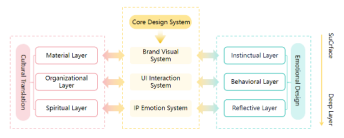
DESIGN STRATEGIES BASED ON CULTURAL TRANSLATION AND EMOTIONAL DESIGN This research constructs a dual theoretical framework for the UI interaction design strategy of intangible cultural heritage (ICH) musical instruments, primarily based on cultural translation and supplemented by emotional design. At its core, the framework uses the cultural disassembly and transformation logic of the material, organizational, and spiritual layers of cultural translation, ensuring the precise extraction, transformation, and implementation of cultural elements from ICH musical instruments while safeguarding the professionalism and integrity of cultural expression. Meanwhile, the framework employs the experiential logic of the instinctive, behavioral, and reflective layers of emotional design as its experiential core, optimizing user visual perception, operational interaction, and emotional resonance. This approach solidifies the cultural foundation of the design through cultural translation and empowers the user experience through emotional design, creating a bi-directional complementarity and deep coupling. It effectively addresses the issue of superficial cultural expression in traditional ICH design and the lack of emotional empathy, aligning with the development needs of ICH digital revitalization design.
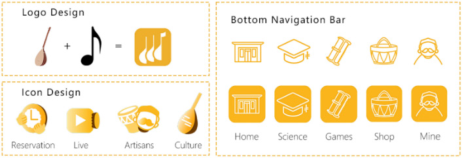
Surface-Level Translation: Instinctive Layer Adaptation Design for ICH Visual Symbols The material layer of cultural translation corresponds to the instinctual level of emotional design, relying on intangible cultural heritage visual symbols to shape users’ aesthetic appreciation and cultural cognition. This study names the app “Hubo,” derived from the traditional nomadic instrument “Hubo Si,” using imagery of sound waves to resonate with the dynamic rhythm of the musical instruments and their cultural implications. The brand logo distils the silhouette of the Dutar instrument and musical notes, employing a three-layer progressive visual structure, and utilizes a warm yellow colour palette paired with white lines, aligning with the characteristics of the local culture to enhance brand recognition. The interface function icons maintain consistency with the main visual system, simplifying and refining cultural symbols such as ethnic architecture, folk instruments, artisans, and musical items, to adapt to the core functional modules of the platform. The interaction states are differentiated through colour and line transitions. The overall visual design integrates ethnic cultural symbols into a modern interface, achieving an organic fusion of intangible cultural heritage with visual experiences at the instinctual level, effectively enhancing users’ aesthetic experience and cultural perception.
294 Li Mid-Level Translation: Optimization Design of Behavioural Layer for Dual-End Interaction Process
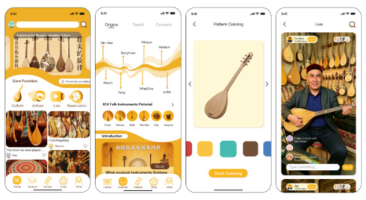
The mid-level cultural translation corresponds to the emotional design behavioural layer, relying on lightweight and human-centric interaction design to achieve a deep integration of user interaction behaviours with the perception of intangible cultural heritage. The platform optimizes the operational system for both end users, providing general users with simple operations such as swipe browsing, engaging interactions, and community communication, which facilitates an immersive understanding of the instrument-making process and lowers the cognitive threshold for appreciating intangible cultural heritage. For artisans, it simplifies the operational processes for publishing works, listing products, and live streaming educational content, establishing an efficient online transmission and business operation path. The overall interaction is simple and smooth, avoiding the cumbersome operations and rigid experiences typical of traditional intangible cultural heritage platforms. This design allows both end users to perceive the charm of intangible cultural craftsmanship through natural and fluid interactions, achieving a bidirectional integration of behavioural interaction experiences and cultural experiences.
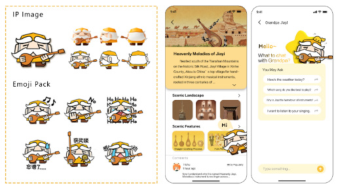
Deep-Level Translation: Reflective Layer Sublimation Design for ICH Spiritual Empathy The deep cultural translation corresponds to the reflective layer of emotional design, focusing on uncovering the spiritual core of intangible cultural heritage and building lasting emotional connections with users. The craft of Jiayi instrument making embodies the local folk traditions and the dedication of artisans to uphold and refine their craft, serving as the essence of the active transmission of intangible cultural heritage. This study uses local earthen sculptures as prototypes to create the exclusive IP of “Grandpa Jiayi,” capturing the authentic portrayal of local artisans who are deeply engaged in instrument making and committed to passing down their skills. The platform leverages this IP as an intelligent assistant, disseminating knowledge about the history of musical instruments, the manufacturing processes, and the culture of Kucha music through engaging human-computer Q&A interactions. This approach breaks the limitations of traditional static displays, guiding users to deeply perceive the cultural value of intangible heritage, awakening public recognition of traditional handicrafts, and fostering lasting cultural memory and emotional resonance. Ultimately, it aims to achieve the in-depth dissemination of the spirit of intangible cultural heritage, facilitating its active transmission and the cultivation of cultural confidence.
In summary, this study integrates cultural translation and emotional design to construct a hierarchical digital design strategy for intangible cultural heritage (ICH). It considers the needs of users from both ends, effectively addressing the issues of superficial digitization and singular experiences in traditional ICH. This provides a practical design foundation for the vibrant and sustainable transmission of the Gaya musical instrument heritage.
SYSTEM IMPLEMENTATION AND USER EXPERIENCE WORKFLOW The complete digital experience of intangible cultural heritage follows the cognitive patterns of users from the surface to the core, progressing from shallow to deep understanding. It adheres to the logic of “initial visual recognition—deepening interaction—spiritual empathy.” Based on this, the digital system for intangible cultural heritage instruments constructed in this study comprises three core modules: a brand visual system, a dual- end UI interaction system, and a meticulous IP emotional system. Users’ understanding of the product begins with intuitive visual impressions, establishing initial cultural perception through distinctive brand visuals. This is then followed by differentiated UI interactions that allow for deeper engagement with the intangible heritage experience and digital operations. Ultimately, supported by the emotional empowerment of the meticulous IP, users achieve deep empathy with the core spirit of the intangible heritage, creating a complete closed-loop experience that encompasses external perception, practical engagement, and internal recognition.
Visual Foundation: Cognitive Paving Design for the Brand Visual System The brand visual system serves as the first point of contact for users with the product, playing a crucial role in the initial cultural transmission and brand recognition. Built upon the cultural foundation of Xinjiang’s intangible heritage instruments, the exclusive “Hubo” brand visual system organically integrates the unique characteristics of Xinjiang’s ethnic culture with modern mobile adaptability. This approach avoids the cumbersome and heavy visual issues often associated with traditional intangible heritage design, allowing users to intuitively perceive the regional features and cultural tone of Jiayi instruments the moment they open the product. This enables them to quickly establish a distinct brand awareness, laying a visual foundation for subsequent in-depth experiences.
Figure 2: Brand visual system.
After users establish a fundamental visual cognition, they can enter a deep experience scenario through the platform’s lightweight UI interaction, achieving an upgrade from passive viewing to active participation. The platform supports general users in quickly completing operations such as browsing intangible cultural heritage, appreciating skills, engaging in fun interactions, and community communication, with a simple and low-threshold operational logic and clear interface hierarchy. By relying on immersive and emotional design, it lowers the cognitive threshold for intangible cultural heritage and enhances user experience and enjoyment. At the same time, the platform balances the developmental needs of both ends, building a dedicated digital operation system for artisans. Unlike general entertainment interfaces, the artisan interface focuses on efficiency and practicality, simplifying the entire process of content publishing, product listing, live explanations, and order management, thereby reducing the learning cost of digital operations. This enables artisans to regularly carry out online skill dissemination and commercial activities, achieving a dual empowerment of intangible cultural heritage dissemination and income increase for artisans.
Figure 3: UI interaction system.
The Spiritual Uplift: Emotional Empathy Construction of the Craftsmanship IP System The deep cultural translation corresponds to the reflective layer of emotional design, focusing on uncovering the spiritual core of intangible cultural heritage (ICH) and constructing long-lasting emotional resonance with users. The craftsmanship of Jia Yi instruments embodies the local folk traditions and the dedication of artisans who strive for excellence and uphold the spirit of inheritance, serving as the essence of the living transmission of ICH. This study uses local earthen sculptures as prototypes to create an exclusive IP called “Grandfather Jia Yi,” which reflects the authentic portrayal of local artisans’ dedication to the craft of instrument making and their commitment to preserving intangible cultural heritage. The platform utilizes this IP as an intelligent assistant to popularize the history of instruments, production techniques, and the culture of Qiuci music through engaging human- computer Q&A formats. It breaks away from traditional static and rigid
Digital UI Design for Intangible Cultural Heritage: Cultural Translation 297 display methods, guiding users to move beyond superficial experiences and deeply perceive the cultural values behind the intangible heritage. This approach aims to awaken public recognition of traditional craftsmanship, accumulate lasting cultural memories and emotional resonance, and achieve a deep transmission of the spirit of intangible cultural heritage at the reflective level, contributing to the living transmission of ICH and the cultivation of cultural confidence.
Figure 4: ‘Grandpa Jiayi’ craftsmanship IP system.
Process Closed Loop: Overall Sorting of Hierarchical Experience System In summary, this chapter completes a comprehensive user experience loop of ‘Visual Cognition–Dual-End Interaction–Spiritual Empathy’ for the digitalization of intangible cultural heritage (ICH). Through the brand visual system, an initial visual output of ICH culture is achieved. Relying on differentiated interaction design between the general public and artisans, it addresses the dual pain points of superficial communication of ICH culture for ordinary users and the difficulties in showcasing artisan skills and promoting their works. Lastly, the craftsmanship IP emotional system facilitates deep empowerment and emotional elevation of cultural spirit. The three-layered system progresses step by step and supports each other, ensuring the systematic display of ICH culture while accommodating the core usage needs of different user groups. This effectively compensates for the shortcomings of traditional ICH digital products, which often have a singular experience and insufficient user adaptability, thereby providing comprehensive process support for the vibrant digital inheritance of Jiayi musical instruments.
DISCUSSION AND LIMITATIONS This study involved 24 public users and artisans of intangible cultural heritage (ICH) in dual-user experience testing. Baseline research indicates that most users have a weak awareness of Jia Yi musical instruments, validating the sample’s effectiveness. The research combines the System Usability Scale (SUS) and interviews to comprehensively assess five dimensions, achieving a product SUS score of 83.6, which meets the standard of excellent usability. Among the
298 Li participants, 91% recognized that the design effectively combines cultural authenticity with modern aesthetics, while 87% believed that immersive interactions significantly lower the cognitive barriers to understanding ICH (Brooke, 1996).The testing results demonstrate that the integration of dual theoretical frameworks in the design, along with the original “Grandfather Jia Yi” IP, can effectively address the shortcomings of traditional ICH design, such as superficiality, limited experience, and insufficient adaptability for both ends. This provides an effective reference for the dynamic and youthful dissemination of ICH.
User experience testing and practical outcomes have fully validated the effectiveness of this research. The study relies on a three-tier cultural translation system to reconstruct the visual and cultural expressions of intangible cultural heritage (ICH), addressing issues of superficiality and outdated visuals in traditional ICH design. By integrating emotional design to cater to the needs of both ends of the user spectrum, it balances the public’s interest in cultural experiences with the digital operational needs of artisans, thereby establishing a highly compatible interactive system. Furthermore, this research leverages the original “Grandfather Jia Yi” IP to create a lightweight and youthful dissemination model that transcends the geographical and channel limitations of ICH, effectively promoting the digital and dynamic transmission of Jia Yi musical heritage.
This study has certain limitations. The coverage of the test sample is limited, and the evaluation is based on a short-term simulation, lacking long-term real usage data. Furthermore, due to the constraints of mobile development conditions, there is still room for optimization in some interaction features, and device adaptation is not yet comprehensive. These factors clarify the direction for subsequent iterations and in-depth research of this study.
ACKNOWLEDGMENT
This paper, based on the dual theories of cultural translation and emotional design, establishes a dual-sided interactive platform aimed at both general tourists and artisans of intangible cultural heritage (ICH). It progressively constructs a digital experience system for ICH, effectively addressing challenges such as the superficial transmission of rural musical ICH, geographical limitations, and difficulties in digital inheritance. User testing results indicate that the platform design has gained recognition from both user groups, and the original IP representation resonates deeply with them, thoroughly validating the feasibility and practical value of integrating these dual theories into the digital design of rural intangible cultural heritage.
Future research will aim to optimize the limitations of this study, such as technical adaptation and insufficient sample coverage. Additionally, efforts will be made to enrich the knowledge base of intangible cultural heritage and introduce engaging interactive scenarios, deepening users’ cultural understanding and emotional connections, thereby further improving the living inheritance system for the digitalization of rural intangible cultural heritage.
REFERENCES
Brooke, J. (1996). SUS: a “quick and dirty” usability scale. In: Usability Evaluation in Industry, Jordan, P.W., Thomas, B., Weerdmeester, B.A., McClelland, A.L. (Eds.). pp. 189–194. Taylor & Francis. Hu, X., Li, Y. (2026). Application of emotional design in accessory cultural and
creative products. Masterpieces of Nature, (10), 89–92. Liu, G., Zhao, S. (2026). Rural cultural revitalization in the new era: theoretical basis, realistic dilemmas and practical paths. Journal of Chongqing University of Arts and Sciences (Social Science Edition), 1–10. Nie, H., Shi, M. (2023). Digital cultural and creative design of Miao embroidery
patterns based on cultural translation. Design, 36(18), 106–109. Norman, D.A. (2004). Emotional design: Why we love (or hate) everyday things.
New York: Basic Books. Othman, R., Ahmad, M., Ibrahim, O., Sa’ari, H., Mat Kamal, S.N., Darami, A.I.
(2021). Overview of UX-UI via virtual reality project in preserving the intangible cultural heritage of Negeri Sembilan, Malaysia. In: 2021 IEEE 9th Conference on Systems, Process and Control (ICSPC ‘21), pp. 180–185. IEEE. Wang, K., Fu, H. (2026). Theoretical reflection and path research on smart transformation of intangible cultural heritage museums empowered by digital intelligence. Library and Information Service, 1–10. Xu, Z. (2025). Practice and research on empowering innovative design of cultural
and creative products with Hami Muqam intangible cultural heritage elements [Master’s thesis, Chongqing Technology and Business University]. Yang, S. (2025). Construction of Shilin Yi Sani traditional music database under the digital background. Art Panorama, (29), 148–150. Zeng, Z. (2022). Research on emotional design of subway appearance modeling.
Design, 35(15), 144–146. Zhong, Y. (2026, May 14). Research on the revitalization and utilization of regional intangible cultural heritage cultural and creative products from the perspective of cultural translation. Xinxiang Daily, p. 003.
LISTED IN THE AHFE DIGITAL BOOKSTORE CATALOGUE
Explore the complete digital volume
Affective and Pleasurable Design
Read this individual research paper free through the original publisher, or explore the full digital proceedings book.
ISBN 978-1-964867-80-9
Explore this ISBN in the AHFE Bookstore ↗Listed in the July 2026 bookstore catalogue; search by ISBN to confirm current availability · Digital book purchase optional