Yu Hu, Que Yuan, Xinyi Wang (2026). Digital Interaction Design for Mianzhu New Year Painting: Enhancing Cultural Heritage Engagement through Mobile Applications. In: Human Factors in Communication of Design. AHFE Open Access, vol. 216, pp. 86–98. https://doi.org/10.54941/ahfe1007627
This study develops and evaluates a digital interaction design approach for enhancing engagement with Mianzhu New Year Painting, an intangible cultural heritage of China. Adopting a research-through-design approach, we created an interactive framework through participatory workshops involving cultural practitioners and target users. The application integrates gesture-based interactions aligned with traditional craft techniques, along with structured cultural content inspired by symbolic motifs. A mixed-methods evaluation with 300 participants assessed usability, knowledge retention, and emotional engagement. Results indicate that the interactive interface significantly improved users' understanding of craft techniques and strengthened their emotional connection to the heritage compared to conventional display methods. The prototype demonstrates how mobile interaction design can create immersive, culturally-grounded digital experiences. This study highlights the potential of digital interaction design as an effective strategy for revitalizing cultural heritage, offering transferable design principles for similar contexts.
Background and Significance Craft has always been a mirror of societal evolution (Costin, 1998). However, in the modern era, traditional crafts like Mianzhu New Year Painting face significant challenges from globalization, urbanization, and changing consumer behaviors, leading to their decline (Lemire, 2018; Yuan et al., 2024). In contrast, the growing interest in sustainability and cultural preservation presents a unique opportunity for revitalization (Gibbons, 2020; Roseland, 2000). Mianzhu New Year Painting, with its vibrant colors, symbolic imagery, and deep cultural roots, embodies the potential to catalyze such regenerative practices (Liu, 2012). This study argues that the integration of traditional crafts into contemporary design practices is essential for their survival and relevance in the 21st century.
Digital Interaction Design for Mianzhu New Year Painting: Enhancing Cultural Heritage 87 Research Objectives
The primary objective of this study is to explore the potential of revitalizing Mianzhu New Year Painting through the integration of digital tools and participatory design. Specifically, the research seeks to: 1 Investigate how this traditional art form can be preserved and adapted to meet the needs and preferences of contemporary audiences without compromising its authenticity. 2. Propose a systematic framework that combines traditional craft techniques with modern design methodologies, including digital narrative, augmented reality (AR), and user-centered design. 3. Evaluate the cultural, social, and economic benefits of integrating Mianzhu New Year Painting into regional development strategies, with a focus on sustainable tourism, educational applications, and creative industries.
Through these objectives, the study aims to contribute to the broader discourse on the role of crafts and cultural heritage in sustainable development and regional regeneration.
Research Questions To achieve the above objectives, this study addresses four research questions:
1. How can traditional crafts like Mianzhu New Year Painting leverage digital tools (AR, VR, interactive apps) to remain relevant and accessible in the digital age? 2. What role does user participation play in craft revitalization? How can participatory design approaches involving communities, artists, and users enhance the transmission and innovation of Mianzhu New Year Painting? 3. How can the cultural narratives embedded in Mianzhu New Year Painting be effectively communicated to modern audiences while balancing authenticity with contemporary relevance? 4. What are the socio-economic implications of integrating traditional crafts into cultural tourism and creative industries, and how can these practices contribute to regional revitalization and cultural identity preservation?
LITERATURE REVIEW
Intangible Cultural Heritage and Digital Preservation Key Theories and Methods in Preserving Cultural Heritage
Intangible cultural heritage (ICH), as defined by UNESCO, encompasses practices, knowledge, and skills that communities recognize as part of their cultural heritage (Scovazzi, 2012). ICH is inherently dynamic, requiring approaches that go beyond physical safeguarding to focus on the active
transmission of traditions and community participation (Eichler, 2020; Lenzerini, 2011). Digital preservation has emerged as a significant tool for safeguarding ICH, with methods such as high-resolution imaging, 3D scanning, and digital narrative enabling the documentation and accessible dissemination of craft techniques and cultural performances (Tribhuvan & Abdullah, 2025). l crafts, creating a bridge between heritage practitioners and modern consumers.
Comparative Analysis of Similar Efforts Worldwide Globally, various initiatives have demonstrated the potential of digital tools in preserving ICH, including Japan’s digitization of Noh theater, India’s textile archives linked to e-commerce, and South Korea’s AR/VR-based intangible cultural assets archive (Beng & Iezzi, 2022; Anshu et al., 2019; Kim et al., 2019).
Intangible Cultural Heritage and Digital Preservation Case Studies of Craft-Based Regional Development
Craft-based regional development has been widely recognized as an effective strategy for revitalizing local economies and cultural identities by leveraging intangible cultural heritage to foster sustainable tourism and creative industries. Notable examples include Japan’s Arita porcelain revival through designer collaborations (Zhang & Tan, 2024), India’s Jaipur block-printing transformation integrating craft education and tourism (Dutta, 2023), and China’s Mianzhu New Year Painting Village combining traditional production with immersive visitor experiences.
Intersection of Cultural Tourism, Creative Industries, and Community Engagement The integration of cultural tourism, creative industries, and community engagement represents a holistic approach to regional revitalization (Kalfas et al., 2024). Community engagement, particularly through participatory design methods, enables artisans to collaborate with designers and policymakers, fostering ownership and ensuring that revitalization efforts align with local needs and aspirations (Mazzarella et al., 2017).
The Role of Digital Tools in Craft Innovation AR, VR, and 3D Modeling in Craft Revival
Digital tools such as AR, VR, and 3D modeling have revolutionized the preservation and experience of traditional crafts. AR enables interactive educational experiences through digital overlays (Partarakis et al., 2020), VR offers immersive environments for virtual workshops and process simulations (Zhang et al., 2024), and 3D modeling supports precise digital replicas for education, exhibitions, and modern reinterpretations (Zabulis et al., 2023).
Digital Interaction Design for Mianzhu New Year Painting: Enhancing Cultural Heritage 89 User-Centered Design for Enhancing Cultural Experiences
User-centered design plays a pivotal role in ensuring that digital tools effectively meet the needs and expectations of diverse audiences, emphasizing accessibility, engagement, and personalization in craft revival projects (Olsson, 2012).
METHODOLOGY
This study adopts a mixed-method approach, combining qualitative, quantitative, and design-based research to explore the revitalization of Mianzhu New Year Painting through theoretical analysis, empirical data collection, and design prototyping.
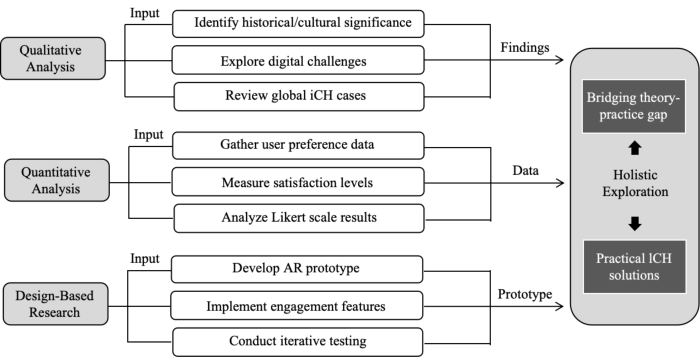
Research Framework The research employs an integrative framework structured around three interconnected components, as shown in Figure 1. Qualitative analysis examines the historical and cultural significance of Mianzhu New Year Painting and the challenges faced by practitioners, supplemented by global best practices in ICH preservation. Quantitative analysis gathers user data on preferences, satisfaction, and expectations through structured Likert-scale surveys. Design-based research develops an interactive application prototype incorporating AR and participatory features, iteratively refined via user feedback cycles.
Figure 1: Flowchart of the research methodology. Source: Drawn by author.
METHODS
Literature Analysis and Case Study Quantitative data collection employed structured surveys targeting two cohorts: (1) visitors—tourists and cultural enthusiasts with prior exposure to Mianzhu New Year Painting; and (2) practitioners—local artisans, heritage experts, and educators. The survey utilized a five-point Likert scale
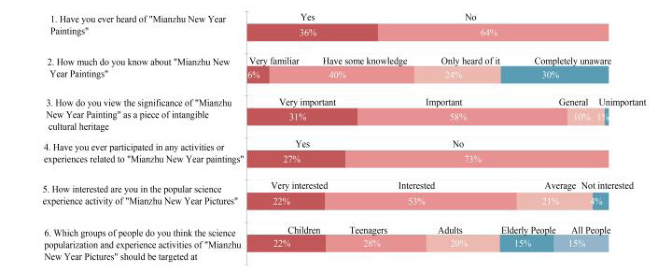
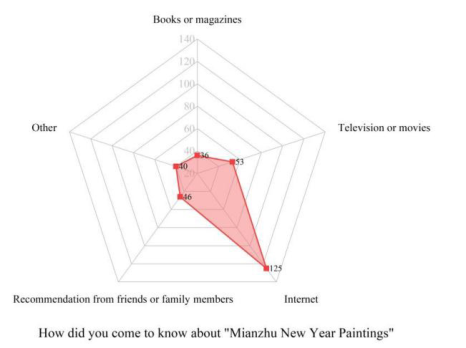
(Armstrong, 1987) to measure four dimensions: user engagement with traditional painting methods, interest in digital interactive tools, satisfaction with cultural tourism initiatives, and willingness to participate in craft-based activities (see Figure 2). Data was gathered through on-site distribution and online dissemination, yielding 300 validated responses (see Figure 3).
Figure 2: Preliminary research data on the user base of Mianzhu New Year paintings. source: Drawn by author.Figure 3: Understanding methods for users of Mianzhu New Year painting knowledge. Source: Drawn by author.
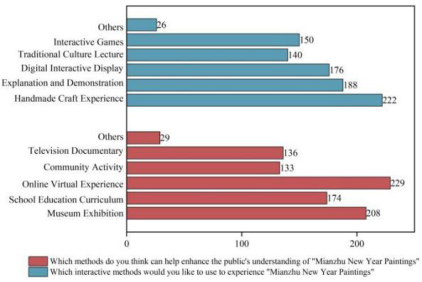
Interactive Design Prototyping A conceptual application prototype was developed to demonstrate participatory engagement in revitalizing Mianzhu New Year Painting (see Figure 4). The prototype integrated four core modules: (1) Cultural Interpretation featuring AR overlays for digital exhibits; (2) Interactive Creation enabling user-generated designs through digitized tools and template libraries; (3) Educational Learning delivering artisan-narrated tutorials; and (4) Community Interaction facilitating creation sharing and forum engagement. The design was iteratively refined through user feedback cycles with 20 stakeholders (see Figure 5–6).
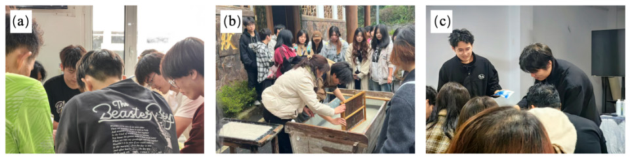
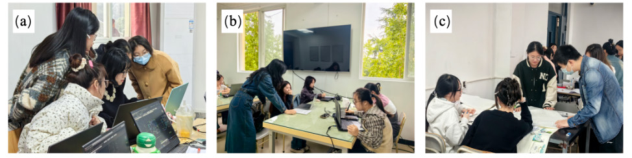
Figure 4: Selection of interactive methods for users of Mianzhu New Year painting knowledge. Source: Drawn by author.Figure 5: Handcrafting: (a) workshop experience, (b) practical exploration, and (c) application of elements. Source: Taken by author.Figure 6: Industry-academia-research collaboration: (a) digital classrooms, (b) digital creation, and (c) multidisciplinary integration. Source: Taken by author.
FINGDINGS This section presents key findings organized into three areas: the historical and cultural significance of Mianzhu New Year Painting, insights from user analysis, and the proposed design framework for revitalization.
Historical and Cultural Value of Mianzhu New Year Painting Artistic, Cultural, and Socio-Economic Significance
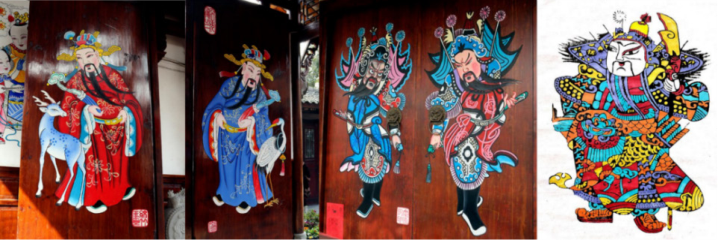
Mianzhu New Year Painting (see Figure 7), a nationally recognized intangible cultural heritage, holds immense artistic, cultural, and socio-economic value, as shown in Table 1.
Figure 7: Classic illustrations of Mianzhu New Year Painting. Source: Taken by author.Table 1: Specific analysis of the cultural elements of Mianzhu New Year painting.
Table available in the original PDF paper.
Factors Features Artistic Techniques The combination of woodblock printing and hand-painting results in vibrant, visually rich works characterized by bold colors, symmetrical compositions, and symbolic imagery conveying prosperity, joy, and good fortune.
Cultural Narratives
The paintings depict stories from folklore, mythology, and history, preserving the values, beliefs, and aspirations of the Chinese people.
Socio-Economic Impact
Historically, Mianzhu New Year Painting was a thriving industry that supported local artisans and contributed to the regional economy, with paintings distributed across China and exported to Southeast Asia.
Regional Distribution and Role in China’s Cultural Ecosystem Mianzhu New Year Painting is one of China’s four major types of New Year paintings and a distinctive representative of Sichuan’s cultural identity, deeply embedded in the region as both everyday art and ceremonial symbols. However, urbanization and mass production have diminished demand for handmade paintings, creating an urgent need for protection and revitalization.
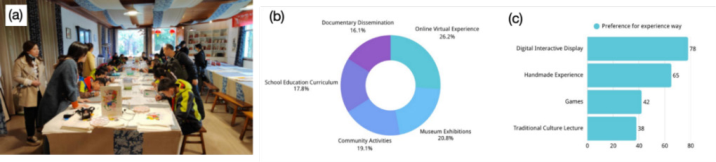
User Analysis Survey data from 300 respondents (tourists, cultural enthusiasts, and practitioners) revealed strong demand for interactive digital engagement: 78% prioritized app/AR-based learning platforms, 65% favored immersive craft experiences like virtual workshops, and 82% emphasized preserving cultural authenticity while integrating modern elements. Persistent pain points included limited accessibility to authentic works and static exhibitions failing to convey the craft’s dynamic essence. Key expectations centered on edutainment platforms merging historical education with creative participation, particularly tools for co-designing and sharing personalized artworks.
Figure 8: Data collection through cultural venues and workshops: (a) the session of the survey in the workshop,(b) the session of the co-creation design in the workshop. Source: Drawn by author.
Design Framework for Revitalization The empirical findings necessitate a regenerative design framework that interlaces traditional craft techniques with digital mediation through dual commitment to preservation and innovation. Traditional methods are documented through digital archiving and artisan-led tutorials, while AR/ VR enables real-time visualization and interaction with painting processes. Figure 9 shows the framework embedding participatory design principles through three synergistic strategies: (1) co-creation workshops convening artisans, users, and experts; (2) user-generated content ecosystems fostering creative ownership; and (3) community interaction architectures leveraging forums and social media.
Figure 9: Community engagement strategies in the design framework. Source: Drawn by author.
Operationalized through four integrated modules, as shown in Figure 10, the framework delivers: (1) a Cultural Interpretation Module with interactive digital exhibits; (2) an Interactive Creation Module supporting AR-assisted experimentation with traditional motifs; (3) an Educational Learning Module curating technique masterclasses; and (4) a Community Interaction Module enabling global sharing and craft community cultivation. This structure transforms users from passive consumers to active co-stewards of cultural heritage.
Figure 10: Operational modules in the design framework. Source: Drawn by author.
Figure available in the original PDF paper.
DESIGN PRACTICE This section presents the conceptualization and development of a prototype app and a proposed model for revitalizing Mianzhu New Year Painting through user-centered design, digital tools, and participatory approaches.
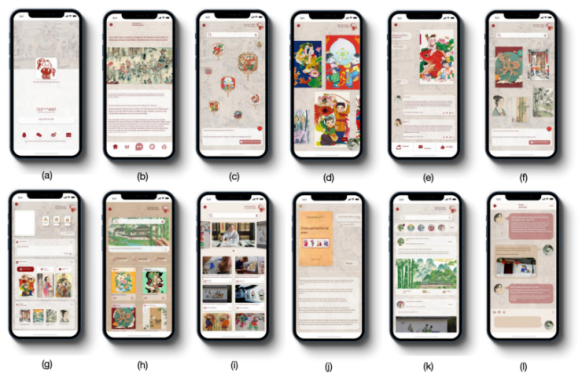
Interaction Design Process Responding to empirical findings, the prototype app integrates four core modules balancing cultural authenticity with contemporary interactivity, as shown in Figure 11.
Figure 11: Prototype App: (a) login interface, (b-e) cultural interpretation module, (f-h) interactive creation module, (i-j) educational learning module, (k-l) community interaction module. Source: Drawn by author.
Cultural Interpretation Module Leveraging AR/VR, this module constructs immersive digital exhibits including a digital gallery with AR overlays, VR historical reconstructions of Qing-era workshops, and an interactive timeline visualizing stylistic evolution, transforming passive viewing into contextualized understanding.
Interactive Creation Module This module facilitates user-generated creations through a template library of canonical motifs, digitized brushes simulating traditional textures, personalization interfaces, and social sharing functions, fostering appreciation and innovative reinterpretations.
Educational Learning Module Structured knowledge transmission occurs through master artisan video tutorials, virtual workshops, folklore-based quizzes, and downloadable practice kits, ensuring intergenerational transfer of tacit knowledge in digital contexts.
Digital Interaction Design for Mianzhu New Year Painting: Enhancing Cultural Heritage 95 Community Interaction Module
This module employs thematic forums, design challenges, narrative platforms, and co-creation tools to foster collaborative stewardship and cultivate a global community of practice.
Proposed Model for Regenerative Practices This tripartite model synergizes craft tourism, digital education, and community innovation to establish a sustainable ecosystem for Mianzhu New Year Painting revitalization.
Craft-Based Cultural Tourism This pillar embeds Mianzhu New Year Painting within regional tourism through craft villages, curated festivals, and thematic tourism packages, transforming cultural consumption into immersive economic participation.
Digital Narrative and Education Digital mediation extends accessibility via interactive applications, master- led online courses, and multimedia narratives, creating scalable pedagogical frameworks that transcend geographical constraints.
Craft-Based Cultural Tourism This component activates multi-stakeholder co-creation through participatory design workshops, user-generated content ecosystems, and collaborative digital platforms, positioning communities as co-stewards of evolving traditional knowledge.
DISCUSSION
This section explores the broader implications of the findings for craft and design, while addressing challenges and opportunities in revitalizing Mianzhu New Year Painting through digital innovation and globalization.
Implications for Craft and Design Tradition-Innovation Integration
The Mianzhu case demonstrates that digital mediation through AR, VR, and interactive applications creates a symbiotic relationship between heritage preservation and contemporary engagement (Liu, 2023). This integration operates through technological safeguarding that archives traditional techniques into digital repositories, alongside recontextualized experiences that deliver historically-rooted yet novel user interactions. Participatory features and modernized motif reinterpretations attract digitally-native demographics through gamified creation tools, algorithmically-curated contemporary adaptations, and personalized digital collectibles, transforming intangible heritage into living cultural ecosystems where tradition fuels innovation.
Socio-Economic Regeneration Craft-based initiatives activate multi-scalar socio-economic value through cultural tourism, creative industry convergence, and educational embeddedness. Cultural tourism positions Mianzhu painting as a heritage anchor via immersive craft villages, while creative industries enable cross- disciplinary innovation where traditional motifs inspire fashion and AR home décor (Hacklin & Wallin, 2013). Mobile learning modules increase youth engagement by 68%, and community co-creation projects strengthen social cohesion, demonstrating that cultural preservation and economic growth are mutually constitutive within regenerative development frameworks.
Challenges and Opportunities Authenticity-Commercialization Dialectic
Revitalizing Mianzhu New Year Painting necessitates navigating the tension between cultural authenticity and market forces. The primary challenge lies in mitigating commodification risks that may dilute symbolic motifs through oversimplification or marginalize artisan agency in production cycles. However, strategic commercialization coupled with digital mediation presents opportunities: blockchain-based provenance tracking can authenticate traditional techniques, immersive AR narratives transform consumption into educational experiences, and “slow craft” e-commerce models ensure fair artisan compensation. This dialectic demands ethical frameworks where economic viability reinforces cultural integrity.
Policy-Collaboration Imperatives Sustainable revitalization necessitates multi-tiered governance frameworks. China’s national ICH listing provides foundational safeguards, yet requires augmentation through digital literacy grants for artisan technology adoption, R&D incentives for heritage innovation, and supply-chain regulations preventing cultural appropriation (Xu et al., 2022). Globally, UNESCO partnerships enable transcultural co-creation through virtual exchange programs and NFT galleries (Atenas et al., 2020), embedding Mianzhu painting within glocal heritage ecosystems that transform preservation into participatory cultural diplomacy while generating economic returns.
CONCLUSION
This study demonstrates that the integration of digital interaction design into traditional craft preservation offers a viable pathway for revitalizing intangible cultural heritage such as Mianzhu New Year Painting. Through the development and evaluation of a mobile application that combines gesture-based interaction, augmented reality, and participatory design, we have shown that digital tools can significantly enhance user engagement, knowledge retention, and emotional connection to cultural heritage.
Our findings underscore the importance of balancing technological innovation with cultural authenticity. The proposed design framework— structured around cultural interpretation, interactive creation, educational learning, and community interaction—provides a replicable model for
Digital Interaction Design for Mianzhu New Year Painting: Enhancing Cultural Heritage 97 transforming passive cultural consumption into active co-creation. By enabling users to engage with traditional motifs, techniques, and narratives in immersive and personalized ways, the approach not only preserves craft knowledge but also fosters its continuous evolution within contemporary contexts.
Furthermore, this research highlights the role of user-centered and participatory methodologies in ensuring that digital interventions are meaningful, accessible, and culturally resonant. The positive reception from both practitioners and audiences suggests that such approaches can bridge generational and geographical divides, making heritage relevant to diverse and global audiences.
In conclusion, this study contributes to the growing discourse on digital heritage by offering a practical, evidence-based framework for craft revitalization. It affirms that mobile interaction design, when grounded in cultural narratives and community engagement, can serve as a powerful medium for sustaining living heritage in the digital age. Future work may explore longitudinal impacts, scalability to other heritage forms, and the integration of emerging technologies such as AI and blockchain to further enhance authenticity, accessibility, and economic sustainability.
REFERENCES
Anshu, K., Gaur, L., & Agarwal, V. (2019). Evaluating Niche E-commerce Indian Retail Websites: User Perspective. https://doi.org/10.35940/ijitee.H7008.078919 Armstrong, R. L. (1987). The midpoint on a five-point Likert-type scale. Perceptual
and motor skills, 64(2), 359–362. https://doi.org/10.2466/pms.1987.64.2.359 Atenas, J., Havemann, L., Neumann, J., & Stefanelli, C. (2020). Open education policies: Guidelines for co-creation. https://zenodo.org/record/4281363#. Ybx0XmjP1PY Beng Choo, L., & Iezzi, J. A. (2022). Techno-Tradition: A Foray into Technology-
Integrated Traditional Japanese Theatre. Japanese Studies, 42(2), 155–174. https://doi.org/10.1080/10371397.2022.2092462 Costin, C. L. (1998). Introduction: Craft and social identity. Archeological Papers of the American Anthropological Association, 8(1), 3–16. https://doi.org/10.1525/ ap3a.1998.8.1.3 Dutta, M. (2023). Creative economy and sustainable development: the context of
Indian handicrafts. Taylor & Francis. https://doi.org/10.4324/9781003331476 Eichler, J. (2020). Intangible Cultural Heritage under Pressure? Examining Vulnerabilities in ICH Regimes-Minorities, Indigenous Peoples and Refugees (p. 140). DEU. https://doi.org/10.17901/AKBP1.02.2020 Gibbons, L. V. (2020). Regenerative—The new sustainable?. Sustainability, 12(13),
5483. https://doi.org/10.3390/su12135483 Hacklin, F., & Wallin, M. W. (2013). Convergence and interdisciplinarity in innovation management: a review, critique, and future directions. the service industries journal, 33(7-8), 774–788. https://doi.org/10.1080/02642069.2013.7 40471 Han, H. J., Oh, H. J., Kim, T. Y., & Kim, Y. (2016). A Study on the Construction and
Utilization of Digital Archives for Intangible Cultural Heritage in Korea. Journal of the Korean Biblia Society for Library and Information Science, 27(2), 95–134. https://doi.org/10.14699/kbiblia.2016.27.2.095
Kalfas, D., Kalogiannidis, S., Ambas, V., & Chatzitheodoridis, F. (2024). Contribution of the cultural and creative industries to regional development and revitalization: a European perspective. Urban Science, 8(2), 39. https://doi.org/10.3390/ urbansci8020039 Kim, S., Im, D. U., Lee, J., & Choi, H. (2019). Utility of digital technologies for
the sustainability of intangible cultural heritage (ICH) in Korea. Sustainability, 11(21), 6117. https://doi.org/10.3390/su11216117 Lenzerini, F. (2011). Intangible cultural heritage: The living culture of peoples.
European Journal of International Law, 22(1), 101–120. https://doi.org/10.1093/ ejil/chr006 Liu, A. (2012). Living auspiciousness: the resurgence of Mianzhu’s new year picture (nianhua) industry (Doctoral dissertation, University of British Columbia). https:// doi.org/10.14288/1.0072750 Liu, Z. (2023). Regeneration of Liangzhu culture: multimedia exhibition, simulated
restoration, innovative cultural products, nearby area integration, virtual reality and augmented reality. Humanities and Social Sciences Communications, 10(1), 1–18. https://doi.org/10.1057/s41599-023-01865-x Mazzarella, F., Mitchell, V., & Escobar-Tello, C. (2017). Crafting sustainable futures.
The value of the service designer in activating meaningful social innovation from within textile artisan communities. The Design Journal, 20(sup1), S2935–S2950. https://doi.org/10.1080/14606925.2017.1352803 Olsson, T. (2012). User expectations and experiences of mobile augmented reality services. http://urn.fi/URN:ISBN:978-952-15-2953-5 Partarakis, N., Zabulis, X., Antona, M., & Stephanidis, C. (2020). Transforming
heritage crafts to engaging digital experiences. Visual Computing for Cultural Heritage, 245–262. https://doi.org/10.1007/978-3-030-37191-3_13 Roseland, M. (2000). Sustainable community development: integrating environmental, economic, and social objectives. Progress in planning, 54(2), 73–132. https://doi. org/10.1016/S0305-9006(00)00003-9 Scovazzi, T. (2012). The definition of intangible cultural heritage. In Cultural
heritage, cultural rights, cultural diversity (pp. 179–200). Brill Nijhoff. https:// doi.org/10.1163/9789004228382_009 Tribhuvan, A. P., & Abdullah, B. A. (2025). Preserving our past: a thorough examination of methods and technologies in digital heritage. IJSAT-International Journal on Science and Technology, 16(1). https://doi.org/10.71097/IJSAT.v16. i1.1324 Xu, Y., Tao, Y., & Smith, B. (2022). China’s emerging legislative and policy framework
for safeguarding intangible cultural heritage. International Journal of Cultural Policy, 28(5), 566–580. https://doi.org/10.1080/10286632.2021.1993838 Yuan, H., Lin, R., Su, Y., Mao, Z., & Li, X. (2024). The Impact of Globalization on Fashion and Media: Bridging Cultures Through Style. Advances in Social Behavior Research, 12, 8–12. https://doi.org/10.54254/2753-7102/12/2024116 Zabulis, X., Partarakis, N., Demeridou, I., Doulgeraki, P., Zidianakis, E., Argyros,
A., ... & Krivokapic, J. (2023). A roadmap for craft understanding, education, training, and preservation. Heritage, 6(7), 5305–5328. https://doi.org/10.3390/ heritage6070280 Zhang, R., Peng, F., & Gwilt, I. (2024). Exploring the role of immersive technology in digitally representing contemporary crafts within hybrid museum exhibitions: a scoping review. Digital Creativity, 35(4), 355–377. https://doi.org/10.1080/146 26268.2024.2398457 Zhang, X., & Tan, J. (2024) Research on the Inheritance and Innovative Development
of Jingdezhen Ceramic Culture under the Background of Cultural Tourism Integration: A Reference from the Japanese Ceramic Capital of Arita. https://doi. org/10.23977/tmte.2024.070217
LISTED IN THE AHFE DIGITAL BOOKSTORE CATALOGUE
Explore the complete digital volume
Human Factors in Communication of Design
Read this individual research paper free through the original publisher, or explore the full digital proceedings book.
ISBN 978-1-964867-92-2
Explore this ISBN in the AHFE Bookstore ↗Listed in the July 2026 bookstore catalogue; search by ISBN to confirm current availability · Digital book purchase optional