Jinhang Liu, Tianchen Dai, Xin Xie (2026). Resolving Form-Meaning Separation: Preference and Acceptance of a Somatosensory FMV Game for Intangible Martial Arts Targeting Z Generation. In: Human Factors in Communication of Design. AHFE Open Access, vol. 216, pp. 27–37. https://doi.org/10.54941/ahfe1007622
As one of the first national intangible cultural heritage items in China, Foshan Wushu, with its technical system of "integration of boxing and weapons", philosophical concept of "combination of martial arts and medicine", and diversified martial arts schools, is a typical sample of traditional Chinese physical culture. However, the current one-way communication mode relying on offline performances and kung fu films limits the audience’s cognition to "action spectacles", making it difficult to touch the spiritual core of "entering the Dao through martial arts" and leading to the communication dilemma of the separation between "form" and "meaning". Although new technologies such as VR and AR have been introduced into existing martial arts culture communication, they mostly stay at the superficial reproduction of cultural representations and fail to construct a complete and in-depth cultural cognition. In response to this, this study proposes a solution of integrating motion-sensing interaction into stylized full-motion video (FMV) games, aiming to resolve the "knowing-practice disconnection" inherent in martial arts communication through embodied interaction. Focusing on Generation Z, the study comprehensively adopts desk research, field investigation, in-depth interviews and questionnaire surveys to explore the necessity and feasibility of this integration mode, and focuses on analyzing Generation Z’s preferences and core concerns regarding Foshan Wushu motion-sensing FMV games. The results show that this integration mode can effectively realize the unity of cultural "form" and "meaning", providing empirical evidence and new theoretical perspectives for exploring the application of serious games in the digital protection of intangible cultural heritage.
As one of the first national intangible cultural heritage items in China, Foshan Wushu presents a stark contrast between its cultural value and current dissemination status: on the one hand, its technical system of “integration of boxing and weapons”, philosophical concept of “combining martial arts with medicine”, and “a hundred schools of thought blooming” martial arts schools constitute a typical sample of traditional Chinese physical culture; on the other hand, its dissemination still overly relies on one-way media such as offline
exhibition halls and kung fu films, resulting in the audience’s understanding of martial arts culture remaining at the level of “action spectacles” and failing to reach the spiritual core of “entering the Dao through martial arts”.
The digital technology revolution has provided a key tool for solving this dilemma. With the dual attributes of “cinematic audio-visual effects plus gamified interaction”, stylized full-motion video (FMV) games have become an important gateway for young groups to access culture. However, the presentation of interactive content in most existing FMV games focuses more on film narrative expression, lacking embodied experience and ignoring the translation of deeper cultural symbols of martial arts, which leads to the “hollowness of expression” in cultural communication. It is worth noting that martial arts itself is a physical discipline. Scholar Zhao Xin pointed out that as a skill of physical performance, Chinese martial arts has diverse value functions, among which educativeness, fitness, entertainment and culturality are the mainstream characteristics of its dissemination (Zhao, 2021). Some scholars also argue that digitalization helps to realize information interaction and timely perceive the audience’s experience effect of martial arts culture (Yu & Li, 2022), emphasizing the impact of “digital simulation and capture technology” on the process and effect of international dissemination of Chinese martial arts (Ma et al., 2018). The maturity of motion-sensing interaction technology has provided hardware support for filling this gap. Motion-sensing devices represented by Kinect and VR controllers can accurately capture users’ body movements, construct a closed-loop interactive scenario of “user action - system feedback - cultural output”, and transform physical participation into a path for deepening cultural cognition. This “embodied interaction” mode not only breaks through the temporal and spatial limitations of traditional media, but also solves the pain point of “separation of knowledge and practice” in martial arts culture communication through the direct connection between physical experience and cultural symbols.
Based on this, the study takes the “Generation Z” group as the target audience. As the backbone of contemporary social development, especially in the cultural field, they are increasingly becoming the most mainstream and dynamic cultural consumer group. Through a combination of qualitative and quantitative methods, this study deeply explores this group’s acceptance, preferences and core concerns regarding such motion-sensing interactive FMV games, thereby providing a theoretical basis and practical path for constructing a digital dissemination paradigm of martial arts that “integrates form and spirit”.
RELATED WORK
This study is positioned at the cutting-edge intersection of film-game integration and motion-sensing interaction. Relevant research at home and abroad exhibits the characteristics of “clear macro-strategies but insufficient micro-methods; available technical tools yet inadequate in-depth integration”, which are specifically reflected as follows: The
Resolving Form-Meaning Separation: Preference and Acceptance of a Somatosensory 29 digital communication of martial arts culture lacks an effective interactive paradigm to realize in-depth transmission from “form” to “meaning”, as well as a user experience-centered interactive design methodology. FMV games suffer from the shallowness of “pseudo-interaction” experiences, where interactive points often serve narrative plot turns rather than cultural interpretation.
Research on Digital Dissemination of Martial Arts Culture An existing research (Li et al., 2024) has primarily been conducted from functional, social, and communication perspectives. This study, however, focuses specifically on a literature review of Wushu culture from the communication perspective. International scholars (Xue et al., 2023) emphasize empirical research, exploring the connections between Wushu, popular culture, and the gaming industry. Key findings include: (1) Wushu remains an important cultural symbol; (2) Significant differences exist in the perception of Wushu between Chinese and international audiences; (3) Wushu’s traditional values have not been diminished by mass media; (4) Film is the primary medium for its global dissemination, but audience perception is still largely shaped by their own cultural backgrounds.
With the development of digital media, research focus has shifted towards technological impacts. Scholars (Li et al., 2022) point out that while digital technology expands communication boundaries, it also leads to content fragmentation, potentially undermining the holistic understanding and national influence of Wushu culture. Although studies (Jhon & Iop, 2018) confirm the positive impact of 3D fighting games on younger demographics, and the importance of digital imaging technology for creating cultural context (Liu & Hua, 2024), current communication practices still tend to prioritize technical skills over intrinsic principles (emphasizing form over spirit). A systematic solution for achieving deep cultural experiences through specific interaction design is still lacking.
Research on FMV Games At present, academic research on film-game integration mostly focuses on media convergence, narrative models and industrial trends, lacking a systematic discussion of its unique aesthetic characteristics (Luo, 2023). FMV games feature an aesthetic that guides the transition from reality to fiction. The evolution of interactive games tends to progress from operational pleasure to narrative participation and philosophical reflection. FMV games blur the aesthetic boundary between film and game through the narrative structure of genre films (Zhao, 2022). In 2023, scholars (Holloway-Attaway, 2023) developed a Mirek Stolee escape room narrative model, classifying escape rooms into four categories using two axes, proposed a space-narrative coupling strategy, and provided a media richness perspective for this study.
Research on Motion-Sensing Interaction Ariely and G. S. Berns (Ariely & Berns, 2010) defined motion-sensing technology as interacting with computers through natural means such as body movements, gestures, and voice. Some scholars have focused on motion- sensing games, arguing that they are centered on somatosensory feedback and intelligent guidance; users control the games through body movements, oriented toward achieving the target form of the digital body, which belongs to “game-based physical behavior”. This study pointed out that the boundary between “the body as a medium” and “the medium as a body” is becoming increasingly blurred, and the body, as a connection, constantly stimulates users’ fitness experience and game practice. However, early motion-sensing technologies, represented by Wii and PlayStation Eye, lacked realism; the body was merely “virtually present” and lacked contextualization and storytelling (Mou & Yu, 2023), a flaw that FMV games can exactly make up for.
METHOD
This study employs a multi-layered and progressive mixed-method approach. First, fieldwork was conducted at the Foshan Zumiao Museum to observe the practical application scenarios and user behaviors of existing motion-sensing devices, thereby providing an empirical foundation for the research questions. Subsequently, based on the fieldwork findings, semi-structured interviews were carried out from the multi-dimensional perspectives of Generation Z users, design scholars, and intangible cultural heritage inheritors, distilling the core dimensions and potential variables influencing acceptance of martial arts motion-sensing FMV games. Finally, grounded in these qualitative findings, the Technology Acceptance Model was introduced to construct a theoretical framework, and a large-sample quantitative validation was conducted through a questionnaire survey, systematically revealing the influence paths and mechanisms of various factors on Generation Z’s acceptance. These three research phases are interlinked and progressively deepening, ensuring that the conclusions are firmly rooted in onsite realities while also balancing the rigor and generalizability of theoretical construction.
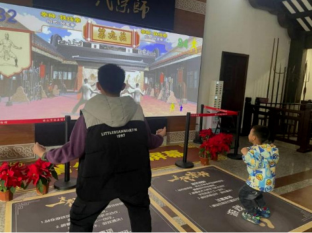
Fieldwork This study conducted a field investigation at Foshan Zumiao Museum and found that it serves as the core area of the “Foshan Old Town Martial Arts Cultural Tourist Trail”. The museum integrates rich martial arts cultural resources, including the Huang Feihong Memorial Hall, Ip Man Hall, martial arts film and television materials, lion dance performances, and the motionsensing game The Grand Master.
The investigation focused on the motionsensing device of The Grand Master (see Figure 1). The device uses sensors to capture user movements and trigger level clearance, but it has shortcomings in scene design, scenario construction, and technical performance.
Figure 1: Site photo of the motion-sensing game in the exhibition hall (Photo by the author).
Observations indicate three key points: (1) Teenagers under 18 show the highest willingness to experience the device; (2) The 18–35 age group has strong participation motivation, but often quits embarrassedly after repeated failures due to technical and operational issues; (3) Firsthand experience reveals problems such as insensitive motion capture, unoriginal level design, and low user retention; (4) These findings provide an empirical foundation for the subsequent optimal design.
Semi-Structured Interview Based on literature review and field investigation, this study identifies Generation Z (born between 1995 and 2010) as the target population. Given their core role in cultural consumption and potential operational barriers in using motion-sensing interaction, this study adopts semi-structured interviews to explore Generation Z’s needs, acceptance, and influencing factors regarding Foshan martial arts motion-sensing film-game works. The research aims to propose feasible strategies for digital communication.
The interview outline includes: (1) an explanation of research ethics; (2) demographic information; (3) game usage habits (including experience with motion-sensing and FMV games); (4) opinions and suggestions on martial arts culture, motion-sensing interaction, FMV narrative, and visual presentation; (5) open-ended supplementary questions. Online interviews lasting 30–40 minutes were conducted with 10 respondents, including Generation Z game enthusiasts, design scholars, and inheritors of Foshan martial arts intangible cultural heritage (see Table 1).
Table 1: Respondent information form.
Table available in the original PDF paper.
Name Gender Gaming Frequency Age FMV Gaming Experience
Motion Gaming Experience A1 Male Almost daily 25 No No
A2 Male Almost daily 24 Yes Yes A3 Male Almost daily 24 No Yes
A4 Male Almost daily 25 Yes No (Continued)
Table 1: Continued.
Table available in the original PDF paper.
Name Gender Gaming Frequency Age FMV Gaming Experience
Motion Gaming Experience A5 Female Several times a week 27 Yes Yes
A6 Male Almost daily 26 Yes Yes A7 Male Almost daily 25 Yes Yes
A8 Female Several times a week 25 Yes Yes AB1 Female Almost daily 24 No Yes
B1 Male Occasionally 33 No No The collected data were coded in multiple rounds using Nvivo software. The interview data were categorized into 11 main categories and 165 subcategories, with themes derived from interview questions and response texts (see Table 2).
Table 2: 11 main categories.
Table available in the original PDF paper.
Name Document Reference Points Basic Personal Characteristics 10 45
Player Evaluation (Motion-Sensing) 7 21 Player Evaluation (FMV) 6 19
Perception of Martial Arts Culture 10 87 Preference for Motion-Sensing Interaction 10 49
Preference for Gesture Interaction Switching 8 23 Game Mechanism Design 8 15
Major Concern 10 15 Technical Implementation Considerations 9 13
The results show that: (1) most respondents’ understanding of martial arts comes from films and games, remaining at a superficial level with insufficient awareness of its philosophical connotations; (2) motion-sensing interaction is appreciated for its strong sense of immersion, yet respondents worry about recognition accuracy and operational difficulty; (3) the ink- wash style is highly recognized for its cultural compatibility, but concerns exist about unclear action contours; (4) users expect short and attractive narratives, smooth gesture interaction, and extended gameplay such as multiplayer online mode. Based on the analysis of the research results, the main factors influencing the acceptance of martial arts motion-sensing film-game products among Generation Z are further summarized as user characteristics, design strategies, and environmental support (see Table 3). These factors, at different levels, will influence Generation Z’s willingness to try and the actual effects of experiencing martial arts motion-sensing FMV games.
Table 3: Main factors influencing generation Z’s acceptance of Motion-Sensing FMV games.
Table available in the original PDF paper.
User Characteristics Design Strategies Environmental Support Motor coordination Feedback process Economic foundation
Gaming experience Ink-wash presentation Spatial support Device familiarity Media richness Sociality
Questionnaire Survey Based on the potential factors summarized from interviews, this study further conducted a questionnaire survey to quantitatively verify the acceptance of martial arts motionsensing interactive filmgames among Generation Z (born between 1995 and 2010). It focused on three core issues extended from the interviews: media richness, gesture interaction during filmgame switching, and preference for the inkwash style in martial arts movement presentation.
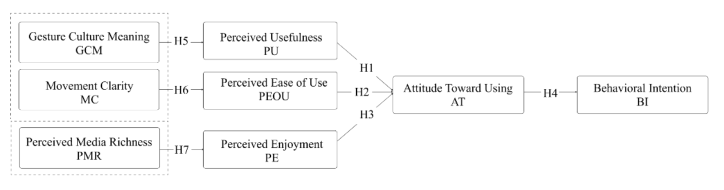
Based on the Technology Acceptance Model (TAM), this study constructed an extended model by introducing Media Richness Theory and a semantic differential scale, with a total of six dimensions and 24 items.
Seven research hypotheses were proposed (see Figure 2), covering the influence paths of perceived usefulness, perceived ease of use, perceived enjoyment, media richness, cultural connotation of gestures, and clarity of inkwash style on attitude toward use and behavioral intention: H1: Perceived usefulness positively affects attitude toward using martial arts motionsensing interactive filmgames among Generation Z.
H2: Perceived ease of use positively affects attitude toward using martial arts motionsensing interactive filmgames among Generation Z.
H3: Perceived enjoyment positively affects attitude toward using martial arts motionsensing interactive filmgames among Generation Z.
H4: Attitude toward using martial arts motionsensing interactive filmgames positively affects behavioral intention among Generation Z.
H5: The cultural connotation of gestures positively affects perceived usefulness of martial arts motionsensing interactive filmgames among Generation Z.
H6: The clarity of inkwashstyle movements positively affect perceived ease of use of martial arts motionsensing interactive filmgames among Generation Z.
H7: Media richness of martial arts motionsensing interactive filmgames positively affects perceived enjoyment of such games among Generation Z.
Figure 2: Hypothetical model.
A total of 300 questionnaires were distributed. After excluding invalid responses, 289 valid questionnaires were retained (valid response rate: 96.3%). Descriptive statistical analysis of the sample data was performed using SPSS 29.0 (see Table 3).
Table 4: Frequency analysis.
Table available in the original PDF paper.
Variable Category Frequency Percentage Gender Male 145 50.20%
Female 144 49.80%
211 73%
Age Group Early Gen Z (Born 1995–2002)
78 27%
Late Gen Z (Born 2003–2010)
Frequency of Playing Almost daily 106 36.70% 2–3 times a week 89 30.80%
Occasionally 77 26.60% Rarely 17 5.90%
Yes 112 38.80%
Ever Used MotionSensing Devices
No 177 61.20% Ever Played FMV Games Yes 94 32.50%
No 195 67.50% Data analysis was performed using the Partial Least Squares Structural Equation Model (PLS-SEM). The measurement model assessment shows that all indicator loadings (0.812–0.899), Cronbach’s α, composite reliability (both > 0.7), and AVE values (0.715–0.804) meet the recommended criteria (see Table 5), indicating good reliability and convergent validity of the scale. The Fornell-Larcker criterion verified the establishment of discriminant validity (see Table 6).
Table 5: Reliability and convergent validity of the scale.
Table available in the original PDF paper.
Construct Cronbach’s Alpha
Composite Reliability (rho_a)
Composite Reliability (rho_c)
Average Variance Extracted (AVE) AT 0.847 0.849 0.908 0.766
BI 0.814 0.816 0.890 0.729 GCM 0.832 0.833 0.899 0.748
MC 0.850 0.862 0.908 0.768 PE 0.857 0.857 0.913 0.777
PU 0.358 0.398 0.316 0.290 0.241 0.261 0.244 0.896 Regarding the explanatory power of the model (see Table 7), the predictive effects of attitude toward use (R² = 0.315) and behavioral intention (R² = 0.255) are within an acceptable range in user acceptance research. However, the R² values of perceived enjoyment and perceived usefulness are relatively low, indicating that these variables may also be influenced by factors not included in the model, such as personal gaming experience, device familiarity.
Table 7: Explanatory power of the model.
Table available in the original PDF paper.
R-Square R-Square Adjusted AT 0.315 0.307
BI 0.255 0.253 PE 0.097 0.094
PEOU 0.144 0.141 PU 0.100 0.097
Hypothesis test results show (see Table 8) that all seven hypotheses are supported (T > 3.29, p < 0.001). The study confirms that applying the ink- wash style on the premise of ensuring clear action recognition, and optimizing the cultural expression and operational fluency of gesture interaction, are key paths to improving acceptance among Generation Z.
Table 8: Hypothesis testing results of the structural mode.
Table available in the original PDF paper.
Supported
Hypot Hesis
Proposed Relationship
T Statistics (|O/STDEV|)
P Values
Path Coefficients (β)
Sample Mean (M)
Standard Deviation (STDEV)
H4 AT -> BI 0.505 0.509 0.055 9.11 0.000 Yes H5 GCM -> PU 0.316 0.322 0.056 5.669 0.000 Yes
0.380 0.385 0.057 6.647 0.000 Yes
H6 MC -> PEOU H3 PE -> AT 0.268 0.267 0.045 6.004 0.000 Yes
H2 PEOU -> AT 0.285 0.287 0.047 6.101 0.000 Yes H7 PMR -> PE 0.311 0.315 0.059 5.248 0.000 Yes
H1 PU -> AT 0.219 0.22 0.045 4.878 0.000 Yes
CONCLUSION
This study explores the feasibility of applying motion-sensing interaction in FMV games to promote Foshan martial arts culture among Gen Z through field research, interviews, and questionnaires. Results show that this integrated approach effectively solves the “separation of form and meaning” in martial arts communication and enables users to shift from passive viewing to deep cultural experience via embodied interaction.
Quantitative analysis confirms that perceived usefulness, perceived ease of use, and perceived enjoyment significantly and positively affect attitude and behavioral intention (all p < 0.001). The cultural connotation of gestures enhances perceived usefulness; movement clarity in the ink-wash style influences perceived ease of use; and media richness improves perceived enjoyment.
Future research may include individual difference variables and adopt longitudinal designs to test actual usage, thus improving the model’s explanatory power and generalizability.
ACKNOWLEDGMENT
This research was supported by the Stable Support Program for Higher Education Institutions (General Program), Shenzhen Science and Technology Innovation Commission (GXWD20220817131619001).
REFERENCES
Ariely, D., & Berns, G. S. (2010). Neuromarketing: the hope and hype of neuroimaging in business. Nature Reviews Neuroscience, 11(4), 284. Holloway-Attaway, L., & Murray, J. T. (Eds.). (2023). Interactive Storytelling: 16th
International Conference on Interactive Digital Storytelling, ICIDS 2023, Kobe, Japan, November 11–15, 2023, Proceedings, Part II (Lecture Notes in Computer Science). Jhon, A., & Iop. (2018, Apr 23-24). The influence of playing 3D fighting games in practicing martial arts.Journal of Physics Conference Series [1st international conference on advance and scientific innovation]. Joint Workshop on KO2PI / 1st International Conference on Advance and Scientific Innovation (ICASI) - Empowering Digital Society through Integration of Multidisciplinarity Aspect, Medan, INDONESIA. Li, C., Long, X. N., Zhao, X., & Wu, X. Q. (2024). Value Representation, Practical
Problems and Promotion Strategies of Chinese Wushu Culture Communication in the Omni-media Era. Journal of Wuhan Sports University, 58(1), 61–67. Li, C., Wang, G., & Jin, Y. Z. (2022). Morphological Evolution, Public Opinion Issues and Path Interpretation of Chinese Wushu Communication in the New Media Era. Journal of Wuhan Institute of Physical Education, 56(4), 7. Liu, G. Q., & Hua, J. T. (2024). Research on International Communication of
Chinese Wushu under the Background of Digitization. Journal of Sports Culture Guide(12), 54–60. Luo, Y. (2023). Research on Interactive Aesthetics of Interactive Film and Television from the Perspective of Film-Game Integration [Master’s thesis, Shanghai University]. Ma, X. J., Jiang, C. Y., & Bowman, P. (2018). Bruce Lee’s Cultural Legacy: An
Academic Review of the 4th International Wushu Forum (Cardiff University, UK). Sports & Science, 39(05), 13–18.
Resolving Form-Meaning Separation: Preference and Acceptance of a Somatosensory 37 Mou, X. Q., & Yu, D. S. (2023). How the Body Becomes a Medium: An Analysis of
Electronic Fitness Group Game Practice Under Actor-Network Theory (ANT). Shanghai Journalism Review(07), 78-88+100. Xue, C. L., Bai, H. Z., Niu, Y. F., & Zhang, R. J. (2023). The Role of Wushu Martial Arts Representation in the Contemporary Mass Culture of the World. Critical Arts-South-North Cultural and Media Studies, 37(3), 45–61. Yu, Z. M., & Li, Y. K. (2022). Value, Dilemmas and Paths of International Promotion
of Chinese Wushu from the Perspective of Digitization. Journal of Sports Culture Guide(12), 66-70+78. Zhao, X. (2021). Communication of Chinese Wushu Culture in the New Media Era: Dilemmas, Opportunities, and Paths. Journal of Wuhan Sports University, 55(5), 7. Zhao, Y. (2022). Fictional Reality and Entertainment Reflection: Changes in
Media Interaction Under the Influence of Film-Game Linkage. Contemporary Cinema(000-003).
LISTED IN THE AHFE DIGITAL BOOKSTORE CATALOGUE
Explore the complete digital volume
Human Factors in Communication of Design
Read this individual research paper free through the original publisher, or explore the full digital proceedings book.
ISBN 978-1-964867-92-2
Explore this ISBN in the AHFE Bookstore ↗Listed in the July 2026 bookstore catalogue; search by ISBN to confirm current availability · Digital book purchase optional