Yue Gu, Jintao Liu, Yuxuan Li, Yulu Hu (2024). Virtual Experiential Design in the Context of Intangible Cultural Heritage: A Case Study of filigree VR design. In: Human Factors in Design, Engineering, and Computing. AHFE Open Access, vol. 159, pp. 1157–1166. https://doi.org/10.54941/ahfe1005683
This paper delves into the application of virtual reality (VR) technology as a solution to the challenges encountered in the preservation and advancement of intangible cultural heritage. Taking the Beijing Filigree VR design as a focal point, this study maximizes the immersive, interactive, and multisensory attributes of VR technology to conceptualize and produce virtual experiential products tailored to Filigree. The investigation examines the merits and distinctive features of virtual reality technology in the dissemination of intangible cultural heritage, including its ability to faithfully recreate authentic scenes and cultural significance, broaden the modes of intangible cultural transmission, and augment audience interaction to fortify the overall user experience. Throughout the design research process, the ICE design model (Insight-Create-Experience, Model) is formulated, providing a lucid research framework for VR design. In the creation phase, the interface design is fine-tuned employing a user experience hierarchy model, thereby facilitating virtual teaching and simulation exercises related to Filigree. This study introduces a novel perspective and methodology for the dissemination and conservation of intangible cultural heritage, establishing a theoretical basis in design for the advocacy and perpetuation of such heritage, exemplified by Filigree.
Filigree, which intricately utilizes precious metals like gold and silver along with rare gemstones, is particularly constrained by the limited availability of these materials and the complexity of its techniques. The crafting process involves eight meticulous manual steps—pinching, filling, stacking, welding, piling, measuring, weaving, and braiding—each requiring a high degree of skill and time, leading to substantial costs and limited production (Li Baohua, 2015). These factors contribute to its scarce market presence and diminished awareness among the younger population, posing significant risks to the craft’s sustainability and heritage value. Addressing these challenges is crucial for the craft’s survival, necessitating innovative strategies that bridge traditional craftsmanship with modern market needs (Wanniarachchi et al., 2020).
Amidst rapid technological advancements, the concept of digital intangible cultural heritage has been increasingly introduced (Burdea et al., 2003; Idris et al., 2016). Virtual reality (VR) technology, which has matured significantly in the application market, offers unique immersive, interactive,
and multisensory experiences (Anthes et al., 2016). This technology enables participants to transcend temporal and spatial constraints, allowing them to closely observe and engage with intangible heritage products from various angles. It can provide detailed tutorials and interactive experiences that traditional methods cannot match, significantly enhancing the learning process for new artisans and enthusiasts, ensuring the effective transmission of complex skills (Bailenson et al., 2008). Additionally, by making the filigree experience accessible to a global audience through VR, public awareness and appreciation can be increased, particularly attracting younger demographics interested in digital experiences, thus addressing the issue of reduced recognition (Selmanovic et al., 2018). Moreover, VR facilitates cultural innovation by allowing artisans to experiment with virtual techniques and designs without the constraints of physical materials and processes (Bolter et al., 2021). In this way, VR technology fosters a novel form of appreciation and creative engagement, serving as a powerful method of cultural dissemination that revitalizes intangible cultural heritage through technology (Skublewska-Paszkowska et al., 2022).
CONTRIBUTION Application of Virtual Reality Technology Using the Beijing filigree VR design as an example, the research extensively leverages the immersive, interactive, and multisensory characteristics of virtual reality technology, successfully designing and developing substantive virtual experiential products for filigree.By utilizing VR, this project transcends the traditional boundaries of artistic appreciation and skill transmission, allowing users not only to view filigree inlay artifacts in stunning detail but also to actively participate in the creation process.
Advantages of VR Technology in Assisting Intangible Cultural Heritage Dissemination In-depth analysis of the advantages of virtual reality technology in the dissemination of intangible cultural heritage, including faithfully reproducing original scenes and cultural significance, expanding the forms of intangible cultural transmission, and enhancing audience interaction to strengthen user experience.
Construction of the ICE Design Model In this study, the ICE design model (Insight-Create-Experience) is developed to provide a systematic framework for VR design and the dissemination of intangible cultural heritage (ICH). The “Insight” phase focuses on deeply understanding the ICH’s history, cultural significance, and techniques. The “Create”phase involves developing high-fidelity VR environments with interactive elements, refined through iterative testing. The “Experience” phase evaluates the VR experiences’ effectiveness in conveying cultural knowledge, engaging users, and gathering feedback for ongoing improvement.
Enhancement of User Experience During the creation phase, through the optimization of the user experience hierarchy model, the study achieves an improvement in interface design, further encouraging users to actively participate in virtual teaching and simulation exercises for filigree, thereby reinforcing user experience.
Virtual Experiential Design in the Context of Intangible Cultural Heritage 1159
METHOD
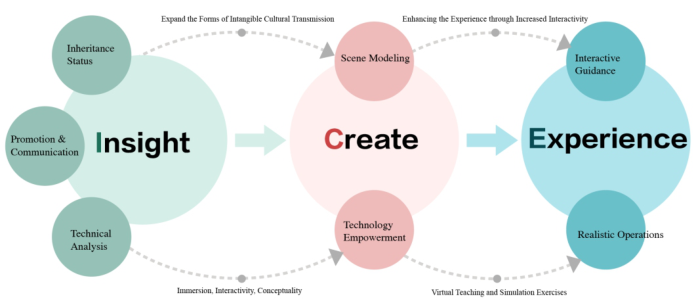
Our research aims to stimulate users’ interest in intangible cultural heritage and reignite their passion for traditional heritage through the Filigree Inlay VR experience. To achieve this goal and provide users with a profound and meaningful experience, we require a systematic and strategic approach to guide the design and development efforts. Throughout the interface research process, practice and exploration gradually led to the development of the ICE model (Figure 1)—a strategic framework encompassing “Insight - Create - Experience.”
Figure 1: ICE design model in filigree VR experience.
In the Insight stage, we identified the challenges faced by Filigree Inlay in its transmission and development through desk research and field expert interviews. These findings laid the foundation for the subsequent design and development. In the Create stage, we developed high-fidelity VR models and interactive experiences based on these insights, striving to achieve optimal technical performance. In the Experience stage, we validated the significance of our research outcomes through semi-structured interviews with participants. This approach allowed us to gather in-depth insights from users, confirming the effectiveness and impact of the VR experience in enhancing their understanding and appreciation of Filigree Inlay.
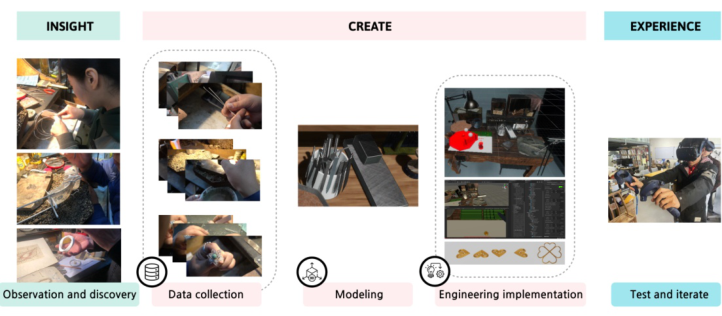
Overall, the ICE model provides a continuous path from problem discovery to the final experience, ensuring that the VR platform meets technical and cultural expectations and offers guidance for optimizing the platform to better address user needs. Figure 2 illustrates the application of the ICE model in the overall design process.
Figure 2: The application of the ICE model in the overall design process.
INSIGHT The central objective of the Insight phase is to delve deeply into comprehending market conditions and user needs. This involves extensive research into the problem domain, encompassing historical perspectives, current scenarios, trends, and existing studies, to precisely define the research problem. In this phase of the study, the author employed research methodologies such as desktop investigations, on-site visits, and interviews with experts to explore the present status and challenges faced by filigree inlay.We conducted in-depth visits to a filigree inlay factory in Tongzhou, Beijing, unearthing several significant challenges in the inheritance process of filigree inlay in Beijing:
The Number of Practitioners in the Field Is Decreasing Several factors contribute to the decline in young people pursuing filigree inlay as a profession, including its complexity, high learning costs, time- consuming nature, and unstable income. Originating from the imperial court this art is traditionally passed down through family and apprenticeships, limiting its wider dissemination (Han, C. 2011, David de la Croix et al., 2018). Field research and interviews with craftsmen indicate that, apart from some regional “Intangible Cultural Heritage Project Successor Training Courses,” there is a significant lack of educational programs in universities, which contributes to low social awareness of this craft (Gong, J. 2012). The closed nature of its family-based transmission hinders new ideas and restricts the promotion of these skills. As Hsieh, Chen, and Liu (2019) noted, cultivating talent is vital in preserving this heritage. Furthermore, many filigree inlay workshops are facing a market crisis, with declining numbers of practitioners and apprentices annually, underscoring the urgent need for attention to talent discovery and development in this field.
Virtual Experiential Design in the Context of Intangible Cultural Heritage 1161
Lack of Documentation, Awareness, and Channels among Artisan The research initiative involved an empirical study through visits to a traditional filigree inlay workshop in Tongzhou, Beijing. Observations showed an aging workforce, primarily male artisans aged 35 to 60, with no use of modern documentation methods like photography or video. Interviews revealed that while artisans are willing to share their experiences, most avoid modern communication channels. Three artisans expressed no interest in creating digital content for social media, prioritizing craftsmanship over marketing. One younger artisan occasionally shared finished products online but showed limited interest in broader promotion. This highlights a gap in the use of modern media for promotion, with the market increasingly expecting artisans to engage in both craftsmanship and modern marketing techniques.
Changes in Popular Aesthetics: Limited Interest among Young People in Filigree Inlay Filigree inlay has historically served royal courts and nobility as gold and silverware, featuring intricate patterns created by flat or stacked gold and silver threads, often adorned with gemstones. In many cases, it incorporates various crafts such as engraving, enamel, and chakutu, symbolizing the wealth and power of the royal palaces and aristocracy. However, contemporary aesthetic trends display diversity, individuality, and internationalization. The younger generation’s expectations for jewelry focus more on innovation in materials and forms, leaning towards affordable, simple, and versatile pieces. This contradiction undoubtedly hinders the dissemination and promotion of filigree inlay.
CREATION Building on the outcomes of the “Insight” phase, we have begun developing a VR platform to showcase the historical context, craftsmanship, and products of filigree inlay. This platform uses virtual reality to offer an immersive experience that educates the public about the art’s cultural value and historical significance. It also serves as a digital archive, allowing users to explore and appreciate filigree inlay without geographical constraints, thereby broadening its appeal. The interactive VR experience enables users to virtually engage in the filigree inlay process, providing a hands-on educational experience.
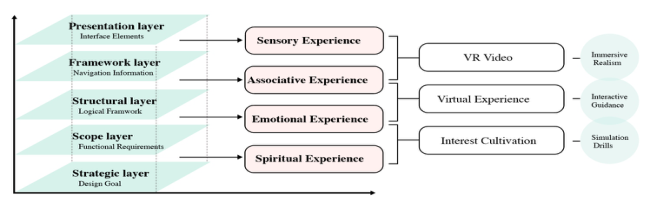
At the “Create” stage, our focus is on interface design, navigation logic, and real-time user interaction. We have developed a user experience hierarchy model tailored to the learning needs of filigree inlay, as shown in Figure 3. The platform integrates elements from this hierarchy to facilitate a comprehensive exploration of the craftsmanship and cultural significance of filigree inlay.
Figure 3: The application of the user experience hierarchy model in constructing the Filigree Inlay VR product.
In crafting the system’s presentation layer and framework layer, significant emphasis is placed on enhancing the sensory and associative experiences of users. To enrich the content, we have collaborated with artisans who provide fundamental insights into filigree inlay and have contributed to creating informative video content in Figure 4. This immersive product experience enables users to intuitively understand the theoretical aspects of filigree inlay, thereby igniting their interest and curiosity in the craft.
Figure 4: High-quality video tutorial filming (Excerpt).
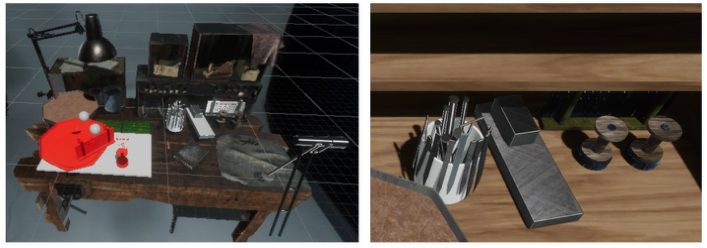
We have developed a virtual platform that immerses users in the filigree inlay production process. This interactive experience enhances understanding and emotional connection by allowing users to engage actively with the craft. Authenticity is ensured by using models and scenes derived from real data, precisely modeled in Maya and imported into Unity according to actual proportions (Figure 5), maximizing the realism of the virtual environment.
Figure 5: Setup of filigree inlay workbench and tool modeling.
Virtual Experiential Design in the Context of Intangible Cultural Heritage 1163
EXPERIENCE Participants
For the study, we recruited volunteers among university students, specifically targeting those who have a passion for handicrafts and a strong interest in traditional culture. The criteria included students aged 21 and over. A total of 6 participants were recruited (4 females and 2 males). The age range was between 21 to 27 years old (M = 24). All interviews were recorded and transcribed after obtaining consent from the participants.
Procedure In this study, participants underwent a comprehensive virtual reality experience in filigree inlay using HTC Vive headsets, encompassing everything from basic knowledge to independent operation, fully simulating each step of the filigree inlay process. Throughout the VR experience, the principal investigator observed and recorded participants’ behaviors and interactions, with a special focus on the smoothness of the experience, accuracy of operations, and learning curves to assess the effectiveness of VR training. After the experience, we conducted semi-structured interviews lasting 15 to 20 minutes, which revolved around participants’ feelings about the experience, learning outcomes, interest in filigree inlay craftsmanship, and any potential improvements. Open-ended questions were used to delve deeply into participants’ views on the VR learning mode and its potential impact on traditional craft learning.
Interview Finding The application of VR design features in the filigree inlay project has demonstrated significant educational and experiential impacts. These features enrich the learning experience and offer practical guidelines for future VR projects focused on cultural heritage. Utilizing these VR strategies enables more effective transmission of skills and cultural knowledge, thereby providing a more engaging and interactive user experience.
(1) Raw Material and Cost Advantages: Taking Beijing filigree inlay as an example, the production factories and training bases are located far from the city center, incurring high commuting costs for those wishing to study and experience this craft systematically. Additionally, the materials used in filigree inlay, such as gold and silver, are precious metals with no suitable low-cost alternatives. Beginners often use lower- purity silver as a learning material, but even so, this easily leads to resource waste. Virtual reality technology effectively addresses this issue by eliminating geographical limitations in learning, significantly reducing financial investment, mitigating resource waste, lowering educational costs, and helping learners quickly get started and develop interest.
I went from knowing nothing about filigree inlay to understanding and experiencing the making process in a very short time. I found the experience
incredibly interesting, Plus, being able to repeat a task without wasting actual materials was a huge advantage for practicing..(p3) (2) The flexibility and enjoyment of teaching: the VR filigree platform allows students to learn and experience professional knowledge from basic to advanced levels, tailored to their personal interests and learning pace. This flexibility supports a more active and exploratory learning approach, which can enhance learners’ enthusiasm and creativity.
I find this learning method entertaining, with no significant pressure, and it fosters an active exploration process.The step-by-step guidance through voice and text prompts really helped me understand what I needed to do at each stage. (p5) (3) Communication Advantages: from a communication perspective, the virtual reality platform simulating filigree inlay scenes provides experiencers with a tangible sense of immersion, stimulating their interest in learning. Participants can immerse themselves in the intangible cultural craft without having to travel to the actual site, which significantly reduces the cost of cultural dissemination and enhances the appeal of traditional culture in mass cultural communication.
I feel like I’ve really entered a filigree workshop with a teacher guiding me by my side. This way of learning is novel and fun, and it greatly stimulates my interest in continuing the experience. (p2)
DISCUSSION AND LIMITATION By applying VR technology in the preservation and dissemination of intangible cultural heritage (Selmanovi´c et al., 2020), the Beijing Filigree VR design aims to explore and demonstrate how modern technology can support and enrich traditional crafts. This approach seeks to surpass the limitations of traditional education (Mazoue, J. G. 2013) by offering immersive, interactive, and multisensory experiences, enhancing learning and engagement for users without the consumption of precious materials.
However, this study has certain limitations. Firstly, due to time and manpower constraints, the focus of this research was mainly on the construction of the design methodology. The VR experience was tested and experimented with only within the team, and was not open to the public. This limitation may lead to a lack of representativeness in the sample, and may not fully reflect public feedback on the VR experience. Secondly, as a high-precision intangible cultural heritage, the production process of filigree inlay is complex and intricate. Currently, VR technology primarily provides functions for cultural dissemination, interest cultivation, and auxiliary teaching, and cannot completely replace actual operation.Although this study recreated the filigree inlay workshop using high-fidelity virtual environments, improvements in interaction design and user interface are still needed. Future research should optimize VR interactions and incorporate multi-sensory experiences, such as haptic feedback, to enhance user immersion. While focused on filigree inlay, future studies could apply the ICE model and user
Virtual Experiential Design in the Context of Intangible Cultural Heritage 1165
experience hierarchy model to other intangible cultural heritage projects, validating their effectiveness across cultures and exploring their potential in improving product design and user experience. These efforts could better preserve and disseminate cultural heritage while enhancing user satisfaction and market appeal.
REFERENCES
Anthes, C., García-Hernández, R. J., Wiedemann, M., & Kranzlmüller, D. (2016, March). State of the art of virtual reality technology. In 2016 IEEE aerospace conference (pp. 1–19). Bailenson, J. N., Yee, N., Blascovich, J., Beall, A. C., Lundblad, N., & Jin, M.
(2008). The use of immersive virtual reality in the learning sciences: Digital transformations of teachers, students, and social context. The journal of the learning sciences, 17(1), 102–141. https://doi.org/10.1080/10508400701793141 Bailenson, J. N., Yee, N., Blascovich, J., Beall, A. C., Lundblad, N., & Jin, M.
(2008). The use of immersive virtual reality in the learning sciences: Digital transformations of teachers, students, and social context. The journal of the learning sciences, 17(1), 102–141. https://doi.org/10.1080/10508400701793141 Bekele, M. K., & Champion, E. (2019). A comparison of immersive realities and interaction methods: Cultural learning in virtual heritage. Frontiers in Robotics and AI, 6, 91. https://doi.org/10.3389/frobt.2019.00091 Burdea, G. C., & Coiffet, P. (2003). Virtual reality technology. John Wiley & Sons. Bolter, J. D., Engberg, M., & MacIntyre, B. (2021). Reality media: Augmented and
virtual reality. MIT Press. Calvert, J., Abadia, R., & Tauseef, S. M. (2019, March). Design and testing of a virtual reality enabled experience that enhances engagement and simulates empathy for historical events and characters. In 2019 IEEE conference on virtual reality and 3D user interfaces (VR) (pp. 868–869). IEEE. Choroma´nski, K., Łobodecki, J., Puchała, K., & Ostrowski, W. (2019). Development
of virtual reality application for cultural heritage visualization from multi-source 3D data. The International Archives of the Photogrammetry, Remote Sensing and Spatial Information Sciences, 42, 261–267. David de la Croix, Matthias Doepke, Joel Mokyr, Clans, Guilds, and Markets: Apprenticeship Institutions and Growth in the Preindustrial Economy, The Quarterly Journal of Economics, Volume 133, Issue 1, February 2018, Pages 1–70. https://doi.org/10.1093/qje/qjx026 Gao, L., Wan, B., Liu, G., Xie, G., Huang, J., & Meng, G. (2021). Investigating the effectiveness of virtual reality for culture learning. International Journal of Human–Computer Interaction, 37(18), 1771–1781. https://doi.org/10.1080/10447318.2021.1913858 Gong, J. (2012). Issues and Countermeasures in Intangible Cultural Heritage
Education in Universities. Higher Education Forum, (05), 78–81. DOI : CNKI: SUN.0.2012–05-026. Han, C. (2011). Research on the Inheritance of Beijing Traditional Jewelry Craftsmanship (Doctoral dissertation). Central University for Nationalities, Beijing, China. Idris, M. Z., Mustaffa, N. B., & Yusoff, S. O. S. (2016). Preservation of intangible
cultural heritage using advance digital technology: Issues and challenges. Harmonia: Journal of Arts Research and Education, 16(1), 1–13. https://doi.or g/10.15294/harmonia.v16i1.6353
Li, P., Fang, Z., & Jiang, T. (2022, February). Research into improved distance learning using VR technology. In Frontiers in Education (Vol. 7, p. 757874). Frontiers Media SA. Li, B. H. (2015). China Intangible Cultural Heritage Series: Filigree Inlay. Beijing:
Beijing Arts and Photography Publishing House. Nikolakopoulou, V., Printezis, P., Maniatis, V., Kontizas, D., Vosinakis, S., Chatzigrigoriou, P., & Koutsabasis, P. (2022). Conveying intangible cultural heritage in museums with interactive storytelling and projection mapping: The case of the mastic villages. Heritage, 5(2), 1024–1049. https://doi.org/10.3390/heritage5020056 Oyelere, S. S., Bouali, N., Kaliisa, R., Obaido, G., Yunusa, A. A., & Jimoh, E. R.
(2020). Exploring the trends of educational virtual reality games: a systematic review of empirical studies. Smart Learning Environments, 7, 1–22. Schubert, T., Friedmann, F., & Regenbrecht, H. (2001). The experience of presence: Factor analytic insights. Presence: Teleoperators&VirtualEnvironments, 10(3), 266–281. https://doi.org/10.1162/105474601300343603 Selmanovi´c, E., Rizvic, S., Harvey, C., Boskovic, D., Hulusic, V., Chahin, M.,
& Sljivo, S. (2020). Improving accessibility to intangible cultural heritage preservation using virtual reality. Journal on Computing and Cultural Heritage (JOCCH), 13(2), 1–19. https://doi.org/10.1145/3377143 Selmanovic, E., Rizvic, S., Harvey, C., Boskovic, D., Hulusic, V., Chahin, M., & Sljivo, S. (2018). VR Video Storytelling for Intangible Cultural Heritage Preservation. https://doi.org/10.2312/gch.20181341 Skublewska-Paszkowska, M., Milosz, M., Powroznik, P., & Lukasik, E. (2022). 3D
technologies for intangible cultural heritage preservation—literature review for selected databases. Heritage Science, 10(1), 3. Tan, Z. (2023). Digital inheritance and innovation of art and culture based on vr technology. cultural heritage, 4, 5. Wanniarachchi, T., Dissanayake, K., & Downs, C. (2020). Improving sustainability
and encouraging innovation in traditional craft sectors: the case of the Sri Lankan handloom industry. Research Journal of Textile and Apparel, 24(2), 111–130. https://doi.org/10.1108/RJTA-09-2019-0041
LISTED IN THE AHFE DIGITAL BOOKSTORE CATALOGUE
Explore the complete digital volume
Human Factors in Design, Engineering, and Computing
Read this individual research paper free through the original publisher, or explore the full digital proceedings book.
ISBN 978-1-964867-35-9
Explore this ISBN in the AHFE Bookstore ↗Listed in the July 2026 bookstore catalogue; search by ISBN to confirm current availability · Digital book purchase optional