Lizhu Zhang, Cecilia Xi Wang (2024). User Experience of Virtual Reality in Healthcare Clinical Training. In: Human Factors in Design, Engineering, and Computing. AHFE Open Access, vol. 159, pp. 1149–1156. https://doi.org/10.54941/ahfe1005682
Background: The field of healthcare education is constantly in search of new and creative solutions to various problems. One such solution that has gained significant popularity is the use of virtual reality (VR) technology to enhance healthcare clinical education and training. Despite its widespread use, there is a dearth of research on how to optimize the learning and immersive experience offered by VR in the context of healthcare clinical training.Objective: This integrative review aims to thoroughly examine the user experience of virtual reality in healthcare education, utilizing existing research cases as a basis. The purpose of this paper is to offer insights into the following research inquiries: What dominant factor can be used to evaluate the user experience of virtual reality in healthcare education? In medical training, What are the special precautions for VR user experience?Data sources: An extensive search was conducted using virtual reality in healthcare clinical training for scientific research data between 2018 and 2024. The search encompassed databases such as PubMed, IEEE Xplore, and Google Scholar. The search retrieved 10 original articles, which were quality-checked and included for review based on the search criteria.Results: After extensive research of case studies in existing literature, we have developed a deeper understanding of the user experiences of medical students and faculty in virtual reality. Our analysis has revealed dominant factors that influence the virtual reality user experience. These insights will ultimately enhance the effectiveness of virtual reality training for medical learning, providing trainees with a more efficient and rewarding experience.
Healthcare education is an intricate process, and in many healthcare education programs around the world, medical students experience a sudden shift from a university-based preclinical phase to a hospital- based clinical phase. This transition often leads to increased stress and anxiety among medical students (Atherley et al., 2019; Radcliff and Lester, 2003). In response to these challenges, many medical schools have introduced innovative approaches such as “transition to trainee programs” or “transitional traineeships” to bridge the gap between academic and clinical areas (Pieterse et al., 2018). However, medical students still expect
to further bridge the gap between the preclinical and clinical phases, which could positively impact their learning and resilience (Pieterse et al., 2018). Therefore, exploring effective educational methods to facilitate the smooth transition and development of medical students at this critical stage has become an important focus in the field of healthcare education.
With the rapid advancement of technology, digital transformation has become an indispensable part of various industries (Salovaara-Hiltunen et al., 2019). In healthcare education, this trend has fundamentally changed the concepts and methods of teaching, sparking the emergence of numerous innovative teaching approaches. Virtual Reality (VR) is widely utilized in medical training, becoming a popular resource that offers higher levels of realism and immersion, enabling students to immerse themselves in various clinical scenarios. VR has become a valuable educational tool, particularly for technologically savvy students (Kardong-Edgren et al., 2019). This technology provides medical students with a means to alleviate anxiety and nervousness associated with patient interactions and real medical situations. VR training allows learners to make decisions in a safe and controlled environment, experience both success and failure and build confidence. This teaching method replicates clinical scenarios in immersive environments, providing learners with practical experience without putting real patients at risk. Research indicates that simulation training is more effective than traditional teaching methods, helping trainees achieve higher levels of competency and ultimately leading to safer patient treatment and care.
User experience is particularly important in VR medical training. Improving user experience and increasing user satisfaction and enjoyment will help to increase the trainees’ interest in learning and using (de Lera et al., 2013). Research has demonstrated that the user experience of VR simulation significantly impacts learning outcomes and influences users’ motivation and engagement (Zaharias and Pappas, 2016). However, there is currently no universally agreed-upon set of scientific criteria for evaluating user experience in VR simulations (Zarour and Alharbi, 2017), making it a challenge to define these criteria and conduct relevant experiments (Guay et al., 2000).
Review Goals and Questions The purpose of this review is to explore, analyse, and synthesize how to evaluate the user experience of VR in healthcare clinical training.
Questions: When VR is used in healthcare clinical training, what dominant factors are used to evaluate its user experience?
What clinical areas in which VR training is applied? In medical training, What are the special precautions for VR user experience?
METHODOLOGY
In order to understand the use of VR technology in healthcare clinical training, we conducted a search using the criteria mentioned below.
User Experience of Virtual Reality in Healthcare Clinical Training 1151
Eligibility Criteria The search was limited to peer-reviewed papers published between January 2018 and March 2024.
Search Strategy Use the following search terms and their different combinations: “healthcare education or clinical training” AND “virtual reality or VR” AND “user experience or UX,” with the Boolean operators (AND, OR). In addition, a manual search was conducted on the references of the included articles. We used these keywords searched in PubMed, IEEE Xplore, and Google Scholar databases, these three paper search platforms.
The inclusion criteria for this review were as follows: (1) Case studies involving health care professionals or nursing/medical students in different disciplines; (2) The author defines the technology as research in VR; and (3) research that focuses on the user experience and accessibility of VR teaching or training.
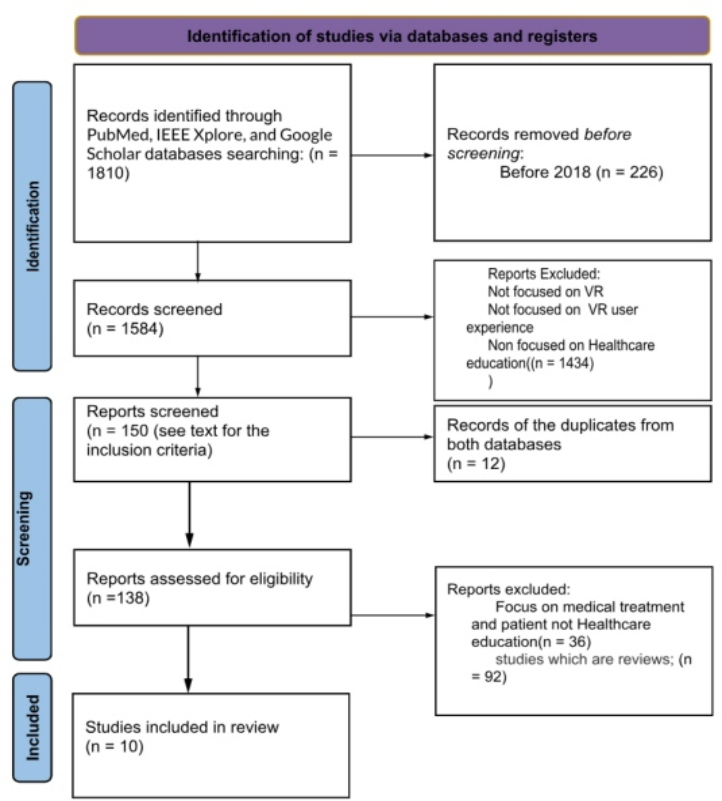
The exclusion criteria were as follows: (1) non-medical research; (3) The research does not pay attention to VR; (3) Review study and the study focused on a specific country; (4) Research not focused on medical training and teaching, non-scientific and anecdotal papers are excluded. Figure 1 shows a detailed description of how this process is followed.
Coding the Papers Initial screening was performed based on the title and abstract. Full-text articles were obtained for all abstracts that initially met the inclusion criteria and for articles for which rejection could not be determined. All included full-text articles were entered into the coding phase and coded and archived in endnote. References of studies that met the inclusion criteria were manually searched to identify other relevant research articles. Researchers independently reviewed the full-text articles and extracted the following data from each included article: authors, year of publication, field of application, sample size, assessment tool, and methodology.
The purpose of collecting the above data was to analyse which major dominant factors are used to assess the VR user experience in clinical training studies and for which clinical training VR training is applied.
Search Outcomes A total of 1810 studies were collected, comprising 283 from IEEE Xplore, 1510 from Google Scholar, and 17 from PubMed. 226 studies dating before 2018 were excluded. Researchers evaluated the remaining 1584 articles. At first, we reviewed the titles and abstracts of the papers and selected 150 that were relevant. We excluded 1434 studies that did not focus on healthcare education, VR, or VR user experience purposes. Subsequently, 12 duplicate studies, 92 review papers, and 36 studies focused on medical treatments and patients were excluded. Following individual reviews and researcher discussions, the selection and exclusion criteria were confirmed, leading to the final selection of studies for review. A total of 10 studies were included
1152 Zhang and Wang
in the analysis. The process of data collection and filtering is depicted (see Figure 1).
Figure 1: The figure shows the data collection and filtering process based on VR search criteria in the field of clinical training.
RESULT
By analysing the papers in depth it helps us to address the research question “How to evaluate user experience in clinical VR training and which factors are used to rate user experience in VR clinical training”. “In which clinical training areas VR clinical training is applied” and “in which VR user experience is specific in healthcare training”.
User Experience of Virtual Reality in Healthcare Clinical Training 1153
Table 1. The table shows the factors evaluated for VR clinical training user experience in ten articles.
Table available in the original PDF paper.
Factor Articles Usability Mäkinen et al., 2023; Lerner et al., 2020; Schild et al., 2018; Lorenz et al., 2019; Birrenbach et al., 2023; Pears et al., 2024 Enjoyment Lerner et al., 2020; Pieterse et al., 2023; Chang et al., 2019; Birrenbach et al., 2023 Engagement Mäkinen et al., 2023; Chang et al., 2019; Schild et al., 2018; Lorenz et al., 2019 Level of realism Pieterse et al., 2023; Schild et al., 2018; Pears et al., 2024 Immersion Mäkinen et al., 2023; Almousa et al., 2021; Pieterse et al., 2023 Attractiveness/ attention Chang et al., 2019; Schild et al., 2018; Lorenz et al., 2019 Presence Mäkinen et al., 2023; Chang et al., 2019 Experience consequence Mäkinen et al., 2023; Pieterse et al., 2023 User flow Mäkinen et al., 2023; Almousa et al., 2021 Interaction Almousa et al., 2021; Pieterse et al., 2023 perspicuity Lorenz et al., 2019; Birrenbach et al., 2023 Ease of control Salovaara-Hiltunen et al., 2019; Birrenbach et al., 2023 learnability Salovaara-Hiltunen et al., 2019; Pieterse et al., 2023 Perceived usefulness Lerner et al., 2020; Chang et al., 2019 Attitude towards training Lerner et al., 2020; Chang et al., 2019 Novelty Pieterse et al., 2023; Lorenz et al., 2019
Dominant Factors Are Used to Rate User Experience in VR Clinical Training As healthcare and technology continue to advance, VR training has become increasingly prevalent in clinical healthcare training to increase the confidence of the trainees and reduce the risk to the patients. The included articles not only demonstrated the use of VR in healthcare clinical training, but also evaluated the user experience. As a result, the user experience in VR training has received a lot of attention and has become a focal point of research and discussion. Out of the ten studies, six evaluated usability, with five utilizing the System Usability Scale(SUS) evaluation (Jordan and Al, 1996). Four studies respectively examined “enjoyment” and “engagement,” and three studies evaluated “immersion,” “realism,” and “attention.” Two studies assessed “the sense of presence,” “experiential consequences,” “user flow,” “interaction,” “clarity,” “ease of control,” “learnability,” “perceived usefulness,” “attitude toward training,” and “novelty,” respectively. Additionally, “satisfaction,” “dependability,” “stimulation,” and efficiency et al. were individual criteria used in separate studies (see Table 1). Clinical areas in which VR training is applied.
1154 Zhang and Wang
Clinical Areas in Which VR Training Is Applied VR clinical training has been extensively utilized across various medical fields. In this review, ten studies showcasing the application of VR in healthcare clinical training are presented individually. The predominant area of application was surgery, with five studies demonstrating the use of VR training in surgical settings. This was followed by emergency, with four studies focusing on VR clinical training in this area. Additionally, two studies focused on nursing VR training, one on examination, and one on gynecology (see Table 2).
Table 2. :The table shows ten articles on clinical areas in which VR training is applied.
Table available in the original PDF paper.
Surgery Pears et al., 2024; Lorenz et al., 2019; Pieterse et al., 2023; Almousa et al., 2021; Birrenbach et al., 2023 Emergency Lerner et al., 2020; Salovaara-Hiltunen et al., 2019; Pieterse et al., 2023; Schild et al., 2018 Nursing Salovaara-Hiltunen et al., 2019; Mäkinen et al., 2023 Examination Pears et al., 2024 Gynecology Chang et al., 2019
The Special Factors for VR User Experience in Medical Training After conducting a thorough review of existing literature, it is evident that there is limited discussion of user experience factors within the context of VR training for medical training. Three studies have concluded that a sense of presence, immersion, and simulation are crucial factors for the success of VR training (Schild et al., 2018; Birrenbach et al., 2023; Almousa et al., 2021). One case study emphasized that realistic VR simulations can more effectively provide trainers with real-world experiences rather than offering multiple choices for the trainee (Almousa et al., 2021). Another study highlighted the importance of avoiding immersion-interrupting elements, such as dialog boxes or drop-down menus, in VR training (Birrenbach et al., 2023). On the other hand, a high level of immersion provides a positive learning experience (Schild et al., 2018). Emphasizing the intention of learning in VR training systems has also been recommended (Chang et al., 2019), and clinical VR training has been shown to help alleviate the anxiety of medical trainers (Pears et al., 2024).
CONCLUSION
The review revealed that usability is the dominant factor for assessing user experience in the clinical VR training. The SUS was widely used to test system usability, and factors such as Enjoyment and Engagement, Immersion, Level of Realism, and Attention were also the main criteria used to judge the user experience in VR training. Although there are no standardized assessment criteria yet (Zarour and Alharbi, 2017), the SUS rating scale is prevalent in evaluating the user experience of VR training. This review sets the stage for establishing a standard for evaluating the user experience of medical
User Experience of Virtual Reality in Healthcare Clinical Training 1155
VR training. In addition, this review found that VR training is extensively utilized in surgical, emergency, and nursing areas of medical clinical training. All of these cases evaluate the user experience of VR training, reflecting the fact that user experience has been increasingly emphasized as a way of evaluating clinical VR training. However, there are limited UX factors for judging provided for the specificities associated with clinical training, and this area deserves further exploration. The review will help researchers to be more targeted in the future to develop criteria that are more appropriate and responsive to the clinical VR training in healthcare.
REFERENCES
Almousa, O., Zhang, R., Dimma, M., Yao, J., Allen, A., Chen, L., Heidari, P. and Qayumi, K. (2021). Virtual Reality Technology and Remote Digital Application for Tele-Simulation and Global Medical Education: An Innovative Hybrid System for Clinical Training. Simulation & Gaming, 52(5), p. 104687812110082. DOI: https://doi.org/10.1177/10468781211008258. Atherley, A., Dolmans, D., Hu, W., Hegazi, I., Alexander, S. and Teunissen, P. W.
(2019). Beyond the struggles: a scoping review on the transition to undergraduate clinical training. Medical Education, [Online] 53(6), pp. 559–570. DOI: https: //doi.org/10.1111/medu.13883. Chang, C.-W., Yeh, S.-C., Li, M. and Yao, E. (2019). The Introduction of a Novel Virtual Reality Training System for Gynecology Learning and Its User Experience Research. IEEE Access, [Online] 7, pp. 43637–43653. DOI: https://doi.org/10. 1109/ACCESS.2019.2905143. de Lera, E., Almirall, M., Valverde, L. and Gisbert, M. (2013). Improving User
Experience in e-Learning, the Case of the Open University of Catalonia. Design, User Experience, and Usability. Health, Learning, Playing, Cultural, and Cross- Cultural User Experience, pp. 180–188. DOI: https://doi.org/10.1007/978-3- 642-39241-2_21. Guay, F., Vallerand, R. J. and Blanchard, C. (2000). On the Assessment of Situational Intrinsic and Extrinsic Motivation: The Situational Motivation Scale (SIMS). Motivation and Emotion, [Online] 24(3), pp. 175–213. DOI: https://doi.org/10. 1023/a:1005614228250. Jordan, P. W. and Al, E. (1996). Usability evaluation in industry. London: Taylor &
Francis, pp. 189–94. Kardong-Edgren, S., Breitkreuz, K., Werb, M., Foreman, S. and Ellertson, A.
(2019). Evaluating the Usability of a Second-Generation Virtual Reality Game for Refreshing Sterile Urinary Catheterization Skills. Nurse Educator, 44(3), pp. 137–141. DOI: https://doi.org/10.1097/nne.0000000000000570. Lerner, D., Mohr, S., Schild, J., Göring, M. and Luiz, T. (2020). An Immersive Multi- User Virtual Reality for Emergency Simulation Training: Usability Study. JMIR Serious Games, 8(3), p. e18822. DOI: https://doi.org/10.2196/18822. Lorenz, M., Constanze Neupetsch, Rotsch, C., Philipp Klimant and Hammer,
N. (2019). Early Virtual Reality User Experience and Usability Assessment of a Surgical Shape Memory Alloy Aspiration/Irrigation Instrument. DOI: https://doi.org/10.1109/vr.2019.8798144. Mäkinen, H., Haavisto, E., Havola, S. and Koivisto, J. (2023). Graduating nursing students’ user experiences of the immersive virtual reality simulation in learning – A qualitative descriptive study. Nursing Open. DOI: https://doi.org/10.1002/no p2.1571.
1156 Zhang and Wang
Pears, M., Antoniou, P. E., Eirini Schiza, Georgios Ntakakis, Henderson, J., Fotos Frangoudes, Nikolaidou, M. M., Evangelia Gkougkoudi, Pattichis, C. S., Bamidis, P. D. and Stathis Th. Konstantinidis (2024). Virtual reality reusable e- resources for clinical skills training: a mixed-methods evaluation. Personal and ubiquitous computing. DOI: https://doi.org/10.1007/s00779-024-01805-9. Pieterse, A. D., Hierck, B. P., de Jong, P. G. M., Ginn, T. F., Hamoen, E. C. and
Reinders, M. E. J. (2023). User experiences of medical students with 360-degree virtual reality applications to prepare them for the clerkships. Virtual Reality. DOI: https://doi.org/10.1007/s10055-022-00731-6. Pieterse, A. D., Huurman, V. A. L., Hierck, B. P. and Reinders, M. E. J. (2018).
Introducing the innovative technique of 360
virtual reality in kidney transplant education. Transplant Immunology, 49, pp. 5–6. DOI: https://doi.org/10.1016/j. trim.2018.03.001. Radcliffe, C. and Lester, H. (2003). Perceived stress during undergraduate medical training: a qualitative study. Medical Education, 37(1), pp. 32–38. DOI: https: //doi.org/10.1046/j.1365-2923.2003.01405.x. Salovaara-Hiltunen, M., Heikkinen, K. and Koivisto, J.-M. (2019). User experience
and learning experience in a 4D virtual reality simulation game. International Journal of Serious Games, 6(4), pp. 49–66. DOI: https://doi.org/10.17083/ijsg.v 6i4.305. Schild, J., Lerner, D., Misztal, S. and Luiz, T. (2018). EPICSAVE — Enhancing vocational training for paramedics with multi-user virtual reality. [Online] IEEE Xplore. DOI: https://doi.org/10.1109/SeGAH.2018.8401353. T. Birrenbach, R. Wespi, Hautz, W. E., Berger, J., Schwab, P. R., G. Papagiannakis,
Exadaktylos, A. K. and Sauter, T. C. (2023). Development and usability testing of a fully immersive VR simulation for REBOA training. International Journal of Emergency Medicine, 16(1). DOI: https://doi.org/10.1186/s12245-023-00545-6. Zaharias, P. and Pappas, C. (2016). Quality Management of Learning Management Systems: A User Experience Perspective. Current Issues in Emerging eLearning, [Online] 3(1). Available at: https://scholarworks.umb.edu/ciee/vol3/is s1/5/ [Accessed 24 Mar. 2024]. Zarour, M. and Alharbi, M. (2017). User experience framework that combines aspects, dimensions, and measurement methods. Cogent Engineering, 4(1). DOI: https://doi.org/10.1080/23311916.2017.1421006.
LISTED IN THE AHFE DIGITAL BOOKSTORE CATALOGUE
Explore the complete digital volume
Human Factors in Design, Engineering, and Computing
Read this individual research paper free through the original publisher, or explore the full digital proceedings book.
ISBN 978-1-964867-35-9
Explore this ISBN in the AHFE Bookstore ↗Listed in the July 2026 bookstore catalogue; search by ISBN to confirm current availability · Digital book purchase optional