Yutong Xia, Tianzi Sheng (2026). Wearable Smart Accessory Design Based on Emotional Design Theory. In: Human Factors in Communication of Design. AHFE Open Access, vol. 216, pp. 134–145. https://doi.org/10.54941/ahfe1007631
This paper looks at how emotional wearable smart accessories can meet the emotional needs of digital natives who struggle with phone addiction and attention problems (Sas, 2023). Current focus tools mainly use timers and punishments. They treat focus as simply “on” or “off,” and they ignore users’ emotions. To address this problem, we used the Kano model (Yang and Liu, 2026) and the Three‑Level Theory of Emotional Design (Zhou et al., 2025) to understand what users really need. We designed an animal‑shaped wearable pendant. Instead of being just a control tool, it becomes a companion that helps users focus. The Kano model helped us identify what users want most from emotional products. Based on the Three‑Level Theory, we created a phone strap with three features: a pressing ritual, emotional feedback through expressions, and a sense of growing companionship (Zhou et al., 2025). The animal design creates emotional connection. The pressing action helps users focus and reduces anxiety from heavy workloads (Chianella, 2020). This research shows how emotional wearables can turn focus tools into emotional partners. It offers new ideas for designing wearable devices and suggests future use in children’s attention training and special education.
Smartphones have changed how young people live. Do you have these habits? The first thing you do when you wake up is check your phone. The last thing you see before sleep is also your phone. Today, phones have become like an extra body part for many people.
Studies show that 52.8% of Chinese college students have smartphone addiction (Wang et al., 2022). Phone dependency not only breaks our attention into pieces but is also linked to mental health problems like depression and anxiety (Sohn et al., 2019).
This problem is especially clear among young people. This generation grew up with the internet. In the library, they pick up and put down their phones seven or eight times in just one hour. When working on a document, they switch to social media after writing just a few lines. After getting distracted, they feel guilty—but still cannot control themselves next time. These people are called “digital natives” (Prensky, 2001). They are good at using different apps and can handle many information streams at once. But at the same time, they have lost the ability to focus.
Wearable Smart Accessory Design Based on Emotional Design Theory 135 Because of this, focus tools have appeared. However, current focus tools like Forest and TomatoTodo mainly use timers and punishments (Forest App, 2025). The core problem is that these products treat people like machines that need to be controlled. They ignore users’ emotional needs.
RESEARCH PURPOSE AND SIGNIFICANCE Research Purpose
To address this problem, this study focuses on how emotional design can help with attention intervention. We want to explore a new kind of wearable device for focus management. This device would help young people reduce anxiety and build inner motivation through three key features: physical rituals, emotional feedback, and a sense of growing companionship (Sas, 2023; Zhou et al., 2025).
Research Significance Norman (2004) divides emotional experience into three levels: visceral, behavioral, and reflective. However, turning these three levels into real products has always been a challenge for designers. This study tries to break down these three levels into clear design actions. For example, the visceral level uses animal images to create emotional connection. The behavioral level uses pressing rituals. The reflective level uses a sense of growing companionship. This framework can help guide the emotional design of similar products. At the same time, this study uses the Kano model to understand user needs (Yang and Liu, 2026). The model helps us tell which emotional features are must-haves and which are nice-to-haves. This way, design efforts match what users really want.
ANALYSIS OF EXISTING DIGITAL SELF-CONTROL TOOLS The Concept of Digital Self-Control Tools
Researchers from the Polytechnic University of Turin published a review in ACM Transactions on Computer-Human Interaction. They define Digital Self-Control Tools (DSCTs) as tools that help users regulate how they use apps and websites. These tools use timers, lock mechanisms, and other methods (Monge Roffarello and De Russis, 2021). The main features of DSCTs include time tracking, blocking distractions, and setting usage limits. Their goal is to help users deal with attention problems caused by overusing digital devices.
Analysis of Typical Cases Take Forest as an example. This app uses tree planting as its main visual feedback system. Users drag a time slider on the home page to set their focus time. They tap the tree icon to start focusing. If users leave the app during the timer—for example, to check social media or play games—the tree dies
136 Xia and Sheng immediately and they earn no coins. Dead trees stay in the user’s record as a visual reminder of failed focus. In group mode, if one person quits early, everyone’s trees die. This strengthens group pressure.
Another popular app is TomatoTodo. Users can set a 25-minute timer or customize their own Pomodoro timer. After starting, they enter a countdown focus mode. However, user feedback shows that anxiety from these tools often comes from deeper psychological causes. One user said that using TomatoTodo for a long time made them feel tied down by the app. Their attention shifted from learning to just counting time. They studied just to fill time, which actually made them less efficient. This psychological pressure changed why they studied—from finishing tasks to just chasing timer numbers. Also, some features like whitelist settings are hard to use. New users waste extra time learning how to use the app, which actually hurts their time management.
Both apps use rigid rules. In Forest’s deep focus mode, leaving early kills the tree. In TomatoTodo’s study mode, force quitting stops the timer. Their social features and time-tracking may also create stress for some users. This all-or-nothing logic helps reduce phone use to some degree. But because it lacks emotional care and causes social comparison, it creates extra anxiety for some users.
CONCEPT EXPLANATION AND THEORETICAL RESEARCH Wearable Devices
The Concept of Wearable Devices Wearable devices are smart devices that people can wear on their bodies. Their main goal is to improve people’s quality of life through continuous user interaction and data collection. They focus on users’ safety, assistance, and entertainment needs.
Research on Wearable Devices in Attention Intervention Revibe is a wearable device created by Pearson company. It is designed for children and adults who have trouble focusing. The device uses an algorithm to decide when to send vibration reminders at set times. A study published in Brain Sciences found that children who used Revibe showed big improvements in attention, organization and planning, self-monitoring, and academic performance (Ayearst et al., 2023). This shows that wearable devices have a bright future in helping people with attention problems.
Emotional Design The Concept of Emotional Design
Norman (2004) explains emotional design theory in his book Emotional Design. He divides users’ emotional experiences with products into three levels: visceral, behavioral, and reflective.
Wearable Smart Accessory Design Based on Emotional Design Theory 137 The visceral level is about how a product looks and feels. It is the user’s first reaction to a product and the most direct trigger of emotion. At this level, products create instant emotional responses through visual and touch features.
The behavioral level focuses on how the product works and how users interact with it. Smooth interaction, quick feedback, and the right level of challenge all belong to this level.
The reflective level is about how the product connects to users’ identity and becomes part of their personal story. This level deals with meaning and memory.
Research on Emotional Design Theory Zhong et al. (2025) combined emotional design theory with scene thinking in their study of festival cultural and creative products. They created a scene level reconstruction method and used analytic hierarchy process to measure users’ emotional needs. This gives our study a useful method to follow.
At the same time, Endres et al. (2025) found through experiments that emotional design can greatly help learners stay focused in distracting environments. How does this work? Emotional design triggers and maintains situational interest, which lowers the mental effort needed for self-control. This means that when users face distractions, emotional design helps them stay focused more easily. They do not need to use extra willpower to fight against distractions.
Research Gap and This Study’s Approach Looking at all the research above, there are some gaps that still need to be filled. Studies on wearable devices are starting to move from just tracking data to being emotional companions. However, current research still has these missing pieces:
First, wearable devices for attention intervention do not fully respond to users’ emotional needs. Revibe’s vibration reminders are gentler than forced screen locks, but they are still one-way communication. There is no real emotional interaction between the device and the user (Ayearst et al., 2023).
Second, very few studies have looked at using physical rituals as behavioral anchors in wearable devices. Using expression feedback to show emotional states is also an area that remains mostly unexplored. There is room for new ideas here.
Third, most emotional design research focuses on digital screens or static products. Some studies have applied emotional design to cultural products, dynamic posters, and learning materials (Zhong et al., 2025; Endres et al., 2025). But there is little research that turns emotional design into physical wearable devices for attention intervention.
138 Xia and Sheng This study tries to fill these gaps. In our design process, we use the Three- Level Theory of Emotional Design as our main guide (Norman, 2004). We bring together animal images, pressing rituals, and growth witnessing into one wearable device. Our goal is to create something that meets users’ needs, helps with attention problems, and provides emotional support at the same time.
RESEARCH METHODS Purpose
This study uses two research methods. We looked at design appearance and focus functions separately. The Kano model helps us understand what focus features users really need and which ones matter most (Yang and Liu, 2026). The semantic differential method, combined with Norman’s Emotional Design Theory, helps us explore how users feel about different designs (Norman, 2004).
Using the Kano Model to Study Focus Function Needs Participants and Data Collection
This study focused on digital natives aged 18-35. To join the study, participants needed to: use their phones for 5 or more hours each day, feel they have trouble focusing, and know something about wearable devices. We sent out 362 questionnaires through the Questionnaire Star platform. We got back 335 valid responses. The response rate was 92.5%. Among the participants, 158 were male (47.2%) and 177 were female (52.8%). For age groups, 192 people were 18-25 years old (57.3%) and 143 were 26-35 years old (42.7%). For occupation, 208 were students (62.1%) and 127 were working professionals (37.9%).
To make sure our questionnaire was reliable, we used a retest method. We randomly picked 30 participants to fill out the questionnaire again two weeks later. The results from both times were 88.7% similar. This is above the 85% standard, which means our data is trustworthy.
User Need Analysis With the Kano Questionnaire After collecting the data, we sorted it and created a Kano evaluation table (Table 1). We used five categories to measure how each need affects user satisfaction: A (Attractive needs), O (One-dimensional needs), M (Must-be needs), I (Indifferent needs), R (Reverse needs), and Q (Questionable results). This helped us analyze what users really want.
The questionnaire covered three areas: appearance, function, and emotional value. To better understand what users like in terms of appearance, we set up comparison questions for each area. After analyzing all 335 responses, we got the Kano results for each user need (Table 1).
Emotional value Sense of companionship 54.6 25.1 7.8 9.6 2.1 0.8 A 0.81 –0.34
Table 1: Kano classification results of user needs (N = 335).
Table available in the original PDF paper.
140 Xia and Sheng After removing R and Q data, we calculated Better-Worse coefficients based on the four categories: A, O, M, and I. Based on the statistical results in Table 2, the analysis is as follows:
Appearance Dimension Analysis: As shown in the table, cute appearance (A = 46.3%) is classified as an Attractive need. Its Better value is 0.74, making it a key appearance feature for improving user satisfaction. Soft colors (O = 34.9%) are classified as a One-dimensional need, with Better = 0.67 and Worse = –0.54. The more this need is met, the more satisfied users become. In contrast, items like serious appearance and bold colors are classified as Reverse needs and should be avoided.
Function Dimension Analysis: One-touch quick start (M = 57.9%) is a Must-be need. Its Worse values are –0.84 and –0.79, meaning it is a basic function the product must provide. Real-time status feedback (O = 44.5%) and gentle distraction reminders (O = 41.8%) are One-dimensional needs. Their Worse values are relatively high (–0.74 and -0.58), meaning if these are not met, user satisfaction will drop significantly. Physical ritual (A = 48.4%) is an Attractive need, with Better = 0.75. It is a core function for creating a sense of surprise and delight.
Emotional Value Dimension Analysis: Sense of companionship (A = 54.6%), sense of achievement (A = 47.5%), and growth visualization (A = 44.5%) are all Attractive needs. Their Better values are all above 0.75. Among these, sense of companionship has the highest Better value (0.81), making it the core highlight of the design. Physical reward redemption shows a more scattered distribution (A = 24.8%, I = 25.7%) and needs to be considered together with other dimensions.
Note: Better-Worse coefficients were calculated after removing R and Q data, based only on the four categories A, O, M, and I. R-type needs are not included in the coefficient calculation.
DESIGN PRACTICE Design Strategy
Based on the Kano model analysis results from Section 4.1, this study builds a design strategy framework from four dimensions: product positioning, function strategy, appearance strategy, and interaction strategy.
Product Positioning Strategy In the Kano survey, sense of companionship, sense of achievement, and growth visualization were the Attractive needs that users most looked forward to. Therefore, we position this product as an “emotionally companionable wearable device.” It is no longer a control tool, but rather a partner that stays with users when they focus. The animal image helps users feel an emotional connection. The pressing action creates a behavioral anchor. The expressive feedback provides real-time companionship. These three mechanisms turn focusing into a process of growing together between users and their companion.
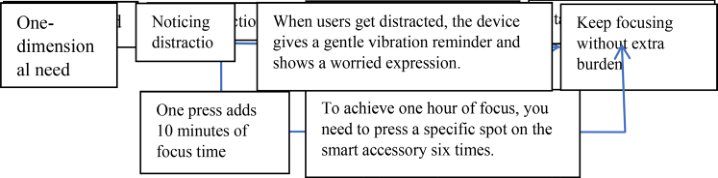
Figure 1: Function strategy diagram.
Function Design Based on Kano Model Results Based on the Kano classification, our function design follows three levels of user needs.
For must-be needs, we designed one-touch quick start. This feature reduces the mental effort users spend on making decisions and makes focusing much simpler. When users want to start focusing, they often hesitate. If the operation feels complicated, they may give up. That is why starting must be simple—just one press. When users press a specific spot on the wearable smart accessory, their electronic device instantly enters focus mode. At the same time, a smiling face appears on the screen to encourage them and help them stay focused (Kano et al., 1984).
For one-dimensional needs, we designed real-time status feedback and gentle distraction reminders. Users need to know how much time is left and whether they get distracted. When they get distracted, they need a reminder— but without added pressure. For example, when the system detects that users have been using their device for two minutes, the animal’s expression changes to a worried face and the device gives a gentle vibration. This reminds users to return to focus without breaking their concentration.
For attractive needs, physical ritual is the key feature that makes our product different. The pressing action creates a sense of ritual for starting focus. This helps users build a conditioned reflex: whenever they press the specific spot on the animal, they instantly enter focus mode (Norman, 2004).
Appearance Strategy The appearance strategy comes from the Kano results of the appearance dimension. Cute appearance is an Attractive need. Users showed a preference for rounded shapes, with a score of 1.68. So the product should have round, soft shapes and avoid sharp corners. Soft colors are a One-dimensional need. Users prefer low-saturation colors that are easy on the eyes. Serious appearance and bold colors are Reverse needs and should be avoided in the design.
Appearance Strategy The appearance strategy comes from the Kano results of the appearance dimension. “Cute appearance” is an attractive need. Users showed a preference for rounded shapes, with a score of 1.68. So the product should have round, soft shapes and avoid sharp corners (Kano et al., 1984). “Soft
142 Xia and Sheng colors” are a one-dimensional need. Users prefer low-saturation colors that are easy on the eyes. “Serious appearance” and “bold colors” are reverse needs and should be avoided in the design.
Interaction Strategy The interaction design focuses on pressing as the main action. Physical ritual is achieved through pressing: a light press starts focus mode, the product vibrates, and a smiling face lights up. A long press ends focus mode, with blinking lights as celebration. When users get distracted, pressing again immediately returns them to focus mode.
The expression feedback uses a design inspired by human-like features. When users see a worried expression, they realize they have drifted off— but without feeling punished like with traditional apps. This greatly reduces psychological pressure (Norman, 2004). The whole interaction makes users feel accompanied, not watched.
Design Solution Form Design
The product is designed as a round pendant. It is 30mm in diameter and 9mm thick. Based on the design needs, we use a dot matrix screen that clearly shows 64 LED lights. If the size were smaller, the pixels would be too dense and the cost would go up. If it were larger, the phone would feel too heavy when hanging, and users would not accept it.
The outer shell is made of high-transparency acrylic. The circuit board inside is slightly visible, giving users a sense of exploration and technology. The strap length can be adjusted from 80 to 120mm. It can be attached to phone holes, backpack zippers, or keychains. This responds to what users mentioned in interviews: “I hope I can carry it all the time, but it shouldn’t get in the way.” This size and weight seem to be the right balance.
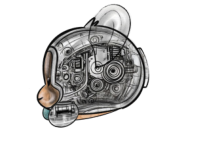
Figure 2: Three views of the curious monkeywearable smart accessory.
Animal Image Series Design According to the Kano results, “cute appearance” (Better = 0.74) is an attractive need, and “soft colors” (Better = 0.67) is a one-dimensional need (Kano et al., 1984). This means that if the design is cute enough, users will
Wearable Smart Accessory Design Based on Emotional Design Theory 143 feel delighted. If it is just okay, they won’t deduct points. However, if the colors are too bold, users will feel uncomfortable.
Based on this, we chose six animal images for our first collection. Each animal has its own personality. So far, only the monkey design is finished. The other five are still being improved. But the direction for the whole series is already set.
Character Name Personality Key Features Color Scheme Warm Bear Warm companionship- oriented Rounded shape Gentle eyes
Gentle Rabbit Gentle and sensitive type Gentle eyes Long ear silhouette
Curious Monkey Independent and curious type Soft lines Lively eyes
Honest Dog Loyal and trustworthy type Droopy ears Honest expression
Spirited Deer Graceful and elegant type Antler silhouette Light feel
Steady Elephant Steady and inclusive type Sturdy lines Calm presence
Animal Image Series Design To some extent, when users choose an animal, they are choosing who they want to be. Some people pick the bear because they feel they are warm like a bear. Others pick the deer because they hope to be more graceful. This kind of projection is the foundation for building an emotional connection. But we do not predict which user will pick which animal. Later, we might use blind boxes to make it more fun.
Pressing Ritual Interaction Design Physical ritual (Better = 0.75) is an attractive need. Pressing itself is simple. But every time users press, they get the same feedback. Over time, this creates
144 Xia and Sheng a conditioned reflex—pressing means it is time to focus. Here are some examples of the interaction:
When users give a light press on the product, the expression screen lights up with a smiling face. A linear motor gives a gentle vibration (50ms single pulse). The phone app automatically opens the focus timer screen. This whole process must happen within 0.3 seconds. If the light takes too long after pressing, the ritual feeling is broken.
When the system detects that users have switched to entertainment apps (users add their own whitelist—we do not judge for them), the expression changes to a worried face. The linear motor gives a gentle vibration (30ms × 3 pulses). If users return to focus after the reminder, the expression goes back to calm. The reminder does not lock the app. Users can ignore it. But the worried expression stays.
When users press and hold for 2 seconds, the expression blinks in celebration (happy blink × 3 times). The linear motor gives two short vibrations. The phone shows how long they focused this time.
CONCLUSION
This study explored a new possibility for wearables in attention intervention— moving from control tools to relationship companions. Using the Kano model, we found that emotional features like companionship and physical ritual are core values that truly satisfy users (Kano et al., 1984). Attention problems reflect an imbalance between people and technology; the solution lies in rebuilding emotional connection, not stricter monitoring.We turned Norman’s Three-Level Theory into actionable design elements (Norman, 2004), offering a framework for similar products.This study has limitations: only the monkey design is finished, other animal designs need development, and technical aspects require user testing. Future research could explore applications in children’s attention training and special education.Technology evolves, but people should always be the purpose of design—not just a means to an end.
REFERENCES
Ayearst, L.E., Brancaccio, R. and Weiss, M.D. (2023) ‘An open-label study of a wearable device targeting ADHD, executive function, and academic performance’, Brain Sciences, 13(12), p. 1728. Chianella, R. (2020) ‘Designing for self-awareness: evidence-based explorations
of multimodal stress-tracking wearables’, Proceedings of the ACM Conference, pp. 45–58. Endres, T. et al. (2025) ‘Sustaining focus when it’s hardest: emotional design strengthens sustained learning, especially in contexts with attractive alternatives’, Computers & Education, 233, p. 105313. Forest App (2025) Forest专注森林app下载. Available at: https://www.pchome.net/
games/574923.html (Accessed: 5 March 2026). Kano, N. et al. (1984) ‘Attractive quality and must-be quality’, Journal of the Japanese Society for Quality Control, 14(2), pp. 39–48.
Wearable Smart Accessory Design Based on Emotional Design Theory 145 Monge Roffarello, A. and De Russis, L. (2021) ‘Understanding and simplifying the
design of digital self-control tools’, ACM Transactions on Computer-Human Interaction, 28(3), pp. 1–34. Norman, D.A. (2004) Emotional Design: Why We Love (or Hate) Everyday Things.
New York: Basic Books. Prensky, M. (2001) ‘Digital natives, digital immigrants’, On the Horizon, 9(5), pp. 1–6. Sas, C. (2023) ‘Designing for emotion and attention regulation’, Trinity College
Dublin Seminars, 23 February. Sohn, S.Y. et al. (2019) ‘Prevalence of problematic smartphone usage and associated mental health outcomes amongst children and young people: a systematic review, meta-analysis and GRADE of the evidence’, BMC Psychiatry, 19(1), p. 356. Wang, A. et al. (2022) ‘The prevalence and psychosocial factors of problematic
smartphone use among Chinese college students: a three-wave longitudinal study’, Frontiers in Psychology, 13, p. 877277. Yang, J. and Liu, Y. (2026) ‘Research on user needs in the design of elderly smart bracelets based on the KANO model’, ACM Digital Library, pp. 1-10. Zhong, L., Zhang, E. and Hu, J. (2025) ‘Scene thinking based emotional design of
festival cultural and creative products’, Packaging Engineering, 46(8), pp. 464–477. Zhou, J. et al. (2025) ‘ShapeBand: design of a shape-changing wristband with soft materials and physiological sensors for anxiety regulation’, MDPI Information, 16(2), p. 101.
LISTED IN THE AHFE DIGITAL BOOKSTORE CATALOGUE
Explore the complete digital volume
Human Factors in Communication of Design
Read this individual research paper free through the original publisher, or explore the full digital proceedings book.
ISBN 978-1-964867-92-2
Explore this ISBN in the AHFE Bookstore ↗Listed in the July 2026 bookstore catalogue; search by ISBN to confirm current availability · Digital book purchase optional