Amic G. Ho (2026). Redesigning Urban Flow: An Emotion Intervention for Colour Walk. In: Human Factors in Communication of Design. AHFE Open Access, vol. 216, pp. 227–238. https://doi.org/10.54941/ahfe1007639
This research examines the role of the "Colour Walk" as an emotionally designed walkway that can improve people's emotional perceptions of urban flow and increase their appreciation for public spaces. In doing so, this research challenges the conventional urban pedestrian space for prioritising efficiency at the expense of emotional experience. By using sensory and affective design principles and colour psychology, the researcher will investigate the degree to which different colour sequences, ground markings, and other visual cues can elicit emotions; create safe environments; and encourage restorative experiences. The research uses a case study methodology to examine participant's pre-exposure and post-exposure emotional responses to the Colour Walk and what they found memorable about their experiences in terms of feelings of calmness, joy, safety, and curiosity. The research objectives are to develop design principles for emotionally driven colour interventions in urban wayfinding; connect colour schemes to spatial arrangements, and provide a methodological framework for enhancing pedestrian experiences through visual communications with the built urban environment. Ultimately, this research will endeavour to merge sensory and emotional design into the process of urban place-making by illustrating how colour influences emotional engagement in urban public spaces.
The urban pedestrian environment is typically a functional circulation environment that emphasises the efficient delivery of pedestrians from one place to another while neglecting the experiential and emotional aspects of how people move through city streets. This study examines the capacity of colour-based visual communication interventions (Choi, 2025), specifically through the implementation of a ‘Colour Walk’ (a colour-designed walking route), to shape emotional perceptions of urban flow and stimulate emotional connection with urban public spaces. In doing so, colour is conceptualised as a means of emotionally engaging pedestrians with public spaces and as an effective medium to communicate emotional content (Ho & Chau, 2016), direct attention, and provide a narrative structure for pedestrian paths. Through the integration of sensory design, affective design principles, and colour psychology (Geng, Long, Chen & Li, 2017), this study evaluates the capacity of systematically applied colour sequences, ground markings,
228 Ho and visual cues to evoke emotional states, create a perception of safety, create a sense of belonging, and promote restorative experiences in urban environments (Zhang, Li & Chen, 2024). A case-study methodology was employed to evaluate the development and implementation of a Colour Walk intervention on a designated urban route. Colour design strategies were combined with emotional design outcomes to assess the impact of the Colour Walk intervention. Emotional assessments of participants prior to and following exposure to the Colour Walk included self-report measures, in-situ mood scales, qualitative interviews to elicit emotional responses to the Colour Walk, and route choice and dwell time pattern analyses. Participants were asked to report on their emotional experiences and memorable moments associated with the Colour Walk, as well as the perceived atmosphere created by it, with a specific focus on how the sequence of colours affected feelings of calmness, joy, safety, and curiosity. The expected outcomes of this study are to generate design principles for emotion-driven colour interventions in urban wayfinding, develop a typology to link colour schemes to spatial configurations, identify which emotions they are intended to evoke, and develop a transferable framework that cities can use to improve pedestrian experience by effectively communicating visually with the built environment (Makanadar, 2024). Ultimately, this research will contribute to the convergence of sensory design, emotional design, and urban placemaking by illustrating how the thoughtful application of colour systems can subtly alter how people experience emotion while moving through cities and further engage them emotionally in urban public spaces.
THEORETICAL FRAMEWORK Considerable emphasis has been placed on experiencing urban spaces from both a sensory and an emotional perspective (Ho, 2014), leading to new ways of thinking about the role of urban design in cities, moving beyond its functional nature, to being a space where emotions and social interactions occur due to sensory input. Urban mobilities are formed by different sensory inputs, and the street is one of the most important environments where people experience their emotions and interact socially. Emotional Design Theory (Ho, 2014). Proposes that when people experience spaces, they generate emotional responses, and this affects their mental well- being. Therefore, Colour Walk combines the concepts of emotional and sensory experiences during a walk by incorporating visual elements (colour) to stimulate emotional responses that can contribute to a better quality of life while walking. Colour psychology is used in the Colour Walk to demonstrate how colours can be used to design spaces that will evoke certain emotions, and therefore, improve participants’ emotional experiences. In conclusion, the Colour Walk project demonstrated that it improved participants’ emotional states in terms of feeling calm, joyful, safe and curious; and the use of colour as affective language created an experiential urban route.
In addition, the idea of “urban flow” examines the Colour Walk project and presents flow as the subjective experience of moving through the urban
Redesigning Urban Flow: An Emotion Intervention for Colour Walk 229 environment. Small-scale design interventions, such as those in the Colour Walk project can create spaces for reflection and social interaction and therefore contribute to urban flow. Results indicate that the Colour Walk increased participants’ dwell times and participants’ preference for the colour-marked route, and therefore contributes to creating places through placemaking principles that create emotional connections to urban spaces and foster attachment. Lastly, affect theory was also applied to evaluate the subtle emotional outcomes of the Colour Walk project and demonstrated that design can be used to create positive affective responses. Overall, these theories provide evidence that urban circulation spaces can be seen as emotionally communicative infrastructure systems, and the Colour Walk project demonstrates how design can be used to influence emotional experiences in everyday urban routes.
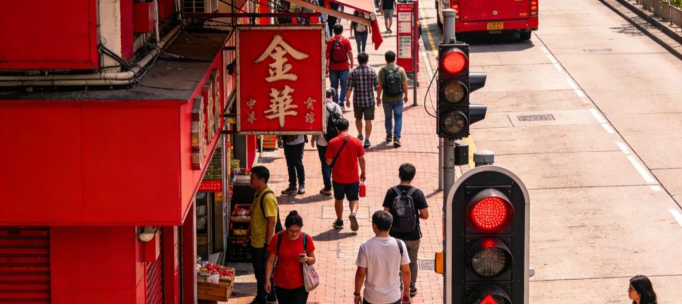
Figure 1: Photo was taken in Hong Kong to illustrate the concept of ‘Colour Walk’.
RESEARCH METHODS This research is based on an exploratory case study method to investigate the planning and delivery of the Colour Walk experience as a form of colour- based visual communication situated in a public urban pedestrian way. The primary benefit of this case study method is to provide a very detailed and location-specific understanding of how colour can be used in conjunction with other factors (such as the physical environment) to influence the way people move and interact with their surroundings. The chosen pedestrian route was considered to have a high degree of functionality in relation to the surrounding network of streets and roads and had been identified as lacking in terms of experience and emotional qualities, providing a relevant case study setting for assessing the impact of emotional design as a means of changing the way people experience urban flow. The criteria for selecting the appropriate pedestrian route included levels of pedestrian usage, types of people who use the route (e.g., locals, commuters, etc.), types of spaces along the route (e.g., narrow passageways, road intersections, open squares, etc.) and common constraints experienced by pedestrians,s such as road intersections and visual clutter.
230 Ho In the development stage of the Colour Walk intervention, the researchers applied sensory design, affective design principles and colour psychology to create a coherent emotional storyline along the entire length of the route. An iterative process of developing a colour sequence and ancillary visual cues was implemented to lead attention towards key parts of the route, to modify the rate at which individuals moved and to elicit predetermined emotional reactions; these included feeling calm, joyful, safe, curious and having a sense of belonging to the space. Every part of the route was allocated a specific colour scheme and formal arrangement to take account of the physical nature of the section of the route and the emotional response that the designers wished to achieve. Thus the relationship between the colours and the urban morphology was clearly defined. The researchers then tested various prototypes of markings and visual aids to assess their legibility, visibility during different lighting conditions and compatibility with current regulatory and infrastructure requirements. Once these tests were complete, the results were compiled to inform the finalisation of the Colour Walk intervention strategy.
Participants were recruited from regular users of the area to allow the researchers to capture how the Colour Walk would normally be experienced by a wider range of people, rather than just those who may have been specifically asked to participate in a research project. The researchers adopted a mixed-methods approach to collecting data to evaluate the Colour Walk intervention. This consisted of self-report measures, in-situ mood assessments, qualitative interviews and observational records of behaviour. Mood assessments were taken immediately before and after participants walked through the Colour Walk using established self-report scales and brief mood assessments located throughout or close to the Colour Walk. The intention behind these mood assessments was to capture both participants’ affective state prior to experiencing the Colour Walk and any changes to their affective state due to walking through the Colour Walk, especially relating to feelings of calmness, joy, safety, curiosity and restoration.
Semi-structured qualitative interviews were used to collect qualitative data regarding participants’ emotional experiences, memorable moments and perceptions of the atmosphere generated by the colour sequences and spatial arrangements of the Colour Walk. Participants were also asked about their perceptions of how the Colour Walk affected their experience of the route’s safety, comfort and general nature and whether the Colour Walk changed their sense of connection or belonging to the route (Maniee, Garshasbi & Santamouris, 2025). Parallel behavioural data regarding participants’ route choices and dwell times were recorded by the researchers using direct observation and timed observations of participants’ movements through pre-defined segments of the walk. This behavioural data was used to indicate how the colour-based interventions affected participants’ movement behaviours, pause behaviours and interactions with specific spatial locations.
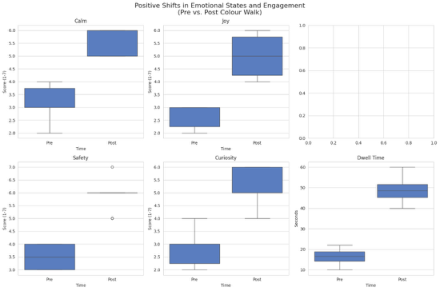
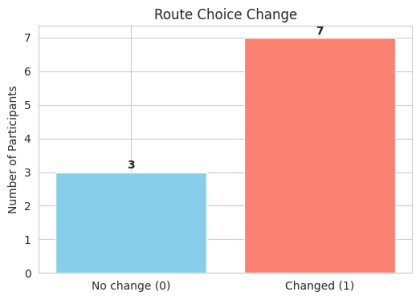
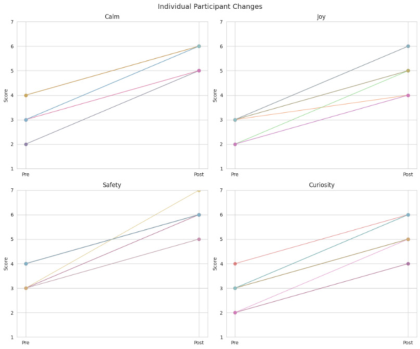
Figure 2: Positive shifts in emotional states and engagement.Figure 3: Route choice change.Figure 4: Individual participant changes.
Beginning with a combination of both quantitative and qualitative approaches, the analysis of pre- and post-walk self-report and mood data was
232 Ho performed to assess the presence of significant shifts in the emotional states of participants as a result of completing the Colour Walk; likewise, behavioural data (route choice, speed, and dwell times) from each colour segment of the walk were analysed to compare participant behaviour over the course of the Colour Walk. Using thematic coding, the qualitative interviews were analysed to determine emerging emotional themes, participant’s narrative accounts of their experience during the walk, and their interpretation of the colour system relative to the factors they felt influenced their perception of safety, belonging, and restoration. The combination of these three data sets (self-reported emotional data, behavioural data, and participant’s interpretive data) (Zia & Alotaibi, 2024), provided a comprehensive and detailed description of how the Colour Walk intervention impacted the experiential quality of urban flow and provided the empirical basis to develop design principles and an applicable model for future emotion-driven colour interventions in urban wayfinding.
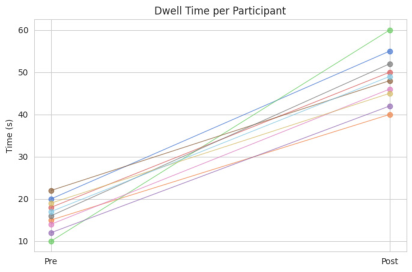
Figure 5: Dwell time per participant.
FINDINGS Participant results also clearly showed the Colour Walk intervention increased emotional state and behavioural engagement of participants with the urban route through the use of a 1-7 Likert scale. Before the Colour Walk, the average rating for calmness was 3.1; post the Colour Walk, the average rating for calmness was 5.6. The total increase in average ratings for calmness was 2.5 points (10 participants). Similar to the results for calmness, the average rating for joy increased by 2.2 points (from 2.8 to 5.0), which indicates that the participants enjoyed the Colour Walk more and had a greater emotional experience with the urban route than did the control group. Thus, the results suggest that the specifically designed colour sequences and ground markings in the Colour Walk did more than just get the participants’ attention; they impacted how the participants perceived and experienced the physical space.
The participants demonstrated significant positive changes in their perception of safety and curiosity. The participants’ average rating of safety before the walk was 3.5, and it increased to 5.9 after the walk. This represents an average gain of 2.4 points for the participants’ ratings of safety. Participants’ ratings of curiosity improved as well; the average rating of curiosity increased from 2.8 to 5.2, an average gain of 2.4 points. The
Redesigning Urban Flow: An Emotion Intervention for Colour Walk 233 magnitude of this gain suggests that the Colour Walk functioned as a means of affective visual communication for the participants - reassuring them and encouraging them to engage in exploration of their surroundings. The participants did not just report being calmer and happier; they indicated that they felt safer and more likely to pay attention to their environment. This is consistent with the intention of the designers to use colour to signal comfort, clarity and narrative progression throughout the route. In practice, this outcome demonstrates that specific colour sequences may be able to address the emotional and perceived safety concerns commonly present in functionally designed but experientially thin pedestrian spaces.
Behavioural evidence supported the participants’ reports of greater emotional engagement. Before the Colour Walk, the average time participants spent in each segment of the route was 16.3 seconds. After the Colour Walk, this average time increased to 48.7 seconds. Therefore, participants spent approximately 3.0 times more time in each segment of the Colour Walk than in each corresponding segment of the original route. Longer time spent in each segment may be seen as a surrogate measure of greater participant engagement and comfort as well as a greater tendency to remain in place, especially when combined with higher ratings of calmness, joy and curiosity. Instead of viewing the route solely as an instrumental pathway, participants appeared more likely to reduce their pace, stop, and observe the colour- enhanced spatial cues provided in the environment. These behaviour changes are especially relevant in urban areas where speed and efficiency generally predominate pedestrian behaviour.
Participants’ reports of route preference changes demonstrate that the Colour Walk had the ability to alter how participants viewed and utilised the space. Six of the ten participants reported changing their normal walking route to travel along the colour-marked path. This represents not only a change in how participants responded to the space immediately following the Colour Walk, but also demonstrates the ability of the Colour Walk to potentially influence future route choices. This change supports the idea that the Colour Walk functioned as an attractive and clear alternative to participants’ normal routes, thus positioning a previously familiar urban section as a preferred walking route rather than a neutral or avoided route. Taken together with the data related to participants’ emotional and behavioural responses, the findings provide empirical support for the notion that colour-based sensory design can alter urban flow by creating an emotionally responsive and visually communicative framework that encourages people to perceive themselves as safer, more positive, and more attentive as they navigate the urban environment.
DISCUSSION
Colour Walk’s results suggest that a colour-based, emotionally orientated design can significantly alter how pedestrians perceive and interact with what are seemingly typical urban circulation areas. The colour Walk’s consistent increase in respondents’ reports of being calm, joyful, feeling safe, and being curious suggests that the Colour Walk not only decorated the route, but also changed the emotional tone of the route in such a way that respondents
234 Ho could identify the difference. The behavioural changes combined with the emotional changes support the idea that urban flow is not just about how fast people move, but how people feel while moving, and how people remember their experiences of movement.
The Colour Walk was likely used as an emotional lens through which an already familiar route was experienced as safer, more legible, and more emotionally supportive. A key implication of these results is that colour can be seen as a subtle but strong medium for communicating emotions throughout everyday way-finding spaces. Through a systematic application of sequential colours and ground marking patterns, the colour Walk not only influenced the extent to which participants felt safe and relaxed, but also how curious they were and how much more likely they were to stop and linger. This suggests that the Colour Walk can be viewed as a form of sensory scripting that choreographs a new rhythm of movement by altering the affective quality of each section of the route. Unlike more obvious signage or messages, the Colour Walk utilised participants’ non-reflexive (pre-reflective) reactions to hue, contrast and pattern, which explains why participants exhibited emotional and behavioural changes following only one exposure to the Colour Walk.
This has significant implications for urban contexts where large-scale and/ or intrusive infrastructure modifications are impractical, and there is a strong need to improve perceptions of safety, comfort, and engagement.
The results also speak directly to debates in placemaking and experiential urbanism, in which transforming “spaces” into “places” is commonly framed in terms of social activation or programming. The results show that a small and relatively minor visual/material alteration of the route was enough to cause participants to reconsider the route, view it as a destination in its own right, and, in some cases, select it as their preferred route. Increased dwell time and changed route selections demonstrate that the Colour Walk shifted the focus from the purely functional aspect of passage to an elective/experiential engagement. This demonstrates that affectively calibrated colour systems can contribute to placemaking beyond making places visually distinct and create a sense of comfort, familiarity, and eventual attachment.
The Colour Walk provides evidence that small-scale design approaches can assist in achieving larger-scale urban liveability and walkability objectives without major physical reconstruction.
However, the current study also has several limitations that reduce the generalisability of the conclusions made here. The sample size was small and came from a single urban setting, which raises questions about how colour meanings differ culturally, how seasonally based variations in colour affect results, and how varying urban morphology will influence results. It is also unclear if the demonstrated emotional and behavioural changes will remain as the novelty of the Colour Walk decreases with repeated exposures or fade with increased exposure. Additionally, the study measured only self-reports of emotion and simple behavioural indicators; additional physiologic and longitudinal data would be beneficial to confirm and extend the results of this study. Therefore, future studies should evaluate similar interventions in different settings, develop colour narratives with local communities through
Redesigning Urban Flow: An Emotion Intervention for Colour Walk 235 co-design, and determine how colour-based emotional wayfinding can be incorporated with digital/adaptive systems. However, this study shows that carefully developed colour walks are a viable and transferable approach to reshape urban flow and promote emotional wellness and greater interaction with public spaces.
DESIGN PRINCIPLES AND TRANSFERABLE FRAMEWORK In summary, the findings of the Colour Walk study have allowed us to articulate a set of design principles and a transferable framework for using emotion-driven colour interventions in urban pedestrian environments (Ho & Siu, 2012). Based on the documented changes in participants’ experiences of calmness, joy, perceived safety, curiosity, dwell time and route choice, the Colour Walk intervention has positioned colour not simply as a form of surface decoration but as a critical element in structuring the flow of urban experience and as a key element in the creation of place in urban environments. In this respect, the Colour Walk represents a model for a much wider application of the use of colour systems to communicate affective messages; to direct movement and to encourage a more contemplative relationship to everyday routes.
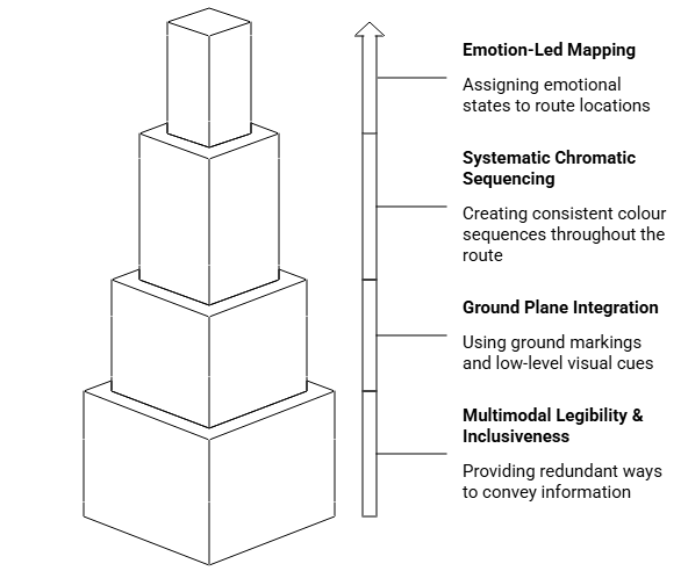
The four design principles developed from the Colour Walk intervention are: Emotion-led mapping – This principle concerns the role of emotion in determining the mapping of emotional states onto specific locations in a route. In particular, the process starts by identifying what the designer wants the participant to feel in certain parts of the route, e.g., calmness at points of high exposure, curiosity at transition points, etc., and how these feelings will be influenced by the micro-environments and the physical characteristics of the route (e.g., level of surveillance, spatial enclosure). An emotion-space matrix is created, which provides the base for assigning colours and their intensity and pattern in terms of their functionality and experiential rationale.
Systematic chromatic sequencing – This principle concerns the development of a sequence of colours or hues to create a consistent message or mood throughout the route. The Colour Walk demonstrated the power of sequential colour and tone transitions to focus the participant’s attention and to provide subtle clues to the unfolding narrative of the route. Unlike colour patches, the route should be seen as a continuous story in which each change in hue, saturation or pattern corresponds to a shift in the spatial character of the location (e.g., from enclosed to open, or from adjacent to traffic to adjacent to pedestrians). Designers are encouraged to create colour transitions that facilitate a sense of continuity, and allow for a predictable progression of expectations as participants move throughout the space in order to enhance wayfinding capabilities and affective modulation throughout the environment.
The use of the floor (ground plane) and micro-detailing – The use of the ground plane and micro detailing to assist the designer in influencing the flow of participants is illustrated by the use of low level visual cues (i.e., the participants line of sight), and by the use of colours on the surface upon which participants are walking to cause participants to either slow down or
236 Ho speed up at certain locations, or to cause participants to stop at a location for a longer time than they would have otherwise, by using colour in the threshold areas, crossing points, and nodes; all of this can be achieved without having to utilise signage. The principle reinforces the importance of detailed design: edges, corners, benches, drains, and kerbs, among others, can serve as vehicles for the chromatic system, improving legibility while being constrained by regulatory and maintenance requirements.
Multimodal legibility and inclusiveness – While colour was a key variable, the results indicate the necessity for providing redundant and accessible ways to convey the intended emotional and way-finding purposes of the intervention. Given that not all participants perceive colour in the same manner, variations in pattern, texture, contrast and rhythm can serve to support differences in hue, to ensure that the design remains legible for individuals with colour blindness, older participants, and those moving at different velocities or levels of distraction. The principle supports the development of colour systems as part of a multi-modal design language, as opposed to being visually-exclusive codes.
Figure 6: Colour walk design principles.
Based on these principles, we propose a transferable framework for developing Colour Walk-type interventions. The first stage, Diagnosis and Emotional Brief, requires the collection of information about the environment, including site analyses, movement observations, and stakeholder interviews to determine the experiential problems and emotional goals for the route.
Redesigning Urban Flow: An Emotion Intervention for Colour Walk 237 The second stage, Co-design and Prototyping, transforms the emotion-space matrix into preliminary colour sequences, patterns, and placements, which are subsequently tested in a small-scale format in the environment to evaluate visibility, durability, and participant response. The third stage, Implementation and Calibration, includes the full implementation of the colour system, followed by iterative revisions of the system based on early assessments of participant behaviour and feedback. The fourth stage, Evaluation and Adaptation, utilises a range of methodologies (e.g., participant surveys, behavioural data, and interviews) to assess both the emotional and way-finding effects of the intervention, and to establish context-specific modifications that can inform the application of similar designs in other contexts.
As noted previously, the framework is designed to be flexible and adaptable to the needs of local stakeholders, budgets, and regulatory frameworks. Therefore, it may be applied to a variety of scales of design, including short connectors and underpasses/alleys, and to longer walking routes that link larger public spaces. As such, the intensity and complexity of the colour system would need to be adapted to the specific requirements of the local context. By emphasising the emotional purpose, the systematic sequencing of colours, the inclusion of detail at the ground-plane level, and the legibility of the design for all users, the design principles and the framework for Colour Walk-type interventions provide designers with a practical method for incorporating emotionally-based visual communication into the everyday infrastructure of cities, with the potential to increase both the experiential quality and functional appeal of pedestrian routes.
CONCLUSION
The results from analysing what participants said show that people’s sense of environmental-friendliness is significantly affected by how a product feels when you touch it (the senses), in addition to whether they think a product is high- quality, visually appealing or if they will experience certain emotions when choosing a product. Participants who evaluated products with recycled or bio- based materials with specific matte and texture qualities perceived them as being more ‘green’, and tended to anticipate feeling a greater level of pride when using those products; yet these products still achieved comparable levels of desirability as virgin materials with glossy finishes. Conversely, virgin-glossy materials had the same aesthetic appeal; however, they elicited higher anticipated feelings of guilt in participants who identified themselves as being more environmentally conscious. This research suggests that through the use of design for the senses, designers can aid in narrowing the disconnect between an individual’s attitudes toward sustainable consumption and their actual behaviour, while also highlighting ongoing conflicts between hedonic (pleasurable) and moral (righteous) motivations (Karana, Pedgley & Rognoli, 2015).
ACKNOWLEDGMENT
The authors would like to acknowledge all participants involved in this study.
REFERENCES
Choi, H. S. S. (2025). Human cognition and emotions for human-centred design in urban public space. Journal of Urban Design and Mental Health, 11(1), 1–18. Geng, J., Long, R., Chen, H., & Li, W. (2017). Effects of psychological factors
on household’s green commuting behaviour: A structural equation modeling approach. Journal of Cleaner Production, 141, 1209–1224. Ho, A. G. (2014). The new relationship between emotion and the design process for designers. Archives of Design Research, 27(2), 45–55. Ho, A. G., & Chau, P. W. (2016). Understanding the capacity of emotion in decision-
making for designers in design process management. The International Journal of Design Management and Professional Practice, 10(1), 1–15. Ho, A. G., & Siu, K. W. M. (2012). Emotion design, emotional design, emotionalize design: A review on their relationships from a new perspective. The Design Journal, 15(1), 9–32. Karana, E., Pedgley, O., & Rognoli, V. (2015). Material and product sensoriality:
Can perceptive qualities support sustainability? Temes de Disseny, 31, 24–39. Makanadar, A. (2024). Neuro-adaptive architecture: Buildings and city design that respond to users’ emotional states. Equilibrium: Quarterly Journal of Economics and Economic Policy, 19(3), 557–590. Maniee, M., Garshasbi, S., & Santamouris, M. (2025). Lighting colour and nocturnal
wayfinding: Impacts on directional confidence and social visibility. Building and Environment, 241, 110590. Zhang, Y., Li, X., & Chen, H. (2024). Urban colour systems and place identity: Environmental colour analysis in historic districts. Frontiers in Psychology, 15, 1220457. Zia, A., & Alotaibi, M. (2024). Modeling perceived experience as a predictor of
behavioural intention in urban environments. Sustainable Cities and Society, 103, 105632.
LISTED IN THE AHFE DIGITAL BOOKSTORE CATALOGUE
Explore the complete digital volume
Human Factors in Communication of Design
Read this individual research paper free through the original publisher, or explore the full digital proceedings book.
ISBN 978-1-964867-92-2
Explore this ISBN in the AHFE Bookstore ↗Listed in the July 2026 bookstore catalogue; search by ISBN to confirm current availability · Digital book purchase optional