Amic Ho (2026). Designing for Emotional Memory: Affective User Interfaces for Learning. In: Human Interaction and Emerging Technologies (IHIET-FS 2026): Future Systems and Design Applications. AHFE Open Access, vol. 235, pp. 83–92. https://doi.org/10.54941/ahfe1007263
The majority of studies related to the area of ‘emotional design’ for learning interfaces are focused on the impact of an interface's emotional aspects on retaining student information. The consensus is generally that there should be an element of engagement with the learning experience; however, relatively few studies have investigated the effect of emotional tone on students' ability to remember (recall) information from those experiences. This study attempts to fill this void in research by developing various interfaces according to a design-and-emotion approach that vary in terms of their emotional tone and are tested through controlled experiments. The researchers conducted a mixed-methods experimental study, comparing an emotionally-tuned interface with a baseline affect-neutral interface among 40 randomly assigned users. Participants completed a learning task and subsequently underwent recall and recognition tests to measure their memory retention. Quantitative results demonstrated that the emotionally-tuned interface significantly improved users' recall and recognition abilities and yielded a more positive user experience. Additionally, qualitative feedback from short post-task interviews revealed insights into users' perceptions of the emotional tone of each interface, further underscoring the effectiveness of emotionally-tuned interfaces in enhancing learning outcomes.
Emotional Design provides the basis for creating environments where users exhibit emotional responses to their use of the technology based upon factors including visual elements, interactivity and narrative (Ho, 2024a; 2024b). This research seeks to develop a systematic method by which researchers can analyse how emotional interfaces are influencing what users pay attention to and then subsequently retain. A mixed-methods approach will be used to examine the effect of an emotionally tuned interface relative to a neutral-affect baseline interface in interactive learning and/or health-related applications. The emotionally-tuned interface will incorporate purposeful affective cues, including but not limited to: colour, typography, imagery, tone- of-voice, and other features designed to elicit positive emotions, including excitement, curiosity, and confidence. Conversely, the neutral-affect interface will act as the control condition and include none of these intended affective cues. The research examines how incorporating emotional/affective design
84 Ho into the User Interface (UI) /User Experience (UX) process can enhance user interaction, memorability and overall user experience (Ludlow et al., 2023). According to past studies, both types of interfaces should provide comparable levels of information. However, this research hypothesises that users who interact with an emotionally supportive (i.e., easy-to-navigate, structured, visually appealing) interface will demonstrate superior recall/ recognition performance than users who interact with either an affect-neutral or a cluttered/neutral interface. Prior studies indicate that certain interface characteristics (e.g., order, symmetry, clarity) greatly assist in retaining information, and therefore, it is expected that emotionally-driven UX design strategies will result in better memory performance and usability ratings as compared to cluttered or neutral interfaces. This research demonstrates a design-oriented and empirical framework that links the affective attributes of interfaces (e.g., colour and tone) to key areas of cognition (attention), memory and user-experience. Additionally, the study illustrates how various design strategies can produce measurable cognitive benefits and thus addresses the significance of emotional design in user interfaces rather than simply providing evidence of the potential for it.
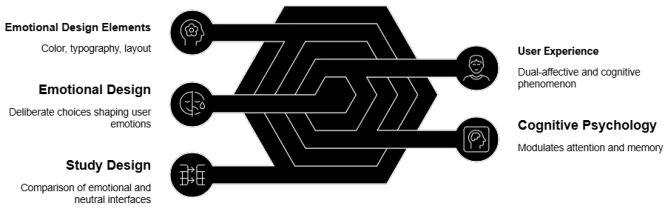
BACKGROUND AND RELATED WORK This study combines theories from cognitive psychology and emotional design to explain how the quality of the feeling evoked by computer interfaces affects students’ learning in digital classrooms. Emotional Design is the deliberate and systematic decision-making regarding a variety of factors concerning an interface’s aesthetic, including its layout, word choice, typography, and colours, which ultimately decide how users experience emotion, and what they perceive about the information presented (Ho, 2024a; 2024b). Based on this view, the user experience of an interface is characterised as both cognitively and affectively (Fogg, 2009); interfaces perceived as warm, calming and friendly are expected to encourage engagement and usability, whereas interfaces viewed as chaotic or affectively neutral may offer few aids for sustained interest and comprehension.
DESIGN-AND-EMOTION FRAMEWORK FOR LEARNING INTERFACES In light of the cognitive effects of affective states, which would contribute to both selective attention and subsequent memory, a positive emotional state is anticipated to minimise extraneous cognitive load and guide attention to central aspects of instruction to increase the likelihood of deep encoding and reliable recall. Thus, visible attributes such as order, symmetry, and hierarchical clarity work together as affective and cognitive assets while they contribute to learner comfort and facilitate the organisation and representation of important concepts in working memory (Nepal et al., 2024). Interfaces lacking sufficient emotional cues or appearing overly sterile or mechanical may fail to either attract attention or motivate effort, resulting in students using their own organisational systems to represent the material. Thus, a framework is built and compares a digitally-designed interface with an affect-neutral control group that presents the same
Designing for Emotional Memory: Affective User Interfaces for Learning 85 instructional content, but minimally includes any affective features. The digitally-designed interface has a harmonious colour scheme (figure 1), easily legible and inviting typography, positively motivational language in micro- copy, and a clearly-organised visual hierarchy to elicit positive affect (e.g., curiosity, confidence) while reducing cognitive load (Gross, 1998; Michie, van Stralen & West, 2011). The affect-neutral control preserves all structural and content elements of the digitally-designed version but uses a less vibrant colour palette, common terminology, and a monotonous layout to provide a functional yet affect-neutral experience. By comparing these two forms of presentation, the study establishes relationships between specific measures of affect and quantifiable measures of student attention, memory, and user- experience (Chau et al., 2025).; thus, establishing emotional design as a testable and cognitive design strategy instead of simply a stylistic option (Bear et al., 2024; Baumel, Fleming, Schueller & Harrer, 2020).
Figure 1: Emotional design in digital learning.
RESEARCH METHODS The study employed a mixed-methods experimental methodology to explore the impact of affective features in a learning interface on learners’ memory performance and experiences within e-learning systems. In a between- subjects laboratory design, forty participants were randomly assigned to one of two environments: an emotionally tuned learning interface designed to elicit positive emotional states—such as excitement and curiosity—or an affect-neutral interface serving as a baseline. The emotionally tuned interface integrated elements such as a warm colour palette, typeface warmth, engaging images, and supportive language in micro-copy to foster a conducive learning atmosphere. Unlike this emotionally tuned interface, the affectively neutral interface lacked emotional indicators; as such, the visually and verbally neutral design was employed. By differentiating emotionally tuned interfaces from affectively neutral ones researchers could identify the causal relationships between the quality of emotional aspects of interfaces and performance. Moreover, they would be able to maintain consistency regarding both the content of tasks (to ensure all participants received similar content) and the degree of difficulty (all participants completed similar task types).
86 Ho The two functionally equivalent e-learning modules included variations concerning only the emotional aspect of design. As other research has indicated, separating the informative content of materials from the affective characteristics is necessary. The emotionally designed interface incorporated several characteristics of good visual order and symmetry, which reduced cognitive load and increased its aesthetic appeal. Thus, the use of positively arousing emotion and motivation in the emotionally tuned interface enhanced learners’ experiences.
The process of experimenting was structured. Upon arriving at the testing location, each participant read and signed an informed consent form. Participants then worked on a self-paced assignment using the assigned interface. Participants viewed and interacted with course materials related to assessment purposes. A time limit was not established for completion of the task, but participants were timed. Duration of interaction provided measures of attention and helped to determine whether some responses should be excluded based on the duration of interaction. Following completion of the initial task, participants were assessed on their ability to recognise or remember information covered during the training session. Participants also provided demographic data about themselves, i.e., age and educational background. While demographic data may provide a context for interpreting results, it will be used solely for contextualisation purposes. To help eliminate variability in prior knowledge of graphic user interfaces and/or e-learning software, participants were required to meet basic eligibility requirements. Randomly assigning participants to either condition further improved internal validity since there was a more even distribution of participant variability among groups.
MEASUREMENT INSTRUMENTS A collection of assessment tools was created to measure both the learner’s experience (subjective) and their acquisition (objective) within an online educational environment. Memory performance was assessed via objective measures, specifically recall & recognition. Recall is measured using free- response questions, whereas recognition is measured using multiple-choice questions. Subjectively, the user’s experience was assessed by means of a standardised survey assessing participants’ perceived usability, hedonics (i.e., pleasure), and satisfaction. These items were designed to elicit users’ emotional responses as well as their perceived workload when engaging with the online educational environment. Additionally, eye-tracking data and participant interaction log data allowed for further quantification of where the learners focused attention and what type(s) of interactions they had with the system. Semi-structured interviews elicited participants’ perceptions of their experience with the online educational environment, while demographic information enabled researchers to determine whether specific user characteristics influenced their emotional responses to the way the online educational platform was designed.
RESULTS
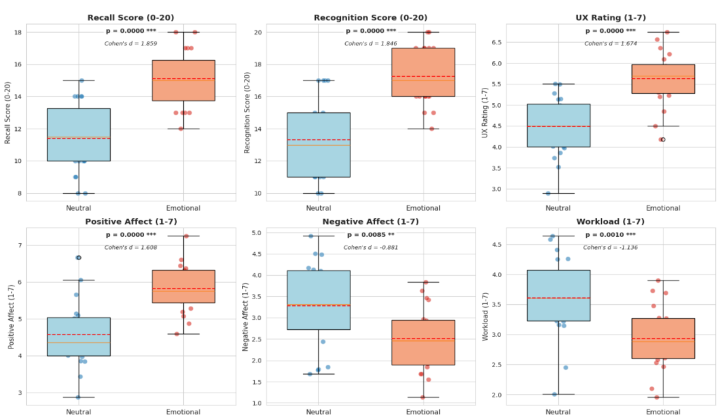
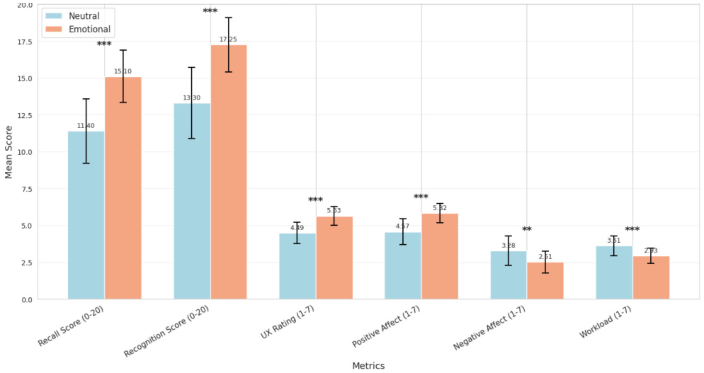
Memory Performance Beginning of the Text Independent samples t-tests demonstrated that participants in the emotionally tuned conditions achieved greater recall than did the participants in the affect-neutral conditions. The mean number of items recalled by participants in the emotionally tuned condition (n = 20) was 15.10 (standard deviation (SD = 1.77) as opposed to the mean of 11.40 (SD = 2.19) items recalled by the participants in the neutral condition, which is a statistically significant difference, t(≈34) = 5.88; p < .001. Therefore, it appears that participants who were exposed to an emotionally supportive interface feature encoded information on a deeper level and retrieved such information more effectively than did participants exposed to an affect-neutral interface. Similarly, recognition performance was also influenced by whether or not the interface was emotionally tuned. That is, participants exposed to an emotionally tuned interface had a mean recognition score of 17.25 (SD = 1.83), while participants exposed to an affect-neutral interface had a mean recognition score of 13.30 (SD = 2.41). Moreover, an independent-samples t-test determined that the difference in mean recognition scores between the emotionally tuned and the affect-neutral interfaces was statistically significant, t(≈34) = 5.84; p < .001.
User Experience and Affect In terms of self-reported user experience, analyses indicated similar advantages for both users’ perception of usability and subjective satisfaction with an emotionally tuned versus an affect-neutral interface. Specifically, mean ratings for overall user experience ratings were significantly greater for the emotionally toned interface (M = 5.63; SD = 0.65) compared to the affect- neutral interface (M = 4.49; SD = 0.72), t(≈36) = 5.29; p < .001. Thus, participants using the emotionally toned interface rated the system as being more usable and satisfying than did participants who used the neutral baseline. Similarly, participants’ emotional state during the learning task was influenced by the emotional design elements of the interfaces. Positive affect ratings were significantly greater when using the emotionally toned interface (M = 5.82; SD = 0.66) compared to the affect-neutral interface (M = 4.57; SD = 0.89), t(≈35) = 5.08; p < .001. Additionally, negative affect ratings were lower when using the emotionally toned interface (M = 2.51; SD = 0.74) compared to the affect- neutral interface (M = 3.28; SD = 0.99), which is a significant finding at t(≈34) = –2.79; p < .01. Overall, these results suggest that the emotionally toned interface not only enhanced performance but also facilitated more positive and less negative emotional responses to the learning task.
PERCEIVED WORKLOAD The data from the Perceived Workload Survey showed that participants who experienced an emotionally tuned design were able to complete tasks with less mental effort than those who used the neutral design. Participants using
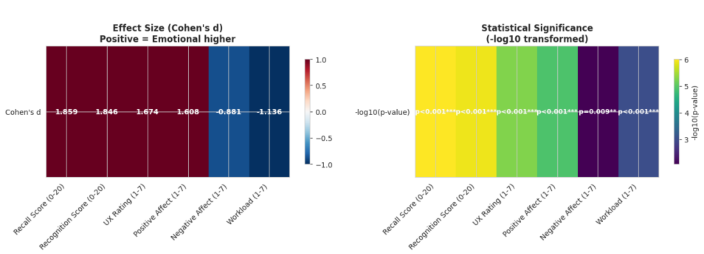
88 Ho the emotionally tuned design reported their workload as being significantly lower than those using the neutral design. The workload for those using the emotionally tuned design was 2.93 (SD = 0.51), whereas it was 3.61 (SD = 0.67) for those using the neutral design. The p-value for the t-test comparing these two means was < .01. Thus, when viewed in combination with the Affective Response and User Experience ratings, these ratings suggest that a visually consistent, emotionally supportive interface can both reduce the amount of mental energy required to perform a task and improve both the learner’s level of engagement and overall performance. Overall, across all of the major metrics, the emotionally tuned interface performed better than the affect-neutral baseline, with medium to large differences favouring the emotionally tuned condition for memory, user experience, affect, and workload metrics. These quantitative metrics provide evidence to support the hypothesis that designers can create cognitively and experientially beneficial interfaces through the incorporation of emotional design elements in e-learning environments.
QUALITATIVE FINDINGS The emotional experience of using the two interfaces is demonstrated through the qualitative results in Table (a)-Table (c). The same patterns shown through quantitative means are reinforced and expanded upon through the qualitative analysis. Participants’ experiences of the emotionally-tuned and the baseline interfaces differ systematically from one another. An example of this difference can be seen in how each interface was described in terms of its emotional tone; emotional-tone words, including ‘warm’, ‘friendly’, and ‘calm’, were exclusive to the emotionally-tuned interface. Similarly, the baseline was characterised as neutral/plain/clinical. This is an indicator that the affective parameters embedded in the emotional design were perceived by participants as signalling supportiveness/approachability through the use of an emotionally-tuned interface. Conversely, participants who used the baseline interface, as well as the rest of the participants, indicated that they saw the interface as more functional than emotionally-supported. Furthermore, when asked about whether the design impacted their learning, there was significant variation between the emotionally-tuned and the baseline interface. Several participants in the emotionally-tuned condition indicated that the design improved their motivation, ability to concentrate, and ultimately aided their memory for the content. Many of these participants also noted a reduction in anxiety and/or effort required to complete the task. On the other hand, many participants in the baseline condition indicated that they could not clearly articulate whether or not the design impacted their learning. Additionally, some participants in the baseline condition indicated that the design may have made it slightly easier or harder to stay focused throughout the completion of the task. Only very few participants linked the design to better retention/memorability of the content. Collectively, this indicates that emotional design did not simply serve as an additional aesthetic element; it served as a mechanism to influence how learners attended to, processed, and retained the content.
INTERPRETING THE IMPACT OF EMOTIONAL DESIGN ON MEMORY Quantitative Findings
The study presents the important benefits of an emotionally-tuned interface over an affect-neutral (neutral) baseline in terms of performance and experience. The emotionally-tuned interface led to greater recall of learned material and elicited better experiences for students while they were engaged in learning. Students experienced lower workloads than did students who utilised the neutral baseline when working through learning materials. The difference in performance is likely related to the emotional aspects of the interfaces used; the information and task structures are identical in each condition. Students utilising the emotionally-tuned interface had greater recollection of key ideas and detail about what they studied, reflecting improved encoding and retrieval mechanisms due to the use of emotional elements in design.
Figure 2: Emotional vs natural condition: T-test comparison.
Users’ experience-based ratings also support the results from the previous section. The emotionally tuned interface received a higher rating for usability, clarity, engagement, and aesthetic quality than the neutral baseline. The designers successfully integrated functionally clear elements with affective elements, resulting in increased positive emotion and decreased negative emotion for users. This represents success in achieving the objective of designing a warm and encouraging environment for learning. Lower ratings on perceived workload by users of the emotionally-tuned interface suggest that emotional design elements promoted more fluid and efficient interaction without increasing either distraction or complexity. Feedback from users further supports this trend, with many referring to the emotionally-tuned interface as being ‘warm’ and ‘inviting’, and providing a more accessible learning environment. The primary findings of this study suggest that learners
90 Ho find an emotion-based, engaging interface to be a much more enjoyable experience compared to an unengaging, neutral interface. Learners indicated that they were able to focus more effectively on their learning experiences when utilising the engaging, emotionally-tuned interface. In addition, learners reported retaining information longer when utilising the emotion- based interface.
Figure 3: Mean comparison with standard error bars.Figure 4: Effect size and significance summary.
Theory-Theoretic Implications Regarding Learning Design Users also described the neutral baseline as simply ‘plain,’ ‘functional,’ and unable to draw attention to itself. They did not see the neutral baseline as having the potential to provide them with a richer or more immersive learning experience. Therefore, collectively these results support one major claim of the design-and-emotion framework that guided this study: That specific affective design parameters (such as colour harmony, typography warmth, and encouraging micro-copy or narrative framing) can be systematically
Designing for Emotional Memory: Affective User Interfaces for Learning 91 configured to produce measurable enhancements to learners’ attention and memory in digital learning settings. Previous studies have established that ‘emotions are important’ for design in education; however, this study supports this notion empirically by demonstrating that an emotionally-tuned interface can both improve learning outcomes and learner perceptions of usability while maintaining clarity and readability throughout. As such, there is no longer a basis to assume that emotional design is merely focused upon aesthetic or branding issues; as demonstrated by this study, it can serve as a cognitive support tool.
Design Implications for e-Learning Two major implications arise for the design of e-learning systems, digital health platforms, and decision-support tools. First, as demonstrated by this study, investing in emotionally supportive design is not just about creating aesthetically pleasing interfaces, but about intentionally designing affective experiences and attentional patterns that will influence how well learners accomplish key tasks such as remembering and understanding. Second, because many of the domains represented through these types of applications (i.e., high-stakes learning environments and potentially anxiety-provoking health-related information) represent areas where cognitive load is typically higher, emotionally supportive design may be particularly beneficial. Strategically designing affective experiences could serve as a means to reduce cognitive overload and promote sustained engagement.
LIMITATIONS There are some significant limitations to consider regarding this study. For example, only one type of learning activity was used in this study. Additionally, due to sampling constraints, the sample size used in this study was somewhat limited. These constraints limit the generalisability of the results obtained in this study. Furthermore, this study only measured short-term recall and recognition. To understand if the effects observed in this study generalise across time or continue beyond initial exposure periods, additional research would need to investigate long-term retention.
CONCLUSION
This study investigated how emotionally supportive design affects student retention of information in educational interfaces and addresses a gap in prior literature. This study consisted of two phases: Phase I involved developing emotionally supported learning interfaces using a design tone framework, and Phase II involved conducting a randomised-controlled trial to compare performance differences between emotionally-supported learning interfaces and affect-neutral learning interfaces. A total of forty participants participated in the study and completed a learning task followed by a recall and recognition assessment. The results indicate statistically significant improvements in recall and recognition scores for learners who utilised
92 Ho the emotionally-supported learning environment as opposed to those who utilised an affect-neutral learning environment. Participants also reported a more positive user experience when interacting with the emotionally- supported learning environment.
ACKNOWLEDGMENT
The authors would like to acknowledge all the participants who generously gave their time and effort to take part in this study.
REFERENCES
Baumel, A., Fleming, T., Schueller, S. M., & Harrer, M. (2020). Digital micro interventions for behavioral and mental health: A conceptualization. JMIR Mental Health, 7(10), e20631. https://doi.org/10.2196/20631 Bear, H. A., et al. (2024). The acceptability, engagement, and feasibility of mental
health apps for underserved young people: A mixed-methods systematic review. JMIR Mental Health, 11(7), e52154. https://doi.org/10.2196/48964 Chau, L. W., et al. (2025). Digital health interventions for depression and anxiety in low- and middle-income countries: A rapid scoping review. JMIR Mental Health, 12(1), e68296. https://doi.org/10.2196/68296 Fogg, B. J. (2009). A behavior model for persuasive design. Proceedings of
the 4th International Conference on Persuasive Technology, 40. https://doi. org/10.1145/1541948.1541999 Gross, J. J. (1998). The emerging field of emotion regulation: An integrative review.
Review of General Psychology, 2(3), 271–299. https://doi.org/10.1037/1089- 2680.2.3.271 Ho, A. G. (2024). Exploring emotional impact in interactive digital art. Proceedings of the 2024 International Conference on Art, Design, and Digital Technology (ADDT 2024), 1–8. https://doi.org/10.4108/eai.24-5-2024.2350023 Ho, A. G. (2024). Understanding typical emotions in the design process.
Convergências -- Revista de Investigação e Ensino das Artes, 17(34), 1–15. https:// doi.org/10.53681/c1514225187514391s.34.261 Ludlow, K., et al. (2023). Co-designing a digital mental health platform ‘Momentum’ with young people. Digital Health, 9, 1–16. https://doi. org/10.1177/20552076231216410 Michie, S., van Stralen, M. M., & West, R. (2011). The behaviour change wheel:
A new method for characterising and designing behaviour change interventions. Implementation Science, 6, 42. https://doi.org/10.1186/1748-5908-6-42 Nepal, S., et al. (2024). The role of context-aware mobile interventions in addressing social isolation in serious mental illness. Psychiatric Services, 75(1), 45–54. https:// doi.org/10.1109/MPRV.2024.3377200
LISTED IN THE AHFE DIGITAL BOOKSTORE CATALOGUE
Explore the complete digital volume
Human Interaction and Emerging Technologies (IHIET-FS 2026): Future Systems and Design Applications
Read this individual research paper free through the original publisher, or explore the full digital proceedings book.
ISBN 979-8-950676-11-6
Explore this ISBN in the AHFE Bookstore ↗Listed in the July 2026 bookstore catalogue; search by ISBN to confirm current availability · Digital book purchase optional