Lina Xu (2023). A Systematic Review of Smart Building Acceptance Based on User Experience. In: Human Factors in Architecture, Sustainable Urban Planning and Infrastructure. AHFE Open Access, vol. 89, pp. 16–25. https://doi.org/10.54941/ahfe1003675
As emerging technologies broaden the field of architectural design, traditional buildings are unable to meet the diverse needs of different groups, and smart buildings have become the future direction of architectural development. Despite this, the focus of the community is still on the development of smart technology, ignoring the user experience. As awareness of building response increases, research in this area is a key gap in how to improve the acceptance of smart buildings by different groups of people. This paper classifies and evaluates research on user experience-based acceptance of smart buildings based on a systematic review using the web of science core collection database based on the existing literature on this topic of research. Two directions are addressed in this review to better answer the questions and objectives of this study. The first review of the theoretical foundations of innovation is conducted in terms of the logic that user experience influences acceptance, mainly user experience theory, emotional design theory, and Unified Theory of Acceptance and Use of Technology. Secondly, based on the theory of affective design, three levels of practical design of smart building interaction experiences are reviewed, the visceral layer (visual and voice interaction), the behavioural layer (gesture, behaviour interaction) and the reflective layer (emotion interaction). This review provides a theoretical framework for the study of user experience influencing acceptance, summarises the classification of interactive experiences that improve user experience, and suggests recommendations and directions for future research on smart buildings. It is found that user experience-centred smart buildings can improve the quality of life of users, leading to increased acceptance and continued adoption for sustainable living.
The Demand for Smart Buildings In recent years, due to the rapid development of information and digital tech- nology, highly smart buildings have received a lot of attention from all walks of life. With the diversification of people’s needs in everyday life, intelligent systems are being added to buildings through the intervention of techno- logy, making them a human-operated environment and making them more convenient for people to live and work in (Nuutinen et al., 2021). Smart
A Systematic Review of Smart Building Acceptance Based on User Experience 17
Buildings are buildings which integrate and account for intelligence, enter- prise, control, and materials and construction as an entire building system, with adaptability, not reactivity, at its core, in order to meet the drivers for building progression, energy and efficiency, longevity, and comfort and sati- sfaction (Buckman et al., 2014). Smart buildings maximise the efficiency of the whole building compared to traditional buildings(Clements-Croome and Croome, 2004). Over time, smart buildings can store user behavi- our and patterns, providing up-to-date information for the future, and can also offer greater convenience and comfort to occupants(Clements-Croome, 2011). Most of the literature on ‘smart buildings’ in the web of science data- base explores smart building information models, energy sources, adaptation methods, sensors, and even market opportunities and barriers for smart buildings.
The Current Challenges of Smart Buildings However, in actual operation, many smart buildings put users in a difficult position because they ignore the user experience (Wei et al., 2016). One of the most fundamental and least researched primary issues that emerged from the research was the question of the acceptance of smart buildings by different groups and how to enhance the interactive experience in smart buildings. The future of smart buildings is centered on the idea of user expe- rience, which, in addition to meeting basic functionality, should also adapt to user preferences and provide a personalized and improved user experi- ence (Nguyen and Aiello, 2013). In particular, the interactive experience. For example, Europe, the United States and Japan have adopted a series of interactive experience-related technologies in response to the ageing popula- tion to achieve the goal of optimizing the interactive experience and building more practical, easy-to-use and user-friendly smart buildings (Carnemolla, 2018). To make users safe, comfortable, and healthy in their environment, thus increasing their acceptance of smart buildings and their willingness to continue using them in order to achieve sustainable development of smart buildings.
The Purpose and Research Question of This Study The aim of this study is not to review smart buildings from a conventional perspective, but to take a developmental view of smart buildings based on the user experience. Therefore, the specific research questions addressed in the systematic review are.
1. What is the relationship between the factors that influence user accepta- nce of smart buildings and the corresponding user experience theories? 2. Which interaction experience categories are involved in current research on smart building design to improve user experience? 3. Which categories of people’s needs, and user characteristics deserve focused attention in UX-based smart buildings?
18 Xu
Methodology
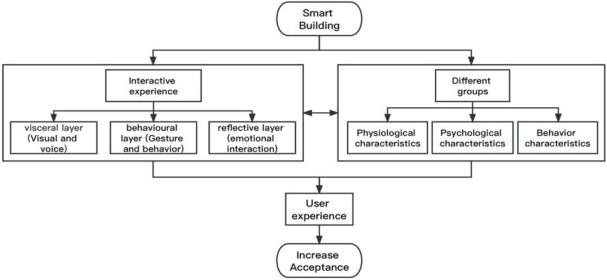
A systematic literature review approach was used in this study. A systema- tic review, usually consisting of a detailed and comprehensive plan and an a priori search strategy, whose goal is to reduce bias by identifying, eva- luating and synthesizing all relevant studies on a given topic(Templier and Paré, 2015). Systematic reviews differ from narrative reviews in that the lat- ter tend to be descriptive and usually focus on a subset of studies based on availability or author selection, and therefore often include an element of selection bias (Uman, 2011). In this study, firstly, the research questions are identified. As shown in Figure 1, UX-based smart buildings provide three types of interactive experiences and are used by different groups of people. The interactive experiences and the occupants interact with each other to enhance the user experience and thus increase the acceptance of UX-based smart buildings. There is a need to review the theoretical underpinnings of the relationship between user experience and receptivity, and which areas of interaction experience have been the focus of research on UX-based intelli- gence. This literature should also be categorized and summarized in order to clarify the important contributions and implications of this research. In addition, based on the results of the systematic review, a theoretical frame- work is provided for the study of the relationship between user experience and acceptance. It also finds the research gap and target group for this area of research to provide a theoretical basis and practical implications for the future development direction of acceptance of smart buildings based on user experience.
In this study, the web of science core collection database was used to conduct a systematic review from both theoretical and practical perspecti- ves, navigating the database through four different combinations of search terms. “User experience, Smart building” (n = 450), “Smart building, User Acceptance” (n = 175), “Interactive experience, Smart building” (n = 99), “User experience, Smart building, Acceptance” (n = 49), resulted in a total of 773 search results. To ensure that the articles collected were consistent with the aims and questions of this research paper, overlapping search results were excluded and all articles were reviewed and initially screened using four cri- teria. 1. focus on refereed journal papers published from 2013-2022. 2. and
Figure 1: Framework of research questions.
A Systematic Review of Smart Building Acceptance Based on User Experience 19
exclude conference papers, books, review papers, etc. 3. these articles must be in the field of architecture in terms of theory, focusing on the relationship between user experience and acceptance. 4. in terms of practice, they must relate to one of the three levels of interaction experience, for example through a limited combination of five other specific keywords, such as “Visual Inte- raction, Smart building”, “Voice Interaction, Smart building”. For example, “Visual Interaction, Smart building”, “Voice Interaction, Smart building” to narrow the search to the question posed by this study. The search was nar- rowed down to the questions posed in this study. In the end, 22 articles were collected.
RESULTS
Trends Publications Over the Years
In terms of time, Table 1 shows the trend of the final selected literature on the relevant topic over time, with a total of four studies published from 2013 to 2018, and from 2019 onwards, the number starts to show an increasing trend. In particular, the number of publications is 6 in 2021. This indicates that researchers are increasingly concerned with the importance of studying user experience and acceptance in smart buildings.
Publications Over the Years Regionally, Table 2 shows the distribution of literature on UX-based smart building research across different countries and regions, making a more gene- ral summary of trends for reference purposes only. China accounted for 31.8% of the 22 articles with 7 articles, followed by Greece with 3 articles, the USA with 2 articles and the UAE with 2 articles. This table provides a
Table 1. Publication trends by year.
Table available in the original PDF paper.
20 Xu
Table 2. Distribution by country or region.
Table available in the original PDF paper.
Country or region Number of publications Percentage of publication China 7 31.8% Greece 3 13.6% United States 2 13.6% United Arab Emirates 2 13.6% Denmark, Austria, Italy, Egypt 4 18.1% Netherlands, Norway, South Korea, Brazil 4 18.1%
good reflection of the country and geographical distribution in user experie- nce based smart building research and sets the context for the research that follows.
Theoretical Foundations User Experience Theory
Systems understanding of smart buildings from a user experience perspe- ctive is largely under-appreciated and is an area to be studied. The term User Experience was coined by American cognitive psychologist Donald Norman. It refers to the feelings that users build up before, during and after using a product or system or service (Norman, 2013). Excellent smart buildings should also have a good user experience, meet the needs of users, make users feel comfortable and happy in the process of living, thus increasing the acceptance (Zhao et al., 2015). Ji & Chan demonstrate through qua- litative research that user experience has a positive impact on user intent and technology adoption (Ji and Chan, 2020). Kim, Cho, & Jun identi- fied residents’ behaviors and intentions in relation to smart home technology from a user experience perspective and developed a customized smart home service for each resident using a user-centered approach (Kim et al., 2020). Therefore, user experience theory should be used as the basis for rese- arch to explore the relationship between user experience and acceptance in smart buildings, and then design to enhance the acceptance of smart buildings.
Emotional Design Theory In Emotional Design, Norman says that good design should satisfy three layers of experience: the visceral layer, the behavioral layer and the reflective layer (Norman, 2004). This means that firstly the first impres- sion is triggered by sensory scanning, often subconsciously, the second layer is the usability and interactive experience during use, and finally the sublimation of emotions is generated. Positive reflections may encourage users to share their experiences with others. In smart buildings, different modes of interaction affect the user experience and acceptance, the state of mind and body, and the quality of life to varying degrees (Li et al., 2020). If an smart building does not meet the emotional needs of its users, it can lead to a poor user experience and therefore reduced accepta- nce. Sandström and Keijer demonstrate through qualitative research that accessibility, ease of use and trust are the basis for positive emotions and acceptance of the various functions that make up a smart home(Sandström
A Systematic Review of Smart Building Acceptance Based on User Experience 21
and Keijer, 2010). In order to increase the acceptance of smart buil- dings by different groups of users, research based on emotional design is needed.
Unified Theory of Acceptance and Use of Technology The Technology Acceptance Model (TAM) and the Unified Theory of Acceptance and Use of Technology (UTAUT) are the most widely used models to predict acceptance behaviour(Dulle and Minishi-Majanja, 2011). Compared to TAM, the UTAUT model more comprehensively presents the four constructs that influence intention to use, performance expectations, effort expectations, social influence and facilitating conditions. Age, gender, experience and voluntariness of use in the model moderate the impact of these expectations and facilitating conditions on intention (Shachak et al., 2019). Examining other variables from a unified theory of technology acceptance and use may also be relevant to a better understanding of user acceptance of smart buildings. Shuhaiber and Mashal incorporated additional user-related factors to examine intention to use the smart home. The results showed that trust, awareness, enjoyment and perceived risk, as well as perceived useful- ness and perceived ease of use, significantly influenced attitudes towards the smart home and thus intention to use it (Shuhaiber and Mashal, 2019).
Practical Design Visceral Layer(Visual and Voice Interaction) In recent years, smart buildings have begun to widely adopt emerging tech- nologies to support complex user needs, and visual interaction will give the user the most intuitive experience. The user’s visual attention is captured according to the user’s visual characteristics, thus enabling effective com- munication with the smart building and increasing user acceptance and satisfaction (Clement et al., 2013). In visually interactive smart buildings, user needs should be considered first and foremost. Basic building navigation, visualization and other interactive methods can be explored to efficiently exchange useful visual information to improve coordination and situation perception for different users in a smart building (Ayyanchira et al., 2022). In addition interactive 3D content in Augmented Reality (AR) provides instant visual feedback to the user (Schall et al., 2013). The introduction of smart VR devices can also provide users with immersive on-screen visuals (Xu, 2022). To enhance the user experience, Fogli and others used user experiments in the later stages of the design of the smart building system, inviting participants to evaluate usability in order to improve user acceptance in the smart building (Fogli et al., 2017).
In smart buildings, voice is the most natural method of interaction and can enrich the user experience (Abdelhamid and Alotaibi, 2021). Most of the literature focuses on how intelligent voice can better serve the user by exploring how the user feels in it and examining how it affects the user’s intention to use it in a smart building in the future. Building intelligent voice assistant interactions, such as those between voice assistants (VA) and vulne- rable groups, to support the daily needs of users requires attention to how
22 Xu
the design of these interactions co-create value for individual and collective well-being (Vieira et al., 2022). The perception and use of intelligent voice assistants by older people is also critical, and the design implications of voice recognition systems can be explored for a better user experience for older people (Kim and Choudhury, 2021). There is a need to focus on the user’s voice characteristics and develop inclusive multi-functional smart building voice recognition systems to improve the accuracy of user voice recognition and bring more features and experiences to the user.
Behavioural Layer (Gesture and Behavioural Interaction) Voice commands and gestures are considered to be the most popular and appropriate interaction mechanisms (Kanda et al., 2004). Gesture recogni- tion as a universal interaction method, gesture-based interactions can be adapted to user and contextual requirements in order to communicate infor- mation to users in an intelligent and sustainable way (Bouloukakis et al., 2019). Gestures can be used to control devices in smart buildings. These gestures are adapted to the user and the environment, ergonomic, intuitive and easy to perform and remember (Khan and Zualkernan, 2018). If gesture interaction is to be implemented in an intelligent environment, it should also provide the ability to recognize and define personalized gesture assignments for basic user commands to establish effective communication with the user and improve the user experience (Vogiatzidakis and Koutsabasis, 2019).
Behavioural interaction is the use of smart building systems to recognise and interact with the actions of users. Behaviour is used instead of sensory channels to avoid the frustration of visual defects and to improve the user experience. How to effectively tap into the user’s behavioral pattern chara- cteristics and schedule is the key to smart buildings (Tao and Tang, 2022). Customised models of accessible intelligent systems from the perspective of different user groups, e.g. mobility impaired, visually hearing impaired, etc (Noori et al., 2021). Especially for elderly care (Han et al., 2020). Spatial- behavioral interaction requires the collection of user behavioral data in a quantitative way, based on which the safety and health of the user in the living environment can be met (Pistofidis et al., 2021). Improving the problems caused by special groups such as the elderly due to behavioral difficulties, identifying user movements etc. in order to improve the acceptance of smart buildings by different groups.
Reflective Layer (Emotional Interaction) In recent years, more and more emotion management systems based on emotional interaction have emerged in smart buildings. Not only do they give functionality to the architectural space, but they also have a unique emotional resonance with it. Especially with the advent of ageing, emotion-based inte- ractions are needed to reduce the cognitive load level of older people and to improve the user experience in smart buildings(Fu, Lv, Zhao, & Yue, 2020). Tuzcuo˘glu et al. examine the user experience in the building by explaining the user’s emotional response through four stages, focusing on user behavior and satisfaction(Tuzcuo˘glu, Yang, de Vries, Sungur, & Appel-Meulenbroek, 2021). M. J. N. Han, Kim, & Kim point out that in current smart building
A Systematic Review of Smart Building Acceptance Based on User Experience 23
systems, user preferences and needs are ignored, which has a negative impact on user satisfaction(M. J. N. Han, Kim, & Kim, 2021). The functional value of smart buildings has a significant positive impact on users’ emotional perce- ptions, which are positively correlated with sustainable relationships, making the emotional experience of users very important(Lin, Zhao, Yu, & Wu, 2019). Create positive impact and improve the user experience by identifying, capturing and interacting with the emotions of different users(Kandampully, Bilgihan, & Amer, 2022). This type of experience requires more analysis of the emotional needs and cognitive characteristics of different users when desi- gning, allowing smart buildings to interact with users emotionally and thus improving their experience and acceptance.
DISCUSSION AND CONCLUSION Benefit
Based on the findings of this systematic review, a new perspective on smart building research is proposed and developed. Research on the acceptance of smart buildings has been largely under-appreciated due to the perspective of user experience. This study classifies and evaluates user experience-based smart buildings at a theoretical as well as a practical level, reviews the con- struction methods for each topic and the ways in which user acceptance and user experience can be improved, analyses the characteristics of the intera- ction between smart buildings and users, and finds the key position of users in smart buildings. A theoretical basis for user experience and acceptance resea- rch is provided, and a classification of smart building interaction experiences to improve user experience is investigated.
Limitations Firstly, the WOS core collection database used for the systematic literature review may not cover all relevant smart building research. There are limita- tions in the sources of data information, the sample size is small and there are still interesting studies that have been excluded. Secondly, there are some keyword combinations that overlap in search and the combined relevance of these overlapping search results has not been reviewed.
Perspectives for Future Research Taken together, future research should expand the search of the database to focus on these limitations. And much of the literature on interactive expe- riences refers to the user experience of different groups in smart buildings, with a focus on children, adults, and the elderly. The role and influence of the family in the development of children is very powerful and research into smart buildings related to children’s pre-school education is on the increase. Secondly, as the internet continues to improve, the need for adults to work remotely or intelligently is coming to the fore. Finally, this review has identi- fied that most UX-based smart building system designs refer to the needs and interactive experiences of older or vulnerable people with respect to smart
24 Xu
buildings. The elderly population, which has more or less sensory, or mobi- lity impairments, has an expanding need for smart buildings. However, in current smart buildings, factors affecting user adoption are not adequately considered and older people usually have a higher cognitive load and lower acceptance of new and emerging things. How to improve the user experience of the elderly community and increase their acceptance and willingness to use smart buildings in a sustainable way to bring sustainable living to the elderly community is still an area of research with depth.
REFERENCES
Abdelhamid, A. A. & Alotaibi, S. R. 2021. Robust voice user interface for internetof-things. Journal of Intelligent & Fuzzy Systems, 41, 5887–5902. Ayyanchira, A., Mahfoud, E., Wang, W. & LU, A. 2022. Toward cross-platform
immersive visualization for indoor navigation and collaboration with augmented reality. Journal of Visualization, 25, 1249–1266. Bouloukakis, M., Partarakis, N., Drossis, I., Kalaitzakis, M. & Stephanidis, C. 2019.
Virtual reality for smart city visualization and monitoring. Mediterranean Cities and Island Communities: Smart, Sustainable, Inclusive and Resilient, 1–18. Buckman, A. H., Mayfield, M. & BECK, S. B. 2014. What is a smart building? Smart and Sustainable Built Environment, 3, 92–109. Carnemolla, P. 2018. Ageing in place and the internet of things–how smart home
technologies, the built environment and caregiving intersect. Visualization in Engineering, 6, 1–16. Clement, J., Kristensen, T. & Grønhaug, K. 2013. Understanding consumers’ in-store visual perception: The influence of package design features on visual attention. Journal of Retailing and Consumer Services, 20, 234–239. Clements-Croome, D. & Croome, D. J. 2004. Intelligent buildings: design, manage-
ment and operation, Thomas Telford. Clements-Croome, D. 2011. Sustainable intelligent buildings for people: A review.
Intelligent Buildings International, 3, 67–86. Dulle, F. W. & Minishi-Majanja, M. 2011. The suitability of the Unified Theory of Acceptance and Use of Technology (UTAUT) model in open access adoption studies. Information development, 27, 32–45. Fogli, D., Peroni, M. & Stefini, C. 2017. ImAtHome: Making trigger-action
programming easy and fun. Journal of Visual Languages & Computing, 42, 60–75. Han, S. R., Yoon, S. & Cho, S. 2020. Smart Accessibility: Design Process of Integrated Geospatial Data Models to Present User-Customized Universal Design Information. Frontiers in Psychology, 10, 2951. Ji, W. & Chan, E. H. 2020. Between users, functions, and evaluations: Exploring
the social acceptance of smart energy homes in China. Energy Research & Social Science, 69, 101637. Kanda, T., Hirano, T., Eaton, D. & Ishiguro, H. 2004. Interactive robots as social partners and peer tutors for children: A field trial. Human–Computer Interaction, 19, 61–84. Khan, W. M. & Zualkernan, I. A. 2018. Sensepods: A zigbee-based tangible smart
home interface. IEEE Transactions on Consumer Electronics, 64, 145–152. Kim, M. J., Cho, M. E. & Jun, H. J. 2020. Developing design solutions for smart homes through user-centered scenarios. Frontiers in psychology, 11, 335.
A Systematic Review of Smart Building Acceptance Based on User Experience 25
Kim, S. & Choudhury, A. 2021. Exploring older adults’ perception and use of smart speaker-based voice assistants: A longitudinal study. Computers in Human Behavior, 124, 106914. Li, Z., Zhang, J., Li, M., Huang, J. & Wang, X. 2020. A review of smart design based
on interactive experience in building systems. Sustainability, 12, 6760. Nguyen, T. A. & Aiello, M. 2013. Energy intelligent buildings based on user activity: A survey. Energy and buildings, 56, 244–257. noori, F. M., Uddin, M. Z. & Torresen, J. 2021. Ultra-wideband radar-based activity
recognition using deep learning. IEEE Access, 9, 138132–138143. Norman, D. 2013. The design of everyday things: Revised and expanded edition, Basic books. Norman, D. A. 2004. Emotional design: Why we love (or hate) everyday things,
Civitas Books. Nuutinen, M., Kaasinen, E., Hyvärinen, J., MÖLSÄ, A. & Siltanen, S. 2021. Making a Building Smart with a Co-Created and Continuously Evolving Enjoyable Service Entity—Insights from a Collaborative Study. Smart Cities, 5, 1–21. Pistofidis, P., Ioannakis, G., Arnaoutoglou, F., Michailidou, N., Karta, M., Kiourt, C.,
Pavlidis, G., Mouroutsos, S. G., Tsiafaki, D. & Koutsoudis, A. 2021. Composing smart museum exhibit specifications for the visually impaired. Journal of Cultural Heritage, 52, 1–10. Sandström, g. & Keijer, U. 2010. Smart home systems-accessibility and trust. Open House International, 35, 6–14. Schall, G., Zollmann, S. & Reitmayr, G. 2013. Smart Vidente: advances in mobile
augmented reality for interactive visualization of underground infrastructure. Personal and ubiquitous computing, 17, 1533–1549. Shachak, a., Kuziemsky, C. & Petersen, C. 2019. Beyond Tam and Utaut: Future directions for HIT implementation research. Journal of biomedical informatics, 100, 103315. Shuhaiber, A. & Mashal, I. 2019. Understanding users’ acceptance of smart homes.
Technology in Society, 58, 101110. Tao, Y. & Tang, Y. 2022. Progressive visual analysis of traffic data based on hierarchical topic refinement and detail analysis. Journal of Visualization, 1–18. Templier, M. & Paré, G. 2015. A framework for guiding and evaluating literature
reviews. Communications of the Association for Information Systems, 37, 6. Uman, L. S. 2011. Systematic reviews and meta-analyses. Journal of the Canadian Academy of Child and Adolescent Psychiatry, 20, 57. Vieira, A. d., Leite, H. & Volochtchuk, A. V. L. 2022. The impact of voice assi-
stant home devices on people with disabilities: A longitudinal study. Technological Forecasting and Social Change, 184, 121961. Vogiatzidakis, P. & Koutsabasis, P. Frame-based elicitation of mid-air gestures for a smart home device ecosystem. Informatics, 2019. MDPI, 23. Wei, P., Chen, X., Chandrasekaran, R., Song, F. & Jiang, X. Adaptive and Persona-
lized Energy Saving Suggestions for Occupants in Smart Buildings. Proceedings of the 3rd ACM International Conference on Systems for Energy-Efficient Built Environments, 2016. 247–248. Xu, J. 2022. Immersive display design based on deep learning intelligent VR technology. Wireless Communications and Mobile Computing, 2022. Zhao, D.-X., He, B.-J., Johnson, C. & Mou, B. 2015. Social problems of green buil-
dings: From the humanistic needs to social acceptance. Renewable and Sustainable Energy Reviews, 51, 1594–1609.
LISTED IN THE AHFE DIGITAL BOOKSTORE CATALOGUE
Explore the complete digital volume
Human Factors in Architecture, Sustainable Urban Planning and Infrastructure
Read this individual research paper free through the original publisher, or explore the full digital proceedings book.
ISBN 978-1-958651-65-0
Explore this ISBN in the AHFE Bookstore ↗Listed in the July 2026 bookstore catalogue; search by ISBN to confirm current availability · Digital book purchase optional