Dandan Li (2022). Gamification Design of Traditional Chinese Culture Applications Based on FAHP. In: Usability and User Experience. AHFE Open Access, vol. 39, pp. 467–474. https://doi.org/10.54941/ahfe1001743
This study focuses on the innovative design of Chinese traditional culture APPs, around the gamification design elements of traditional culture, aiming to improve the user experience of traditional culture APPs and promote the inheritance and innovation of traditional culture. Based on the theme of traditional culture products, user needs and design elements of traditional culture gamification product design are extracted and analyzed through a literature review. Based on the five elements of user experience, a hierarchical index model for evaluating the gamification design of Chinese traditional culture APP was established using Analytic Hierarchy Process (AHP); based on multiple questionnaire evaluations by the expert group, the weight values of each evaluation index were calculated and the importance ranking of each index was determined. Then the fuzzy comprehensive evaluation of each scheme was conducted to select the optimal design scheme. The evaluation results show that several factors that have the greatest influence on the gamification design of traditional culture APP are a clear rule system, achievement incentives for people, and visual design that follows the aesthetics of traditional culture. The design elements at different levels in the traditional culture APP were calculated and compared using fuzzy hierarchical analysis, and the priority ranking of the design elements was derived, which can enable designers to better understand users' design preferences for the traditional culture APP. Meanwhile, the traditional culture APP gamification design evaluation model can help evaluate the user experience of the culture APP and help designers make better decisions.
The Chinese culture has a long history, stimulating the excellent Chinese tra- ditional culture to burst into new vitality and vigor, protecting and developing the excellent traditional culture with important cultural value and heritage significance, and promoting the construction of advanced socialist culture. With the rapid development of Internet technology and mobile network, the mobile terminal has become the main way for people to receive and spread information, and APP has become the main platform for traditional cul- ture dissemination and application. APP has reduced the cost of traditional
culture dissemination, broken the limitation of time, space, and technology, and effectively broadened the dissemination of traditional culture.
Traditional culture popularization APP carries the function of spreading and popularizing cultural content but also ensures a good experience for users in the process of using it. Gamification design is an important development direction of experience design. Integrating gamification design in traditi- onal culture science popularization apps and motivating the Yung Thing through gamification elements is an effective way to promote users to actively participate in cultural heritage.
RELATED WORKS Gamification Design
The concept of “gamification” was first introduced by Nick Pelling in 2002 and has been gaining attention from the academic community since 2010. Gamification is a design approach that amplifies and increases the playful- ness of an activity to make the behavior more enjoyable (Xiao Chen, 2015). Gamification products are usually driven by game elements, incentives, and emotions to influence users’ motivation and behavior. Kevin Werbach consi- ders gamification as the use of game elements and game design techniques in non-game contexts, which involves 3 concepts, namely game elements, game design techniques, and non-game scenarios (Werbach and Hunter, 2012). Gartner defines gamification as, the use of game mechanics and experience design to engage and motivate users to achieve their goals (Burke, 2014). Combining the above scholars’ understanding of gamification, this study defines gamification in the design field as empowering non-gamified scena- rios or products using games, inspiring product innovation, and improving experiences through games, allowing users to have more fun and create greater product value in the process of using products.
User Experience Elements In 2007, Jesse James Garrett first proposed in his book “Elements of User Experience” that a good user experience should be shaped from five strate- gic levels, scoping, structural, framework, and performance levels (Garrett, 2002), as shown in the figure. These five layers provide an infrastructure for mobile application product design and construct the overall user experience of the product from the abstract to the concrete, from the bottom up. With the development of information technology, mobile applications are flourishing like spring but inevitably fall into homogenization. Therefore, paying atten- tion to and improving the user experience of products is an important means to maintain the vitality of products and promote the healthy and sustainable development of business services.
Chinese traditional culture is mostly presented in the form of books, han- dicrafts, clothing, musical instruments, and other physical products. In the information age, the wide popularity of cell phones and computers makes mobile applications an effective carrier for the popularization and promotion of traditional culture science, and technology. Therefore, when gamification
Gamification Design of Traditional Chinese Culture Applications Based on FAHP 469
Table 1. User experience evaluation index of gamification design of traditional culture APP.
Table available in the original PDF paper.
Secondary indicators Literature sources
Target level Primary indicators Range layer B1
(Palmer et al., 2012)
Clear rules system (Zhaohui Yang, 2014) Interesting character story setting Attractive growth goals and incentives
Traditional culture APP user experience evaluation index system A
Logical information hierarchy and clear layout
(Yunan Zhong and Maoqi Xu, 2019) Structure- frame layer B2
(Liying Li and Yuxin Cao, 2022) Clear navigation settings (Ting Zhang and Li Peng, 2020) Interaction with behavioral habits, natural and smooth (Zhaohui Yang, 2014)
(Ting Zhang and Li Peng, 2020) Timely response and feedback Style follows cultural aesthetics, trendy and novel Expression layer B3 (Yiting Zhen and Ye Sun, 2022) Uniform visual style (Xiaoshuang Liu et al., 2021)
design of traditional culture app is carried out, the five elements of user expe- rience should be satisfied first, and each level should focus on user experience to get meaningful and valuable cultural products.
EVALUATION MODEL CONSTRUCTION OF GAMIFICATION DESIGN OF CHINESE TRADITIONAL CULTURE APP Extraction of Relevant Indicators
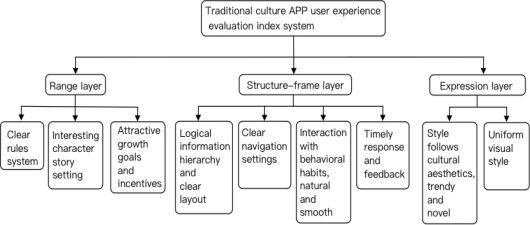
This study refers to the literature related to user experience and combines the characteristics of the gamification design of Chinese traditional culture APPs. Through literature, retrieving the evaluation and interviews of relevant products on the Internet, and design research, we summarize the index factors that affect the user experience of traditional culture and group them into three levels under the user experience elements, namely, scope level, structure-frame level, and performance level, and subdivide these categories into multiple factors.
Evaluation Index System Establishment With the user experience evaluation index system of traditional culture APP as the target layer, the scope layer, the structure-frame layer, and the perfor- mance layer as the first-level indicators, and the specific elements obtained by screening as the second-level indicators, a hierarchical analysis model of user experience evaluation of gamification design of traditional culture APP is established.
470 Li
Figure 1: Hierarchical model of user experience for gamification design of traditional culture APP.
Evaluation Index Weight Assignment Firstly, the relative importance between the evaluation indicators is obtained by a two-by-two comparison of the first level evaluation indicators, i.e., by scoring and assigning values with the nine-level scale method to obtain the first level evaluation indicator judgment matrix B1.
[Equation or mathematical symbol available in the original paper PDF]
Equations and mathematical formulas are available in the original paper PDF.
b11 b12 b13 b21 b22 b23 b31 b32 b33
1 5 3 1 5 1 1 3 1 3 3 1
Let the weight vector of the evaluation index elements be Q. Then, according to the matrix property, it is obtained that: B × Q = λmax × Q (1)
In the above expression: λmax is the maximum eigenvalue of each jud- gment matrix B.
Calculate the weight vector of the first level evaluation indicators.
The combined weights of each indicator in the factor layer to the target layer are shown in Table 2.
The consistency test was performed on the weight of each level element, and the judgment value CR = 0. 0370 < 0.1 was obtained for the judgment matrix of the weight of the primary rating index, which meets the consistency test criteria [6]. The consistency ratios of the three weight judgment matrices of the secondary rating indexes are 0.0176, 0.0495, and 0, respectively, and the CR values are less than 0. 1, which meet the consistency test criteria and indicate that the data are real and valid and do not need to be adjusted.
The weight vector of all nine evaluation indicators Q is obtained by mul- tiplying the weight vector of primary evaluation indicators with the weight vector of secondary evaluation indicators.
Q = (0.355, 0.078, 0.203, 0.043, 0.009, 0.032, 0.021, 0.194, 0.065) According to the results of quantitative analysis, the weights of the nine factors are ranked, and the results are: C11 > C13 > C31 > C12 > C32 >
Gamification Design of Traditional Chinese Culture Applications Based on FAHP 471
Table 2. Evaluation index weight consistency test result.
Table available in the original PDF paper.
Target layer
Indicator layer
Factor layer
Weighting of the indicator layer to the target layer
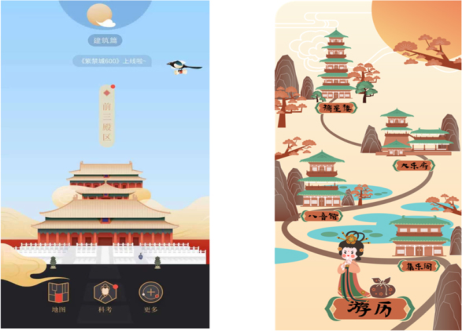
Figure 2: Forbidden City 600” and “Huaxia Music” home page interface.
C21 > C23 > C22 > C24. It can be seen that the rule system, achievement incentive, and visual conformity to cultural aesthetics greatly influence the user experience of the gamification design of the unified culture app, ranking in a relatively important position, accounting for 0.355, 0.203, and 0.194 respectively.
FUZZY COMPREHENSIVE EVALUATION OF GAMIFICATION USER EXPERIENCE OF TRADITIONAL CULTURE APP First of all, the traditional culture APP for gamification design evaluation was determined, and the Forbidden City 600, a Forbidden City culture APP produced by the Forbidden City Museum, and the Chinese traditional musi- cal instrument culture APP designed by the author, “Huaxia Music”, were selected, as shown in Figure 2. 33 respondents were then selected, with an age range of 21-25 years old, including 13 design graduate students 13, and 20 general users.
472 Li
Table 3. Correspondence table of evaluation set and its fuzzy affiliation function.
Table available in the original PDF paper.
Evaluation set Evaluation Score Fuzzy affiliation function [Equation or mathematical symbol available in the original paper PDF][Equation or mathematical symbol available in the original paper PDF][Equation or mathematical symbol available in the original paper PDF][Equation or mathematical symbol available in the original paper PDF] 1, 0 < x < 50 (60 −x)/10, 50 ≤x < 60
Equations and mathematical formulas are available in the original paper PDF.
Fuzzy Evaluation Matrix Construction The evaluation index set P = {p1, p2, p3, …, p9} is constructed with the user experience evaluation index system of gamification design, the evalu- ation set V = {V1,V2,V3,…,V5}is set, the evaluation level is formulated as five levels, and the established evaluation set and the corresponding fuzzy affiliation function are shown in Table 3 (Qiu and Chen, 2018).
After the respondents scored the two APP (Huaxia Music and Forbidden City 600) according to the nine evaluation elements, the percentages were converted into a fuzzy evaluation matrix equation using the fuzzy affiliation function formula, in which n indicates the number of evaluation indicators, and here n = 9.
[Equation or mathematical symbol available in the original paper PDF]
[Equation or mathematical symbol available in the original paper PDF]
[Equation or mathematical symbol available in the original paper PDF]
[Equation or mathematical symbol available in the original paper PDF]
Equations and mathematical formulas are available in the original paper PDF.
R1 R2 · · · Rn
r11 r12 · · · r15 r21 r22 · · · r25 · · · rn1
· · · rn2
· · · · · · · · · rn5
The different rows in R reflect the affiliation degree of the evaluated object (traditional culture APP “Huaxia Music”and “Forbidden City 600”) to each rank fuzzy subset from the viewpoint of 9 evaluation element indicators. The fuzzy weight vector Q is used to synthesize the different rows to obtain the degree of affiliation of the evaluated object to each rank of a fuzzy subset
Gamification Design of Traditional Chinese Culture Applications Based on FAHP 473
in general, i.e. the fuzzy synthesis evaluation result vector J. The evaluation result matrix J can be obtained by synthesizing the fuzzy affiliation evaluation matrix R and the weight matrix Q of each evaluation element index.
[Equation or mathematical symbol available in the original paper PDF]
Equations and mathematical formulas are available in the original paper PDF.
To verify the design evaluation model, evaluation experiments were condu- cted using the traditional musical instrument culture APP and the Forbidden City culture science APP, i.e., the “Huaxia Music” APP and the “Forbidden City 100” APP were used as samples to determine the differences between the user experiences of the two Chinese traditional culture APPs.
All respondents were invited to score the design of the “Huaxia Music” APP and “Forbidden City 100” APP on a percentage scale according to 9 evaluation element indicators, and the statistical results obtained after fuzzy affiliation calculation of the scores were compiled to arrive at the fuzzy evaluation matrix of the gamification design of “Huaxia Music” APP.
[Equation or mathematical symbol available in the original paper PDF]
[Equation or mathematical symbol available in the original paper PDF]
Equations and mathematical formulas are available in the original paper PDF.
Seeking a user experience evaluation model for the gamification design of the traditional musical instrument culture app “Huaxia Music”: J1 = (0.003, 0.057, 0.106, 0.407, 0.426)
In the same way, the user experience evaluation model of the gamification design of the Forbidden City 600, a cultural app of the Forbidden City, can be obtained: J2 = (0.233, 0.369, 0.271, 0.120, 0.004)
The above evaluation results show that for the Forbidden City 100 gami- fication design of the Forbidden City cultural popularization APP, 23.32% of people think it is not good, 36.99% think it is average, 27.16% think it is better, 12.08% think it is good, only 0.45% think it is very good.
As for the evaluation of the gamification design of the traditional musical instrument culture popularization APP “Huaxia Music”, only 0.3% of peo- ple think it is bad, only 5.7% think it is average, 10.6% think it is better, more than 40.7% think it is good and 42.6% think it is very good.
474 Li
CONCLUSION
Traditional culture app design carries the function of transmitting cultural content to users, and the design should bring good experience and pleasant emotion to users, so that they can easily understand and absorb traditional cultural content. Gamification design is an important trend of experience design, so the introduction of gamification design in the cultural APP will better enhance the user’s sense of use and increase user viscosity and reten- tion, so the design requires the participation of designers and users.In order to make the design results more in line with users’ needs, the fuzzy compreh- ensive evaluation method, which can get the overall assessment of the design scheme and also calculate the assessment results of each index according to the hierarchy of design indexes, intuitively shows the importance of diffe- rent design indexes in the gamification design of traditional culture APP, and guides the subsequent modification and improvement. The use of quantita- tive evaluation in the gamification design of traditional culture science APP can enable designers to better understand user needs, design more attractive mobile applications and improve user experience.
REFERENCES
Burke, B. (2014). Gartner Redefines Gamification. URL http://blogs.gartner.com/br ian_burke/2014/04/04/gartner-redefines-gamification/ Garrett, J.J. (2002). The Elements of User Experience. Peachpit Press. Palmer, D., Lunceford, S., Patton, A. (2012). The engagement economy: how
gamification is reshaping businesses. Deloitte Rev. 52–69. Werbach, K., Hunter, D. (2012). For the Win. Wharton Digital Press. Xiaoshuang Liu, Xiaotong Han, and Kaibo Ma. (2021). Research on the design of cloud disk applets based on user experience elements. Industrial Design. 123–124. Ting Zhang, Li Peng. (2020). Research on the design and application of non-heritage
APP based on user experience. Packaging Engineering. 41, 182–187. Liying Li, Yuxin Cao. (2022). FAHP-based comprehensive evaluation of service quality of anonymous social platform--a case study of “Soul app”. Intelligence exploration. 45–52. Zhaohui Yang. (2014). Study on the gamification design of Internet products.
Information Technology and Informatization 89–91. Linxiang Qiu, Bingfa Chen. (2018). Evaluation of fuzzy hierarchical analysis method for the gamification design of news applications. Mechanical Design and Manufacturing Engineering. 47, 119–122. Yiting Zheng, Ye Sun. (2022). Traditional culture app design in the context of new
media--Jinshu APP as an example. Data. 88–90. Yunan Zhong, Maoqi Xu, 2019. Study on the application strategy of gamification design in Internet products. Design. 32, 152–154. Xiao Chen. (2015). Gamification practice of tool products. Industrial Design
Research (3rd series). 130–133.
LISTED IN THE AHFE DIGITAL BOOKSTORE CATALOGUE
Explore the complete digital volume
Usability and User Experience
Read this individual research paper free through the original publisher, or explore the full digital proceedings book.
ISBN 978-1-958651-15-5
Explore this ISBN in the AHFE Bookstore ↗Listed in the July 2026 bookstore catalogue; search by ISBN to confirm current availability · Digital book purchase optional