Tingyi S. Lin, Yin Ho Wang (2022). A User Experience Investigation on Using AR Technology for Explaining Step-by-Step Instructions. In: Usability and User Experience. AHFE Open Access, vol. 39, pp. 95–101. https://doi.org/10.54941/ahfe1001695
Since Augmented Reality (AR) technology is able to help young children read storybooks and understand the content more interestingly (Tuli & Mantri, 2019), as well as can help students in learning abstract geometry (Flores-Bascuñana et al., 2019), AR technology has the potential capacity to extend the representation from paper to digital, and to bring ideas from virtual to reality. In order to use AR to import step-by-step information more effectively and to provide a friendly user experience, we use AR as an auxiliary tool for step-by-step instructions to help users receive and understand the content of information in diversified ways. However, the differences between real and virtual environments often affect the user's ability to operate the devices, to read the information, and to understand the content. In order to explore how the import of AR-assisted step-by-step instructions affects users' experience during operation, we conducted a task-based test and evaluated how the viewing angle and the viewing distance have an effect on test-takers' reading of documents. We analyzed the relationship between devices and human behaviors to understand users' experience in operation, this study explores 1) what is the best viewing angle and distance when users are reading documents and operating AR system; and 2) how the relative positional relationship of the AR developing between paper-based step-by-step instructions affect users' operation. The results show that: 1) Although all test-takers have no significant difference in terms of operation of viewing angle (p=0.535) and viewing distance (p=0.489), there are significant differences in terms of time spent by test-takers on completing this task (p=0.048); 2) During this experiment, the operating range of a test-taker's viewing angle is about 70~87 degrees, while the operating range of the viewing distance is about 16~23 cm; and 3) The differences between the relative positional relationship of AR developing block and the step-by-step instructions in text has an impact on the test-taker's operating experience. The AR developing block laid out on the right-hand side of the text box allows users to have greater adaptability in operational performance among other layout arrangements.
The advancement of technology and the progress of societies have drasti- cally changed how people work, learn, and communicate, and the demand for information is increasingly high. In need of advanced communication, we have to provide the right people with the right information in the most effective way (Jacobson, 2000). Step-by-step instructions help avoid lengthy text and provide a clearer way of showing the process, making the informa- tion easier for the user to follow and understand. It often provides better
user-friendly experience (Knott, 2020). Extensive development of research and products related to step-by-step instructions often play a key role in cri- tical moments. For example, evacuation action cards posted next to a manual call point enables users to take the right action while raising an alarm in the event of a fire incident (Kelly, 2021).
Not only Shelton and Hedley (2004) claimed that Augmented Reality (AR) technology can provide unique and powerful links “to spatial kno- wledge acquisition through visuo-motor involvement in the processing of information,” but this technology latter was proved to be able to help young children read storybooks and understand the content more interestingly (Tuli & Mantri, 2019). It also can help students in learning abstract geometry (Flores-Bascuñana et al., 2019). Studies have shown that AR has potential to extend the space of text content to abstract interpretations. However, the spatial presence differences between real and virtual worlds usually affect the user’s ability to judge (Grechkin et al., 2010). Moreover, novices often fail to focus on targeted objects nor do not know how to interact with the interface on the devices (Harley, 2020). In order to bridge this gap, this study there- fore explores 1) what is the best viewing angle and distance when users are reading documents and operating AR system; and 2) how the relative positio- nal relationship between AR developing images and paper-based instructions affect users’ operation.
LITERATURE REVIEW
Augmented reality technology provides multi-level expression. Not only Azuma (1997) highlighted that AR has the ability synchronizing real and virtual visual information in 3D space, but Schumacher (2018) also descri- bed that users are able to receive virtual and real information in real time to know new product through AR. Such technology provides a special visual experience allowing users to experience and to connect real world informa- tion through digital content. It has been widely applied in many fields such as education, medicine, engineering, and game industries (Xiong, 2021). Several pioneers have explored the user’s operating efficiency and experience through observing three different viewing distances between the physical screen and the virtual projection by using AR equipment with head-mounted display. Gupta (2004) found that the distance from different viewing distances to the virtual text has affected the fatigue level, speed and accuracy in varying degrees, among which the fatigue level has the most significant impact. Ano- ther similar study investigated the error of viewing angle of virtual objects on a 24-inch flat panel monitor and suggested that viewing angle can affect the subjects’ performance in operating tasks (Weber & Ni, 2015).
AR technology incorporates features including real-time interaction and a combination of real and virtual world. Since the experiences of reading through AR can combine the advantages of physical documents and digital content (Dünser, 2008), the way in which how visual information represented on print-based document or through computer-generated AR technology is critical. This consideration sheds light on the relationship of relative posi- tion between paper-based documents and computer-generated perceptual
A User Experience Investigation on Using AR Technology 97
information AR technology. Document is a carrier of information transmis- sion with a long history and a wide range of applications. Documents can be divided into different types of documents according to their content proper- ties, which include differences in the arrangement of images and texts (Lin & Yi, 2016). If the theme structure does not align with the visual structure of the interface, it may confuse users (Karafillis, 2013). “Good visual pre- sentations tend to enhance the message of the visualization” (Wilke, 2019). Therefore, the architecture of visual information in the paper-based docu- ment is particularly important, and such a concept will serve as the research cornerstone of how AR-assisted step-by-step instructions in this study affect the user’s vision and perception.
The way document is laid out affects users’ attention span and reading speed (Maderlechner, 1999). Document structure and information archite- cture set off the traffic flow. We can tell where and which designers and publishers want to emphasize from the arrangement. Eglin & Bres (2003) also argued that information is perceived differently depending on different document types. Also, Schnotz’s (2017) suggested an asymmetry relationship between texts and images and it often causes different information proces- sing strategies. Based on the arguments above, this study extends the concept to investigate the positional relationship between text on the document, AR marker and its projected imagery.
RESEARCH METHOD In order to explore how the import of AR-assisted step-by-step instructions affects users’ experience during operation, we used AR as an auxiliary tool and conducted a marker-based AR (image recognition AR) task-based test to evaluate how the viewing angle and the viewing distance have an effect on test-takers’ reading of documents. The measurement tool was developed with Unity application (version 2019.4.0f1) in android system (OPPO Reno Z), with which recorded the data of viewing angle and viewing distance in time. Observation was overt when the subjects operated the task procedures, inclu- ding 1) focusing operation: measuring viewing angle, viewing distance, and the time spent; 2) users’ experience evaluation: scoring users’ experience in focusing operation on 7-point Likert Scale questionnaires; 3) reading opera- tion: read and answer the given problems; 4) users’ experience evaluation: scoring users’ experience in reading operation on 7-point Likert Scale que- stionnaires; and 5) comprehensive satisfaction assessment on 7-point Likert Scale questionnaires.
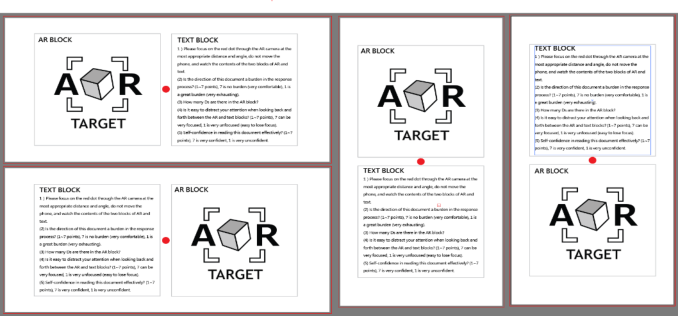
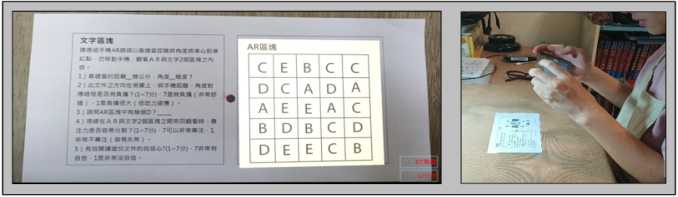
With a gender balance strategy, forty subjects aged 18 to 65 were invited to participate in this experiment. Subjects were randomly divided into four groups. That is, each group of ten subjects used one of relative relationship samples- AR marker on the right hand side, on the left hand side, on the upper side, and on the bottom side of text description. The dot in the center of the samples is used for crosshair correction in the AR lens as a bench- mark for distance measurement (Figure 1). Images were projected and come alive for subjects to go through the tasks followed by the step-by-step text description (Figure 2). Subjects’ behavioral operation were recorded during
98 Lin and Wang
Figure 1: Four types of relative relationships (left, right, upper and lower sides) betw- een descriptive text and the AR marker with its projected area. The dot in the center is used for crosshair correction in the AR lens as a benchmark for distance measurement.Figure 2: Experimental operation scenario.
experiments for complementary analysis while one-way ANOVA was used for data analysis.
RESULTS AND ANALYSIS Results show that there was no significant difference between viewing angle (F(3,36)=0.741, P = 0.535<0.05) and viewing distance (F(3,36)=0.824, P = 0.489<0.05) in the focusing operation performed by the subjects in Task 1. This result helped us to identify the behavioral measurements of 16-23cm viewing distance and 70–87° viewing angle during the operation. However, a significant difference in time spent from the results of focusing operation task (F(3,36)=2.899, P= 0.048<0.05). While the subjects spent the most least time using AR marker on the left hand side layout (M = 11.1, SD = 12.84), they spent the most time using AR marker on the lower side layout (M = 26, SD = 19.89) to complete the task. On the contrary, there was a significant difference in users’ experience evaluation in focusing operation (F(3,36)=3.488, P = 0.027<0.05). The layout with AR marker on the right hand side earned the highest score (M = 5.8, SD = 0.79), slightly higher than the left hand side one (M = 5.4, SD = 1.43). The lowest score falls on the layout with AR marker on the upper side (M = 4, SD = 1.49), using a7-point Likert scales (Table 1).
A User Experience Investigation on Using AR Technology 99
Table 1. Results and Qne-Way ANOVA analysis on focusing, positioning, and operation experiences.
Table available in the original PDF paper.
Item AR_Left AR_Right AR_Upper AR_Lower F P M (SD) M (SD) M (SD) M (SD)
5.60 (1.58) 6.00 (1.25) 4.50 (1.84) 5.70 (1.83) 1.596 0.207 Overall Satisfaction *P(Significance)<0.05, there is a significant difference
Table 2. Multiple Comparisons-Post Hoc LSD analysis Test Result.
Table available in the original PDF paper.
Dependent Variable (I)GROUP (J)GROUP Mean Different(I-J) P value
AR_Left AR_Upper 1.40000* 0.023*
Positioning Time AR_Left AR_Upper −14.70000* 0.040* AR_Lower −14.90000* 0.037* AR_Right AR_Lower −14.00000* 0.050* Experience on Focusing Operation AR_Left AR_Upper 1.90000* 0.005* AR_Right AR_Upper 1.80000* 0.004* Experience on Reading Operation
AR_Right AR_Upper 2.60000* 0.000*
*P(Significance)<0.05, there is a significant difference
The 97.5% correct rate in the task of reading operation (Task 3) provided a certain confidence level for us to continuously observe subjects opera- ting behaviors and to ensure the following tasks, including users’ experience evaluation and comprehensive satisfaction assessment.
Although there was no significant difference in the comprehensive satisfa- ction assessment, we noticed from users’ experience evaluation in reading operation (F(3,36)=6.395, P = 0.001<0.05) that the layout with AR marker on the right hand side earned highest score (M = 5.9, SD = 0.99). The layout with AR marker on the lower side is the second (M = 5.4, SD = 0.71), and the lowest score falls on the layout with AR marker on the upper side (M = 3.3, SD = 1.64).
From multiple comparison by LSD post-hoc test analysis, results show that the horizontal relative positional relationship of AR marker and the step-by- step instructions is better than the vertical, regards to operating performances in focusing and positioning, as well as the overall operation experiences (Table 2).
100 Lin and Wang
Another finding worth mentioning from the observation is the differences of users’ postures and gestures in operation. There are 95% users would consider using whether vertical or horizontal direction of the cell phone at the start of the operations. A small number of subjects would stand and hold the phone with one hand. Some would use the other hand to assist with during the operations. Subjects who used the layout with AR marker on the right hand side all sat and watched with both hands holding the cell phone. Meanwhile, the AR marker on the right hand side layout has the best outcomes on users’ experience evaluation in both focusing operation and reading operation.
DISCUSSION AND CONCLUSION Through the series of experiment and observation, we are able to conclude above findings in answering the research question. Firstly, since no significant difference was found in viewing angle and viewing distance measuring, this result helps to identify that the suitable operation viewing angle is ranging from 70–87 degree angle and the comfortable viewing distance is ranging from 16–23cm in this study. Secondly, the results show that users’ operati- onal performance is more efficient when the AR marker locates on the left side of instructional description. However, users’ perceptual satisfaction level is higher when the AR marker locates on the right hand side of instructional description, with which to provide greater users’ experiences in operation. The relative positional relationship between the text on printed document and the AR marker with its projecting imagery indeed affect users’ operati- onal experiences. In sum, the results of viewing distance and viewing angle provide references in the development of using AR technology for assisting instructional purpose, especially to be used along with print based materials. Also, we found that the horizontal relative positional relationship of AR mar- ker and the textual instructions provides better operating performances and experiences than vertical ones. This research opens up more possibilities in using augmented reality technology for explanation and instruction purpo- ses. Although there are many questions remained to be answered, the insights from this study provide constructive reference and guidance for scholars and practitioners in the design and development related field.
REFERENCES
Azuma, R. T. (1997, August). A Survey of Augmented Reality. In Presence: Teleoperators and Virtual Environments, 6(4), pp. 355–385. Bascuñana, M. F., Diago, P. D., Taranilla, R. V., & Yáñez, D. F. (2019, 12 21). On
Augmented Reality for the Learning of 3D-Geometric Contents: A Preliminary Exploratory Study with 6-Grade Primary Students. Education Sciences. Dünser, A., Grasset, R., & Billinghurst, M. (2008). A Survey of Evaluation Techniques Used in Augmented Reality Studies. Human Interface Technology Laboratory New Zealand, Technical Report TR-2008–02. Eglin, Véronique & Bres, Stéphane. (2003). Document page similarity based on
layout visual saliency: Application to query by example and document classifi- cation. 1208–1212. 10.1109/ICDAR.2003.1227849.
A User Experience Investigation on Using AR Technology 101
Flores-Bascuñana, M., Diago, P. D., Villena-Taranilla, R., & Yáñez, D. F. On Augmented Reality for the Learning of 3D-Geometric Contents: A Preliminary Exploratory Study with 6-Grade Primary Students. Education Sciences, 10(1), 4. https://doi.org/10.3390/EDUCSCI10010004 Grechkin, T. Y., Nguyen, T. D., Plumert, J. M., Cremer, J. F., & Kearney, J. K. (2010).
How does presentation method and measurement protocol affect distance estima- tion in real and virtual environments? ACM Transactions on Applied Perception, 7(4), 1–18. https://doi.org/10.1145/1823738.1823744 Gupta, Divya. (2004). An Empirical Study of the Effects of Context-Switch, Object Distance, and Focus Depth on Human Performance in Augmented Reality. Harley, A. (2020). UX Guidelines for Augmented-Reality Shopping Tools. Retrieved
from Nielsen Norman Group: https://www.nngroup.com/articles/augmented-rea lity-ecommerce-guidelines/ Karafillis, A. (2013). Improving User Experience in Manuals. from UX Magazine: https://uxmag.com/articles/improving-user-experience-in-manuals Knott, R. (n.d.). https://www.techsmith.com/blog/user-documentation/. (TechSmith
Corporation) Retrieved from https://www.techsmith.com. Lin, T.S. & Yi, M.-Z. (2016). Document design for consumer use: A case study on electricity statement. 21. 25–44. Maderlechner, G., Schreyer, A., & Suda, P. (1999). Information Extraction from
Document Images using Attention Based Layout Segmentation. Schumacher, H. (2018, 4 6). Inside the world of instruction manuals. Retrieved from bbc.com: https://www.bbc.com/future/article/20180403-inside-the-world-of-inst ruction-manuals Schnotz, W. & McElvany, N. et al. (2017). Development of dynamic usage of stra-
tegies for integrating text and picture information in secondary schools. In: D. Leutner, J. Fleischer, J. Grünkorn & E. Klieme (Eds.), Competence Assessment inEducation – Research, Models and Instruments (303–313). Dordrecht: Springer. Shelton, B. E. & Hedley, N. R. (2004). Exploring a cognitive basis for learning spatial relationships with augmented reality. Technology, Instruction, Cognition and Learning, 1(4). 323–357. Tuli, N., & Mantri, A. (2019). Usability Principles for Augmented Reality based Kin-
dergarten Applications. ScienceDirect,9th World Engineering Education Forum, WEEF 2019, p. 679. Weber, B., & Ni, R. (2015). Effect of Viewing Angle on 3D Multiple Object Tracking.
Proceedings of the Human Factors and Ergonomics Society Annual Meeting, 59(1), 1052–1055. https://doi.org/10.1177/1541931215591296 Wilke, C. O. (2019). Fundamentals of Data Visualization: A Primer on Making Informative and Compelling Figures (1 ed.). O’Reilly Media. Xiong, J., Hsiang, EL., He, Z. et al. (2021). Augmented reality and virtual reality
Read this individual research paper free through the original publisher, or explore the full digital proceedings book.
ISBN 978-1-958651-15-5
Explore this ISBN in the AHFE Bookstore ↗Listed in the July 2026 bookstore catalogue; search by ISBN to confirm current availability · Digital book purchase optional