Qiuli Jin, Zihan Ma, Zhikai Zhao, Shuping Xiong (2026). Designing Adaptive Transparency User Interface for Pedestrian Safety in Mobile AR. In: Human Systems Engineering and Design (IHSED2026): Future Trends and Applications. AHFE Open Access, vol. 237, pp. 34–43. https://doi.org/10.54941/ahfe1008143
As augmented reality (AR) glasses become integrated into daily life, their use during walking introduces critical safety challenges: virtual overlays can occlude real-world information, forcing users to divide attention between digital content and environmental hazards. While transparency control can mitigate this issue, fixed settings may be inadequate for dynamic walking contexts where lighting, scene complexity, and user motion change continuously. This paper presents an environment-aware transparency control system that dynamically adjusts AR interface opacity in real-time using a lightweight, interpretable heuristic. The system extracts visual features from the headset's passthrough camera, including scene motion, ambient brightness, and visual complexity, and combines them with head rotation velocity from inertial sensors to compute continuous transparency values. A within-subjects study (N=10) in a real-world indoor walking environment compared three interfaces: Opaque, Semi-Transparency, and Adaptive Transparency. Results show that both transparency-enabled interfaces significantly improved perceived safety and situational awareness while reducing interface interference compared to the Opaque condition (p < 0.001). Cognitive workload was reduced by 46.3–51.1% under both the Semi and Adaptive conditions. No significant differences were observed in objective walking behavior across interfaces. Although no significant differences were found between the Semi and Adaptive in either objective or subjective measures, 60% of participants preferred the Adaptive interface, suggesting that dynamic responsiveness offers perceived benefits for mobile AR safety and user experience.
The rapid adoption of consumer augmented reality (AR) glasses marks a fundamental shift toward wearable AR integrated into everyday pedestrian activities. Devices such as Meta Ray-Ban Display (Meta, 2025) have exceeded seven million units in sales (OnOff, 2026), while the broader smart glasses market grew by 210% in 2024 (BusinessABC, 2025). As AR transitions from a specialized tool to a personal computing platform, a critical safety challenge emerges: digital overlays can occlude real-world information essential for safe navigation, particularly in dynamic pedestrian environments.
Designing Adaptive Transparency User Interface for Pedestrian Safety 35 Transparency control is the primary mechanism for mitigating such occlusion, allowing users to perceive the physical world through virtual content. However, it introduces a fundamental trade-off: increasing transparency enhances environmental awareness but reduces content readability. Prior work has shown that transparency and background complexity jointly influence both performance and user preference (Hussain and Park, 2024), while perceptual responses to transparency are inherently non-linear, limiting the effectiveness of fixed settings (Zhang and Murdoch, 2021). This challenge is further exacerbated during walking, where lighting, user motion, and environmental hazards change continuously (Erickson et al., 2020), rendering static transparency inherently suboptimal.
Recent adaptive AR systems attempt to address this limitation but remain constrained in pedestrian contexts. Li et al. (2024) introduced SituationAdapt, which leverages vision-language models to adjust UI layouts based on scene semantics, but evaluation was limited to static indoor scenarios. Cheng et al. (2021) proposed SemanticAdapt, an optimization-based approach for virtual content placement using semantic relationships, yet similarly targeted stationary use. More recently, Pei et al. (2025) presented AttentionAR, a risk-aware system that modulates transparency based on user attention and environmental hazards using multimodal large language model reasoning, but the computational latency of such inference may be incompatible with pedestrian scenarios where hazards emerge within fractions of a second.
Prior research on AR interface design during walking further confirms the influence of environmental factors such as traffic density on user preferences for window size, opacity, and placement (Chang et al., 2024a; Chang et al., 2024b). Although a fixed transparency value (e.g., 0.68) has been suggested for outdoor walking scenarios, such recommendations cannot accommodate the continuous variability encountered in real-world environments. Additional work on text positioning (Rzayev et al., 2018) and dual-task presentation strategies (Klose et al., 2019) further highlight the impact of walking on visual attention and cognitive load.
These limitations motivate the following research question: How can optimal AR UI transparency be predicted and applied in real time for pedestrians? To address this, we propose an environment-aware adaptive transparency control system that dynamically adjusts UI opacity based on visual and motion-related features, and evaluate it through a within-subjects user study (N = 10) in a real-world indoor walking environment comparing three interfaces: fully opaque (Opaque), fixed semi-transparency (Semi), and adaptive transparency (Adaptive).
METHOD
We developed a lightweight, heuristic-based transparency control system for real-time operation on standalone AR headsets during walking. The system continuously extracts visual and motion-related features and computes adaptive transparency values with minimal latency.
System Design Four environmental features are extracted in real-time. Three visual features are computed from the passthrough camera feed using OpenCV. View motion is estimated as the optical flow magnitude between consecutive frames, capturing scene dynamics. Brightness is defined as the mean pixel intensity, representing ambient lighting, while contrast is computed as the standard deviation of pixel intensities, reflecting scene complexity and visual structure.
In addition, head rotation velocity is obtained from the headset’s inertial measurement unit, serving as an indicator of user activity and attention shifts. Rapid head movements suggest active environmental scanning and therefore require higher transparency, whereas stable viewing permits higher opacity to enhance content readability.
The transparency value is computed as a weighted combination of these features: _ , _ , , f w m ion head motion brightness contrast vie ot
where 0 1 , represents the transparency level. Weights were empirically tuned through pilot testing to balance responsiveness and stability. A temporal smoothing filter is applied to prevent rapid fluctuations that could distract users, allowing gradual transitions while preserving responsiveness to meaningful environmental changes.
Participants Ten participants (all male; age range: 23–30 years, M = 25.8, SD = 2.3) were recruited from a university population. All had normal or corrected- to-normal vision and prior experience with AR or XR technology. The experiment was conducted using a Meta Quest 3 headset operating in video passthrough mode with a fixed diagonal field of view of 45°. Xsens inertial measurement units, worn on the lower body, captured walking behavior at 60 Hz.
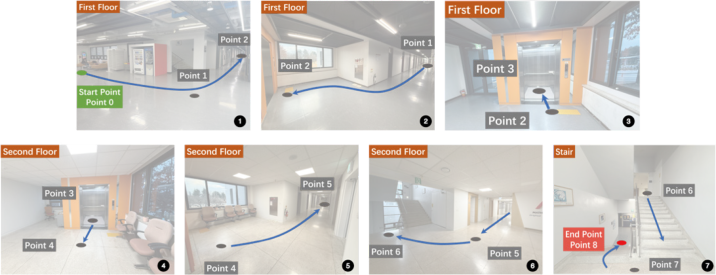
Task and Procedure The experiment was conducted in a real-world indoor walking environment spanning two floors of a university building. Figure 1 illustrates the predefined route, which included straight corridors, turns, elevator transitions between floors, open waiting areas, and a stair descent, covering approximately 300 meters and requiring 3–5 minutes per condition. Participants walked at a comfortable, self-selected pace while viewing video content through the headset. Two experimenters accompanied each participant: one ensured safety, and the other managed data logging and system monitoring.
Figure 1: Predefined indoor walking route spanning two floors of the university building.
Experimental Design and Measures A within-subjects design was employed with one independent variable (interface type) at three levels: Opaque (fully opaque), Semi (fixed 68% opacity), and Adaptive (dynamically modulated opacity). Condition order was counterbalanced using a Latin square design, with 3–5 minute breaks between conditions to reduce fatigue and carryover effects.
Objective performance was quantified using four gait metrics derived from Xsens data: average walking speed, average stair descent speed, stride length, and stride width. Subjective experience was assessed after each trial using a 7-point Likert questionnaire (Table 1) evaluating three dimensions: safety and situational awareness, UI interference and visual readability, and viewing experience and attention flow.
1. I could easily perceive pedestrians and obstacles in my surroundings.
Safety & situational awareness
2. I felt confident that I could respond to potential hazards in time while walking.
3. The interface did not obstruct my forward view or interfere with my walking.
UI interference & visual readability
4. I did not need to turn my head excessively to remain aware of my surroundings.
5. The interface did not hinder my ability to follow the video content.
Viewing experience & attention flow
6. Switching attention between the video and the surrounding environment felt smooth and natural.
Data Analysis Data were analyzed using repeated-measures analysis of variance (ANOVA) at 0.05. Significant effects were followed by Bonferroni-corrected post hoc paired comparisons. Assumptions of normality and sphericity were verified, with Greenhouse–Geisser corrections applied when sphericity was violated. Effect sizes are reported as partial eta squared (η 2p).
Preference rankings were analyzed using the Friedman test, followed by Wilcoxon signed-rank tests with Bonferroni correction.
RESULTS
Table 2: Summary of repeated-measures ANOVA results for objective and subjective measures across interfaces (*p < .05, **p < .01, ***p < .001).
Table available in the original PDF paper.
2p
Type Measure F df p η Average walking speed 1.75 (2, 18) .203 0.163
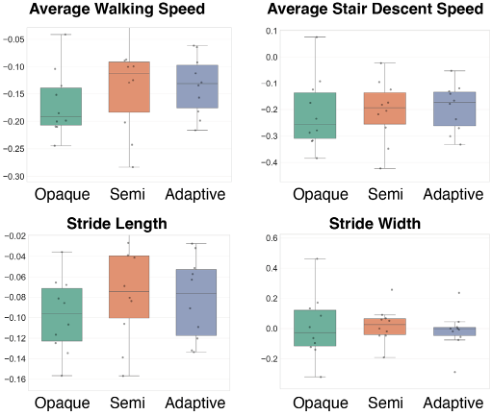
Objective Walking Behavior As shown in Table 2, no significant main effects of interfaces were observed for any gait metrics. Average walking speed, average stair descent speed, stride length, and stride width did not differ across interfaces (all p > .20), with small-to-moderate effect sizes ( 2 0 032 0 163 p . . ). Mean walking speed ranged from 0.98 to 1.03 m/s, lower than the typical preferred speed of 1.2-1.4 m/s reported for young adults (Bohannon, 1997), and consistent with the reduced walking speed under visual dual-task conditions (Schabrun et al., 2014), as shown in Figure 2.
Figure 2: Objective gait metrics across interfaces. No significant differences were observed in average walking speed, average stair descent speed, stride length, or stride width. Values are expressed as percentage change relative to baseline walking.
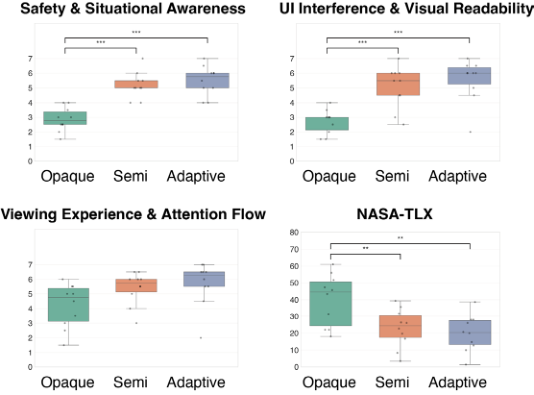
Subjective Measures In contrast, as shown in Figure 3, interfaces significantly influenced subjective experience. Perceived safety and situational awareness showed a strong main effect ( ( )
2 2,18 25.19, .001, 0.737) F p p η = < = . Post hoc comparisons indicated that both Semi (M SD = = 6 15 0 67 . , . ) and Adaptive (M SD = = 6 30 0 66 . , . ) were rated significantly higher than Opaque (M SD = = 3 35 1 09 . , . , both p < .001), with no significant difference between Semi and Adaptive. UI interference and visual readability also showed a significant main effect (F p p 2 18 20 32 001 0 693 2 , . , . , . ), with both Semi and Adaptive outperforming Opaque (both p < .001), and no significant difference between them. Viewing experience and attention flow showed a smaller but significant main effect (F p p 2 18 4 32 029 0 326 2 , . , . , . ), although no pairwise differences remained significant after Bonferroni correction.
NASA-TLX scores differed significantly across interfaces with a large effect size (F p p 2 18 16 23 001 0 643 2 , . , . , . ), as shown in Figure 3. Both Semi (M SD = = 24 8 8 7 . , . ) and Adaptive (M SD = = 22 6 9 2 . , . ) yielded substantially lower workload than Opaque (M SD = = 46 2 12 1 . , . ), corresponding to reductions of 46.3% and 51.1%, respectively (both p < .001), with no significant difference between Semi and Adaptive.
Figure 3: Subjective measures and NASA-TLX scores across interfaces. Asterisks indicate significant pairwise differences after Bonferroni correction (p < .05, **p < .01, ***p < .001).
User Preferences All participants ranked Opaque as the least preferred interface. A Friedman test confirmed a significant effect ( ( ) ² 2 15.2, .001, ’ 0.76 = < = p Kendall sW χ ). Post hoc tests showed that both Semi and Adaptive were significantly preferred over Opaque (both p < .001), with no significant difference between them.
DISCUSSION
Transparency control significantly improved user experience during AR walking. Both Semi and Adaptive interfaces outperformed Opaque with large effect sizes in perceived safety and situational awareness, UI interference and visual readability, and cognitive workload, with NASA-TLX scores reduced by 46.3–51.1%. These findings extend prior work on transparency-readability trade-offs in stationary AR displays (Hussain and Park, 2024; Zhang and Murdoch, 2021) to a dynamic walking context, demonstrating that even partial transparency effectively mitigates attentional conflict between virtual content and the physical environment.
Objective gait metrics remained stable across all interfaces. Although not statistically significant, descriptive trends suggest higher walking speed, longer stride length, and narrower stride width under Semi and Adaptive compared to Opaque. Prior dual-task gait research has shown that increased cognitive demands during walking typically manifest as reduced speed, shortened stride length, and increased gait variability (Al-Yahya et al., 2011; Schabrun et al., 2014). The observed trends may therefore reflect a lower attentional burden under transparency-enabled interfaces, though confirming this interpretation would require a larger sample.
Designing Adaptive Transparency User Interface for Pedestrian Safety 41 No significant differences were observed between Semi and Adaptive on any measured outcome. The controlled indoor environment provided relatively stable conditions, which may have limited the opportunity for adaptive transparency to demonstrate clear advantages over a fixed value. Outdoor settings with more dynamic lighting transitions, varying traffic density, and unexpected hazards would provide a stronger test. The modest sample size (N = 10) may have further limited statistical power to detect subtler effects between two interfaces.
Despite similar quantitative outcomes, preference data revealed a clear divergence: 60% of participants favored Adaptive for its responsiveness, while 40% preferred Semi for its predictability and consistency. This pattern aligns with human-automation interaction research, where appropriate system responsiveness can enhance perceived control and trust (Parasuraman and Riley, 1997) but may reduce usability if perceived as unpredictable (Jameson, 2008). These findings suggest that individual tolerance for interface variability should be considered in adaptive AR design, and that hybrid or user-configurable strategies may better accommodate diverse preferences.
The heuristic-based approach offers practical advantages for real-world deployment. Unlike model-driven systems relying on deep learning or large language model inference, the proposed method requires no GPU acceleration and maintains low latency suitable for safety-critical pedestrian scenarios. The explicit feature weighting also provides interpretability and allows designers to tune system behavior for specific contexts or user needs.
LIMITATIONS Several limitations should be acknowledged when interpreting these findings. This study was conducted in a controlled indoor environment with limited variability; outdoor settings with more dramatic lighting, traffic, and hazards may produce different results. The sample was small (N = 10) and homogeneous, limiting generalizability to broader populations. Feature weights were manually tuned through pilot testing and may not represent optimal values across users or contexts. Exposure duration was short (3–5 minutes per condition), leaving longer-term adaptation and habituation effects unexplored. Finally, the task focused on video viewing and does not generalize to other AR use cases such as navigation or real-time information retrieval.
CONCLUSION
This work presented an environment-aware adaptive transparency control system for AR walking using a lightweight heuristic that integrates optical flow, brightness, contrast, and head motion. A within-subjects study demonstrated that transparency control significantly improves perceived safety, visual readability, and cognitive workload during walking. While adaptive and fixed transparency produced comparable quantitative outcomes, majority user preference for adaptive behavior points to experiential benefits not captured by standard metrics. These findings establish transparency control
as a fundamental design consideration for pedestrian AR applications and demonstrate that real-time adaptive transparency is feasible on current consumer hardware without computationally intensive models. Future work should evaluate this approach in outdoor environments, explore data-driven feature weight optimization, and investigate personalized adaptation that accommodates individual differences in user preference.
ACKNOWLEDGMENT
This work was supported by the Korea Advanced Institute of Science and Technology (KAIST) (Grant No. A0601003029). The authors would like to thank Haejun Kim and other members of the Human Factors and Ergonomics Lab for their helpful discussions and contributions to this work.
REFERENCES
Al-Yahya, E., Dawes, H., Smith, L., Dennis, A., Howells, K. and Cockburn, J. (2011).
Cognitive motor interference while walking: A systematic review and meta- analysis. Neuroscience & Biobehavioral Reviews, 35(3), 715–728. Bohannon, R.W. (1997). Comfortable and maximum walking speed of adults aged 20–79 years: Reference values and determinants. Age and Ageing, 26(1), 15–19. BusinessABC. (2025). Ray-Ban Meta Glasses: Smart Wearables Growth. Available
at: https://businessabc.net/ray-ban-meta-glasses-smart-wearables-growth Chang, C.J., Hsu, Y.L., Tan, W.T.M., Chang, Y.C., Lu, P.C., Chen, Y., Wang, Y.H. and Chen, M.Y. (2024a). Exploring augmented reality interface designs for virtual meetings in real-world walking contexts, proceedings of the 2024 ACM Designing Interactive Systems Conference, pp. 391–408. Chang, Y.C., Hsu, Y.L., Tan, W.T.M., Chang, C.J., Lu, P.C., Chen, Y., Wang, Y.H.
and Chen, M.Y. (2024b). Experience from designing augmented reality browsing interfaces for real-world walking scenarios. Proceedings of the ACM on Human- Computer Interaction, 8(MHCI), 1–26. Cheng, Y., Yan, Y., Yi, X., Shi, Y. and Lindlbauer, D. (2021). SemanticAdapt: Optimization-based adaptation of mixed reality layouts leveraging virtual- physical semantic connections, proceedings of the 34th Annual ACM Symposium on User Interface Software and Technology, pp. 282–297. Erickson, A., Kim, K., Bruder, G. and Welch, G.F. (2020). Exploring the limitations of
environment lighting on optical see-through head-mounted displays, proceedings of the 2020 ACM Symposium on Spatial User Interaction, pp. 1–8. Hussain, M. and Park, J. (2024). Effect of transparency levels and real-world backgrounds on the user interface in augmented reality environments. International Journal of Human–Computer Interaction, 40(16), 4265–4274. Jameson, A. (2008). “Adaptive interfaces and agents”, in: The Human-Computer
Interaction Handbook, Sears, A. and Jacko, J.A. (Eds.), 2nd ed. CRC Press, pp. 433–458. Klose, E.M., Mack, N.A., Hegenberg, J. and Schmidt, L. (2019). Text presentation for augmented reality applications in dual-task situations, proceedings of the IEEE Conference on Virtual Reality and 3D User Interfaces (VR), pp. 636–644. Li, Z., Gebhardt, C., Inglin, Y., Steck, N., Streli, P. and Holz, C. (2024). SituationAdapt:
Contextual UI optimization in mixed reality with situation awareness via LLM reasoning, proceedings of the 37th Annual ACM Symposium on User Interface Software and Technology, pp. 1–13.
Designing Adaptive Transparency User Interface for Pedestrian Safety 43 Meta. (2025). Meta Ray-Ban Display: AI Glasses with an EMG Wristband. Available
at: https://about.fb.com/news/2025/09/meta-ray-ban-display-ai-glasses-emg- wristband/ OnOff. (2026). Meta Smart Glasses: Record-Breaking 7 Million Sales. Available at: https://www.onoff.gr/blog/en/metaverse-vr/meta-smart-glasses-record-breaking- 7-million-sales/ Parasuraman, R. and Riley, V. (1997). Humans and automation: Use, misuse, disuse,
abuse. Human Factors, 39(2), 230–253. Pei, Y., Huang, R., Zha, M., Wang, G., Wang, P., Kang, Q., Yang, Y. and Shen, H.T.
(2025). AttentionAR: AR adaptation and warning for real-world safety via attention modeling and MLLM reasoning, proceedings of the 38th Annual ACM Symposium on User Interface Software and Technology, pp. 1–19. Rzayev, R., Woźniak, P.W., Dingler, T. and Henze, N. (2018). Reading on smart glasses: The effect of text position, presentation type and walking, proceedings of the CHI Conference on Human Factors in Computing Systems, pp. 1–9. Schabrun, S.M., van den Hoorn, W., Moorcroft, A., Greenland, C. and Hodges, P.W.
(2014). Texting and walking: Strategies for postural control and implications for safety. PLOS ONE, 9(1), e84312. Zhang, L. and Murdoch, M.J. (2021). Perceived transparency in optical see-through augmented reality, proceedings of the IEEE International Symposium on Mixed and Augmented Reality Adjunct (ISMAR-Adjunct), pp. 115–120.
FIND THE COMPLETE VOLUME IN THE AHFE DIGITAL BOOKSTORE
Explore the complete digital volume
Human Systems Engineering and Design (IHSED2026): Future Trends and Applications
Read this individual research paper free through the original publisher, or explore the full digital proceedings book.