Jiawei Tang, Yuanbo Sun, Huayu Zhang, Zhiyuan He (2023). Design of Integral Kitchen CMF Evaluation System Based on Virtual Reality. In: Ergonomics In Design. AHFE Open Access, vol. 77, pp. 297–306. https://doi.org/10.54941/ahfe1003387
Integral kitchen is a new form of kitchen, and becomes an inevitable trend. The existing evaluation methods of integral kitchen CMF include graphic display, sample display and product display, but there are some problems such as tedious evaluation process, high cost and subjective evaluation. The paper analyses existing evaluation methods, demonstrates the necessity of applying virtual reality to the integral kitchen CMF evaluation. The results show that the integral kitchen CMF evaluation system based on virtual reality can improve the efficiency and quality of evaluation. This paper puts forward four design strategies, and provides reference for related design research.
With the rapid development of economy, the integral kitchen has become an inevitable trend in order to improve the quality of user experience in kitchen and solve the problem of clutter. Researches show that users pay more attention to kitchen CMF design. Traditional kitchen CMF design evaluation efficiency is low. Also, there is a certain degree of subjective randomness. These problems need a complete and scientific evaluation method and scene evaluation experience to solve. With the development of science and tech- nology, applying virtual reality to CMF design evaluation will be one of the future trends. Therefore, whether the application of virtual reality in the inte- gral kitchen CMF design evaluation field can help improve the evaluation efficiency and reduce the evaluation cost is of great significance.
RESEARCH STATUS Research Status of Integral Kitchen
Integral kitchen is a new form of kitchen, including cabinets, kitchen appli- ances (range hood, refrigerator, oven, steam box, etc.), other kitchen uten- sils, the focus of design is the integral cabinet. The integral kitchen is a combination of the three, achieve the “cabinet-electricity integration”.
“2022-2027 China Integral Kitchen Market Research and Investment Stra- tegy Forecast Report” published by Zhongyan Industrial Research Institute (ChinaIRN) shows that the market scale of integral kitchen has reached about
40 billion yuan. However, the integral cabinet furniture ownership rate is only 6.8% in about 100 million urban households, far lower than the average level of European and American developed countries of 35%. But about 29% of urban households said that they would buy and relocate the integral cabinet furniture in the future, which indicates that integral kitchen has a huge deve- lopment space. According to experts’ predictions, kitchen decoration costs will account for more than 30% in the future consumption of urban home decoration. In the next 5 years, the intended purchase of integral kitchen is about 29 million sets, with an average of 5.8 million sets per year (Zhongyan industry institute, 2022). More and more major consumers are paying for the appearance of kitchen products. The report shows that consumers aged 18–35 (the main force of kitchen consumption) account for nearly 70% of the shopping group of “pay for appearance”.
There are also papers to prove this trend. A paper shows a question- naire for the integral kitchen market demand in the early stage, conducts a consumer demand survey, and obtains the ranking of influencing factors of kitchen through statistical analysis of the survey data (Lv et al., 2020). Among them, consumers who think material or colour influences choices account for 62.5% and 42.5% respectively. CMF contains material and colour. So, CMF design has a huge impact on consumers’ choice of integral kitchen.
Research Status of Integral Kitchen CMF Evaluation CMF represents colour, material and finishing. Colour is the primary element of visual presentation, which is determined by both materials and finishing. The material is the carrier of the product, which determines the choice of colour and finishing. The finishing determines the available materials and the range of colours that can be selected. CMF organically combined the three.
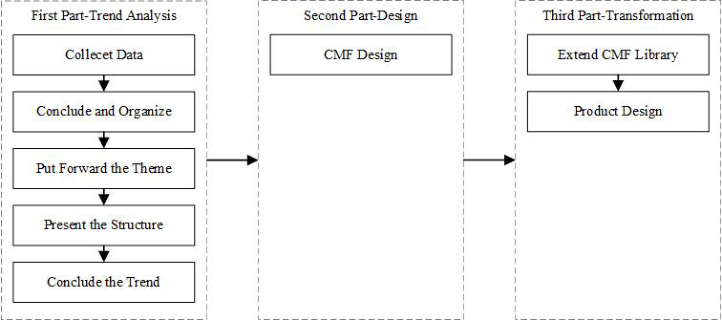
At present, there is no unified and complete CMF design process or method for the whole kitchen at home and abroad. Different designers have different CMF design methods and processes. The paper analysed and summarized relevant data,then came the CMF design process(see Figure 1) (Fu et al., 2022). The whole design process is divided into: First part-trend analysis, Second part-design, Third part-transformation (Li, 2019).
Design evaluation is the most important part of the whole design process, which can screen out the best design scheme and reduce the blindness of the design. It is found that most designers mainly focus on CMF design and ignore the imperfection of CMF design evaluation. The existing CMF design evaluation has several characteristics, such as variable standards, diverse methods and relative results. After the investigation, this paper sorted out three common CMF design evaluation methods of kitchen products: graphic display, sample display and product display.
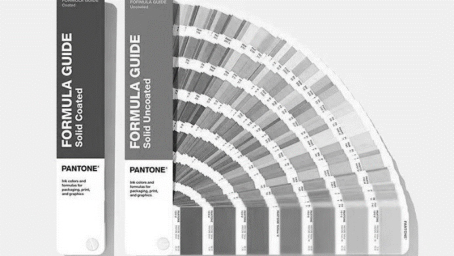
Designers often use graphic display (see Figure 2), such as design manual, in the design phase. For example, the figure shows a Pantone colour card. Graphic display containing texts and pictures have some problems such as limited display content. The transmission mode is two-dimensional. It can- not fully satisfy the functional demonstration and ergonomic verification of three-dimensional model which are quite important during design evaluation.
Design of Integral Kitchen CMF Evaluation System 299
Designers often use sample display (see Figure 3) in the early stage of mass production. The sample display is usually hanging different boards in the room for the user to choose from. According to the integral plan- ning and basic model products, CMF designers develop samples with dif- ferent colours, surface materials and finishing. After making the samples, some industry experts and leaders will be invited to evaluate, and the sele- cted samples will be the production basis. This evaluation method has some problems, such as weak interaction and detached evaluation from the whole environment. Different from traditional kitchen product CMF design, the integral kitchen CMF design needs to consider the integral effect.
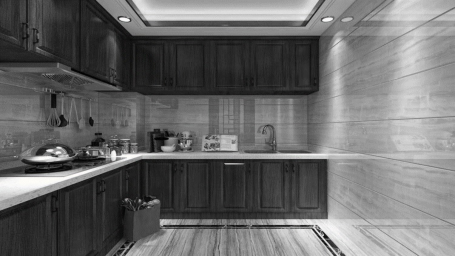
Designers often product a small amount of products to evaluate the CMF design (see Figure 4) before mass production or after product launching. The CMF designer will instruct the factory to produce some products for com- parison and review of the actual state of various styles of CMF design, and the top leadership decision will choose one or several styles. The CMF desi- gner will add these chosen styles to the CMF library and the industry will mass product the corresponding samples. This evaluation method has the best effect, but it has the problems of long iteration time and high cost.
The above three methods all have some subjective arbitrariness and lack of unified standards. People’s evaluation is very subjective. Under different external influences and different moods, people have different feelings tow- ards the same CMF. The imperfect CMF design evaluation method reduces the work efficiency and increases the design cost, which is not conducive to the development of the integral kitchen CMF design.
APPLICATION OF VIRTUAL REALITY TO INTEGRAL KITCHEN CMF EVALUATION Introduction to Virtual Reality
Virtual reality technology can help users experience the virtual world in the computer through visual, auditory, tactile and other sensory systems, so that users have the feeling of being in the scene. VR has three outstanding chara- cteristics: interaction, immersion and imagination. The core is the feeling of the person, the emphasis is the leading role of the person.
Application Status It is found that the digital design evaluation system has broad application prospect and high academic value. At present, virtual reality is widely used in the field of home decoration at home and abroad. Virtual reality technology
Design of Integral Kitchen CMF Evaluation System 301
is applied more frequently on kitchen decoration which is the most important and complex part of the home decoration.
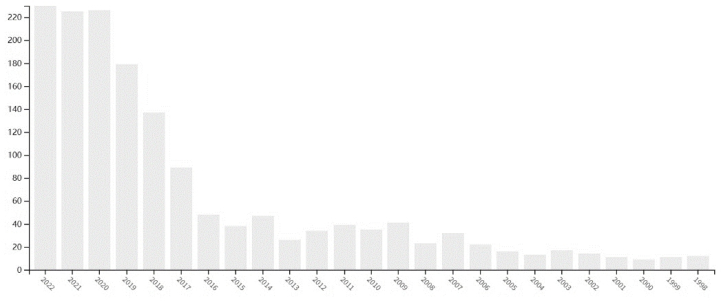
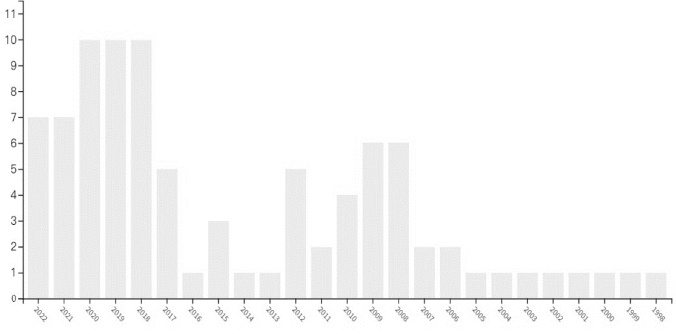
Virtual reality provides a new way of design evaluation, makes the user feel like being in the real world. This paper selects the full-text database of Chi- nese academic journals in the CNKI database as the Chinese literature source, and the non-Chinese database in the web of science as the foreign literature source, and searches with the keywords “VR” and “design evaluation”. By January 2023, the publication trend of relevant literatures(see Figure 5 and Figure 6). There were 1,597 foreign literatures and 81 Chinese literatures. Among them, there are 1 foreign literature and 3 Chinese literatures related to kitchen CMF or kitchen products CMF.
Not only the academic community attaches great importance to the appli- cation of VR in design evaluation, but also enterprises have combined VR with kitchen. At present, the application of virtual reality technology in design evaluation has made some achievements at home and abroad.
Figure 5: The publication trend of relevant foreign literatures.Figure 6: The publication trend of relevant Chinese literatures.
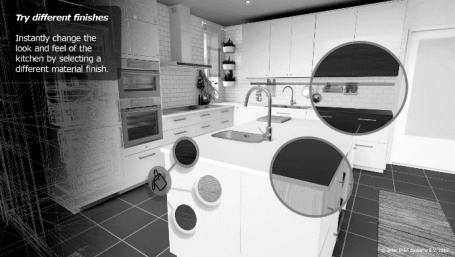
Abroad, IKEA launched IKEA VR Experience (see Figure 7) in 2016. Through this VR game, players can choose various materials to decorate their kitchens.
In China, OPPEIN, the leading enterprise in kitchen decoration, also coo- perates with “VR+ Home” (see Figure 8), in which designers can publish their design schemes, with interactive display functions such as “quick cabi- net arrangement”, “quick decoration” and “one-click change of room style”. It not only improves the efficiency of marketing, but also improves the experience of consumers, which is universally praised.
Although there is a precedent for the application of virtual reality in kitchen CMF design, the existing evaluation of kitchen CMF evaluation is still a subjective judgment of VR users without unified, scientific and quan- tifiable evaluation results. They improve the evaluation efficiency, but the evaluation quality still needs to be improved.
ADVANTAGES OF APPLYING VIRTUAL REALITY TO INTEGRAL KITCHEN CMF EVALUATION Improve Evaluation Efficiency
VR reduces the time of repeated proofing and modification and the risk of design investment: users can directly select the best design for subsequent production after evaluation in the system.
Design of Integral Kitchen CMF Evaluation System 303
VR fills the information gap in the display of traditional evaluation methods: the content conveyed is not limited, and the information can be effectively classified and displayed orderly. Designers cannot get immediate feedback and the degree of operation is low only through graphic or sample display.
VR avoids attention deficit: The traditional way of evaluation is for users to accept fragmented display information, but VR systems transform infor- mation into a continuous complete experience. The integral kitchen CMF design evaluation is different from the traditional kitchen CMF evaluation. The integral kitchen focuses on the CMF design of all the products in the kitchen rather than a single product. Therefore, the original relatively inde- pendent and static presentation can no longer meet the evaluation needs of users. The VR system allows users to experience every detail of the inte- gral kitchen CMF design smoothly, without being distracted by the external environment or irrelevant design in the integral kitchen, so as to achieve information immersion.
Improve Evaluation Quality One of the advantages of integral kitchen CMF design evaluation system based on virtual reality is that it has a unified and quantifiable evaluation standard. The integral kitchen CMF design style is numerous, different styles of evaluation have different criteria, with the change of the times, evaluation indicators will change, designers can change the evaluation indicators in the system and the value of the indicators.
Consistent With the Future Development Trend With the continuous development of technology, the barriers to use VR will be lowered. In the process of CMF evaluation, tactile and vertigo problems caused by VR will be constantly improved and solved in future.
With the continuous enrichment of material conditions, consumers pay more attention to whether they can meet their emotional needs. Virtual reality can not only bring users multi-sensory evaluation experience, but also apply Kansei engineering to the evaluation standard part of evaluation system.
DESIGN STRATEGY Efficient Interaction
The evaluation system screen needs to be concise and efficient, and can pro- vide users appropriate guidance. For example, system designers can add a scene at the beginning to instruct the user how to use the system; system desi- gners can set text introduction or the voice button next to kitchen products to watch or listen to the explanation while experiencing the kitchen.
The evaluation system should be easy to operate, so that users can quickly start to evaluate and avoid invalid operations. Take the HTC VIVE controller as an example, there are many buttons on the controller, but through experi- ments, it is found that users are only familiar with the operation of the trigger
buttons, so do not give too many functions to the system, and only need to send out rays to select by pulling the controller.
In addition, the scene needs to be clear to ensure that users can comfortably complete the whole process of the integral kitchen CMF evaluation.
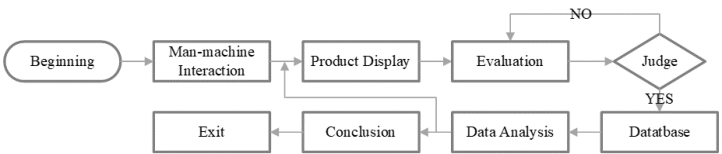
Reasonable Evaluation Process The integral kitchen CMF design evaluation system (see Figure 9) mainly includes man-machine interaction module, kitchen CMF design module, eva- luation module, data collection and processing module (Zhang et al., 2019). The evaluation process should be logical and logical and easy to understand. VR system can display unlimited information. VR system designers need to carry out iterations in continuous user testing to control the amount of infor- mation and prevent users from low evaluation efficiency and poor experience due to excessive information require.
Evaluation Criteria Based on Kansei Engineering Using the integral kitchen CMF design evaluation system based on virtual rea- lity, designers can change the evaluation indicators in the system according to the needs. The existing kitchen CMF evaluation is still the subjective jud- gment of VR users, so the system needs scientific and quantifiable evaluation criteria.
Liu Jianjun et al. analyzed the hot topics and evolution trend of CMF research based on CiteSpace, and revealed the research objects, research methods and related theories involved in the study of CMF by many rese- archers (Liu et al., 2021). The top research method is Kansei Engineering. So, the application of Kansei engineering in CMF design is a hot trend at present.
Kansei Engineering was proposed by former Chairman of Mazda Motor Group Kenichi Yamamoto in 1986, aiming at finding out users’ needs and feelings on products, and establishing a set of user demand-oriented product research and development system based on this, which can transform users’ fuzzy perceptual images into product design elements (Nagamachi, 2002).
At present, there is no literature related to Kansei engineering applied to integral kitchen CMF, but Kansei engineering is widely applied to single categories of CMF in the kitchen. For example, Yang Dongmei et al. used semantic difference method and correlation analysis methods of Kansei engi- neering to study the perceptual image of colour of elderly products by taking
Figure 9: Flow chart of VR evaluation system.
Design of Integral Kitchen CMF Evaluation System 305
pressure cooker as an example (Yang et al., 2018). Zhang Bao et al. stu- died the perceptual image of bluetooth speaker CMF by using the semantic difference method in Kansei Engineering (Zhang et al., 2021).
Therefore, the application of evaluation standards based on Kansei engi- neering in the VR evaluation system can improve the evaluation quality.
Realistic Evaluation Environment The virtual environment should restore the real scene as much as possible and have a high degree of interaction. Users can experience and evaluate the CMF of the kitchen just like in the real scene. In the design, it is necessary to consider the model scale, fineness, material mapping, rendering and ligh- ting consistent with the real scene as far as possible, and the lens position is consistent with the average eye height of human.
Proper Hardware Devices There are several kinds of VR devices, but in order to ensure the comfort of users during evaluation and reduce vertigo, it is recommended to choose VR devices with the maximum field Angle of 110
and the maximum refresh rate of 90Hz, as well as computers with high CPU and GPU (Wang, 2018).
CONCLUSION
The existing CMF evaluation methods of integral kitchen cannot meet the needs of users. This paper explores the possibility of applying virtual rea- lity to the evaluation of integral kitchen CMF design. Firstly, it analyses the current CMF evaluation methods of the integral kitchen and their existing defects, such as tedious process, subjective evaluation criteria and high eva- luation cost. Then, it demonstrates the possibility of applying virtual reality to the integral kitchen CMF design evaluation, and finds that virtual reality can perfect the above defects. Finally, the design strategy of applying virtual reality to the integral kitchen CMF evaluation is proposed, which provides a reference for the future design of virtual reality evaluation system.
REFERENCES
Fu, X. L., Hu, Y. L., & Hu, S. L. (2022). A review of the research on perceptual intentionality design driven by CMF. Design (09), 90-93. Li, Y. W. (2019). CMF Design Course. Beijing, China: Chemical Industry Press. Liu, J. J., Xu, J., & Sun, B. (2021). Hot topics and evolution trends of CMF research
in China: a bibliometric analysis based on CiteSpace. Design (01), 92-95. Luo, S. J., & Pan, Y. H. (2007). Research progress of perceptual image theory, technology and application in product design. Chinese Journal of Mechanical Engineering (03), 8-13. Lv, J. Z., & Pang, Z. H. (2020). Preliminary Market research of integral cabinet
product design. Mechanical Design (S2), 35-38. Nagamachi, M. (2002). Kansei engineering as a powerful consumer-oriented technology for product development. Applied Ergonomics, 33(3): 289–294. Wang, S. J. (2018). Research on the application of Virtual Reality Technology in
Museum Display Design (Master Dissertation, Jiangnan University).
Yang, D. M., Zhang, J. N., Ding, M., Yang, P., & Xu, X. Y. (2018). Color design method of elderly products based on perceptual image. Mechanical Design (03), 110-113. Zhang, B., Hu, A. G., & Zhang, D. (2021). Design Method of Bluetooth Speaker
CMF Based on Kansei Engineering. Packaging Engineering (08), 156-161. Zhang, M., & Huang, H. (2019). Research on Product design Evaluation System based on VR interactive technology. Modern Electronic Technology (19), 173- 177. Zhongyan industry institute. (April 26, 2022) Market In-depth Research and
Investment Strategy Forecast Report of China’s integral Kitchen Industry (2022- 2027). Zhongyan industry institute. https://www.chinairn.com/news/20220826/ 162850621.shtml
LISTED IN THE AHFE DIGITAL BOOKSTORE CATALOGUE
Explore the complete digital volume
Ergonomics In Design
Read this individual research paper free through the original publisher, or explore the full digital proceedings book.
ISBN 978-1-958651-53-7
Explore this ISBN in the AHFE Bookstore ↗Listed in the July 2026 bookstore catalogue; search by ISBN to confirm current availability · Digital book purchase optional