Zhang Haoran, Yuanbo Sun, Song Yuqing, Chen Siwan, Xu Maoyuan (2023). Service Design of Virtual Decoration Based on Human Factors Requirements. In: Ergonomics In Design. AHFE Open Access, vol. 77, pp. 317–325. https://doi.org/10.54941/ahfe1003389
This study considers virtual space as a service implementation site with many people and many machines participating. Menu interfaces, interactive objects, and virtual people in virtual space are considered service access channels in this system. Based on the method of service design, this paper builds a virtual home decoration design platform that users can participate in.First, analyze the user needs in the home decoration service process, especially in the design and planning process. At the same time, according to the characteristics of virtual media, summarize the capabilities of service participants and compilation constraints. Secondly, by reconstructing the human-machine collaborative relationship of service contact elements, a service system with multiple virtual channels and full process coverage is designed to complete the function assignment of a virtual home decoration design platform. Finally, comb the information architecture according to the system's functional requirements. At the same time, a virtual interaction prototype is developed based on the Unity platform.This study verifies the consistency of service design and human-machine system design in concept, process, and method. At the same time, based on the user's perception of service in virtual space, a virtual service contact model is constructed, and a design strategy for a virtual service contact channel that meets human-factor requirements is presented.
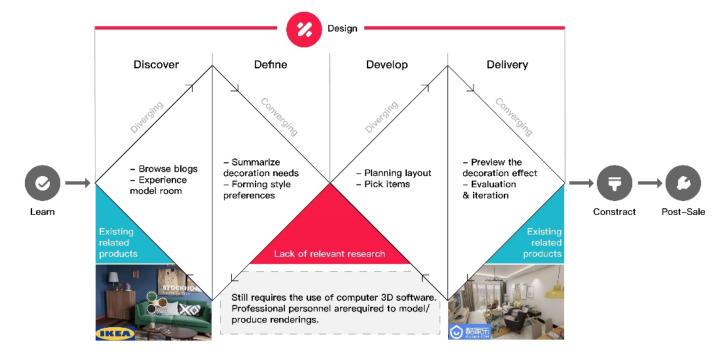
The research on home decoration services based on VR technology focuses on the service media innovation of “experience between templates” and “effect preview” links. Ikea’s virtual boardroom applies VR media to furniture sales. The virtual roaming function of Kujiale applies VR media to the preview of the decoration effect. At present, there is a lack of research on layout design, as shown in Figure 1. In the design process, users need to use compu- ter three-dimensional software. Such software requires users to have a strong spatial imagination and software operation level, so there is a strong pro- fessional threshold. The purpose of this paper is to create a virtual home decoration platform for users to do interior design in a virtual space. Users can achieve indoor layout through natural interaction such as grabbing and
Figure 1: Current research status of home decoration design tools.
dragging. Virtual design tools help create a “what you see is what you get” design experience, thereby reducing the cognitive load of spatial imagination on users.
Service facilities are often viewed as a single service channel in service design. However, due to the diversity of virtual service access modes, it is inappropriate to view virtual reality devices as a single channel in the service system. The purpose of this study is to discuss whether treating menu interfa- ces, objects, and virtual humans in virtual space as multiple service channels can help to sort out the functions of virtual systems. This study will resh- ape the virtual service process and service delivery from the perspective of human-machine system design, rather than media innovation on a single link of service.
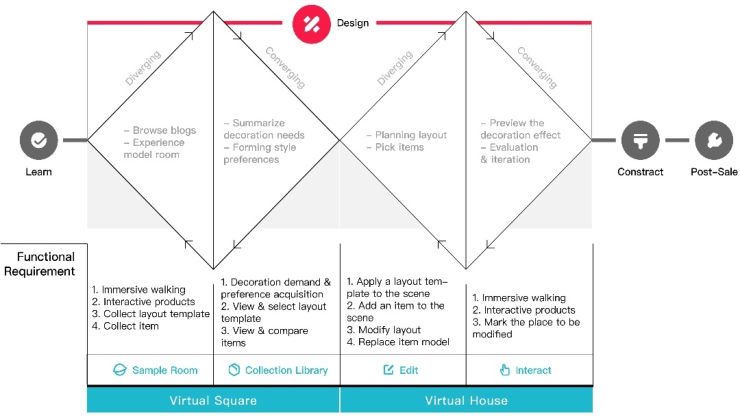
REQUIREMENTS ANALYSIS OF HOME DECORATION The current home decoration design process conforms to the double-drill model as shown in Figure 1. It shows the user needs in four stages of home decoration design. In the early days, users were inspired by sample rooms and decoration case texts. In the process of browsing, constantly clarify their living needs and style preferences. In the later stage, users or design agents use computer-aided means for home decoration design. Finally, the scheme is previewed, communicated, discussed, and modified through display means such as effect maps.
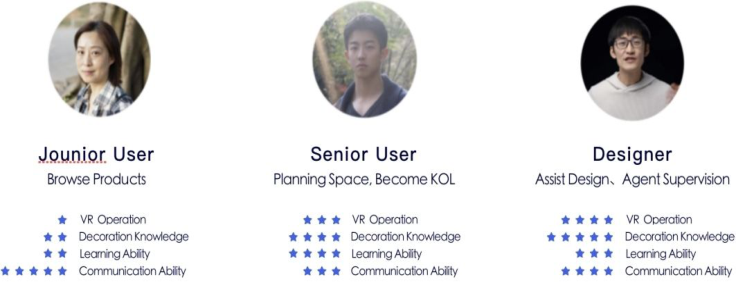
At the same time, interviews and research found that home decoration design users can be divided into four categories: small white users, ordinary users, DIY users, and design agents, as shown in Figure 2. Small white users lack basic interactive skills and are therefore not suitable for using virtual home decorating design tools. Ordinary users are customized groups that can use general electronic equipment. They have less knowledge and experience in interior design, so they need to complete the design with the help and advice of design agents. DIY users have a good understanding of interaction and interior design, so they can complete the design task by themselves.
Service Design of Virtual Decoration Based on Human Factors Requirements 319
Figure 2: Personas of home decorating service participants.
To better understand the process of home decoration design, the author conducted home decoration design practice as a designer. Based on user inte- rviews, summarize key pain points and possible reasons mentioned by users. Next, a linear regression analysis of the cause and pain point was performed using the Richter scale. The sample questionnaire includes 20 users who have received or are receiving home improvement design services. Thus, the three reasons that cause the strongest correlation between each pain point were statistically analyzed. The questionnaire results are shown in Table 1.
Table 1. Correlation analysis table of pain points and causes.
Table available in the original PDF paper.
Pain Point Cause Questionnaire results
0.723
Influenced by the designer’s personal style
The gap between the design scheme and the case effect
0.641
The style of the sample room is difficult to refine
0.569
The details in the sample room are difficult to reproduce
0.792
The gap between actual residence and design scheme
Unclear residential needs of users 0.833 The display effect of the scheme is not true
0.707
Difficult to express user demands 0.423 Inefficient communication between users and design agents
Difficult to express user demands 0.523 The design agent cannot understand the user’s demands Long modification cycle 0.636
DESIGN STRATEGY OF VIRTUAL HOME DECORATING PLATFORM Service design considers the interaction between various stakeholders and other aspects of the system. Essentially, it is to solve the system human- machine problem between people, people, and material, people and infor- mation. The virtual home decoration platform has a variety of interactive
modes and objects and has the collaborative function of many people. It is a human-machine system with many people and many machines participating. Therefore, this study will expand the design of a virtual home decoration platform with the help of the concept, method, and process of service design.
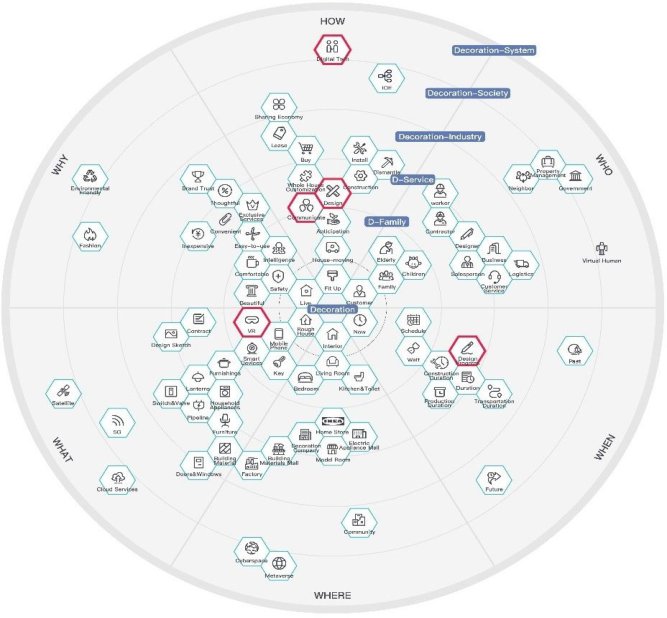
Based on the research results, this study uses a service eco-map to describe the current home decoration service-related elements and system operation mode, as shown in Figure 3. Extract “enablers” that can solve user pain points and trigger service innovations, which are shown in red boxes.
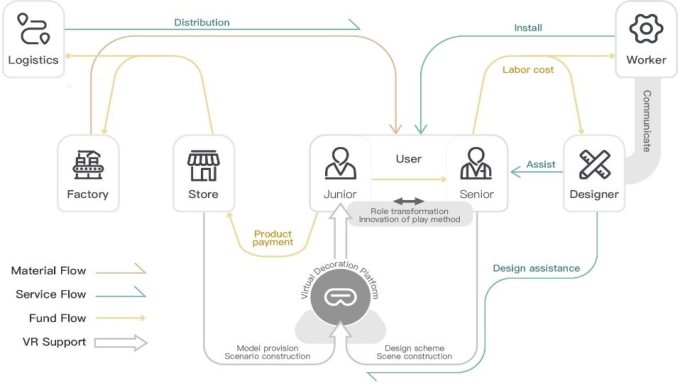
Finally, a new virtual home decoration service system is summarized, as shown in Figure 4.
At the same time, the following key innovation opportunities are summa- rized:
1. Virtual Element Transplantation and Household Adaptation between Templates to Close Case Effect Gaps 2. Step-by-step design of functional layout and material style to reduce design complexity 3. Real-time modification of the scheme to reduce the modification cycle 4. Immersion preview of the project to help users establish their living needs and improve the display 5. Designers work with users to improve communication efficiency and user engagement
Figure 3: Service ecology map of virtual home decorating.
Service Design of Virtual Decoration Based on Human Factors Requirements 321
Figure 4: Service system map of virtual home decorating.
Virtual communities and virtual houses will provide scenarios as two servi- ces in the virtual home furnishing service system. They correspond to the sections of case browsing and scenario editing. Based on the above oppor- tunities, the functional requirements of the virtual home decoration design platform in each stage of service are summarized, as shown in Figure 5.
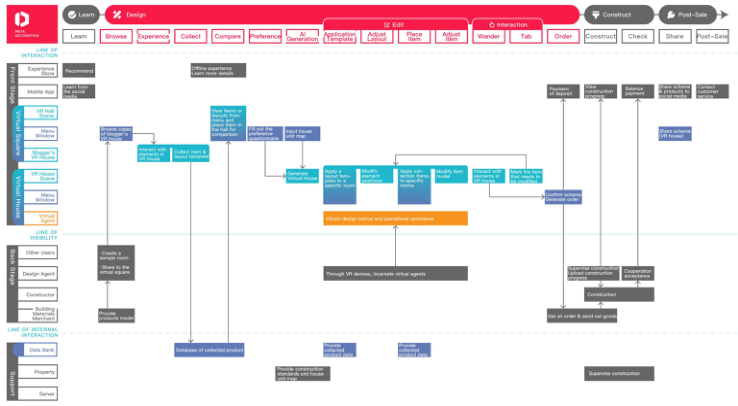
This study uses service blueprints to allocate functions of a virtual home decoration design system. Consider the various interactive elements in the virtual home decoration platform as different service delivery channels, as shown in Figure 6. The interaction modes of virtual reality media can be
Figure 5: Functional requirement of home decorating platform.Figure 6: Service blueprint of virtual home decorating.
roughly divided into three categories: virtual object interaction, menu inter- face interaction, and virtual human interaction. The interactive mode of each service link is determined by its function. Service links with large amounts of information are usually implemented through menu interface class ele- ments, which are represented in blue in the diagram. Links that require easy operation and visual display are implemented through virtual object class elements, represented by green in the diagram. Virtual people can collabo- rate remotely, shown in yellow. Other entity service channels are shown in gray.
The use of service design tools helps to establish a virtual way of interacting with each part of the process. Considering menu interfa- ces, objects, and virtual humans in virtual space as multiple service channels can effectively reduce the complexity of human-machine system design.
VIRTUAL PROTOTYPING This research is based on the unity platform and HTC vive headworn rea- lity device for prototype development. Including scene design, interface interaction design, and other work.
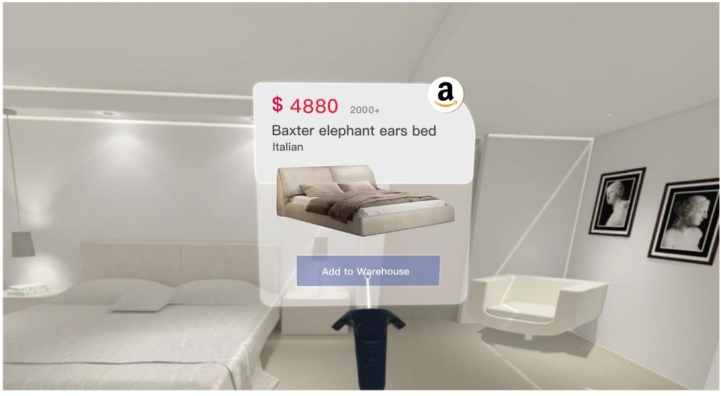
In the virtual square scene, users can enter the sample room and collect items, as shown in Figure 7.
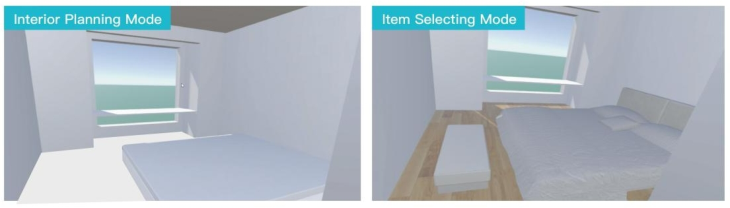
In a virtual house scenario, users can intuitively modify the interior layout or edit the style of a single item, as shown in Figure 8. This is in line with the thinking mode of interior design, which edits the interior space from both functional and formal dimensions, reducing the cognitive burden of spatial information clutter on users.
Service Design of Virtual Decoration Based on Human Factors Requirements 323
Figure 7: Collect item in virtual decorating platform.Figure 8: Two edit modes of virtual decorating platform.
CONCLUSION
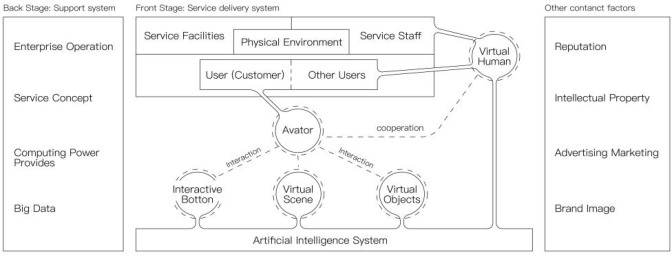
This study explores the possibility of service implementation in virtual rea- lity media by constructing a virtual home improvement design platform. In design practice, it has been found that services in virtual spaces can effectively compensate for the limitations of physical service contact and leverage the advantages of virtual media. Service contact modes in virtual space include menu interfaces, scene atmospheres, virtual objects, and virtual humans. Based on the service contact system model, the virtual media service contact model is formed by supplementing it with the service delivery relationships of the virtual service contact elements, as shown in Figure 9. In the future, this study will use virtual reality interaction prototypes and role-playing meth- ods to evaluate and iterate the service system, thereby further verifying the usability of the virtual home improvement service system.
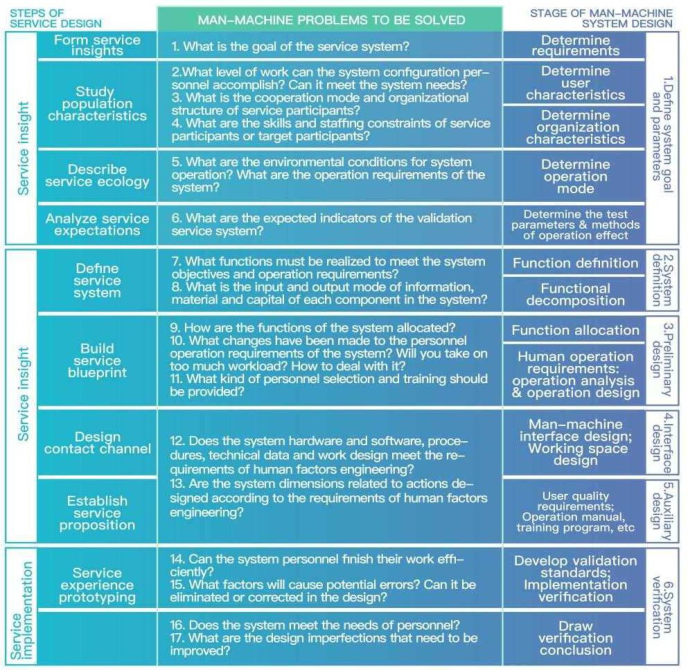
This study verified the role of service design methods in virtual platform design through design practice. Service design and human-machine system design have strong similarities in design concepts, processes, and tools, as shown in Figure 10. Compared with planar interface design, virtual system interaction design has complex elements and diverse interaction methods. It
Figure 9: Virtual service contact model.Figure 10: Comparison between service design and man-machine system design.
can be seen as a man-machine system involving multiple people and multiple machines. Using service design tools to allocate functions to various elements of a virtual platform can effectively reduce the complexity of virtual system design.
Service Design of Virtual Decoration Based on Human Factors Requirements 325
REFERENCES
Grönroos C. (1984). A service quality model and its marketing implications. European Journal of marketing. Hamilton J. (2004). Journal of Systems Science and Systems Engineering. Service
value networks: Value, performance and strategy for the services industry. 13(4): 469–489. Lingguo Bu, Chun-Hsien Chen, Kam K. H. Ng, Pai Zheng, Guijun Dong, Heshan Liu. (2021). Journal of Cleaner Production. A user-centric design approach for smart product-service systems using virtual reality: A case study. 280(2). Pai Zheng, Tzu-Jui Lin, Chun-Hsien Chen, Xun Xu. (2018). A systematic design
approach for service innovation of smart product-service systems. Journal of Cleaner Production. Volume 201. Ping Yao. (2022). Research Article. Spatial Expression of Multifaceted Soft Decoration Elements: Application of 3D Reconstruction Algorithm in Soft Decoration and Furnishing Design of Office Space. Richard A. Grover, James L. Heskett, Peter K. Mills, Richard Normann. (1987).
Service Management: Strategy and Leadership in Service Businesses. Academy of Management Review. 12(3). Shostack G L. (1984). Designing Services that Deliver. Harvard Business Review. 62(1): 133–139.
LISTED IN THE AHFE DIGITAL BOOKSTORE CATALOGUE
Explore the complete digital volume
Ergonomics In Design
Read this individual research paper free through the original publisher, or explore the full digital proceedings book.
ISBN 978-1-958651-53-7
Explore this ISBN in the AHFE Bookstore ↗Listed in the July 2026 bookstore catalogue; search by ISBN to confirm current availability · Digital book purchase optional