Chenxi Wang, Fan Zhang, Yuanbo Sun (2023). Visual analysis of the progress, hot spots and trends of service design research based on bibliometrics. In: Ergonomics In Design. AHFE Open Access, vol. 77, pp. 307–316. https://doi.org/10.54941/ahfe1003388
In order to better understand and grasp the progress of service design research at home and abroad, we analyzed the distribution of related literature output, research hotspots, basic knowledge and frontier trends with the help of CNKI database and Web of Science database as domestic and international data sources, combined with literature clustering and bibliometric methods. The results show that both domestic and foreign service design research is on the rise, and the research hotspots and citation frequencies are higher in foreign countries than in China. Foreign research hotspots mainly shift from quality, model, design, and management to science, technology, and service system, and focus on user needs and experience, and design thinking becomes a new research focus and continues to this day; while domestic research is mainly oriented to social innovation, public culture and technology-driven service design.
Service design was first put forward by Shostack in 1980s (Lynn Shostack, G., 1982). Since then, “service”, as a research object with multi-disciplines and multi-fields, is being explored from top to bottom or from bottom to top, and many concepts such as service economy, service marketing, service management, service engineering and service science have been derived (Hu, F., 2019). In the field of design, the formal proposal of service design origina- ted from Total Design written by Hollins in 1991 (Hollins G., 2019). Service design has evolved on the basis of interactive design, and combined with the knowledge of different professional fields such as product design, ethnogra- phy, service management and information system (PATRíCIO L., 2013), it has evolved into an interdisciplinary comprehensive research method (Cheng, X., 2020). With the continuous development of service economy and experie- nce economy, a large amount of research literature has emerged in the field of service design at home and abroad, but there are few review articles. Based on
this, through quantitative and systematic combing, we understand the distri- bution of domestic and foreign research and the current research hotspots, so as to provide effective reference for subsequent research.
RESEARCH DESIGN Research Methodology
This study adopts the method of Mapping Knowledge Domain (MKD) by Chen Chaomei and other scholars (Chaomei Chen, 2016). With the help of information visualization tools VOSviewer and Citespace, we analyzed the output distribution, research hotspot distribution, basic knowledge and fron- tier trend of the literature, and draw the corresponding scientific knowledge map to show the research progress of service design at home and abroad.
Data Source This paper takes the service design research literature collected in CNKI data- base and Web of Science database in the past 20 years as the sample, and the time span of the study is from 2002 to 2022. In order to ensure the credibility and investigation value of the data sources of this study, the three major cita- tion indexes of SSCI, SCI-Expanded, and A&HCI in the core collection of authoritative database Web of Science were selected as the data sources, and the search formula was set as follows after manual comparison and analysis to remove irrelevant results: TS = (“Service Design” or “Design for Service” or “Design of Service”) for the subject search, and the document type was Article. The search results were carefully checked and sorted out, and irrele- vant data samples were deleted, and a total of 1018 articles were retrieved. Then it was searched in CNKI database under the same search conditions, and 914 valid sample documents of domestic service design were obtained after sorting out and eliminating.
BIBLIOMETRIC RESULTS AND ANALYSIS OF SERVICE DESIGN Distribution of Research Outputs
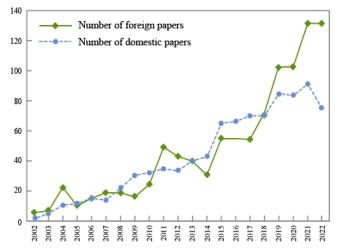
A line graph of the time series change in the volume of domestic and foreign service design publications is shown in Figure 1, which shows that the volume of literature has been on the rise in the last 20 years. The number of foreign publications shows a fluctuating upward trend, rising significantly from 2003 to 2004 and from 2009 to 2011, surging to 102 from 2017 to 2019, and reaching a peak of 133 in 2021. The number of domestic publications showed a continuous increase from 2002 to 2014, and a surge from 2014 to 2015, peaking in 2021.
During the period 2002 to 2022, foreign service design research has focused on management, operations research management, and business, followed by relatively more research in engineering and manufacturing, computer science information systems, engineering industry, art, enginee- ring electronics, telecommunications, and public environmental occupational
Visual Analysis of the Progress, Hot Spots and Trends 309
Figure 1: Amount variation of published service design papers as time changes at home and abroad.
health. Among them, management and business are particularly prominent, reflecting the close association between service design and its existence.
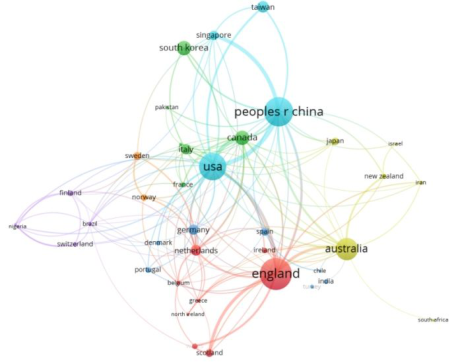
The data in the WOS database were classified by country and region, and the knowledge map of the country/region cooperation network was obtained as shown in Figure 2. In terms of partnership networks, the United States and the United Kingdom, China and Canada cooperate more closely, the United Kingdom has the most contact with Scotland and the United States, China has the most cooperation with the United States and Singapore, and Australia has more cooperation with England, Sweden, the United States, China, New Zealand, and Italy in that order. The United Kingdom has the most contacts with Scotland and the United States, China has the most con- tacts with the United States and Singapore. The top 10 countries/regions are listed in Table 1, and there are more than 40 major countries/regions in the past 20 years and the total number of published articles in the top 10 coun- tries/regions accounts for 93.51% of the total data. Among them, the UK tops the list of countries in terms of the number of publications, in addition to China, the US and Australia, which have also accumulated a large number
Figure 2: Cooperation distribution map among countries and regions.Table 1. Top ten countries/regions of published papers in number.
Table available in the original PDF paper.
No. Country /
No. Country /
Region
Total citations in the literature Region
Total citations in the literature
Number of articles published
Number of articles published 1 England 197 3948 6 Canada 65 1032 2 China 172 2090 7 Taiwan 47 638 3 Australia 120 1728 8 Netherlands 44 1417 4 USA 159 3397 9 Germany 41 863 5 South Korea 66 432 10 Italy 40 894
of researches in this field and ranked in the top five in terms of the number of papers.
There are 203 major research institutions in the field of service design research in the past 20 years, and the top five service design research institu- tions are University of Sydney, University of Toronto, University of London, Nanyang Technology University, and University of Melbourne (Table 2). The ranking of domestic institutions in terms of CNKI publications (top 5) is shown in Table 3. Jiangnan University is in the leading position in China (57), while Hunan University (37), Tsinghua University (35), Guangdong Univer- sity of Technology (25), and Guangzhou Academy of Fine Arts (22) in the 2nd-5th positions respectively. A total of 3,997 foreign scholars have contributed in the field related to service design. The most productive foreign authors in the field of service design are listed in Table 4, which lists the six most productive authors. Among them, Shimomura, Yoshiki is the most productive, followed by Lee,
Table 2. Top five foreign institutions of published paper in number.
Table available in the original PDF paper.
Institutions Number of articles published
Total citations in the literature University of Sydney 20 350 University of Toronto 17 316 University College London 17 367 Nanyang Technology University 17 384 University of Melbourne 17 612
Table 3. Top five domestic institutions of published paper in number.
Table available in the original PDF paper.
Institutions Number of articles published JiangnanUniversity 57 Hunan University 37 Tsinghua University 35 Guangdong University of Technology 25 Guangzhou Academy of Fine Arts 22
Visual Analysis of the Progress, Hot Spots and Trends 311
Table 4. The most productive foreign & domestic author of service design.
Table available in the original PDF paper.
Institutions Research area
Domestic / Foreign
Author Number of articles published
Service engineering
Foreign Shimomura, Yoshiki 8 Tokyo Metropolitan University Lee, Ching-hung 7 National Yang Ming Chiao Tung University Intelligent System Design Chen, Chun-hsien 6 Nanyang Technological Product Design and Developmen Meng, Qiang 6 National University of Singapore
Operations Research & Management Science Patricio, Lia 5 Universidade do Porto Health Care Sciences & Services Verma, Rohit 5 University of Cambridge Operations Research & Management Science Domestic Ding Xiong 15 Guangzhou Academy of Fine Arts
Service innovation and touch point design Xu Yanzhang 13 Tianjin Normal University Cultural Arts Management and Service Design Gong Miaosen 12 Jiangnan University Social Innovation and Service Design Zhang Linghao 11 Jiangnan University User Experience Design Xin Xiangyang 10 Tongji University Interaction and Experience Design
Ching-hung., Chen, Chun-hsien., Meng, Qiang., Patricio, Lia., Verma, Rohit. A total of 1,715 domestic scholars have researched in the field of service design, among which Ding Xiong of Guangzhou Academy of Fine Arts has the highest number of publications, while Xu Yanzhang of Tianjin Normal University, Gong Miaosen and Zhang Linghao of Jiangnan University, and Xin Xiangyang of Tongji University are in the 2nd-5th place in terms of productivity.
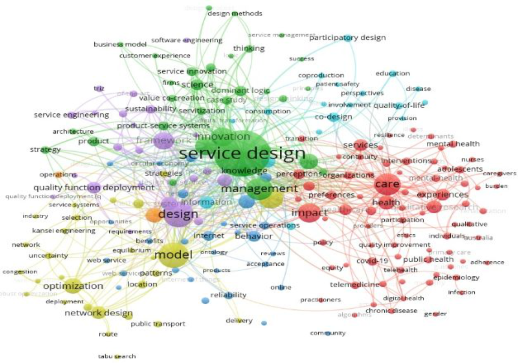
Research Hotspots In VOSviewer, the keywords in the metadata title and abstracts of the litera- ture were analyzed by arithmetic, and the threshold value was set to 5. A total of 247 out of 4908 terms were detected to meet the threshold value, and the keyword co-occurrence mapping of foreign service design research literature was generated as shown in Figure 3. 6 clusters could be found by clustering the keyword co-occurrence network. Cluster 1: Service design based on inno- vative management, which is clustered by keywords such as management, innovation and system. Cluster 2: Product-service system design, clustered by the keywords product design, product-service system, quality function deployment, product development, etc. Cluster 3: Service computing, clu- stered by keywords such as model, quality, optimization, network design, etc. Cluster 4: Healthcare service design, clustered by keywords such as care, health, and experience. Cluster 5: User-centered service design, clustered by the keywords satisfaction, behavior, service quality, etc. Cluster 6: Service
Figure 3: The cluster diagram of keywords in service design research abroad.
design methods, clustered by keywords such as co-design and participatory design.
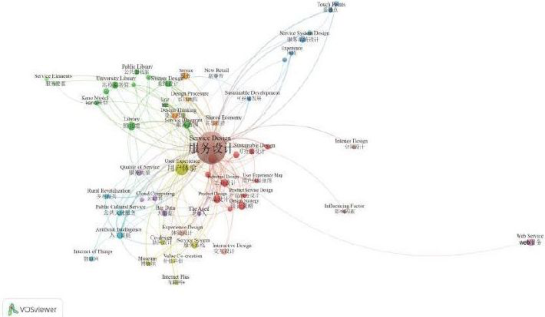
The keyword co-occurrence mapping of domestic service design resea- rch literature generated in VOSviewer with the same conditions is shown in Figure 4, and six main clusters can be found by clustering the keyword co-occurrence network. Cluster 1: Service design methods, which are clu- stered by the keywords of user experience, collaborative design, and value co-creation. Cluster 2: Product service system design, clustered by product service system, product service design, product design, sustainable design, etc. Cluster 3: User-centered service design, clustered by keywords such as user requirements, Kano model, and service blueprint. Cluster 4: Service system design, clustered by keywords such as experience, touch points, and service flow. Clustering 5: Technology-driven service design, clustered by keywords such as artificial intelligence, Internet of Things, big data, cloud compu- ting, etc. Cluster 6: Social innovation-oriented service design (Shijian Luo,
Figure 4: The cluster diagram of keywords in service design research in China.
Visual Analysis of the Progress, Hot Spots and Trends 313
2018), clustered by keywords such as rural revitalization and community services.
A comparative analysis of domestic and foreign research hotspots reve- als the differences between domestic and foreign service design. On the object level, due to the historical and cultural precipitation of China, under the policy background of rural revitalization, some traditional villages have become the unique objects of service design in China, and service design is combined with traditional villages to achieve precise poverty alleviation. In foreign countries, more service design is oriented to medical and health care, focusing on the experience in the medical process. Most of the research hotspots in foreign literature focus on human-centered, systematic way of thinking with the goal of innovation and improvement of service quality and service experience; domestic research hotspots focus on proposing product service systems for specific objects, for example, service design is applied in libraries, museums and other fields.
Fundamental Knowledge and Cutting-Edge Trends By analyzing the co-citation relationship of foreign literature data, the highly cited references (top 10) in foreign service design literature are shown in Table 5. From 1982 to 1984, Shostack published two papers on the sub- ject of “service” can be designed, and put forward the concept of combining tangible products with intangible services for the first time, and put forw- ard the design method of “service blueprint” for the first time (G. Lynn. Shostack, 1982&1984). A. Parasuraman developed a model of “five ele- ments of service quality evaluation”, namely, tangibility, safety, reliability, responsiveness and empathy, which is called “SERVQUAL” scale, and it is still widely used today (A. Parasuraman, 1988). Vargo advocates that every- thing is a service and encourages enterprises to replace commodity-oriented
Table 5. Top ten highly cited references in social innovation design.
Table available in the original PDF paper.
Year First author Title Frequency of citations
35 2002 Susan Meyer Goldstein
The service concept: the missing link in service design research?
25 2008 Stephen L. Vargo
Evolving to a new dominant logic for marketing 35 2004 Stephen L. Vargo Designing services that deliver 34 1984 G.Lynn. Shostack How to design a service 28 1982 G.Lynn. Shostack Service-dominant logic: What it is, what it is not, what it might be
24 1985 A Parasuraman
A conceptual model of service quality and its implications for future research
21 2011 Lia Patrício
State-of-the-art in product-service systems 23 2007 Tim Baines Service design for experience-centric services 21 2010 Leonieke G. Zomerdijk Multilevel service design: from customer value constellation to service experience blueprinting
20 1988 A Parasuraman
SERVQUAL: A multiple-item scale for measuring consumer perceptions of service quality Note: Citation frequency represents the number of times the corresponding literature was cited by the sample of this paper, excluding the number of citations from other research areas.
logic with service-oriented logic (Stephen L. Vargo, 2004). Tim Baines defi- nes the concept of PSS, reports its origins and characteristics, and summarizes the available tools and methods (Tim Baines, 2007). Lia Patrício proposed a new interdisciplinary method MSD for designing complex service systems (Lia Patrício, 2011). Over the past 20 years, these authors’ papers have had a lasting and important impact in the field of service design. From the nati- onal distribution of service design research, although the number of papers published in China is relatively high, from the analysis of highly cited docu- ments on service design, there are very few documents with international influence.
To explore the cutting-edge trends in the domestic service design field, the citation burst and keyword burst in Citespace were used to detect the cutting- edge trends in foreign research. From the keyword burst results (Table 6), service design research shifted from quality (GronroosC, 1993), models, design, and management to science, technology, and service systems, and focused on user needs (Cook, L. S., 2002) and experience (Zomerdik L G, 2010), and technology and design thinking (Buchanan R, 1992) became the focus of research and continues to this day.
On the domestic side, 18 articles (6 articles per year) with high service design hotness in the past 3 years were collected and analyzed based on the number of citations and downloads from the CNKI database. The number of citations in the literature in recent years can indicate the research hotness of the topic, and the number of downloads in a short period of time can indi- cate the degree of attention to the literature. The literature with high hotness in the design of the knowledge network service is shown in Table 7. The articles selected in 2020 and 2021 are ranked according to the number of citations, while in 2022, they are selected based on the comparative analy- sis of the publication time and the number of downloads. Observing the key words of the literature in Table 7, we find that the literature topic terms are mostly focused on regional revitalization, public culture, home-based care for the aged, intangible cultural heritage, Internet, intelligent services, etc., which indicates that rural revitalization and social innovation is a hot spot for service design research nowadays. With the development of the infor- mation age, service design driven by artificial intelligence, internet and other technologies is also a hot spot, especially in the post-epidemic, medical health and home-based care for the aged related directions are also the frontier of research at home and abroad.
Table 6. Strongest outbursts of keywords in service design.
Table available in the original PDF paper.
Sudden Keywords Strength Start and end time Design 5.05 2009–2013 Science 2.22 2008–2016 Product-service system 4.04 2018–2019 Technology 2.44 2019–2022 Design thinking 2.73 2020–2022
Visual Analysis of the Progress, Hot Spots and Trends 315
Table 7. Highly popular literature of service design in CNKI.
Table available in the original PDF paper.
2022 2021 2020
Basic principles of service design: from user-centered to stakeholder- centered(49)2195
Research on museum experience design based on service design thinking and methodology(13)2352
Research on the marketing strategy of agricultural products based on service design thinking1089
Research on the design of intelligent home care service system(25)2435
Value-based Co-creation of Group Intelligent Service Design Model and Empirical Analysis(11)4825
Research on the design of refined intelligent services for the home care population 1642
Product design innovation strategy integrating service design concept(17)1061
Design strategies for intelligent museum services under new technological conditions(10)1262
A study on the participatory experience of users of West African cultural heritage products from a service design perspective(4)2189 Contact Points in Service Design: Definition, Research Status and Trends 1363
Identification and study of journey visualization tools in service design(8)1383
Design strategies for public cultural services based on mobile Internet - an example of museum app design in the era of artificial intelligence(16)954 Branding Liaoning Non-Foreign Heritage Based on Service Design Thinking(15)1427
Research on rural tourism innovation from the perspective of service design(7)2332
Strategies for designing intelligent services of farmhouse in the context of rural revitalization(4)950
Research on the design of community home care health management service based on Internet+(14)1578
Research on the Design of User Participatory Public Cultural Services in the Context of Rural Revitalization(5)1660
Research on the design of retail services for Winter Olympic cultural and creative products under BPC scenario architecture(1)1211 Note: The number of citations in parentheses is the number of times the article has been cited, and the number of downloads outside of parentheses is the number of times the article has been downloaded.
CONCLUSION
Through the analysis of the relevant literature on service design at home and abroad, we can see that the research at home and abroad is generally on the rise, and the attention to service design is getting higher and higher. At present, the UK and the US are the leading countries in service design research, which is closely related to their economic development stages in developed countries. Correspondingly, the institutions, authors and docu- ments in Britain and the United States have the strongest influence. As a hot research direction of design discipline, service design will also become a research carrier for people’s innovative behavior, and analyzing its laws and characteristics will become a hot topic in the future. In the design process of human-centered, insight into the user’s behavior, psychological changes and needs and worries in a service system, accurate access and expression of
contact points, so as to better grasp the loopholes and improve the existing service ecosystem.
The study shows that there is still a gap between the domestic service design field and the advanced level. Domestic research institutions should strengthen cross-level and interdisciplinary cooperation to better apply service design to scientific research, business, and industry. At the same time, there are some limitations in this paper. The results of the database and the retrie- val method chosen for the study may have some deviation from the actual, and the service design has the property of cross-discipline, the article does not analyze the above knowledge points in depth, and will be further enhanced in the subsequent research.
REFERENCES
Baines, T. S., Lightfoot, H. W., Evans, S., Neely, A., Greenough, R., Peppard, J., & Wilson, H. (2007). State-of-the-art in product-service systems. Procee- dings of the Institution of Mechanical Engineers, Part B: journal of engineering manufacture, 221(10), 1543–1552. Buchanan, R. (1992). Wicked problems in design thinking. Design issues, 8(2), 5–21. Cheng, X., (2020). A Review of Product Service System and Service Design Research.
Journal of Beijing University of Posts and Telecommunications (Social Sciences Edition), 22(05): 61–73. Cook, L. S., Bowen, D. E., Chase, R. B., Dasu, S., Stewart, D. M., & Tansik, D. A.
(2002). Human issues in service design. Journal of operations management, 20(2), 159–174. Grönroos, C. (1984). A service quality model and its marketing implications. European Journal of marketing, 18(4), 36–44. Hollins, G., & Hollins, B. (1991). Total Design: Managing the design process in the
service sector. Pitman. Hu, F,. Li, W,. (2019). Defining “Service Design”. Packaging Engineering, 40(10): 37–51. Li, J. and Chen, C. M. (2016). CiteSpace: Technology Text Mining and Visualization.
Beijing: Science Press. Luo, S,. Zou, W,. (2018). Status and progress of service design research. Packaging Engineering, 39(24): 43–53. Lynn Shostack, G. (1982). How to design a service. European journal of Marke-
ting, 16(1), 49–63. Parasuraman, A., Zeithaml, V. A., & Berry, L. (1988). SERVQUAL: A multiple-item scale for measuring consumer perceptions of service quality. 64(1), 12–40. Patrício, L., & Fisk, R. P. (2013). Creating new services. Serving customers: Global
services marketing perspectives, 185–207. Patrício, L., Fisk, R. P., Falcão e Cunha, J., & Constantine, L. (2011). Multilevel service design: from customer value constellation to service experience blueprinting. Journal of service Research, 14(2), 180–200. Shostack, L. (1984). Designing services that deliver. Harvard business review, 62(1),
133–139. Vargo, S. L., & Lusch, R. F. (2014). Evolving to a new dominant logic for marketing.
In The service-dominant logic of marketing (pp. 21–46). Zomerdijk, L. G., & Voss, C. A. (2010). Service design for experience-centric services. Journal of service research, 13(1), 67–82.
LISTED IN THE AHFE DIGITAL BOOKSTORE CATALOGUE
Explore the complete digital volume
Ergonomics In Design
Read this individual research paper free through the original publisher, or explore the full digital proceedings book.
ISBN 978-1-958651-53-7
Explore this ISBN in the AHFE Bookstore ↗Listed in the July 2026 bookstore catalogue; search by ISBN to confirm current availability · Digital book purchase optional