This paper aims to discover the problems encountered in conducting design thinking workshops online, which is also the starting point and the anchor point of the online teaching platform design. Through literature research, the problems existing in the existing teaching platform were obtained, and the competitive analysis was carried out to obtain the most suitable teaching platform for conducting online design thinking workshops. An online teaching experiment was carried out to explore the specific problems existing in the online design thinking workshop. The results show that the problems of online design thinking workshops can be summarized in four areas: technology, collaboration between groups, insufficient interaction between teachers and students, and lack of atmosphere. The findings of this study can be translated into user requirements in the future, and then transform the functionality of the teaching platform and carry out the design of the teaching platform.
With the rapid changes and development of global economy and science and technology, the cultivation of innovative talents has become the key and important focus of national strategic development. The Special Action Plan for the Enhancement of Design Capability in Manufacturing (2019-2022) explicitly encourages the development of design thinking and innovation awareness initiation education in primary and secondary schools (MIIT, 2019), and design thinking is precisely the best methodological system to pro- mote students’ thinking development and stimulate innovation awareness. Design thinking workshops not only provide students with the experience of innovation practice, but also help to enhance students’ knowledge of innova- tion (Zhang, K. et al. 2017). Due to the limitations of teachers and geography, the promotion of design thinking in basic education is still relatively slow. Entering the era of education information technology 2.0, it is becoming a consensus and common practice to cultivate students’ higher-order thinking with the help of the Internet. However, online learning is not always easy to implement and brings satisfaction for educators and learners, especially when
Online Teaching Platform of Design Thinking Workshop 23
Figure 1: Stage content of the Design Thinking workshop.
Figure available in the original PDF paper.
the subject requires intense physical presence and face-to-face interaction, like the Design Thinking course (Zulaikha, E. & Sari, E. 2020).
Research has been done on design thinking education online. jinge Huang et al. demonstrated the feasibility of design thinking education online through online instruction (Huang, J. et al. 2020), Wisam et al. explored the positive impact of using an online whiteboard as a learning tool on students’ design thinking learning (Zaqoot, W., & Oh, L. B. 2018), Ellya Zulaikha et al. used the Design Thinking 2.0 framework to curriculum for adaptation (Zulaikha, E.et al.2020), and Mana Taheri et al. developed a prototype design thinking MOOC to teach design thinking online to the general public (Taheri, M. et al. 2018). It can be found that there are relatively few existing studies that have explo- red online suitable teaching platforms for design thinking workshops. In this paper, by conducting an online teaching experiment, collecting subjective information and combining it with literature research, we explore the pro- blems and possibilities of solutions for conducting design thinking workshops online.
CONTENT AND FEATURES OF DESIGN THINKING WORKSHOP Content of Design Thinking Workshop
Unlike traditional teaching methods, the educational practice of design thin- king is often organized and conducted through workshops that are project- based, small-group, heuristic, discussion-based, and team-participatory. In the workshop, each team is guided by the instructor to apply the five stru- ctured steps of design thinking to generate ideas step by step and creatively solve complex problems. The workshop stage content are shown in Figure 1.
Features of Design Thinking Workshop Design thinking workshops are conducted with the following characteristics:
(1) Based on real situations and problems or on a specific theme. The work- shop is based on a “design challenge project theme”, which is usually a real problem or challenge that exists in the real world and needs to be solved. (2) Use design thinking methods. Design thinking is the basis and premise of the workshop as a tool and method for effective problem solving. Cur- rently, IDEO and D.School’s design thinking process model are widely used. (3) Use a series of visualization tools and methods in the workshop process. Teachers can choose suitable tools for different sessions according to the needs of the task. Common tools include empathy maps, user journey maps, brainstorming, etc. (4) Based on a multidimensional collaborative approach. Collaboration is mainly reflected in: between students and students, between students and teachers, and between teachers and teachers or other personnel. The workshop is confronted with real problems that are interdisciplinary in nature, so the participants need to be members of different professional backgrounds. (5) It is conducted in a flexible and free space. Unlike a traditional classroom, the space of a design thinking workshop can be arranged as a group discussion table (either round or square), where each group of students sits around the table and creates while discussing.
STATUS OF ONLINE TEACHING PLATFORM The development of online education platforms in China started late, and currently the mainstream online teaching platforms are divided into three categories: the first category is a resource platform, such as: China Univer- sity MOOC; the second category is a real-time communication tool, such as Tencent Meeting; and the third category is a comprehensive learning mana- gement platform, such as DingTalk. Looking at the online teaching platform literature, the following problems mainly exist at present.
(1) Technical aspects: some online teaching platforms are not stable enough and the network is congested, leading to lagging, delays and dropped connections. (2) Functional aspects: online teaching platforms have different functio- nal characteristics, teachers adopt complex and diverse platforms, and switching between different platforms brings inconvenience to students’ learning. The function of some teaching platforms is not sufficien- tly developed and not suitable for complex experimental and practical courses. (3) Interaction: the support of these platforms for effective classroom inte- raction is obviously insufficient, and the frequency of teacher-student interaction is significantly reduced compared with that of face-to-face teaching.
The whole process of Design Thinking Workshop emphasizes observa- tion, collaboration, rapid learning, idea visualization, and rapid concept
Online Teaching Platform of Design Thinking Workshop 25
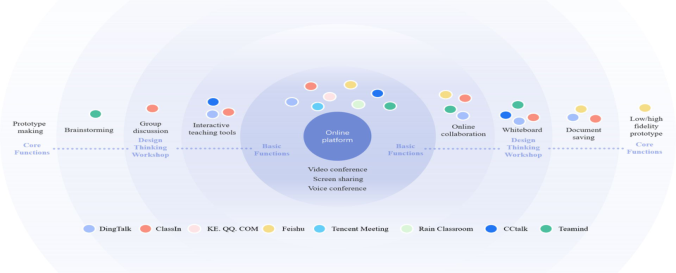
prototyping. For the characteristics and content of the workshop, several current mainstream online teaching platforms were selected for competitive analysis, namely: Classin, DingTalk, Tencent Meeting, Feishu, Teamind, KE.QQ.COM, Rain Classroom, CCtalk as shown in Figure 2.
The inner circle of the diagram shows the basic functions of the online teaching platform, while the outer circle shows the core competencies to sup- port online design thinking workshops. classin not only has group discussion functions and online interactive teaching tools, but also can upload files to personal cloud drive for storage, while teamind, as an online collaborative whiteboard, can record every idea with colorful sticky notes. In the current teaching platform, Classin and Teamind are chosen to be used together for online teaching experiments.
This online workshop was organized by the Human Training Network for the Automotive Electronics Industry and co-organized by DT Education Studio of Beijing Institute of Technology. The theme of the workshop was intelligent cockpit design for L3 assisted driving. 14 teachers from different universities recruited by the Automotive Electronics Industry Human Training Network and nine graduate students from the DT Education Workshop were mixed into four groups to find new possibilities for intelligent cockpits under L3 assisted driving based on the five steps of design thinking through a three-day online workshop.
The workshop requires close interaction between participants, instructors, and facilitators, and all activities are designed using problems and project- based learning with design thinking as a framework for problem-solving thinking. Table 1 shows the workshop schedule, content, tools used, and participant outcomes.
The experience of the five steps of design thinking during the online work- shop is as follows: In the empathy phase, participants build empathy for users and stakeholders by sharing their own stories and scenarios of using the car, interviewing colleagues/friends, literature research, etc. In the define phase,
Table 1. Workshop schedule, content, tools used and student outcomes.
Table available in the original PDF paper.
Workshop Time DT Stages Workshop Contents Teaching Platform Works
participants mapped through target users and different usage scenarios to find L3 assisted driving technology to support the identification of current problems. In the ideate phase, participants proposed several design concepts and created relevant cards for the target group’s emotional design of the car and human-car life scenarios under the online guidance of the mentor. The final output of this workshop is a design solution and cannot be prototyped, as prototypes require a tangible product or interaction. It is suggested that physical product prototypes can be organized for remote and online usabi- lity testing by creating 3D prototypes or 360° product videos. Another thing we could try is for the group members to create prototypes in virtual reality to interact with the prototypes in a unique way for tangible interaction and usability testing.
Questionnaire Design This study used a semi-structured questionnaire to focus on the problems that arose when the participants attended the workshop online, the learning effect of the workshop, and the acceptance and expectation of the online work- shop with virtual reality technology to form a formal questionnaire outline, as shown in Table 2. The purpose of the questionnaire is to understand the problems that arise during the online workshop participation and the users’ feelings about using the relevant functions of the teaching platform.
Online Teaching Platform of Design Thinking Workshop 27
Table 2. Questionnaire outline.
Table available in the original PDF paper.
Dimension Get Information Define user Whether the participant has attended the workshop, the form and number of workshops attended Basic Information Participant’s status, major, and regi on of participation in the online workshop Identify the problem Specific issues arising from online workshops Learning Evaluation Learning outcomes of the participants in this online workshop Virtual Reality Participants’ acceptance and expectations of the workshop with virtual reality technology
Analysis of Results There were 23 participants in this workshop, and 19 questionnaires were col- lected, all of which were valid. During the online workshop, 18 participants (94.7%) did not turn on the camera throughout the workshop. The results suggest that participating in the workshop with the webcam turned off online can reduce the stress of the participants, and this idea was confirmed by Sho- ckley et al. in a four-week trial, where the webcam was indeed more tiring during the virtual sessions (Shockley, K. M. et al. 2021).
Twelve people (63.2%) felt that alternating between ClassIn and Teamind during the workshop added to the learning burden. The results indicate that instructors use different teaching platforms depending on the content, which causes great inconvenience to the participants.
Fourteen people (73.7%) thought that more interactivity was needed in online brainstorming, and seven people (36.8%) thought that more intera- ctivity was needed in online icebreakers and group debriefings. Numerous studies have pointed out that teacher-student interaction and student-student interaction can alleviate learners’ learning isolation and also play an impor- tant role in improving learners’ motivation, learning stickiness, and learning experience.
Ten people (52.6%) perceived communication problems in online team communication exchanges. The results show consistency with Swanson et al. who noted that online students experience communication and socialization challenges in distance learning classes due to the lack of face-to-face com- munication and the lack of intensive interaction in online classes (Swanson, A. C. 2010). And there are four main reasons for the problems: first, netw- ork problems; second, unfamiliarity of team members with each other at the beginning of the workshop; third, poor communication due to low motiva- tion of team members online; and fourth, due to equipment problems, some participants could not use the required software.
During the online brainstorming process, 11 (57.9%) of the team members could not communicate face-to-face and thought they could be more carefree and thus generate better ideas. Most of the participants attended the online workshop in their offices or dormitories or homes, and 11 people (57.9%)
thought that the space they were in would not allow them to generate better ideas during the online brainstorming stage.
The average scores of participants’ evaluation of online teaching platforms ClassIn and Teamind were 4 and 3.32, and the average score of satisfaction with the presentation of brainstorming (Teamind sticky notes) was 3.74, which indicated that the practicality of Teamind and the presentation of sticky notes were relatively average.
CONCLUSIONS & FUTURE WORK This study identified the main problems in conducting online design thinking workshops, which can be summarized in four areas: technology, collabora- tion between groups, inadequate interaction between teachers and students, and lack of sense of atmosphere issues. The main problems faced by online workshops are the inability to discuss and communicate face-to-face, the inability to interact directly, and the poor communication between team members. Due to the online workshop, participants could not feel the pre- sence of others better and lacked a sense of atmosphere to maintain and promote participants’ motivation.
This questionnaire may have some factors that affect the results and vali- dity of the study. Next, the specific questions obtained in the questionnaire stage will be transformed into user requirements and validated to ensure that the user requirements obtained in this study are universal and representa- tive. Next, the transformation of user requirements to platform functional requirements will be carried out, and the transformed platform functions will be developed and designed. Finally, usability tests will be conducted on the online teaching platform design solution to verify its usability and iterate according to the feedback.
ACKNOWLEDGMENT
This paper is highly supported by the Fund project of Introduction and Imple- mentation of Design Thinking Education in Primary and Secondary Schools and School of Design and Art, Beijing Institute of Technology.
REFERENCES
Huang, J., Pan, W., Liu, Y., Wang, X. and Liu, W., (2020), July. Engineering design thinking and making: online transdisciplinary teaching and learning in a Covid-19 context. In International Conference on Applied Human Factors and Ergonomics (pp. 159–166). Luo, H., Feng, Q., Chen, Y., Zeng, L., & Zuo, M. (2020). Research on online tea-
ching platforms and tools for primary and secondary schools during the “war on epidemic”.J.Modern Educational Technology. 07, 113–119. (in Chinese) MIIT. (2019). Special action plan to improve manufacturing design capabilities (2019–2022). J. Machinery Industry Standardization & Quality. 12,12–15. (in Chinese)
Online Teaching Platform of Design Thinking Workshop 29
Shockley, K.M., Gabriel, A.S., Robertson, D., Rosen, C.C., Chawla, N., Ganster, M.L. and Ezerins, M.E., (2021). The fatiguing effects of camera use in virtual mee- tings: A within-person field experiment. Journal of Applied Psychology, 106(8), p. 1137. Swanson, A.C., (2010). Establishing the best practices for social interaction and
e-connectivity in online higher education classes. Taheri, M., Mayer, L., Schmieden, K.V. and Meinel, C., (2018). The DT MOOC prototype: towards teaching design thinking at scale. In Design thinking resea- rch (pp. 217–237). Zaqoot, W. and Oh, L.B., 2018, November. Teaching design thinking using online
whiteboarding in a graduate-level digital innovation course. In 26th International Conference on Computers in Education, Metro Manila, Philippines (pp. 26–30). Zhang, K., Ma, B., Dong, P., &Fu, X. (2017). Design Thinking based Innovation Development for College Students.J. Education Modernization. 13, 39–41. (in Chinese) Zulaikha, E. and Sari, E., (2020), November. Keep online design thinking alive:
A case study in Indonesia. In 28th International Conference on Computers in Education, ICCE 2020 (pp. 503–512). Asia-Pacific Society for Computers in Education.
LISTED IN THE AHFE DIGITAL BOOKSTORE CATALOGUE
Explore the complete digital volume
Ergonomics In Design
Read this individual research paper free through the original publisher, or explore the full digital proceedings book.
ISBN 978-1-958651-23-0
Explore this ISBN in the AHFE Bookstore ↗Listed in the July 2026 bookstore catalogue; search by ISBN to confirm current availability · Digital book purchase optional