Shijun Ge, Yuanbo Sun, Ruowei Cao (2022). An Exploration in Integrating Design Thinking into Chinese High School Curriculum. In: Ergonomics In Design. AHFE Open Access, vol. 47, pp. 15–21. https://doi.org/10.54941/ahfe1001914
Integrating design thinking into high school curriculum has positive effects in improving student’s key competences. The research in China so far, however, is only focused on the curriculum of individual subject with little work on multidisciplinary integration. Under the goal of developing student’s key competences, this work studies curriculum standards of all high school disciplines, combines recommended teaching approach for each subject, and proactively explores a path for integrating design thinking across all of them. As an outcome, we propose a feasible solution for integrating design thinking into high school multidisciplinary education. This can be seen as a theorical basis for deepening the reform of quality education in China.
With increased technological competition, preparing next generation tech- nological and innovative talents is an essential element for all countries to safeguard their position in future international competition. It is also a critical element for China to realize its national innovation-driven development stra- tegy. The report ‘Special action plan for improving design capability within manufacture sector 2019-2022’1highlighted the demand for cultivating high- end manufacturing design talents, and encouraged basic school reform to include design thinking and innovative mindset into basic education. The- refore, how to cultivate more innovative talents is a pivotal topic to be addressed.
Design thinking is an innovative thinking approach. It has surpassed its use originated from professional design area, and being applied widely in the other domains. In other words, design thinking transforms specialized design capability into basic quality, which can be applied universally (Tim Brown, 2018). United States first introduces the design thinking to basic education for students within the areas like exploration, learning, debating, innovation and collaboration. For example, the project ‘design thinking in schools (K12)’ collaborated by the K12 lab at institution of design at Standford university 1Publication number 218, Ministry of industry and information technology, 2019.
and IDEO (Standford University and IDEO, 2017). Within China, scholars also started their theorical and practical research on integrating design thin- king. For example, Linlin and etc., pointed the integration of design thinking and school curriculum has important effects in developing key compete- nces within basic education (Lin Lin and Shusheng shen, 2018). Peng Chen, and etc., explored how to improve teaching quality by integrating design thinking and STEAM education(Peng Chen, 2021). Yongqin Xiao discussed design thinking guided learning strategy in middle school physics(Yongqin xiao, 2019). Qinyong Zuo and etc., integrated design thinking into biology curriculum at high school (Qinyong Zuo, 2020).
Thus, there are many studies on STEAM and design thinking education, but they do not elaborate the fundamental reason and value for integrating design thinking into STEAM education. Many scholars studied the integra- ting design thinking into single curriculum, but there are no multidisciplinary strategies so far. In this work, we, based on high school educational targets set by Chinese ministry of education, explore the feasibility of integrating design thinking across all high school disciplinaries. We select high school education for this work because high school students have well-developed logical thinking, pre-requisite multidisciplinary knowledge and the ability to migrate their learning. Our goal is to propose a design thinking integrated multidisciplinary STEAM education strategy in order to deepen education reform and to cultivate students’ key competences.
ADVANTAGES OF INTEGRATING DESIGN THINKING INTO STEAM EDUCATION Design thinking is an innovative method used by designers in the design pro- cess. The five steps of design thinking proposed by institution of design at Standford university are well-known and highly recognized in the field of education. The basic five steps are: Empathize, Define, Ideate, Prototype and Test. That is, through user research, to start with user needs, identify well- defined problems, maximize solutions through brainstorming, optimize the solutions, and conduct model development and experimentation for some selected solutions. In this process, it is necessary to using multidisciplinary knowledge, the best solution is finally obtained through continuous iterati- ons. The essence of design thinking can then be reflected in the essence of thinking, the essence of method and the essence of innovation.
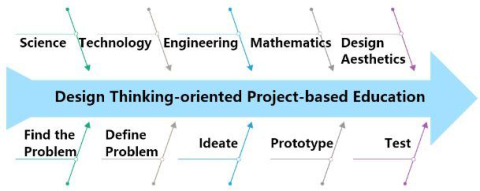
Design thinking starts with a problem and then uses a combination of means to solve the problem. This process requires the use of knowledge and skills in science, technology and engineering. STEAM education emphasizes the use of interdisciplinary concepts to guide students to explore, learn, and innovate. The project-based teaching is based on constructive supports to cultivate students’ teamwork ability and interdisciplinary ability. Projectiza- tion is the basic method of design thinking teaching, which coincides with STEAM teaching. When STEAM teaching is expressed by fishbone diagram, the design thinking process can be used as the backbone of fishbone (see Figure 1).
An Exploration in Integrating Design Thinking into Chinese High School Curriculum 17
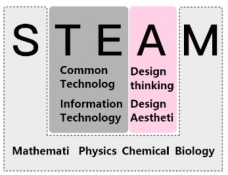
Figure 1: Project-based teaching guided by design thinking.Figure 2: Design thinking, design aesthetics and STEM education.
The introduction of design thinking into basic education originated from STEAM education in the United States. STEAM is an educational model for the development and an upgrade from STEM education. The A is abbreviated for Art, which covers Art & Design. Art has the meaning of humanities and can also be understood as the design aesthetics of products in a narrow sense. Whereas, Design mainly refers to design thinking (see Figure 2).
One advantage of design thinking is to cultivate students’ multi- dimensional abilities through the process of exploration and cooperation. This is consistent with the goal from Framework for Twenty-first Century Key Competences (Wei Rui and etc., 2020) proposed by Beijing Normal Uni- versity and Partnership for 21st Century Learning. As Table 1 summarized, each step of design thinking can cultivate corresponding key competences.
Therefore, STEAM education integrating design thinking is built up on practical problems, with proper subject integration as the basic support, the cultivation of necessary skills as the practical focus, deep integration of art, and fair participation as the fundamental principles. The aim is to cultivate students with a new teaching model with the purpose to develop excellent human resources with comprehensive literacy, problem-solving ability and innovation ability.
MULTIDISCIPLINARY INTEGRATION WITH DESIGN THINKING China closely follows the development trend of international education. Chi- nese scholars strive to actively explore a STEAM that conforms to China’s national conditions and has Chinese characteristics as a nation as well as school-level. As early as the 2nd STEM International Education Conference
Table 1. The five design thinking steps with their corresponding key competences.
Table available in the original PDF paper.
Design thinking 5Cs framework Empathize Cultural Competence, Critical Thinking, Communication Define Cultural Competence, Critical Thinking, Communication, Collaboration Ideate Critical Thinking, Creativity, Communication, Collaboration Prototype Critical Thinking, Creativity, Communication, Collaboration Test Critical Thinking, Communication, Collaboration
was held in Beijing in 2012, scholars discussed how to integrate STEM educa- tion concepts into the teaching of various science and technology education courses such as mathematics, physics, chemistry, biology, geography, scie- nce, and etc (Jie Ding and etc., 2013). The development of science education and other issues were discussed in depth. The goal is to find a constructive approach to develop an education system with Chinese characteristics.
Design Thinking Incorporated Subjects At present, the application of design thinking in high school is mainly based on the integration of compulsory courses such as general technology, infor- mation technology, science and labor. The education and teaching methods advocated by the curriculum standards of technical courses are highly consi- stent with the design thinking integrated STEAM education method. details as follows (see Table 2):
At present, the application of design thinking in high school education, in addition to compulsory courses such as secondary technical courses and science courses, is also carried out through comprehensive practical courses, school-based courses and after-school clubs and other project-based work- shops to enhance students’ inquiry skills, innovative thinking and design aesthetics.
Integrate Design Thinking in Other Disciplines Moreover, the design thinking integrated STEAM education helps to promote students’ interest and score in learning mathematics, physics, chemistry and other disciplines, and has great multidisciplinary integration potential. Now we demonstrate its feasibility by going through each curriculum standard.
Mathematics is a science that studies quantitative relationships and spatial forms,and it is the foundation of natural science and permeates all aspects of modern society and people’s daily life. Mathematics is also closely related to art, such as scales, rhythm, golden ratio, and etc. China’s General High School Mathematics Curriculum Standards proposes (MOE of PRC, 2020): to cre- ate a suitable teaching environment to inspire students to think, to promote cooperation and other learning methods, and to promote the development of practical ability and innovative consciousness. In short, various disciplines can be integrated into one through mathematics.
An Exploration in Integrating Design Thinking into Chinese High School Curriculum 19
Table 2. Disciplines that have integrated design thinking.
Table available in the original PDF paper.
Subject Curriculum Standards Regulations General Technology It is a course based on practice, focusing on creativity, and embodying the unity of science, technology and humanities. Special attention has been paid to integrate science, technology and humanities, highlight the cultivation of practical ability, innovative thinking, advocate a student and practice-centered diversified learning method, focus on creating diverse learning situations linked to students’ existing experience, and take active learning methods such as cooperative inquiry (Ministry of Education of the People’s Republic of China, 2020). Information Technology
The information technology course advocates a project-based learning method: knowledge construction, skill development and integrate thinking into the process of using digital tools to solve problems and complete tasks. The course allows students to participate in information technology-supported communication, sharing and cooperation, and increase information awareness (MOE of PRC, 2020). Science Science courses should emphasize the two characteristics of integration and inquiry. Scientific inquiry is a process of integrating among creative thinking activities, experimental activities and logical reasoning. It requires many iterations and constantly new discoveries and problems. The subject promotes the development of science in the process of problem solving (MOE of PRC, 2020).
Physics is a basic discipline in the field of natural sciences, which studies the basic structure, interaction and motion of matter in nature. China’s Gene- ral High School Physics Curriculum Standard points out that (MOE of PRC, 2020): to create a learning situation in which students are actively involved, willing to explore, good at experimentation, and diligent in thinking, and guide students to understand the nature of physics through a variety of tea- ching methods. Scholars have recognized the advantages of the integration of physics and design thinking, for instance, Yongqin Xiao integrated design thinking into the Deep Learning of Physics (Yongqin Xiao, 2019).
Chemistry is a basic discipline that studies the composition, structure, pro- perties, transformation and application of matter at the atomic and molecular levels. China’s Chemistry Curriculum Standards for General High Schools advocates (MOE of PRC,2020) the creation of real problem situation, carries out various exploration activities based on chemical experiments, promotes the transformation of students’ learning methods, and cultivates their inno- vative spirit and practical ability. Because the characteristic of chemistry is that it can serve life, some scholars use the method of design thinking to find problems from life situations (Miaomiao Lu etc., 2018).
Biology is a basic subject in the natural sciences, and it is a science that studies the phenomena of life and the laws of life activities. China’s General 2MOE of PRC abbreviates Ministry of Education of the People’s Republic of China.
High School Biology Curriculum Standards stresses the needs to implement the interrelationship between science, technology and society, and points out that it is necessary to amplify the importance of interdisciplinary connections. Some scholars encourage students though design thinking to practice inquiry- based learning activities, or completing engineering tasks (Liang Cheng and Xiao hui, 2015).
INTEGRATING DESIGN THINKING INTO THE STEAM CURRICULUM In conclusion, The curriculum view of integrating design thinking not only conforms to the concept advocated by the curriculum standard, but also has advantages in cultivating core competences. How to build a curriculum can be considered from the following 4 aspects (Min Peng and Dequan Zhu, 2018):
(1) Carefully prepare teaching design to ensure teaching quality. Problem design should be carried out based on the real world. Teachers should design required subject knowledge to solve the problem, such that sub- ject knowledge and research questions are carefully matched to design a reasonable teaching process. (2) Utilize all the teaching resources to create STEAM teaching conditions. Focus on constructing laboratories inside and outside the school to pro- vide environmental support for students to create or solve problems; use the power of the whole society, including colleagues, parents, enter- prises, non-profit organizations and communities to improve the effect of STEAM teaching; Use technical tools - includes not only hardware devices such as circuit boards, sensors, and 3D printers, but also cogni- tive tools such as Scratch visual programming software, concept maps, visual maps, and 3D modeling. (3) Flexible teaching evaluation to promote the sustainable development of students. Change evaluation objective from knowledge to ability, and change the scope of evaluation from single skill to multi-skill. Encourage situational evaluation and interactive evaluation. This means teachers are required to evaluate students’ learning process in real time, and students will provide feedback to teachers immediately after getting evaluation. (4) Teachers should actively participate in professional training to improve abilities. The examples are intensive course training, online professio- nal learning, professional group collaborative learning, such as teachers’ online workshops.
CONCLUSION
Integrating Design Thinking education reform not only breaks the isola- ted disciplines by promoting integrated curriculum development, but also significantly impacts the development of students’ core competence. It has inspirational effects on stimulating students’ creative thinking, establishing a strong bond between school and real world, and integrating real life scenarios into the curriculum.
An Exploration in Integrating Design Thinking into Chinese High School Curriculum 21
In the future, this work will combine relevant theory and research appro- ach from educational neuroscience. Starting with cognitive science, an inter- disciplinary and comprehensive follow up research will be carried out in order to provide rigorous and reliable scientific evidence, which can be used for education reform and cultivating innovative talents.
ACKNOWLEDGMENT
I would like to express my gratitude to the reviewers for their incisive recommendations for revisions and improvements. I would like to thank my supervisor, Professor Sun, for his patient guidance.
REFERENCES
Jie Ding, Su Cai, Fengguang Jiang, Shengquan Yu. (2013). Research on Science, Technology, Engineer, Mathematics (STEM) in Education Innovation and Inter- discipline—Review of the 2nd International STEM in Education Conference, Open Education Research. Volume 19 No. 02. Liang Cheng,Xiaohui zheng. (2015). The STEM Educational Philosophy and Its
Enlightenment in American Middle School Biology Curriculum, BIOLOGY TEA- CHING Volume 40 No. 06. Lin Lin, shusheng shen. (2018). Study on Functional Path of Integrating Design Thinking to Subjects Teaching: An Access to Cultivate Key Competence in Basic Education, E-EDUCATION RESEARCH Volume 39 No. 05. Miaomiao Lu, Yajun zheng, Xiaohong Zhan. (2018). The penetration of STEM edu-
cation concept in the teaching of organic chemistry in high school—Taking “the extraction process of lemon essential oil” as an example, Education In Chemistry No. 07. Min Peng, Dequan Zhu. (2018). The Key Features and Implement Approaches of Effective STEAM Teaching: Based on the Perspectives of STEAM Teachers in the United States, Journal of Distance Education Volume 36 No. 02. Ministry of Education of the People’s Republic of China. (2020). General High Sch-
ool General Technology, Information Technology, Science, Mathematics, Physics, Chemistry, Biology Curriculum Standards. Beijing: People’s Education Press. Peng Chen. (2021). Research on STEM Integrated Curriculum of Technology Education based on Design Thinking—Taking the Curriculum “Designing Better Schools” as an Example, MODERN EDUCATIONAL TECHNOLOGY Volume 31 No. 01. Qinyong Zuo, Xin Chen. (2020). Practice of senior middle school biology teaching
under the guidance of design thinking, Biology Teaching Volume 45 No. 02. Rui Wei, and et. (2020). The Research Design of the 5Cs Framework for Twenty-first Century Key Competences, EDUCATION SCIENCES No. 2. Standford University, IDEO. (2017). Deisgn Thinking in Schools (K-12). The
Standford Website: https://www.design-thinkinginschools.com/. Tim Brown. (2018). IDEO,Change by design. Hangzhou: Zhejiang Education Publishing House. Yongqin Xiao. (2019). Discussion on the deep learning strategy of high school
physics led by design thinking, Physics Teacher Volume 40 No. 08.
LISTED IN THE AHFE DIGITAL BOOKSTORE CATALOGUE
Explore the complete digital volume
Ergonomics In Design
Read this individual research paper free through the original publisher, or explore the full digital proceedings book.
ISBN 978-1-958651-23-0
Explore this ISBN in the AHFE Bookstore ↗Listed in the July 2026 bookstore catalogue; search by ISBN to confirm current availability · Digital book purchase optional