Zihan Bi, Yuanbo Sun, Shuai Sun, Kaimin Guo (2022). Ease Analysis of Interactive Mode of Intelligent Connected Vehicles: A Case Study of Physical Button and Virtual Interface. In: Ergonomics In Design. AHFE Open Access, vol. 47, pp. 70–77. https://doi.org/10.54941/ahfe1001921
With the development of intelligent connected Vehicles, there are more ways of human-vehicle interaction, and the information obtained by drivers is more abundant. It is necessary to consider how to improve the efficiency of human-computer interaction and driving safety of intelligent connected Vehicles in terms of ease of use. At this stage, the intelligent networked vehicle is still in the development stage of coexistence of physical control interaction and touch screen interaction. This paper attempts to analyze the human-computer interaction method in the vehicle based on the ease of use theory. Through research and case analysis, we try to summarize suggestions for improving the ease of use of human-vehicle interaction in current intelligent connected Vehicles.
As the automobile industry gradually presents the development trend of intelligence and networking, the way of human-computer interaction in auto- mobiles has also undergone great changes. The specific manifestation is that it is no longer limited to a single physical device, but is moving towards an integrated multi-dimensional and multi-display method. How to make the human-computer interaction system of intelligent connected Vehicles easier to use has become a new focus of design. At present, due to the gradual increase of information and functions, and the rich and diverse interaction methods, problems such as lack of interaction logic, cumbersome operation steps, and confusion of interface information structure also appear frequently (Sun, B.W et al., 2019). These problems will cause users to have unclear reco- gnition, misunderstanding, and improper operation of driving tasks, reduce interaction efficiency and driving experience, and even affect driving safety.
In recent years, domestic and foreign scholars have carried out related research in this field. Li Zheyuan et al. (Li, Z.Y, 2018) analyzed the design rules of automotive interactive devices and interactive interfaces from the perspectives of aesthetics, ease of use and safety; Sun Bowen et al (Sun, B.W
Ease Analysis of Interactive Mode of Intelligent Connected Vehicles 71
et al., 2019) emphasized the logic of the hierarchical relationship of the inte- ractive interface and proposed the principle of hierarchical design; Huang Z (Huang, Z. et al., 2018) et al. proposed a task-oriented voice interaction scene design method; Schmidt et al. (Schmidt, GJ et al., 2017), analyzed different interactions in emergency situations The pros and cons of channels.
It can be seen that scholars at home and abroad have discussed the human- computer interaction mode of intelligent connected Vehicles from different dimensions. However, there are few studies on the interaction mode of Intel- ligent connected Vehicles from the perspective of ease of use, and the few studies focus more on the logical sorting of the interaction interface and the comparative analysis of different interaction channels. Therefore, based on the sorting out of the concept and characteristics of ease of use, combi- ned with the characteristics and situations of human-computer interaction of intelligent connected Vehicles, through desktop research and collection of cases, the methods of human-computer interaction are summarized and analyzed by classification. This paper attempts to summarize the design strategies for the ease of use of human-computer interaction in intelligent connected Vehicles, so as to provide a certain reference for the design of human-computer interaction systems for intelligent connected Vehicles in the future.
AN OVERVIEW OF THE RELEVANT THEORIES OF EASE OF USE The Theoretical Basis of Ease of Use
Ease of use is a user-centered design concept whose nature is interpreted as easy to use, and the focus of ease of use is to make the design of the pro- duct conform to the user’s habits and needs (Karapanos, E., 2013). With the improvement of technology and the quality of life, the needs of users are also more diverse. It is not enough to satisfy “available” alone. More merchants, users and markets tend to be personalized, emotional, and Factors such as ease of use and experience are closer, that is, on the premise of satisfying basic functions, it will bring users a more pleasant experience, master the operation method through efficient learning methods, and reduce cognitive impairment.
Features of Ease of Use Jakob Nielsen (Neilsen, J., 2016) believes that ease of use includes five ele- ments: learnability, efficiency, memorability, low error rate, and satisfaction. Alan Cooper proposed that easy-to-use interaction design must reduce the cognitive burden of users. Users need to do four types of work when intera- cting with products: cognitive work, memory work, visual work, and physical work. As shown in Table 1, the six characteristics in the ISO 9126 software quality model (Jung, H.J. et al., 2006) are: functionality, reliability, ease of use, efficiency, maintainability, and portability.
We combine this standard with the human-computer interaction system of the in-telligent networked vehicle, and analyze the characteristics of the ease of use design of the human-computer interaction system of the intelligent
Table 1. ISO 9126 Software Quality Model.
Table available in the original PDF paper.
networked vehicle from the perspective of “human-machine-environment”, which should include the following three parts: 1 System direction: functio- nality, mainly refers to the operability and accuracy of the design; reliability, refers to the fault tolerance and easy recovery of the design; 2 User ori- entation: Ease of operation, which refers to the ease of understanding and learning of the design; Efficiency, which refers to the time characteristics and resource utilization of the design; 3 Direction of use environment: maintai- nability and portability. From a design perspective, this means that stability, recognizability and ease of change must be maintained.
CHARACTERISTICS OF HUMAN-COMPUTER INTERRACTION IN INTELLIGENT CONNECTED VEHICLES At present, it is in the transitional stage of hybrid interaction between traditio- nal two-dimensional interaction and interactive information screen. Since the relationship between the operating environment of the intelligent connected Vehicles and the human-computer interaction is more complex, through data collection and research, we divide the characteristics of the intelligent con- nected Vehicles human-computer interaction into the following three points:
1 Highly adaptable. Because the car is in a dynamic environment during use. Changes in factors such as time, road conditions, geographic location, light, and noise will affect interactive behavior and changes in content. The user accepts and processes this information with fluidity and uncertainty, so the human-computer interaction of the car should have a high degree of adapta- bility to adapt to different usage scenarios and make adjustments quickly, so as to facilitate the user’s understanding or decision-making. 2 Safety. The interaction of the human-machine system of the car belongs to the category of “transient non-immersive operation”. During the driving process, most of the user’s resources are occupied by the main task of “driving”, and the user’s attention can only be limited to the interactive task operation. This requi- res designers to put driving safety in the first place and avoid the conflict between secondary tasks and primary tasks. 3 Integration and multidimen- sionality. Intelligent networked vehicle is an important carrier integrating many functions, and complex interactive information should be managed through integration and design. In addition, there is currently a development trend of multi-dimensional interaction channel integration, which can reduce
Ease Analysis of Interactive Mode of Intelligent Connected Vehicles 73
the completion time of interactive tasks, reduce cognitive load and improve comfort for different driving scenarios and needs.
HUMAN-COMPUTER INTERACTION MODE OF INTELLIGENT CONNECTED VEHICLES The current human-computer interaction methods of intelligent connected Vehicles include physical manipulation interaction, touch screen interaction, voice interaction, gesture interaction, etc., which will be explained separately below.
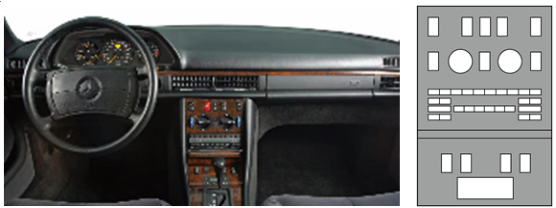
Physical Manipulation Interaction Due to the limitation of technology, the functions of early vehicles are relati- vely limited, and users generally control the vehicle through physical buttons, knobs, paddles, etc. Relevant studies believe that physical manipulation is a highly effective interaction mode and mode (Sun, B.W et al., 2019). Howe- ver, with the increase of user demand, if the increasing functions in the car are still implemented by physical buttons and knobs, the complicated buttons will make the user’s operation extremely inconvenient, which obviously incre- ases the user’s learning cost. For example, in the 1979 Mercedes-Benz S-Class (Figure 1), due to the large number of electronic systems loaded in the car, the number of buttons has also increased, and the center console is occupied by different physical buttons, making it difficult for users to operate profici- ently. How to make the interaction between vehicles and driving convenient and improve the usability of human-vehicle interaction is an urgent problem to be solved at that time.
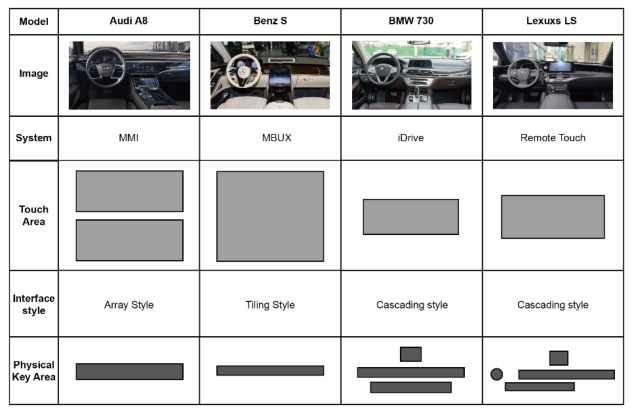
Hybrid Interaction Between Physical Buttons and Touch Screen Advances in technology have integrated computers and screens into human- vehicle interaction design. The central control design of automobiles has gradually developed from physical buttons to touch screens. At present, the hybrid interaction between physical buttons and touch screen is still the main- stream way of human-vehicle interaction. After investigation, we selected four luxury cars of the same level in the same period for comparative analysis (Figure 2).
Figure 2: Layout analysis of human-machine interaction system for different vehicle models.
The Audi A8 has a split dual touchscreen center console design and retains the five more frequently used physical buttons, while the Mercedes S has a full large full touchscreen with eight handy buttons at the bottom for a quick overview.Compared with the design of the A8, the tiled interactive interface of the Mercedes-Benz S is clearer and the function interval is larger, which can effectively prevent users from accidentally touching and improve the accuracy of interaction. The design of BMW 730 and Lexus LS is more traditional, and their interactive interface adopts a layered design, and the number of physical buttons is more than the previous two models, the screen size is also smaller, and the visual experience is generally low, but the advantage is The spatial location of the physical buttons is fixed to make the haptic feedback more realistic. At the same time, these four models have added sound feedback to simulate physical interaction in the touch interaction design. The advantage is to improve the accuracy of blind operation and indirectly improve the safety factor; in addition, the feedback method of sound and touch conforms to the original interaction habits, reducing the User learning cost and improving the ease of use of the product.
Full Touch Interaction The biggest difference between full-touch interaction and single physical inte- raction is that the displayed information is not limited by the layout, the information level is clearer, and the visual experience is better, but the phy- sical feedback of the touch screen has not yet reached an absolute level of immersion.
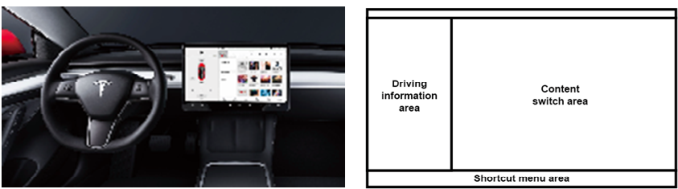
For example, Tesla (Figure 3) has abandoned traditional physical buttons and implemented most functions through a large touch screen display, and the user can customize the display position of the function. However, its touch
Ease Analysis of Interactive Mode of Intelligent Connected Vehicles 75
Figure 3: 2021 Tesla model 3.Figure 4: Some BMW models feature Alexa voice assistant.
screen interface carries too many functions, there are too many unnecessary information interferences, and the display of main tasks related to driving is not clear enough. According to a questionnaire survey conducted by Tang Ziwen (Tang, ZW, 2017), it is found that although users are more inclined to the intuitive and clear operation interface of the full touch screen in terms of learning and cognition, in terms of security, the full touch interactive system Interfere with driving safety. Relevant studies also believe that in today’s days when fully autonomous driving is not yet popular, full touch screen is not the best vehicle interaction design solution in the face of solving the problem of distracting driving attention resources (Peng,Y.Y., and Lu, J.L.,2018).
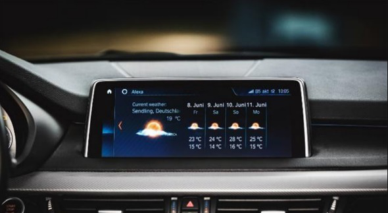
Multi-Channel Fusion Interaction Multi-channel fusion interaction is to integrate multiple sensory channels (Sight, Hearing, Smell, Touch, Taste, Somatosensory, etc.) of people together. Users can comprehensively integrate cognition, operation and experience interaction. Its advantages are to reduce cognitive load, reduce unneces- sary interaction steps and improve perceived comfort for users for different driving scenarios. Many car companies have gradually released their con- trol over the central control system and tried to combine them with mature technologies in other fields. For example, in 2018, BMW announced that Amazon’s Alexa artificial intelligence assistant will be gradually integrated into some models, aiming to provide users with a more natural interaction and communication experience (Figure 4).
The coexistence of multi-dimensional interaction methods is the design trend of the human-computer interaction system of intelligent connected Veh- icles, including a natural interaction and augmented reality. Since various technologies are not yet mature, multi-channel fusion interaction is still in a slow development stage, and there is still room for research in market acce- ptance, technical maintainability, and reliability. But it is undeniable that it must be the development trend of the human-computer interaction mode of intelligent connected Vehicles in the future.
CONCLUSION
The research on the ease of use of human-computer interaction is a key part of the design of intelligent connected Vehicles. This paper uses case studies to analyze how to improve the efficiency of car interaction and driving safety from the level of ease of use. Finally, suggestions for improving the usability of the human-vehicle interaction design of intelligent connected Vehicles are put forward: 1 Optimize the interaction mode to make the interaction between people and vehicles more natural and reduce the burden on users. Improve the multi-modal interaction experience; 2 Pay attention to the rationality of interaction logic and reduce unne- cessary level jumps. Allow users to operate more easily and intuitively, reduce the probability of errors, and improve driving safety; 3 Improve the identification of interface information, simplify information levels, and give users different degrees of guidance to avoid redundant design; 4 Improve the ease of learning of the interaction method, the interaction method should conform to the user’s operating habits, reduce the user’s learning cost, and follow the principles of consistency and corresponde- nce in design, that is, the physical buttons and the touch screen should be designed accordingly.
The ease of use design suggestions put forward in this paper are mainly for the thinking of the current situation. In the future, intelligent connected Vehicles will gradually realize fully automatic driving. At that time, the car will be transformed from a single driving tool to an “ agent “ and a mova- ble “third space”. The research focus of the ease of use of human-computer interaction will not only stay at the level of driving control, but its content will be more diversified and more valuable.
REFERENCES
Huang, Z. and Huang, X., 2018, April. A study on the application of voice interaction in automotive human machine interface experience design. In AIP Conference Proceedings (Vol. 1955, No. 1, p. 040074). AIP Publishing LLC. Jung, H.J., Jung, W.T. and Yang, H.S., 2006, May. A study on the standard of softw-
are quality testing. In International Conference on Computational Science and Its Applications (pp. 1052–1059). Springer, Berlin, Heidelberg.
Ease Analysis of Interactive Mode of Intelligent Connected Vehicles 77
Karapanos, E., 2013. User experience over time. In Modeling users’ experiences with interactive systems (pp. 57–83). Springer, Berlin, Heidelberg. Li, Z.Y., 2018. Research on HMI User Interface Design of Connected Cars. Informa-
tion and Computers, (7), pp. 15–17. Neilsen, J., 2016. Usability 101: Introduction to Usability, Jakob Nielsen’s Alertbox of 25 August 2003. Accessed on, 12. Peng, Y.Y., and Lu, J.L., 2018. Research on interaction design of in-vehicle infotain-
ment system based on car networking. Electronic world, (20), pp. 136–137. SAE International. (2022) Taxonomy and Definitions for Terms Related to Driving Automation Systems for On-Road Motor Vehicles. [online] Available from: https://www.sae.org/standards/content/j3016_202104 Schmidt, G.J. and Rittger, L., 2017, September. Guiding driver visual attention with
LEDs. In Proceedings of the 9th International Conference on Automotive User Interfaces and Interactive Vehicular Applications (pp. 279–286). Sun, B.W, Yang, J.M. and Sun, Y,B., 2019. Research on Hierarchical Design of Automotive Human-Machine Interface. Mechanical Design, (2), pp. 121–125. Tang, Z.W., 2017, Research on HMI Interaction Design of Vehicle-mounted Central
Control in the Intelligent Era[online]. Available from: https://kns.cnki.net/KCMS/ detail/detail.aspx?dbname=CMFD201801&filename=1018040877.nh
LISTED IN THE AHFE DIGITAL BOOKSTORE CATALOGUE
Explore the complete digital volume
Ergonomics In Design
Read this individual research paper free through the original publisher, or explore the full digital proceedings book.
ISBN 978-1-958651-23-0
Explore this ISBN in the AHFE Bookstore ↗Listed in the July 2026 bookstore catalogue; search by ISBN to confirm current availability · Digital book purchase optional