Zhongzhen Lin, Chien-Hsiung Chen, Shasha Li (2023). The User Interface Design of Central Bank Digital Currency: An Empirical Study. In: Human-Centered Design and User Experience. AHFE Open Access, vol. 114, pp. 70–78. https://doi.org/10.54941/ahfe1004223
It is certain that the Central Bank Digital Currency (CBDC) as the future direction of monetary development has become a general consensus among central banks around the world. Many studies have been conducted on the technical and macroeconomic implications of CBDC at the level of technology and macroeconomics. Nonetheless, there is a lack of research on the user interface design of CBDC. The purpose of this study focuses on evaluating the relationship between the font size layout of CBDC interfaces and user age. A 3 (font size) X 2 (user age) mixed factorial design was used to assess the impact of the relevant research variables on users' subjective evaluations. The experimental results showed that, firstly, younger users preferred CBDC interface designs with medium-sized fonts and older users preferred large-sized fonts. Secondly, this study also found that both older and younger users were biased towards disliking CBDC interface designs with small font sizes. In addition, this study found that CBDC user interfaces with large fonts had the strongest sense of security, while CBDC user interfaces with small fonts did not. It is worth noting that younger users feel that CBDC is a secure payment method more than older users. Finally, young users have the highest NPS net recommendation index for medium-sized fonts, and older users have a higher NPS net recommendation index for large-sized fonts. The above findings can be used as design guidelines for the issuance and design of CBDC for the relevant countries in the future, and have high academic and theoretical value as well.
With the emergence of various third-party innovative payment tools and cryptocurrencies, people’s payment habits have been reshaped, and tradi- tional paper money can no longer meet people’s payment needs. In particular, new payment tools have to some extent had a substitution effect on legal ten- der, which threatens the monetary authority and legal status of central banks (Vigna and Casey, 2016, Cunha et al., 2021). These have prompted central banks to have to start seriously considering whether to issue CBDCs. among them, the BRICS countries, which include China and Russia, also seem to want to change the US dollar-dominated international financial architecture by issuing CBDCs (Liu and Papa, 2022). Furthermore, in the academic world
The User Interface Design of Central Bank Digital Currency: An Empirical Study 71
it is also believed that CBDCs have the potential to be the next step in the future development of currencies and to make changes to the current mon- etary and financial system on a global scale (Wang et al., 2022, Kuehnlenz et al., 2023).
In addition, in order to maintain sovereign control over the money stock, there are already many countries that have begun research and piloting of CBDCs. A 2021 study by the Bank for International Settlements (BIS) indicates that approximately 86% of central banks worldwide are actively conducting research related to CBDCs (Boar and Wehrli, 2021). This is up 6% from the 80% figure in 2020 (Boar et al., 2020). As of July 2023, the Boston Consulting Group’s CBDC tracking report shows that in addition to the Bahamas, Jamaica, and Nigeria, which have formally issued CBDCs, there are 19 other countries that are in the proof-of-concept and pilot stages before formally issuing CBDCs. In addition, research suggests that CBDCs are likely to have a phasing out effect on traditional cash in the future (Agur et al., 2022). All of the above suggests that CBDC is likely to become a major medium of exchange in the international currency market.
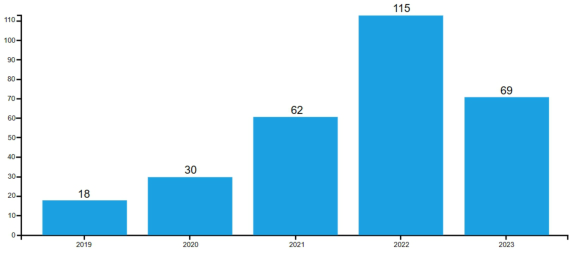
As of July 2023, this study conducted a subject search on all databases of Web of science with the keyword “Central Bank Digital Currency”, and a total of 315 results were obtained. In addition, the number of related liter- ature in the past five years is 261, and the number of literature is climbing year by year (as shown in Fig. 1), which shows that CBDC-related research is receiving attention from academics, and its research value and space are huge. However, most of the current CBDC-related studies mainly focus on macro-level discussions such as cryptocurrency technology and financial sta- bility (Hoang et al., 2023). Few systematic studies have been conducted in the area of user interface design for CBDC. In particular, based on the principle of universality of CBDC’s legal tender status, older users’ usage preferences and psychological perceptions also deserve to be emphasized and studied. Therefore, the main goal of this study is to fill this academic and practical research gap and to provide in-depth analysis and useful suggestions for the user interface design of CBDC in order to promote its successful implemen- tation and widespread use in practical applications. These research findings are expected to provide valuable guidance to central banks that are about to introduce CBDC to meet the design and implementation challenges they will face in the future.
Figure 1: The number of documents related to “Central Bank Digital Currency” in the Web of science database in the last 5 years.
MATERIALS AND METHODS
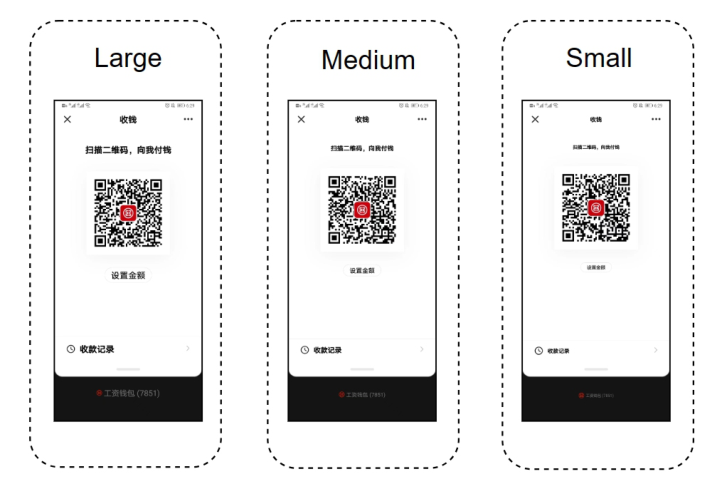
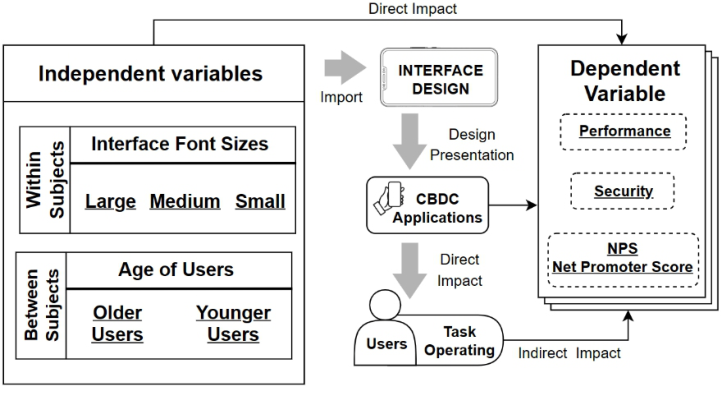
The methodology of this study consisted of collecting quantitative data from the experiment and analyzing it. The experiment in this study was a 3x2 mixed factorial design in which interface font (large, medium, and small) was a within-subjects variable and user age was a between-subjects variable. The presentation of the interface font variables in the experiment is shown in Figure 2. In addition, according to the nature of this study, this exper- iment controlled for the age stratum of the subjects. Therefore, a total of 36 participants were recruited through the purposive sampling method. The ages of these participants ranged from 18–70 years old. In this study, all participants were categorized into two age groups: (i) young users (n = 18) up to and including 39 years of age, and (ii) older users (39 years of age and older; n = 18). Finally, all participants in this study reported themselves to be right-handed and to have normal vision (including normal after correction).
Figure 2: Three sizes of fonts in the CBDC interface of this study.
In order to assess participants’ e-CNY operational behaviors in a real trad- ing scenario, this study employed a simulated mobile application resembling e-CNY as the experimental prototype (as shown in Fig. 2). Four moderately challenging tasks were designed for this study: 1. Opening the e-CNY pro- totype application and displaying the payment QR code to the participants. 2. Presenting the e-CNY receipt QR code to the participants. 3. Verifying the amount of e-CNY consumption red packet. 4. Checking the total balance of e-CNY wallet. In addition, we tested the user’s NPS net recommendation index in this study and used a 7-point “Likert Scale” to assess the user’s sub- jective evaluation (i.e., preference, reasonableness, and sense of security) of the relevant CBDC interfaces. The model architecture of this study is shown in Figure 3.
The User Interface Design of Central Bank Digital Currency: An Empirical Study 73
Figure 3: The research model of this study.
This study used an in-laboratory simulation of a trading scenario to explore the methodology. All participants were tested in a consistent exper- imental environment with the same equipment and lighting conditions. The equipment used in the experiment was a 6.39-inch HUAWEI Mate 20 Pro phone equipped with the HarmonyOS system. In addition, the prototype CBDC application used in the experiments was downloaded to the experi- mental devices in advance to exclude the possible influence of communication signal differences. Meanwhile, the screen brightness and volume of the exper- imental devices were adjusted to the maximum level to ensure the consistency of the experimental conditions.
RESULTS
In this study, the mixed factorial analysis of variance (ANOVA) method was applied to analyze the research results statistically in detail. Through the SPSS software program, we conducted a careful data analysis of the experimental data. In the study, we systematically explored the main effects of factors such as font size and user age in the CBDC interface on participants’ subjective experience, as well as the interaction effects between them. In the final analysis, in order to gain insight into the significant differences between the levels of different factors, we applied LSD post hoc tests to further explore the factors with significant main effects.
Preference This study employed a unidimensional 7-point Likert scale to investigate par- ticipants’ perceived preferences towards the CBDC prototype they operated. Table 1 presents the results of the variance analysis related to participants’ preference levels in this study. As evident from Table 1, there exists a signifi- cant main effect of font size (F = 81.723, p = 0.000 < 0.05). Further post hoc
LSD analysis revealed no significant difference (p = 0.211 > 0.05) between the large font (M = 5.750, SD = 0.185) and medium font (M = 5.361, SD = 0.162). However, a notable distinction (p = 0.000 < 0.05) was observed between the large font and small font (M = 2.389, SD = 0.219). Moreover, a significant disparity (p = 0.000 < 0.05) was found between the medium font and small font. In other words, employing large and medium fonts in the CBDC user interface yielded no pronounced difference in overall user preference. It is noteworthy that both the large and medium fonts in the CBDC interface were inclined towards favorable user preferences, while the small font in the CBDC interface tended to be unfavorably received. Addi- tionally, the main effect of age exhibited no significant variance (F = 2.575, p = 0.118 > 0.05).
Table 1. The mixed factorial ANOVA results of the degree of preference.
Table available in the original PDF paper.
Source SS df MS F p η2 Post Hoc Font Size 243.389 2 121.694 81.723 0.000** 0.706 Large=Medium>Small Age 2.370 1 2.370 2.575 0.118 0.070 Font Size × Age 2.685 2 11.343 7.617 0.001** 0.183 Error 101.259
* Significantly different at α = 0.05 level (*p < 0.05). ** Significantly different at α = 0.01 level (**p < 0.01).
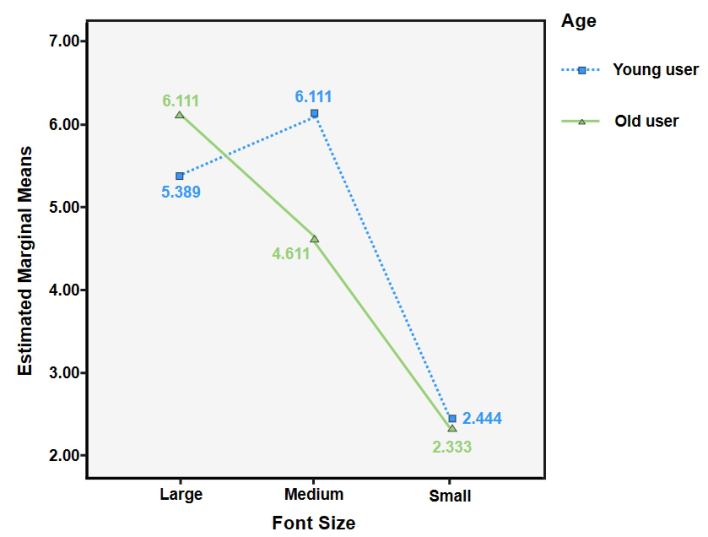
Figure 4: Interaction diagram of font size and age in terms of degree of user preference.
The User Interface Design of Central Bank Digital Currency: An Empirical Study 75
Furthermore, it is evident from Table 1 that a significant interaction effect exists between font size and age (F = 7.617, p = 0.001 < 0.05). The inter- action between these two variables is illustrated in Figure 4, where older users (M = 6.111, SD = 1.132) exhibit a higher preference for the large font size compared to younger users (M = 5.389, SD = 1.092). Conversely, younger users demonstrate a greater preference for the medium font size (M = 6.111, SD = 0.963) than older users (M = 4.611, SD = 0.978). It is noteworthy that younger users expressed a high degree of favorabil- ity towards the medium font size. Moreover, younger users indicated a stronger preference for the small font size (M = 2.444, SD = 1.247) than older users (M = 2.333, SD = 1.372), and both groups leaned towards disliking it.
Security This study also used a single-dimensional, 7-point Likert scale to investi- gate participants’ perceptions of the safety of the CBDC prototype they were operating. Table 2 illustrates the ANOVA results related to the security per- ceptions of the participants in this study. As seen in Table 2, there was a significant difference in the main effect of font size (F = 36.828, p = 0.000 < 0.05). Further LSD post-hoc analyses showed that there was a significant difference (p = 0.001 < 0.05) between large (M = 5.972, SD = 0.237) and medium (M = 4.917, SD = 0.116) font sizes. Moreover, there was also a sig- nificant difference (p = 0.000 < 0.05) between large and small size characters (M = 3.111, SD = 0.267). In addition, there was also a significant differ- ence (p = 0.000 < 0.05) between medium-sized and small-sized characters. It is worth noting that the user security perceptions of the CBDC interface for large and medium-sized characters are biased towards security, while the user security perceptions of the CBDC interface for small-sized characters are biased towards insecurity. Moreover, the CBDC interface with large font size gives the strongest security perception to users.
Table 2. The mixed factorial ANOVA results of the degree of security.
Table available in the original PDF paper.
Source SS df MS F p η2 Post Hoc Font Size 150.722 2 75.361 36.828 0.000** 0.520 Large=Medium>Small Age 4.481 1 4.481 4.546 0.040* 0.118 Young User>Old User Font Size × Age 4.130 2 2.065 1.009 0.370 0.029 Error 139.148
* Significantly different at α = 0.05 level (*p < 0.05). ** Significantly different at α = 0.01 level (**p < 0.01).
In addition, there was a significant difference in the main effect of age (F = 4.546, p = 0.04 < 0.05). A pairwise comparison analysis revealed that younger users perceived security (M = 4.870, SD = 0.135) than older users (M = 4.463, SD = 0.135). In addition, as can be seen in Table 2, the interaction effect between font size and age was not significant (F = 1.009, p = 0.370 > 0.05).
NPS
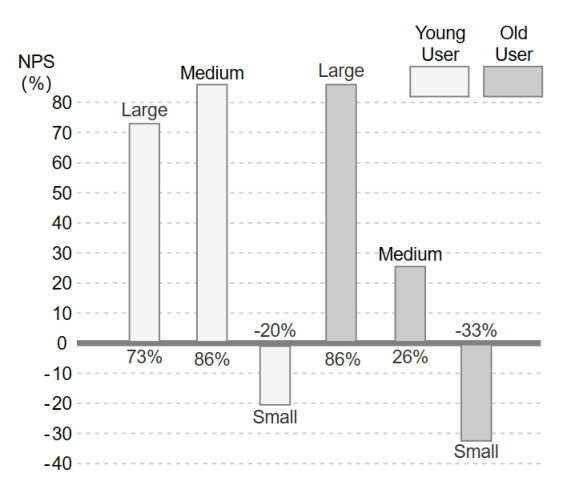
NPS, short for Net Promoter Score, was initially introduced by Reichheld in 2003. The fundamental role of NPS is to predict the likelihood of users rec- ommending a particular product or company. This is because when a user recommends a product to friends or family, there is a certain probability that those individuals may become users of the same product. Therefore, NPS has been widely adopted as a predictive indicator by relevant industries (Baehre et al., 2022). The NPS question in this study is formulated as follows: “How likely are you to recommend the CBDC application? This question is single-choice and ranges from 0 to 10. Generally, participants choosing 9 or 10 are classified as ‘promoters’, those choosing 7 or 8 are classified as ‘passives’, and participants selecting below 7 are categorized as ‘detrac- tors’. Furthermore, the NPS score is calculated as the difference between the percentage of ‘promoters’ and ‘detractors’. Reichheld (2011) defines NPS as indicating a favorable situation when the NPS score reaches 50% or above, whereas a negative satisfaction level is implied when the NPS score is below 0%. The NPS scores in this study are depicted in Figure 5. As illustrated in Figure 5, younger users exhibit NPS scores above 50% for both large and medium fonts, while the NPS score for the small font is below 0%. Con- versely, among older users, only the NPS score for the large font surpasses 50%, and the NPS score for the small font remains below 0%. This indicates that younger users hold a positive perception of the CBDC user interface with large and medium fonts, whereas older users solely express a positive attitude towards the CBDC user interface with a large font. Importantly, both age groups display a negative disposition towards the CBDC user interface with the small font.
Figure 5: NPS values in this study.
The User Interface Design of Central Bank Digital Currency: An Empirical Study 77
LIMITATIONS While several findings of this study provide insights for central banks on the verge of launching CBDC and academic researchers, caution is advised in interpreting these research findings. This caution stems from the existing lim- itations in this study that need to be addressed in future research. Firstly, the experiments of this study were conducted exclusively on the HarmonyOS operating system of Huawei smartphones, and the applicability on other operating systems remains unverified. To enhance the generalizability of the study outcomes, future research is recommended to replicate the experiments across diverse operating systems. Secondly, despite adopting a methodology similar to prior research (Rather and Hollebeek, 2021) by categorizing par- ticipants as younger and older users with an age boundary of 39, further granularity in categorizing participant ages can be explored in future stud- ies. Lastly, this study’s participant pool did not include special groups such as individuals with disabilities. However, given the inclusive design nature of CBDC, future research could consider incorporating users from special groups in the design considerations to ensure broader inclusivity in the design.
CONCLUSION
This study aimed to explore the relationship between font size in the CBDC user interface and user age, while also endeavoring to analyze user prefer- ences, security perceptions, and Net Promoter Score. Specifically, we observed significant variations in user preferences for different font sizes in the CBDC user interface among users of distinct age groups. Based on the experimen- tal outcomes, the following design recommendations are proposed: firstly, designers should be cautious about employing small font sizes in the CBDC user interface, as they lead to reduced preference across various age cohorts. Secondly, the use of a larger font size in the CBDC user interface may enhance users’ perceptions of security. Lastly, for younger users, both large and medium font sizes could positively influence their inclination to recommend the system, whereas among older users, only a large font size might augment their willingness to recommend. However, developers need to strike a balance between the preferences and needs of younger and older users, considering their respective subjective experiences.
These suggestions could potentially provide valuable insights for future considerations involving the use of CBDC by older users, thereby contribut- ing to the universal design and sustainable development of CBDC in the future.
ACKNOWLEDGMENT
This research study did not receive any specific individual, public, or com- mercial support. Thanks to the anonymous reviewers for their comments and efforts to improve the paper.
REFERENCES
Agur, I., Ari, A., & Dell’Ariccia, G. (2022). Designing central bank digital currencies.
Journal of Monetary Economics, 125, 62–79. Baehre, S., O’Dwyer, M., O’Malley, L., & Lee, N. (2022). The use of Net Promoter Score (NPS) to predict sales growth: insights from an empirical investigation. Journal of the Academy of Marketing Science, 1–18. Boar, C., & Wehrli, A. (2021). Ready, steady, go?-Results of the third BIS survey on
central bank digital currency BIS papers. Boar, C., Holden, H., & Wadsworth, A. (2020). Impending arrival–a sequel to the survey on central bank digital currency. BIS paper, (107). Cunha, P. R., Melo, P., & Sebastião, H. (2021). From Bitcoin to Central Bank Dig-
ital Currencies: Making Sense of the Digital Money Revolution. Future Internet, 13(7), 165. Hoang, Y. H., Ngo, V. M., & Vu, N. B. (2023). Central bank digital currency: A systematic literature review using text mining approach. Research in International Business and Finance, 101889. Kuehnlenz, S., Orsi, B., & Kaltenbrunner, A. (2023). Central bank digital currencies
and the international payment system: The demise of the US dollar?. Research in International Business and Finance, 64, 101834. Liu, Z. Z., & Papa, M. (2022). Can BRICS de-dollarize the global financial system?.
Cambridge University Press. Rather, R. A., & Hollebeek, L. D. (2021). Customers’ service-related engagement, experience, and behavioral intent: Moderating role of age. Journal of Retailing and Consumer Services, 60, 102453. Reichheld, F. (2011). The ultimate question 2.0 (revised and expanded edition): How
net promoter companies thrive in a customer-driven world. Harvard Business Review Press. Reichheld, F. F. (2003). The one number you need to grow. Harvard business review, 81(12), 46–55. Vigna, P., & Casey, M. J. (2016). The age of cryptocurrency: how bitcoin and the
blockchain are challenging the global economic order. Macmillan. Wang, Y., Lucey, B. M., Vigne, S. A., & Yarovaya, L. (2022). The effects of central bank digital currencies news on financial markets. Technological Forecasting and Social Change, 180, 121715.
LISTED IN THE AHFE DIGITAL BOOKSTORE CATALOGUE
Explore the complete digital volume
Human-Centered Design and User Experience
Read this individual research paper free through the original publisher, or explore the full digital proceedings book.
ISBN 978-1-958651-90-2
Explore this ISBN in the AHFE Bookstore ↗Listed in the July 2026 bookstore catalogue; search by ISBN to confirm current availability · Digital book purchase optional