Xu Dongjie, Ye Junnan (2023). Instructional design and practice of installation art based on Steam-Obe concept. In: Human-Centered Design and User Experience. AHFE Open Access, vol. 114, pp. 114–121. https://doi.org/10.54941/ahfe1004228
The digital wave triggered by new technology has changed the traditional way of life. Digital media art, as the most cutting-edge part of contemporary art, has been gradually followed up with professional creation courses related to digital media in colleges and universities. Interactive device art creation course is an important practical course for digital media art major. Seek innovation points in multi-media platforms and conduct independent interdisciplinary creation, so as to learn interactive installation art creation in digital media art.At present, there are still some problems in the design of interactive device art creation course, which are mainly reflected in the following aspects:1. The teaching system is not comprehensive enough. The comprehensiveness and pioneering nature of interactive installation art make it require higher and more comprehensive professional quality of students. However, the current teaching system has problems such as single curriculum, lack of interdisciplinary integration and lack of special training.2. Lack of project management awareness. In the practical teaching of interactive installation art creation, due to the comprehensiveness and diversity of the course, students often need to organize a team to complete it. However, due to the lack of project management awareness, students are difficult to lack effective organization and management of complex projects such as interdisciplinary practice and media integration.3. The assessment and evaluation system is not comprehensive enough. The current curriculum assessment and evaluation system lacks an incentive mechanism for innovation, attaches too much importance to the training of new media art talents, and fails to assess the quality of students' innovation ability quantitatively. As a result, students have problems such as stylized creation and weak innovation consciousness, and a more perfect assessment mechanism for new media art education.In view of the above problems, by analyzing the concept of OBE and STEAM, the content and process of experimental teaching are optimized, and an online and offline experimental teaching mode of interactive installation art that integrates OBE and STEAM is constructed. This model includes two modules of basic theory and experiment, and the course development and evaluation system based on STEAM concept.Combining OBE mode with STEAM concept, the change of teaching mode pays more attention to improving students' comprehensive quality fundamentally, and attaches importance to students' learning and development. In teaching, "student-teacher-problem" should be the center. Students are given learning tasks or problems, and teachers help students with academic practice, thinking and exploration in the process of guidance, so as to achieve the purpose of understanding new knowledge.The concrete practice of the construction of the teaching model integrating the concepts of OBE and STEAM is as follows:1. Establish a teaching knowledge system based on STEAM concept, and cultivate the ability of artistic creation with STEAM concept.2. Student-centered. Student-centered is the core idea of OBE model. The STEAM concept emphasizes the nature of practice and supports students' active, independent and socialized learning by promoting their comprehensive quality.3. Project-based learning. Through project-guided learning, problem-oriented, specific open-ended questions are put forward so that students can explore answers, master methods, broaden their thinking and improve their practical ability, so as to ultimately enable students to independently develop innovative project works.4. Establish a course assessment system and works evaluation system based on the STEAM concept, and improve the overall evaluation of students' course performance and professional creation.At present, East China University of Science and Technology has successfully carried out online and offline hybrid experimental course teaching by integrating the concepts of OBE and STEAM. Students watch MOOC videos recorded by teachers through the school's online learning platform, learn the creation process of installation art online, and conduct concentrated experiments in offline basic experimental courses. In the project practice module, students gave full play to their thinking and made plans. After prototype testing and optimization, many excellent assignments were finally produced, and students got good results.The digital media Art major of East China University of Science and Technology was selected for practical verification. Through course assessment and teaching evaluation, this teaching mode has achieved good results, which can improve students' learning engagement, improve students' design innovation literacy, cross-media innovation literacy, and enhance students' learning experience and teaching satisfaction. It provides a reference for the teaching reform of interactive installation art.
With the development of digital media art courses in major universities, the research and design of its teaching mode have become the aim of this course to cultivate students’ higher aesthetic taste and innovative ability. On the one hand, innovation is the inevitable requirement for the development of education, is the trend; On the other hand, based on the characteristics of the discipline itself, students are required to have the ability to innovate and
Instructional Design and Practice of Installation Art Based on STEAM-OBE Concept 115
make use of the professional quality they have learned to create artistic works that can arouse people’s emotional resonance.
By integrating the STEAM-OBE concept and aiming at the problems exist- ing in the current new media art creation course, this course proposes new and innovative plans for the course structure, teaching methods, teaching concepts and assessment methods, which greatly improves the organizational ability of the course.
OUTCOMES-BASED EDUCATION OBE comes from the concept of OBE (Outcomes-based Education) in the international educational community in recent years, that is, results-oriented education, which is a goal-oriented education model, due to its expected “Outcomes”. Derived from the concept of “Student Learning Outcomes” SLOs (Student Learning Outcomes), we can invert the expected “learning outcomes” to cultivate students’ ability and design teaching programs, so OBE can also be understood as “ability-oriented education”.
This concept emphasizes the integrated assessment of cognition, skills and attitudes, and optimizes the effect of education and teaching through the topological structure of “guide structure, result orientation, learning assessment and student center”. OBE pays more attention to students’ learn- ing process and reflection, emphasizing the overall integration of students through reflection and practical operation in the complete learning process.
STEAM CONCEPT STEAM concept originated in the United States. It mainly consists of five goals and evaluation systems, including Science, Technology, Engineering, Art and Mathematics, which can cross disciplinary restrictions and make knowl- edge and skills more inclusive and connected. It is an educational practice form that integrates science and technology with humanities.
The STEAM concept has been constantly changing since the 1980s, and has accumulated a lot of teaching results and practical cases.In the 21st cen- tury, Georgette Yakman proposed to add “A”, that is, Art, to “STEM”, thus giving birth to the concept of STEAM. The concept of STEAM no longer only focuses on the integration of science and technology disciplines, but develops the integration of STEAM education towards a broader and more multidimensional interdisciplinary field.
THE TEACHING GOAL OF INTERACTIVE INSTALLATION ART EXPERIMENT Interactive installation art experiment is a new art form, through digital tech- nology, sensors and other scientific and technological means to interact with the audience to create visual and auditory interactive effects. Its goal is to help students understand and master the basic principles and technical means of interactive installation art through experimental teaching, and cultivate their ability to create new artistic expressions and solve practical problems.
116 Ye and Xu
The teaching objectives of interactive installation art experiment mainly include the following aspects:
1. Let students master the basic concepts of interactive installation art. 2. Cultivate students’ creative thinking. 3. Cultivate students’ technical ability. 4. Cultivate students’ teamwork spirit. 5. Cultivate students’ aesthetic quality.
The teaching goal of interactive installation art experiment is comprehen- sive, not only technology, but also thinking and art, which can improve students’ all-round literacy and comprehensive ability.
Experimental Hardware and Software of Interactive Installation Art Arduino Uno development board kit, 3D printing equipment and open source hardware are used as teaching hardware. Use Arduino IDE, processing, Touch-Designer, etc. as teaching software.
EXPERIMENTAL TEACHING CONTENT DESIGN BASED ON OBE AND STEAM CONCEPT OBE refers to the student-centered, through the teaching based on learners’ ability goals, to achieve the overall improvement of students’ ability and qual- ity. In the experimental teaching of installation art, OBE is adopted to achieve the following aspects of work:
1. Setting course objectives According to the actual situation of students and the law of physical and mental development, the curriculum objectives in line with scien- tific principles and educational laws are set up, and the core skills and related abilities that students should master when learning installation art experiments are explained in detail. 2. Arrangement of teaching content The teaching content should be closely related to the curriculum objec- tives, and try to improve students’ interest and enthusiasm, so that they can take the initiative to participate in experimental activities and develop their potential. 3. Application of teaching methods In experimental teaching, a variety of teaching methods should be adopted, such as phenomenon observation, experimental operation, practical activities, creative thinking, etc., combined with the actual situ- ation of students and the course content, to cultivate students’ hands-on ability and innovative consciousness. 4. Establishment of evaluation system In the process of experimental teaching, it is necessary to conduct a com- prehensive evaluation according to the curriculum objectives, assess the ability and quality of students, and promote the feedback and summary of students’ results through guiding students’ self-evaluation and evalu- ation, so as to improve students’ self-management and lifelong learning ability.
Instructional Design and Practice of Installation Art Based on STEAM-OBE Concept 117
CONSTRUCTION OF TEACHING MODEL INTEGRATING OBE AND STEAM CONCEPT Combining OBE and STEAM concept, the change of teaching model pays more attention to fundamentally improve the comprehensive quality of stu- dents and attach importance to students’ learning and development. We should focus on “student-teacher-problem”. Students are given learning tasks or problems, and teachers help students with academic practice, thinking and inquiry in the process of guidance, so as to achieve the purpose of understanding new knowledge.
The concrete practice of constructing the teaching mode integrating OBE and STEAM concept is as follows:
1. Guide students to study Teachers should guide students to learn, propose questions or tasks, guide students to find answers and discover potential, so that students can gradually master STEM-related professional knowledge in these practices. 2. Progressive observation Adopting the progressive observation method, students can gradually understand and master the learning knowledge through the process of exploration and practice, so as to better master and practice, and improve the learning effect. 3. Student-centered Student-centered is the core idea of OBE concept. The STEAM concept emphasizes the nature of practice, and supports students’ active, inde- pendent and social learning by promoting the improvement of students’ comprehensive quality. 4. Project based learning Through project-guided learning, problem-oriented, specific open ques- tions are put forward, allowing students to explore answers, master methods, broaden ideas, and improve practical ability, so as to ulti- mately enable students to independently develop innovative project works.
CONSTRUCTION OF COURSE ASSESSMENT SYSTEM BASED ON STEAM CONCEPT
1. Basic evaluation dimension Scientific experiments. The elements of scientific experiment should be reflected in the curriculum, so that students can explore scientific knowl- edge, improve scientific practice ability and explore innovative thinking through experimental operation. Project works. By giving students some specific course projects, stu- dents are asked to think creatively in the project, design and produce art or technology products or works that meet the course objectives, and evaluate students’ innovation level and creative ability. Mathematical model. In teaching, natural science, technology, engi- neering and art should be closely combined with mathematics, so that
118 Ye and Xu
students can learn to use mathematical methods to establish mathe- matical models of practical problems and improve the ability to solve problems with mathematics.
Table 1. Curriculum schedule.
Table available in the original PDF paper.
Instructional objectives Hours
Teaching weeks
The type of course Content of courses
4
1 Online teaching The basics of interactive installation art
Understanding the basic concept, development history and basic creation process of installation art.
4
Offline teaching Basic creative practice 1
Understanding the implementation principles of hardware and functions
4
Learning some of the basic functions of creative software
Learning TouchDesigner: Creative Case Studies and Basic Application Methods.
4
Offline teaching Basic creative practice 4
Advancing the Creation of Installation Art.
4
5 Offline teaching interim report Reporting the Knowledge Acquired in the Initial Phase, and Generating a Design Proposal for the Subsequent Project.
4
Offline teaching prototyping Creating a Prototype for the Creative Project Design.
4
6 Offline teaching Test and iteration
Completing an Installation Artwork.
4
Offline teaching Conclusion and evaluation
Peer Assessment among Students and Course Evaluation Conducted by Teachers.
2. Project management In STEAM education, it is necessary to conduct a holistic assessment of students’ project works, so as to promote the improvement of students’ literacy, skills, hands-on ability and innovation ability. The assessment system should include the following: Project planning. students need to pre-plan the project’s goals, schedule, resource requirements, etc., to ensure that the project works smoothly and efficiently.
Instructional Design and Practice of Installation Art Based on STEAM-OBE Concept 119
Project execution. In the process of project implementation, students need to carry out group cooperation, experimental operation, literature reading, data analysis, production results and so on. Project evaluation. The content of evaluation includes the quality of the project results, whether they meet the expected objectives, the division of labor and collaboration of students, personal performance, and so on. Project review. Students need to review and evaluate the entire project, which helps to find shortcomings and improve teaching effectiveness, and also plays an important role in promoting the lifelong growth of students. 3. Comprehensive evaluation Comprehensive assessment needs to assess students’ ability from multiple angles, so the assessment elements include: students’ scientific experiment ability, artistic creation ability, innovative thinking ability, communication and cooperation ability, research methods and experimental safety and environmental awareness, and so on.
TEACHING PRACTICE AND EVALUATION The course assessment will be based on students’ comprehensive online and offline learning. The final total score includes mainly usual score (30%) + final score (70%).
The final score will include the presentation of the creative project (10%) + completion of STEAM metrics (50%) + innovation and design of the project (30%) + teamwork (10%).
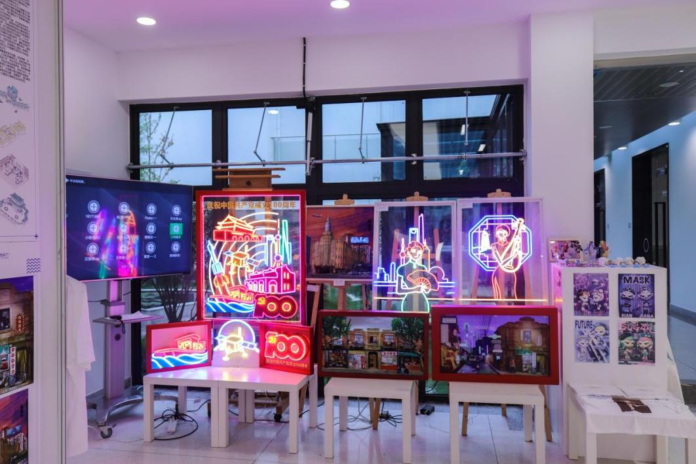
TEACHING PRACTICE At present, the concepts of OBE and STEAM, has been successfully car- ried out by the School of Art Design and Media of East China University of Science and Technology. Students watch the teaching videos recorded by teachers through the school’s online learning platform, learn the creation process of installation art online, and conduct concentrated experiments in offline basic experimental courses. All the students completed the online MOOCs viewing within the specified time, and had repeated viewing records. In the project practice module, students give full play to their thinking, select the project, formulate the plan, and conduct in-depth design research using observation method, experience method, questionnaire survey, com- petitive product analysis and other methods. After prototyping testing and multiple optimizations, many excellent large-scale projects are finally born, such as the interactive lighting installation art works combining Arduino open source hardware and LED lights. In the end, all the students got good grades.
120 Ye and Xu
Figure 1: Curriculum outcome (by the author, 2021).
CONCLUSION
Aiming at the problems existing in the experimental courses of interactive installation art, this study reformed and explored, integrated the concepts of OBE and STEAM with the mixed teaching mode of online and offline, and constructed a new teaching mode for experimental courses of digital media art majors.
Practice has proved that the new model effectively improves students’ learning efficiency and enthusiasm for interactive installation art, reduces the learning difficulty, and better achieves the curriculum training goal. Compared with the traditional teaching model, the teaching effect has been significantly improved, and it has better practical application and promotion value.
constructed framework model, the research can be further expanded, the possibility of applying this model in other courses or teaching of other majors can be studied, and specific implementation methods can be proposed.
REFERENCES
Ali Tian, Chunxiao Hou. (2022). ‘Research on the Breakthrough path of Integrated Online and Offline Education (OMO) development: from the perspective of path dependence and path Creation’, China Audio-visual Education, 73(01), pp. 78–85. Butnaru G I, Nita V, Anichiti A, et al. (2021).‘The Effectiveness of Online Education
during Covid 19 Pandemic-A Comparative Analysis between the Perceptions of Academic Students and High School Students from Romania’. SUSTAINABIL- ITY, 13(9), p. 5311. Chao Ma, Hong Zeng, Hongxiang W. (2019). ‘Research on Online and offline mixed experimental teaching model’, Laboratory Research and Exploration, 38(05), pp. 185–189.
Instructional Design and Practice of Installation Art Based on STEAM-OBE Concept 121
Jianmin Gong, Beilei Xiao. (2020). ‘Who should Make the curriculum outline -- on the design of OBE talent Training Program’, Higher Engineering Education Research, 20(04), pp. 180–187. Tian Zhang, Huaibin Qin. (2020). ‘Information Technology Teaching in junior mid-
dle School under STEAM Concept: A case study of DoPBL teaching model’, Office Automation, 25(23), pp. 24–26+43. Wei Liu, Yaobin Xie, Rui Chang. (2019). ‘Based on open source hardware innovation practice ability training mode’, Research and Practice of Computer Education, 137(11), pp. 140–146. Xue E Y, Li J, Xu L J. (2020). ‘Online education action for defeating COVID-19 in
China: An analysis of the system, mechanism and mode’, Educational Philosophy and Theory, doi: 10.1080/00131857.2020.1821188. Yating Huang, Ya Wang. (2022). ‘A study on the influencing mechanism of undergraduate learning Engagement in mixed teaching under the background of Epi- demic situation: from the perspective of exploring community Theory’. China Higher Education Research, 22(03), pp. 52–59. Yi Song, Yuhan Cui, Hongjia Ma. (2020) ‘The United States K-12 Integrated
STEM education Framework: Philosophy, curriculum path, and support system’ Contemporary Education Forum, 20(02), pp. 65–75. Zhiqiang Wang, Shunshun Xiong, Qingmei Yang. (2019) ‘Future Makers: The concept, practice and reference of Educational maker-spaces in the United States’ Global Education Perspectives, 50(07): 64–76.
LISTED IN THE AHFE DIGITAL BOOKSTORE CATALOGUE
Explore the complete digital volume
Human-Centered Design and User Experience
Read this individual research paper free through the original publisher, or explore the full digital proceedings book.
ISBN 978-1-958651-90-2
Explore this ISBN in the AHFE Bookstore ↗Listed in the July 2026 bookstore catalogue; search by ISBN to confirm current availability · Digital book purchase optional