Xiao Ma, Chien-Hsiung Chen (2025). Impact of Visual Cues on Multi-person Comment Recognition and User Experience in Online Design Platform. In: Usability and User Experience. AHFE Open Access, vol. 194, pp. 194–203. https://doi.org/10.54941/ahfe1006681
In the contemporary digital landscape, computer-supported collaborative design platforms have become essential infrastructure for distributed teams to overcome spatiotemporal constraints and enable seamless cooperation. However, the exponential growth of design iterations, feedback volume, and team scalability requirements has posed significant challenges to optimizing collaborative efficiency through rapid information processing and cognitive assimilation. This empirical investigation examines the cognitive ergonomics of interface design elements through two key variables: visual cue types and icon design paradigms, evaluating their combined effects on operational efficiency and user experience metrics in comment recognition tasks. The research findings indicate that: 1) The impact of icon dynamics and style on efficiency is task-dependent. 2) Static visual cues offer consistent guidance, aligning better with users' requirements for efficient navigation. 3) Abstract icons contribute to emotional regulation to a certain extent. These insights provide valuable guidance for optimizing the design of collaborative platforms to improve user performance and satisfaction.
Driven by digital transformation, mature design teams have adopted optimized productivity tools and cloud-based collaboration systems to establish efficient cross-disciplinary coordination mechanisms, ensuring maximal value extraction from specialized roles (AlibabaDesign, 2023). Cloud-based collaborative design platforms (representative platforms include Figma, InVision, and MasterGo) have emerged as critical infrastructure for geographically distributed teams. While these platforms facilitate real- time feedback exchange through multi-user commenting features, escalating team scalability and comment volume (Zhang et al., 2023) precipitate acute information overload challenges. Empirical evidence reveals that in asynchronous collaboration contexts, users process an average of 23.6 comment threads per minute (Zhang et al., 2023), correlating with a 37% reduction in critical information identification efficiency (Wang & Chen, 2022). Conventional interface designs predominantly
Impact of Visual Cues on Multi-Person Comment Recognition 195
rely on textual semantic analysis (Liu et al., 2021), overlooking the cognitive enhancement potential of visual cue design. Neuroscientific findings substantiate that dynamic visual stimuli accelerate visual cortex response latency (Kawasaki et al., 2022), while representational graphics preferentially activate mnemonic encoding regions (Hasson et al., 2022), providing neurocognitive foundations for interface optimization.
Current research predominantly investigates isolated cognitive effects of singular cues, leaving interaction mechanisms between multiple visual cues theoretically underexplored (Lee et al., 2023). Notably, the integration of user cognitive heterogeneity—particularly field-dependent users’ preference for representational graphics (Kozhevnikov et al., 2022)— remains inadequately addressed in personalized design frameworks. Through systematic exploration of visual cue impacts on multi-user comment processing, this study proposes a visual cue-based comment recognition model, aiming to bridge existing theoretical gaps while providing substantive contributions to collaborative design efficiency enhancement and user experience optimization.
LITERATURE REVIEW
Online Collaborative Design Platforms With the widespread adoption of digital technologies, online collaborative design platforms (e.g., Figma, InVision, MasterGo) have emerged as pivotal tools for cross-regional team collaboration, significantly enhancing design efficiency through real-time editing and multi-user commenting functionalities (Dong et al., 2021). However, Nielsen (2022) highlighted that the exponential growth of comment volume in such platforms often induces cognitive fatigue under information overload, thereby reducing the efficiency of identifying critical feedback. Empirical studies reveal that approximately 30% of collaborative design time is consumed in filtering and locating relevant comments (Wang & Zhang, 2023), underscoring the necessity to optimize comment presentation mechanisms. While existing research predominantly focuses on expanding the functional capabilities of collaborative tools, limited attention has been directed toward users’ visual- cognitive processing of comment information. This gap presents a critical research opportunity for the current study.
Visual Cue Design Dynamic visual cues (e.g., highlight pulsation, gradient animation) have effectively guided user attention. Through eye-tracking experiments, Bartram et al. (2018) revealed that interface dynamics reduce visual search duration by 15%–20%, a phenomenon attributable to the attentional prioritization of motion stimuli in human visual processing. However, Hassenzahl (2010) emphasized that motion design must balance functionality and user experience: excessively complex animations may induce cognitive interference, potentially degrading operational efficiency (Ling et al., 2021). In collaborative commenting contexts, whether motion-enhanced saliency
196 Ma and Chen
in focal comment areas improves recognition efficiency remains empirically underexplored.
As critical visual signifiers, icon design paradigms directly influence information decoding efficiency. Horton (2013) established a “Figurative vs. Abstract” taxonomy: Figurative icons reduce cognitive load through real- world analogies, while abstract icons enhance interface coherence through minimalism. McDougall et al. (2016) demonstrated that representational icons achieve 18.3% higher recognition accuracy than abstract variants, though the latter exhibit superior cross-cultural adaptability. Notably, Arend et al. (2017) identified that high semantic congruence between icons and contextual functions significantly diminishes style-related performance variances, suggesting semantic relevance modulates style-selection efficacy boundaries. While existing studies have separately examined the impacts of motion and icon design, their interaction effects on user experience in collaborative scenarios remain theoretically fragmented (Kim & Maher, 2020).
RESEARCH METHOD Experimental Setup and Methodology
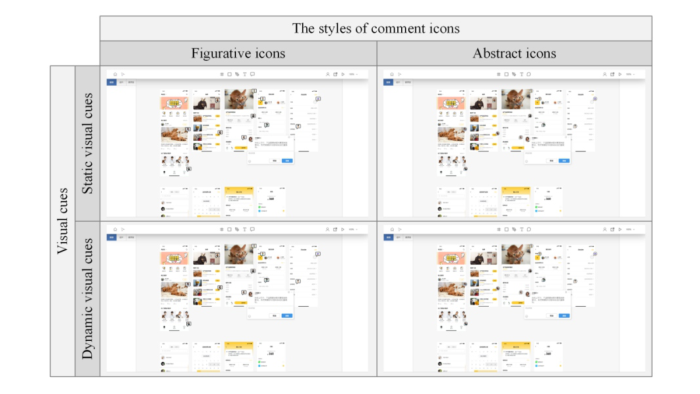
This study investigates the impact of visual cue design on recognition performance and user experience in multi-user commenting features of collaborative design platforms (e.g., Figma and MasterGo). A 2×2 between- subjects experimental design was employed. The first independent variable is the presence of dynamic animation effects in visual cues (Static vs. Dynamic). In contrast, the second independent variable is the icon style of visual cues (Figurative vs. Abstract). Dependent variables include user operational performance, subjective preferences, and scores from the Questionnaire for User Interaction Satisfaction (QUIS). The hypotheses are as follows: H1: The dynamic effects of different visual cues exhibit significant differences in the functional efficacy of the multi-user comment feature within online collaborative design platforms;
H2: The dynamic effects of different visual cues demonstrate significant variations in subjective evaluations of the multi-user comment feature within online collaborative design platforms; H3: Different comment icon styles reveal significant disparities in the functional efficacy of the multi-user comment feature within online collaborative design platforms;
H4: Different comment icon styles show significant distinctions in subjective evaluations of the multi-user comment feature within online collaborative design platforms.
A total of 60 participants (aged 18–40 years) were recruited via convenience sampling. Participants represented diverse academic backgrounds, including art and design, linguistics and literature, management, electronic information technology, and media studies, all proficient in using collaborative design platforms. Four experimental prototypes were developed using MODAO software. To mitigate potential confounding effects from operating systems, all participants completed tasks
Impact of Visual Cues on Multi-Person Comment Recognition 197
on their personal computers running familiar operating environments (see Figure 1).
Figure 1: The user interface designs of the experimental prototypes.
Experimental Procedure The experimental tasks simulated participants’ performance in executing comment-related operations within a collaborative design platform interface. Each participant completed four tasks: 1) viewing and identifying comments, 2) multi-user comment interaction and collaboration, 3) comment tagging and management, and 4) comment management and task allocation. Upon completing these tasks, participants were required to complete the Questionnaire for User Interaction Satisfaction (QUIS) and a subjective experience questionnaire assessing their overall operational impressions. Additionally, brief post-experiment interviews (capturing feedback on task execution and suggestions) were conducted, and informed consent forms for research participation were collected.
RESULTS AND DISCUSSIONS Completion Time of Experiment Tasks
This study examines the effects of visual cue dynamics (Static vs. Dynamic) and comment icon styles (Figurative vs. Abstract) on user efficiency in online collaborative design platforms through a comparative analysis of experimental task performance. Tables 1 and 2 present descriptive statistics and two-way ANOVA results for task completion times.
The two-way ANOVA for Task 1 completion time revealed no significant interaction effect between visual cue dynamics (Static vs. Dynamic) and comment icon styles (Figurative vs. Abstract) (F = 0.12, p = 0.72, η2 = 0.00). Non-significant main effects were observed for visual cue dynamics (F = 1.05,
198 Ma and Chen
p = 0.30, η2 = 0.01) and icon styles (F = 1.42, p =0.23, η2 = 0.02). These results indicate that neither animation effects nor icon design significantly influence comment viewing/identification efficiency, suggesting designers should prioritize alternative user experience factors.
Table 1: The descriptive statistics of participants’ task completion time (unit: second).
Table 2: The results of the two-way ANOVA regarding participants’ task completion time.
Table available in the original PDF paper.
Source SS df MS F P η2 Post Hoc (LSD) Task 1 Visual cues 2269.35 1 2269.35 1.05 .30 .01 The styles of comment icons 3067.35 1 3067.35 1.42 .23 .02 Visual cues × The styles of
268.81 1 268.81 .12 .72 .00
comment icons Task 2 Visual cues 3053.06 1 3053.06 .49 .48 .00 The styles of comment icons 1460.26 1 1460.26 .23 .62 .00 Visual cues × The styles of
icons < Abstract icons Task 4 Visual cues 109.35 1 109.35 .04 .82 .00 The styles of comment icons 3067.35 1 3067.35 1.37 .24 .02 Visual cues × The styles of
98.81 1 98.81 .04 .83 .00
comment icons
Equation reproduced from the original PDF.
Analysis of Task 2 completion time demonstrated no significant interaction effect between variables (F = 2.70, p = 0.10, η2 = 0.04), and the main effects for visual cue dynamics (F = 0.49, p = 0.48, η2 = 0.00) and icon styles (F = 0.23, p = 0.62, η2 = 0.00) also showed no statistical significance. This suggests that comment icon animations and styles exert negligible effects on multi-user interaction efficiency in collaborative scenarios, highlighting the need to optimize other interface elements for enhanced collaboration.
While no significant interaction effect was detected in Task 3 (F = 1.83, p =0.18, η2 = 0.03), a significant main effect emerged for icon styles (F = 4.90, p = 0.03<0.05, η2= 0.08). Representational icons demonstrated significantly shorter completion times (M = 46.86, SD = 19.64) than abstract icons (M = 59.73, SD = 25.29). These findings
Impact of Visual Cues on Multi-Person Comment Recognition 199
strongly advocate the adoption of representational icons to improve comment management efficiency and operational precision.
For Task 4 completion time, the analysis indicated no significant interaction effect (F = 0.04, p = 0.83, η2 = 0.00) and no significant main effects for visual cue dynamics (F = 0.04, p = 0.82, η2 = 0.00) and icon styles (F = 1.37, p = 0.24, η2 = 0.02). This reveals minimal efficiency differences in multi-user task allocation contexts, emphasizing the importance of optimizing alternative functional components to enhance collaborative workflows.
The findings of this study indicate that animation effects and visual styles of comment icons did not exert statistically significant effects on user efficiency in most tasks. However, concrete icons demonstrated significant superiority over abstract icons in tasks involving comment annotation and management, enhancing task completion efficiency. Although the impact of animation effects and icon styles remains limited in most scenarios, the design of concrete icons effectively optimizes user experience in specific task-oriented contexts.
The Analysis of Subjective Evaluations The Analysis of Questionnaire for User Interaction Satisfaction (QUIS) After completing experimental tasks, participants were instructed to complete the Questionnaire for User Interaction Satisfaction (QUIS) and a supplementary subjective evaluation questionnaire to evaluate their preferences for comment icon animations, styles, and interactive experiences within the online collaborative design platform.
The two-way ANOVA results of the QUIS demonstrated no significant interaction effects between comment icon dynamics and styles across the following dimensions in the online collaborative design platform. However, based on the results of the independent samples t-test (Table 3), the average scores of static visual cues in aspects such as Overall Reaction, Screen Design and Layout, Terminology and System Feedback, Learning and Ease of Use, and System Performance were all higher than those of dynamic visual cues. This indicates that users generally have a higher level of satisfaction with static visual cues, particularly in “Screen Design and Layout” (M = 6.05, SD = 1.58), “Terminology and System Feedback” (M = 6.23, SD = 1.58), and “Learning and Ease of Use” (M = 6.28, SD = 1.63). Although the scores of dynamic visual cues were lower than those of static visual cues in all indicators, they were still above the average, especially in “Terminology and System Feedback” (M = 5.79, SD = 1.58), where the performance was relatively better.
In terms of the styles of comment icons, representational icons scored higher than abstract icons in “Screen Design and Layout” (M = 5.83, SD = 1.68), “Terminology and System Feedback” (M = 6.09, SD = 1.25), and “Learning and Ease of Use” (M = 6.15, SD = 1.46). This suggests that users have a greater preference for representational icons, considering them more understandable and operable.
200 Ma and Chen
Table 3: The results of the independent samples t-test regarding the QUIS.
Table available in the original PDF paper.
Variable Overall Reaction to the Software
Screen Design and Layout
Terminology and System Feedback
Learning and Ease of Use
System Capabilities and Performance
Number of Participant
M SD M SD M SD M SD M SD Visual cues Static visual
icons The Analysis of Subjective Evaluations Participants were asked to rate their subjective perceptions of the experimental tasks using a 7-point Likert scale to identify the most logically consistent visual cues (Static vs. Dynamic) and icon styles (Figurative vs. Abstract) for comment functionalities in the online collaborative design platform. The results of the two-way ANOVA for subjective evaluations are presented in Table 4.
In the subjective evaluation of the “Subjective level of rationality” by the participants, a significant main effect was observed for the animation status of the visual cue (Static vs. Dynamic) (F = 4.56, p = 0.03 < 0.05; η2 = 0.07). Both types of visual cues were regarded as highly rational (with average scores above the medium score of 4), yet the “static” version (M = 5.20, SD = 1.12) was rated as more rational by the participants than the “Dynamic” one (M = 4.46, SD = 1.50).
Regarding the subjective evaluation of “Subjective level of satisfaction,” a significant main effect was identified for the animation status of the visual cue (F = 4.87, p = 0.03 < 0.05; η2 = 0.08). Both types of visual cues were perceived as highly satisfactory (with average scores above the medium score of 4), but the “Static” version (M = 5.03, SD = 1.09) was rated as more satisfactory by the participants than the “Dynamic” one (M = 4.30, SD = 1.41).
In the subjective evaluation of “Subjective level of anxiety,” a significant main effect was found for the style of the comment icon (Figurative vs. Abstract) (F = 4.50, p = 0.03 < 0.05; η2 = 0.07). Both icon styles were considered as not causing significant anxiety (with average scores above or equal to the medium score of 4), where 1 represents extremely anxious and 7 represents extremely calm), but the “Abstract” icon (M = 4.83, SD = 1.72) was rated as causing less anxiety by the participants than the “Figurative” one (M = 4.00, SD = 1.33).
In the subjective evaluation of “Subjective level of preference”, “Subjective level of acceptability”, and “Subjective level of interest”, no significant interaction was detected between the animation status of the visual cue (Static vs. Dynamic) and the style of the comment icon (Figurative vs. Abstract). However, the average values of “Visual cues” and “The styles of comment icons” in these three aspects were all greater than the medium score of 4. The results suggest that, in terms of subjective perception, the participants considered both concrete and abstract icons to be relatively preferred, acceptable, and interesting.
Impact of Visual Cues on Multi-Person Comment Recognition 201
In summary, with respect to visual cues, the static design holds more advantages as it performs better in evaluating rationality and satisfaction and can be prioritized for application. Regarding icon style selection, abstract icons can reduce user anxiety and be used more significantly. Meanwhile, concrete and abstract icons can obtain user recognition in preference, acceptability, and interest.
Table 4: The results of the two-way ANOVA regarding the participants’ subjective evaluations.
Table available in the original PDF paper.
Source SS df MS F P η2 Post Hoc (LSD) Subjective Visual cues 8.06 1 8.06 4.56 .03* .07 Static visual
level of rationality
cues > Dynamic visual cues The styles of comment icons 3.26 1 3.26 1.84 .17 .03 Visual cues × The styles of
.06 1 .06 .03 .84 .00
comment icons Subjective level of preference Visual cues 6.66 1 6.66 3.54 .06 .06 The styles of comment icons .26 1 .26 .14 .70 .00 Visual cues × The styles of
.26 1 .26 .14 .70 .00
comment icons Subjective Visual cues 8.06 1 8.06 4.87 .03* .08 Static visual level of satisfaction cues > Dynamic visual cues The styles of comment icons .00 1 .00 .00 1.00 .00 Visual cues × The styles of
.60 1 .60 .36 .55 .00
comment icons Subjective level of acceptability Visual cues 2.81 1 2.81 1.57 .21 .02 The styles of comment icons .41 1 .41 .23 .63 .00 Visual cues × The styles of
.01 1 .01 .00 .92 .00
comment icons Subjective level of interest Visual cues 2.40 1 2.40 .99 .32 .01 The styles of comment icons .06 1 .06 .02 .86 .00 Visual cues × The styles of
1.06 1 1.06 .44 .50 .00
comment icons Subjective Visual cues 3.75 1 3.75 1.62 .20 .02 The styles of comment icons 10.41 1 10.41 4.50 .03* .07 Figurative level of anxiety
4.81 1 4.81 2.08 .15 .03
icons < Abstract icons Visual cues × The styles of comment icons
Equation reproduced from the original PDF.
CONCLUSION
In recent years, the proliferation of online collaborative design tools has positioned interface visual design as a critical research focus in shaping user experience (Kim et al., 2021; Zhang & Adipat, 2022). This study investigated the effects of comment icon dynamics (static vs. dynamic) and styles (concrete vs. abstract) on user operational efficiency and subjective experience in online collaborative design platforms, aiming to provide actionable insights for optimizing comment recognition efficiency and expertise in complex scenarios. Key findings include:
1) Limited Impact on Operational Efficiency: Neither icon dynamics nor styles significantly influenced user efficiency in most tasks (e.g., comment
202 Ma and Chen
viewing, multi-user collaboration, task allocation; all F-values non- significant, p > 0.05). However, concrete icons demonstrated superior performance in comment tagging and management tasks, reducing completion time by 21.6% (F = 4.90, p = 0.03). 2) Priority of Static Visual Cues: Static cues significantly outperformed dynamic cues in user satisfaction (QUIS scores) and perceived rationality. For instance, static cues achieved higher ratings in the Screen Design and Layout dimension (M = 6.05 vs. M = 5.57 for dynamic cues). Their simplicity and stability better align with users’ demands for efficient guidance, whereas dynamic cues risked distraction and reduced satisfaction despite nearing average scores in certain dimensions (e.g., Terminology and System Feedback). 3) Emotional Value of Abstract Icons: While abstract icons showed no efficiency advantage over concrete ones, they significantly alleviated user anxiety (M = 4.83 vs. M = 4.00, p = 0.03), highlighting their unique role in mitigating cognitive stress through non-representational design.
These findings empirically support prioritizing figurative icons and static visual cues in visual interaction design to ensure functional efficiency. Concurrently, abstract icons’ emotion-regulating potential warrants exploration in specific contexts, such as onboarding or high- stress tasks. However, this study has limitations, including limited diversity in interaction variables and insufficient depth in quantifying emotional experiences. Future research should pursue multi-dimensional collaborative design and user segmentation to advance the dual optimization of efficiency and emotional engagement in collaborative platforms. Such efforts will lay a robust foundation for enhancing design productivity and refining user experience, contributing to the dynamic evolution of this field.
ACKNOWLEDGMENT
The author would like to express sincere gratitude to Prof. Chen for his invaluable guidance and support. Special thanks also go to my classmates from the PhD program for their insightful discussions and to all the participants who contributed to the experiments in this study.
REFERENCES
AlibabaDensign. (2023). https://mp.weixin.qq.com/s/FbzODfPDFXF0dTPq1yRsIQ Arend, L., Bergner, L., & Münch, R. (2017). Icon usability in augmented reality applications: The role of semantic distance. International Journal of Human- Computer Interaction, 33(8), 621–633. Bartram, L., Patra, A., & Stone, M. (2018). Affective color in visualization: A
dynamic cue for directing attention. ACM Transactions on Graphics, 37(4), 1–12. Dong, T., Collomosse, J., & Steane, J. (2021). Real-time collaboration in cloud-based design tools: A case study of Figma. Design Studies, 75, 101–123. Hassenzahl, M. (2010). Experience design: Technology for all the right reasons.
Morgan & Claypool.
Impact of Visual Cues on Multi-Person Comment Recognition 203
Hasson, U., Nastase, S. A., & Goldstein, A. (2022). Neural encoding of schematic and abstract visual representations during collaborative tasks. NeuroImage, 264, 119702. Horton, W. (2013). The icon handbook: Covering everything from ideation to
implementation. Five Simple Steps. Kawasaki, M., Watanabe, J., & Noritake, A. (2022). Temporal dynamics of visual cortex activation by static versus animated stimuli. Cerebral Cortex, 33(7), 3781–3795. Kim, J., Lee, S., Park, H., & Choi, Y. (2021). Effects of visual complexity in
collaborative tools. Proceedings of the 2021 CHI Conference on Human Factors in Computing Systems (pp. 1–12). ACM. Kim, M. J., & Maher, M. L. (2020). The effects of visual cues in collaborative virtual environments: A meta-analysis. Computers in Human Behavior, 112, 106–118. Kozhevnikov, M., Blazhenkova, O., & Becker, M. (2022). Field dependence-
independence mediates visual information processing in digital interfaces. Computers in Human Behavior, 136, 107382. Lee, S., Kim, D., & Park, H. (2023). Meta-analysis of multimodal cue interaction effects in HCI systems. International Journal of Human-Computer Interaction, 39(8), 1623–1638. Ling, J., van Schaik, P., & Coventry, L. (2021). The impact of animation
complexity on cognitive load and task performance. International Journal of Human-Computer Studies, 145, 102–115. Liu, Y., Wang, Q., & Huang, T. (2021). Semantic analysis of collaborative comments in online design platforms. IEEE Transactions on Multimedia, 24, 3124–3135. McDougall, S., Reppa, I., & Taylor, S. (2016). Why a button is better than a bolt:
The role of icon concreteness in usability. Human Factors, 58(4), 579–595. Nielsen, J. (2022). Collaboration usability: Patterns and anti-patterns in remote design tools. Nielsen Norman Group. https://www.nngroup.com/ Wang, L., & Chen, S. (2022). Cognitive load measurement in asynchronous
collaboration environments. Behaviour & Information Technology, 41(11), 2341–2356. Wang, Y., & Zhang, L. (2023). Information overload in design collaboration platforms: A time-motion analysis. Proceedings of the 2023 CHI Conference on Human Factors in Computing Systems (pp. 1–14). ACM. Zhang, H., Li, R., & Fu, W. (2023). Information flow density in remote collaborative
design platforms. International Journal of Computer-Supported Collaborative Learning, 18(1), 89–114. Zhang, P., & Adipat, B. (2022). Collaborative interface design trends. Journal of Multimodal User Interfaces, 16(3), 145–160.
LISTED IN THE AHFE DIGITAL BOOKSTORE CATALOGUE
Explore the complete digital volume
Usability and User Experience
Read this individual research paper free through the original publisher, or explore the full digital proceedings book.
ISBN 978-1-964867-70-0
Explore this ISBN in the AHFE Bookstore ↗Listed in the July 2026 bookstore catalogue; search by ISBN to confirm current availability · Digital book purchase optional