Anglu Li, Chang Guo (2025). Designing the healing process of natural pattern tie-dyeing based on user experience. In: Usability and User Experience. AHFE Open Access, vol. 194, pp. 12–26. https://doi.org/10.54941/ahfe1006664
Influenced by fast-paced life and information globalization, more and more people are facing emotional problems such as anxiety, insomnia, tension, and avoidance. Meanwhile, as the average quality of life improves, people tend to look for diverse and natural ways to heal their hearts. Making crafts has been shown to have some emotional soothing effects. Therefore, this study establishes a design scheme for the tie-dye healing process centered on user experience. In this paper, the user's needs and emotions are comprehensively analyzed, organized and sequenced. Subsequently, the natural patterns available for tie-dye were categorized according to users' needs. Finally, the tie-dye healing process is designed by combining the user experience model with the traditional Chinese tie-dye process to reduce the difficulty of production. We also analyze the effect and visual performance of different natural patterns in relieving users' stress in the tie-dye process. This paper builds an art healing model of tie-dye from three dimensions: user experience, natural patterns, and user needs. It proves the effectiveness of natural patterns and traditional crafting in relieving emotions. The important elements and steps in it also provide references for other art healing pathways.
As the pace of life accelerates, an increasing number of urban dwellers feel anxious (Goodwin et al., 2020). At the same time, the trend of information globalization makes huge information invade people’s living space explosively (Graf & Antoni, 2023), and good communication devices are blurring the boundaries between work and living space (Karale, 2021). For example, people also receive or worry about messages from work during breaks (Palumbo, 2020). Or, due to the disclosure of privacy (Vimalkumar et al., 2021), harassing information frequently interferes with people’s mentality (Wei et al., 2020). This is especially true in Asian countries (Kim et al., 2021). All this information makes people unconsciously produce more negative emotions such as anxiety, pressure and confusion (Hickman, 2020). Most importantly, it also makes people gradually lose their ability to calm down and concentrate (Mei et al., 2023; Stankovi´c et al., 2021).
Designing the Healing Process of Natural Pattern Tie-Dyeing Based on User Experience 13
However, such problems are not serious enough to require the help of drugs or medical devices (Li et al., 2022). Therefore, faced with such a situation, people often tend to use healing methods that promote mental health (Insel, 2022; Kohrt et al., 2020). At present, art healing performs well in solving mental health problems, and it has received the attention of many patients and psychologists (Malchiodi, 2020). According to previous research, art forms such as painting, music, and dance have been referenced in the field of psychological healing (Brancatisano et al., 2020; Sun et al., 2022), and they each have advantages in different dimensions (Dunphy et al., 2021). Handcrafting has been gradually introduced into psychological healing and has shown certain effects (Tubbs & Drake, 2024). Therefore, we hope to further study the effect of manual production on calming the mood of users (Le Lagadec et al., 2024; Pöllänen & Weissmann-Hanski, 2020). In recent years, tie-dyeing, with a history of more than two thousand years, as a traditional Chinese folk skill, has attracted attention in the academic field of cultural inheritance. The fabric produced by tie-dye usually has a beautiful blue indigo color and natural patterns. It presents a pure texture and pure handmade production process can bring unique patterns and fabric works. This is the equipment production cannot be reproduced, but also to bring a good experience to the user. In a space away from work or high- pressure environments, the tie-dye experience promises to be a form of artistic healing that helps users focus and gain peace. However, the traditional tie-dye process is not simple. Based on the traditional tie-dyeing process, we need to establish a tie-dyeing experience process suitable for users according to the user experience design model.
TIE-DYE AND USER EXPERIENCE Overview of Tie-Dyeing Process
Tie-dyeing is one of the main means of obtaining dye-proof printed textiles in ancient China. Tie dyeing in the literal sense means tying up the fabric first and then dyeing it. “Tying” is the most important link in the entire tie-dyeing process. The tied part cannot be colored during dyeing, thus forming various patterns on the fabric. The way and strength of the binding determines the pattern of the pattern and the clarity of the color edges. “Dyeing” means dyeing the wrapped fabric. The source of the dye and the length of time it is soaked will affect the final pattern on the fabric. Traditional tie-dye works present a blue-white picture, derived from blue vegetable dyes and white fabrics. In modern tie-dye works, there are also processes that use multi-color dyes for secondary infection.
The tie-dyeing process referred to in this paper mainly comes from the Bai nationality tie-dyeing process in Dali, Yunnan, China. Bai’s tie-dye is full of human exploration and pursuit of nature, which is a good beginning for the healing of urban population. The process is mainly divided into five steps: preparing dyes, tying flowers, dyeing cloth, unstitching and drying. The process of preparing the dye takes the longest. The Bai people use a local herb called “Ban lan gen” (Isatis indigotica Fortune) as a material for making dye. A large amount of Isatis indigotica Fortune is cut into sections
14 Li and Guo
and soaked in water for 10 days, which turns blue. Strain the herbs, retain the juice and ferment again for 10 days. After a few days of fermentation with fresh-keeping lime, the liquid will appear thick. Finally, according to the needs of dyeing cloth, the dye is added water ratio. Tying flowers is the most important link in the tie-dyeing process. Sewing a variety of patterns with a needle and thread, different patterns, stitches are different, including: stiches, pinch, crepe, bundle, around, fold, stack, sew, select. In this link, it is difficult to judge the shape of the pattern and the quality of the process through the state of the tied fabric, and errors cannot be remedied, so this link is the stage where users need the most help. Dyeing is the process of dyeing the tied cloth, including steaming or soaking, dehydration, infection, wringing and rinsing. The final step is to air dry or dry according to the weather.
Based on the Bai tie-dyeing process, this study combined with modern tools to adjust and optimize the above steps and designed a set of tie-dyeing experience process based on users’ psychological needs and experience design model. Its focus is on the user experience and user emotion, rather than the quality and technology of the tie-dye product.
User Experience Design Model It is widely believed that the concept of user experience was introduced by Donald Norman in the 1990s. User experience has been continuously promoted with the help of the Internet and information technology (Hassenzahl, 2013), entering the fields of psychology, education, human- computer interaction, and interaction design (Fariyanto et al., 2021; Schmidt & Huang, 2022). Many scholars interpret user experience differently depending on their field of study (Neuhofer et al., 2020). Lucas Daniel defines user experience as what users do, think and feel when operating or using a product or service, including the rational value and emotional experience that designers provide to users through the product or service. Norman, on the other hand, see UX as all the interactions between users and businesses, services and products. He believes that UX designers tend to be more interested in people themselves and enjoy analyzing the way people think. In his article, “From User Experience to Experience Design,” scholar Xin Xiangyang proposes the EEI model based on established experience design theories, i.e., the three dimensions of expectation, event, and impact (辛向阳, 2019). The perspectives and approaches of these three scholars are the main references of this study.
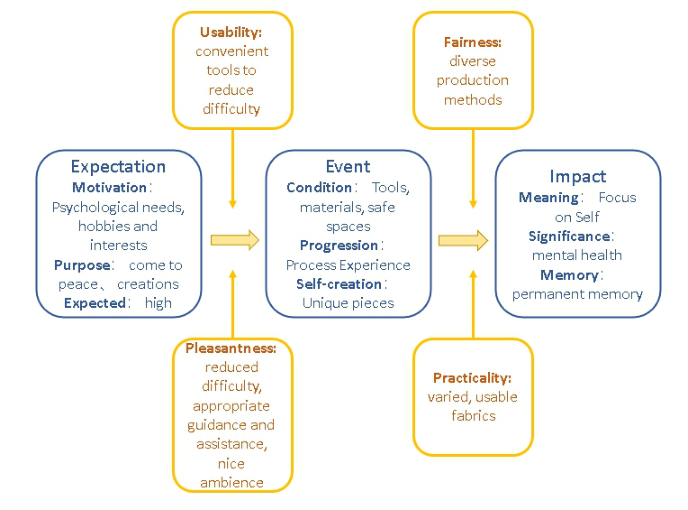
We started from what users do, think and feel when they participate in the tie-dye process, and adjusted it based on Xin Xiangyang’s EEI model. The user experiences design principles proposed by Norman include usability, fairness, pleasure, and practicality. The tie-dye healing experience is more prominent in terms of usability and practicality than art healing methods like music and painting. In terms of usability, we will make it somewhat less difficult to make and provide convenient tools. In terms of fairness, we consider the differences in user groups and offer a variety of tie-dyeing methods to ensure that they can be practiced regardless of gender or age. For example, rubber bands are used to wrap fabric instead of stitches. In
Designing the Healing Process of Natural Pattern Tie-Dyeing Based on User Experience 15
terms of pleasantness, t is very important to reduce the difficulty of operation, appropriate guidance and assistance, and create a good atmosphere. In terms of practicality, we provide users with a variety of usable fabric products as raw materials, including scarves, hats, hair bands, socks, clothes, scarves and so on. We combined the EEI model and Norman’s principles of user experience design to construct a basic distribution of requirements for the tie-dye healing experience, see Figure 1.
Figure 1: The EEI model and norman’s principles of tie-dye healing experience.
TARGETING USERS AND ACQUIRING DEMAND User Groups for Tie-Dye Healing Experience
Tie-dye healing experience design starts from “healing” and “experience” respectively (Unger & Chandler, 2023), and utilizes good experience to achieve a certain degree of healing effect. Its main target groups are: urban population living with chronic stress and anxiety, including office workers and students, people who have difficulty in concentrating and are always agitated, handicraft enthusiasts and children who like to do handicrafts. These four groups of people were the ones from whom samples were taken for interviews and surveys in this study.
We took a sample of 40 people from the target population, including 10 office workers, 10 school students, 15 patients suffering from emotional problems, and 5 handicraft enthusiasts. By inviting them to participate in semi-structured interviews, we succeeded in obtaining their needs for tie-dye experiences. In terms of the materials needed for the tie-dye process, we
16 Li and Guo
compiled the tools and materials used in the traditional tie-dye process of the Bai people and tracked down tie-dye craft enthusiasts on the Internet to analyze the tools and materials they use. Regarding the environment and guidance, we researched the Bai Tie-Dye Experience in Dali, Yunnan Province, China; the Pottery Experience in Jingdezhen, Jiangxi Province, China; and the Sound Healing Experience in Beijing, China. Through our research, we have summarized several environmental requirements that contribute to the healing experience. All the requirements obtained through interviews, research, and analysis were divided into three categories: tools and materials, tutorials and instruction, and environment and furnishings. A total of 22 requirements can be seen in Table 2.
Table 1: Summary of tie-dye healing experience process requirements.
Table available in the original PDF paper.
Tools and Materials Tutorials and Guides Environment and Furnishings Plant and other dyes B1 On-site demonstration C1 Light-colored interiors E1 Variety of fabrics B2 Video Tutorials C2 Good light E2 Threaded needle B3 Graphic sign C3 Soft music E3 Multi-sized rubber
User Requirements Classification Based on Kano Model The study has a multitude of needs acquired through interviews and research. However, space, funds, and service personnel are limited when building a tie-dye healing experience process. Meanwhile, in the above experience design model, user expectation is a very important part, and the importance of each function should correspond to the user’s needs. To enhance user satisfaction with the tie-dye experience within a limited scope, we need to analyze and categorize the above requirements according to the user’s psychological expectations. Therefore, we introduced the Kano model to analyze and evaluate the above requirements.
The Kano Model is a quality management tool developed by Japanese quality scientist Noriaki Kano, hence the name “Kano Model”. The Kano Model identifies the importance of different types of requirements and helps designers prioritize product functions and features. By applying the Kano model, design teams can better satisfy user expectations to improve user experience and satisfaction. Therefore, the characteristics of Kano model are consistent with the needs of user experience design and emotional design. According to the Kano evaluation criteria, we classify requirements into five categories: must-have (M), expected (O), attractive (A), undifferentiated (I),
Designing the Healing Process of Natural Pattern Tie-Dyeing Based on User Experience 17
reverse (R), and another category of questionable results (Q). Their detailed meanings are shown in Table 2.
Table 2: Explanation of types of user requirements.
Table available in the original PDF paper.
Type of Needs Explanation Must-have (M) These are basic requirements that are taken for granted by users. Users will not be satisfied if these requirements are not met but meeting them does not necessarily lead to increased users’ satisfaction. One-dimensional
(O)
These are requirements that are directly proportional to users’ satisfaction. Users are more satisfied when these requirements are met to a higher level. Attractive (A) These are unexpected features that delight users when present, but their absence does not necessarily lead to dissatisfaction. Indifferent (I) These are features that do not significantly affect users’ satisfaction. Reverse (R) These are features that, if present, decrease customer satisfaction. Questionable (Q) Refers to a question that the respondent did not understand or answered incorrectly.
Based on the design principles of the Kano q1uestionnaire, we created the Kano two-way questionnaire for tie-dye healing experience, to analyze the above needs positively and negatively respectively. Examples can be found in Table 3. The data collected by the questionnaire will be calculated by using the formula to obtain the DA, DO, DM, DI, DR
of the demand indicators. The formula is as follows: DA = A A + O + M + I + R DO = O A + O + M + I + R
Equation reproduced from the original PDF.
In the above equations: “A” is the percentage of Attractive, “O” is the percentage of Expected, “M” is the percentage of Must-have, “I” is the percentage of Non-differentiated, and “R” is the percentage of Reversed. After calculating the values of DA, DO, DM, DI, and DR for each demand, the maximum value can be used to determine the Kano attribute of the demand indicator.
In this session, a sample of 40 target group members were selected to participate in a Kano questionnaire about the tie-dye experience. To ensure the validity of the results, we explained to them in detail the specifics of each function and how to fill in the two-way questionnaire. And after obtaining the data from the questionnaire, we interviewed the users about some of the salient values. After obtaining their reasons for filling out the questionnaire in this way, this was used to further fulfill the users’ expectations. The final requirement data and its types can be seen in Table 4.
18 Li and Guo
Table 3. KANO two-way questionnaire.
Table available in the original PDF paper.
If Yes, Your Attitude (Positive Question)
Tie-Dye Experience Requirements
If Not, Your Attitude Is (Negative Question)
Satisfied
Satisfied
Tolerable
Tolerable
Should be
Should be
Not matter
Not matter
Dissatisfied
Dissatisfied
B1 B2 B3 B4 B5 ...
Table 4: Types of tie-dye healing experience design needs.
By applying the Kano model, we were able to identify the specific attributes of the 22 needs. There were 8 Musts (M), 4 Expectations (O), 10 Attractions (A), and no Reversals (R), No Differences (I), or Questionable Outcomes (Q). Combining Tables 1 and 4, we find that the Essential needs are concentrated in Tools & Materials and Tutorials & Instruction. Charismatic needs are
Designing the Healing Process of Natural Pattern Tie-Dyeing Based on User Experience 19
focused on the environment and furnishings, while aspirational needs are scattered among the three types. In the return phase, for the smoked E5 and the ornamental pet E7, a small number of users indicated that they did not like the smell. We therefore made E5 and E7 optional in the UX process. Combined with the data derived from analyzing Kano’s model and user returns, essential needs and desired needs are the backbone of the process of designing the tie-dye experience. And charismatic needs help to enhance users’ sensory experience and emotional experience.
DESIGNING A TIE-DYE HEALING EXPERIENCE PROCESS Simplify the Traditional Tie-Dye Process
The traditional tie-dye process of the Bai people is complicated and time- consuming. Therefore, we need to simplify the traditional process steps, shorten the production time and reduce the difficulty at the same time, so that the tie-dye experience process can meet the fairness requirements of the experience design (Wen et al., 2022). Traditional tie-dye is divided into four segments: making the dye, tying the flowers, dyeing the cloth, and drying the cloth. The dye-making process includes collecting the root of the bluebell, cutting it, soaking it, fermenting it, filtering it, adding lime powder to re-ferment it, and mixing it with the dye. Tying session includes drawing auxiliary lines, folding, tying or sewing. Fabric dyeing includes soaking, dehydrating, dip-dyeing, soaking and oxidizing, and second dip-dyeing. Drying session includes rinsing, dehydrating, air drying.
In the pre-preparation stages, we need to prepare plant dyes and purchase various cloths and fabrics in advance. However, according to the analysis of Kano users’ needs, it can be concluded that making plant dyes is also an important experience to get in touch with nature. It belongs to the attractive requirements and most of the users don’t want to miss it. So, we keep the experience of making dyes and prepare the tools such as slate, sealing bucket and filter for the users. In the mid-making stages, we reduce the difficulty of tying the flowers with the help of rubber bands and shorten the time by applying the method of steaming the cloth instead of soaking the fabric. In the later stages, users can choose natural air drying or opt for a fan or dryer to shorten the waiting time and obtain their work quickly.
Extracting Natural Patterns and Tying Methods There have been cases where nature design has been proven to be beneficial to people’s emotional stability (Chulvi et al., 2020). To further liberate users from the depressing city life for a while, we need to build better experiential spaces with the help of natural patterns. By organizing the existing tie-dye patterns, the study extracted five natural patterns that are suitable for novices to try. We have also included six simple natural patterns because they are easier to tie and are suitable to be used for novices to learn the tie-dye process. These six natural patterns are derived from nature, such as mountains, water, fish, sun, and flowers. The tying methods and post-dyeing patterns for these eleven patterns are organized in Table 5.
20 Li and Guo
Table 5: Patterns for tie-dye healing experiences.
Table available in the original PDF paper.
The Process of Tying the Fabric
Dyed Patterns Description of the Tie Fabric
1. Long sections: fold the fabric like a staircase, followed by tying the fabric in sections with a rubber band.
2. Center segmentation: pinch the center point of the fabric and lift it up and tie the fabric tightly with a rubber band in segments.
3. Random kneading: knead the fabric randomly into a ball, followed by tying the fabric tightly with a rubber band.
4. Kapok: First fold the fabric in half, followed by folding each of the two parts in reverse. Fold a triangle from one end and fold along the triangle front and back in turn. Wrap the three corners with a rubber band.
5. Rotate: pinch a point of the fabric to rotate it, then tighten the fabric with a leather strap.
Continued
Designing the Healing Process of Natural Pattern Tie-Dyeing Based on User Experience 21
Table 5: Continued The Process of Tying the Fabric
Table available in the original PDF paper.
Dyed Patterns Description of the Tie Fabric
6. Cloud pattern: Grab the fabric starting from the edge and incrementally and evenly grab the remaining fabric. Tie the fabric evenly with a thin string or rubber band. 7. diagonal stripes: start folding from one corner of the fabric, fold the fabric into a long narrow strip, and tie the center part of the fabric with a sacrifice.
8. Fish scales: Wrap the fabric tightly around a metal chopstick, then squeeze the fabric along the chopstick to wrinkle it, finally tie the ends of the fabric with a thin rope.
9. Water wave: Wrap the fabric at an angle around a 2-cm diameter tube and subsequently tie the fabric tightly with a spiral of fine cord. Compress the fabric along the tube and tie it again with fine cord.
10. Clip dyeing: fold the fabric back and forth up and down, fold it into a square, clip the fabric with a wooden piece, and then tie the fabric with a rubber band.
Continued
22 Li and Guo
Table 5: Continued The Process of Tying the Fabric
Table available in the original PDF paper.
Dyed Patterns Description of the Tie Fabric
11. Eight-petal flower: Fold the fabric in half once, then twice, and finally multiple times at an angle. Tie the fabric with a thin string around the circle and then use multiple rubber bands to tie the fabric at intervals.
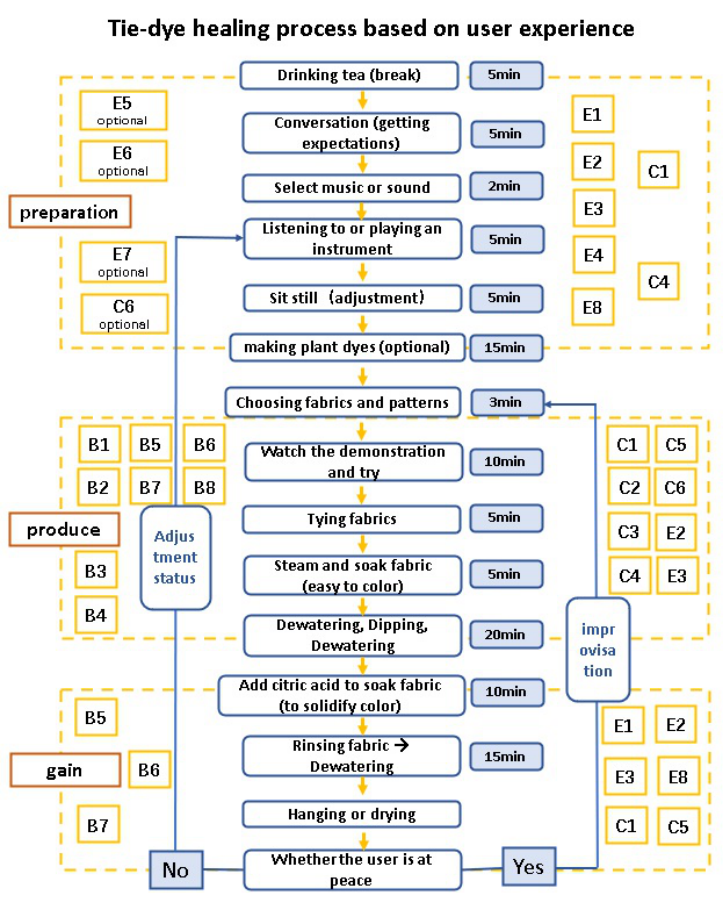
Tie-Dye Process Design Based on User Needs Synthesize the above information and combine it with the EEI model to translate the information into a tie-dye experience process. The entire process has been divided into three parts: preparation, production, and harvest. The specifics of the three parts can be viewed in Figure 2. The picture also shows where each of the design requirements above plays a major role in the process.
The promising part of the EEI model is mainly laid out in the preparation phase. In the preparation section, we set up a room with a differentiation from the urban style. In addition to natural decorations, we added elements such as ethnic clothing, candles, and pets to isolate the stressful atmosphere of the city with the ambiance of the space. To help users calm down, we introduced a part of sound healing, such as meditation, mantle, hand dish, and ambient sound. At the same time, using the theory of emotional contagion (Barsade et al., 2018), three volunteers who were in good psychological condition and emotionally calm were allowed to read, tie-dye or paint quietly in the room. During the time the user is drinking tea, the user’s expectations can be accessed as a means of adjusting the subsequent demonstration and teaching. During this step, the user can independently choose whether to wear ethnic clothing, use incense, or pet an emotionally soothing pet. Once the user has adjusted their state, they can choose to participate in the making of the plant dyes or go straight to the making of the session. The events and impacts in the EEI model are focused on the production phase. We provide users with eight types of fabric that can be tie-dyed: scarves, silk scarves, hats, socks, t-shirts, tote bags, ponchos, and placemats. This gives users more choices, while enhancing the usability of tie-dyed pieces and prolonging their attention to the tie-dyed pieces, resulting in more memories. According to the Impact link in the EEI model, retaining a long memory of a piece helps to increase its sense of importance and meaning to the user. Tying is the most complex step in the whole process. Considering the varying social skills of users, we provide a variety of tutorials to help users learn how to tie fabrics, such as instructional videos, step-by-step signage, and tutorial manuals, to ensure that users who don’t want to communicate with each other can complete the tying steps independently to the greatest extent possible. After the production is completed, we will assess whether
Designing the Healing Process of Natural Pattern Tie-Dyeing Based on User Experience 23
the user is calm or not based on the user’s heart rate, respiratory rate, and user feelings; if no, the user will return to the preparation stage to meditate and strike the instrument, if yes, the user can continue to select fabric and patterns for production or create their own tie-dye patterns. At the end of the experience, users can take away their tie-dye creations and homemade jars of vegetable dyes or, leave the creations and dyes at the experience for display or use.
Figure 2: Tie-dye healing process based on user experience.
24 Li and Guo
EVALUATION AND CONCLUSION After completing the design of the tie-dye healing experience process, we built the experiment according to the standard and invited 10 target users to experience it. They included 5 students, 3 office workers, 1 craft enthusiast and 1 experience design expert. Each user had 2 to 3 hours of experience, during which we observed and photographed and recorded their state before and after the experience and analyzed them in comparison with their descriptions. The results showed that 8 users calmed down after the experience, and 7 users were able to focus on their creations in the second tie-dye session.
In follow-up user interviews, two users who were unable to calm down expressed discomfort at being subjected to eye contact during the production process. Three users who had difficulty concentrating raised similar issues and additionally mentioned that concerns about the quality of the finished product made them nervous. To refine the user experience, eye contact and work pressure are issues we need to improve further. Therefore, we further refined the step of talking to capture user expectations in the preparation phase. We added small paper questionnaires that users could choose to use to express expectations with conversation or fill out the questionnaire to express expectations. This step helped us identify users who avoided eye contact and were pressured to produce work. For users who avoid eye contact, we will try to create a separate space that belongs to the user and allow the volunteer responsible for the emotional infection to leave. For users who are pressurized with their work, we allow them to skip the step of choosing a pattern and let them create freely after explaining the process of making tie-dye.
All summed up, this set of natural pattern tie-dye healing experience process has a certain effect on calming the user’s mood and enhancing the user’s attention. However, there is still room for improvement in terms of space arrangement, cost saving, and user state analysis. We hope that the design of this experience process can inject new vitality into traditional culture while healing anxiety and expand the ways and possibilities of art healing.
REFERENCES
Barsade, S. G., Coutifaris, C. G., & Pillemer, J. (2018). Emotional contagion in organizational life. Research in Organizational Behavior, 38, 137–151. Brancatisano, O., Baird, A., & Thompson, W. F. (2020). Why is music therapeutic for
neurological disorders? The Therapeutic Music Capacities Model. Neuroscience & Biobehavioral Reviews, 112, 600–615. Chulvi, V., Agost, M. J., Felip, F., & Gual, J. (2020). Natural elements in the designer’s work environment influence the creativity of their results. Journal of Building Engineering, 28, 101033. Dunphy, K., Federman, D., Fischman, D., Gray, A., Puxeddu, V., Zhou, T. Y., &
Dumaresq, E. (2021). Dance therapy today: An overview of the profession and its practice around the world. Creative Arts in Education and Therapy (CAET), 158–186.
Designing the Healing Process of Natural Pattern Tie-Dyeing Based on User Experience 25
Fariyanto, F., Suaidah, S., & Ulum, F. (2021). Perancangan aplikasi pemilihan kepala desa dengan metode ux design thinking (Studi kasus: kampung kuripan). Jurnal Teknologi Dan Sistem Informasi, 2(2), 52–60. Goodwin, R. D., Weinberger, A. H., Kim, J. H., Wu, M., & Galea, S. (2020). Trends
in anxiety among adults in the United States, 2008–2018: Rapid increases among young adults. Journal of psychiatric research, 130, 441–446. Graf, B., & Antoni, C. H. (2023). Drowning in the flood of information: A metaanalysis on the relation between information overload, behaviour, experience, and health and moderating factors. European Journal of Work and Organizational Psychology, 32(2), 173–198. Hassenzahl, M. (2013). User experience and experience design. The encyclopedia of
human-computer interaction, 2, 1–14. Hickman, C. (2020). We need to (find a way to) talk about… Eco-anxiety. Journal of Social Work Practice, 34(4), 411–424. Insel, T. (2022). Healing: Our path from mental illness to mental health. Penguin. Karale, A. (2021). The challenges of IoT addressing security, ethics, privacy, and
laws. Internet of Things, 15, 100420. Kim, Y., Wang, Q., & Roh, T. (2021). Do information and service quality affect perceived privacy protection, satisfaction, and loyalty? Evidence from a Chinese O2O-based mobile shopping application. Telematics and informatics, 56, 101483. Kohrt, B. A., Ottman, K., Panter-Brick, C., Konner, M., & Patel, V. (2020). Why we
heal: The evolution of psychological healing and implications for global mental health. Clinical Psychology Review, 82, 101920. Le Lagadec, D., Kornhaber, R., Johnston-Devin, C., & Cleary, M. (2024). Healing Stitches: A Scoping Review on the Impact of Needlecraft on Mental Health and Well-Being. Issues in Mental Health Nursing, 1–14. Li, T., Sun, M., & Wu, S. (2022). State-of-the-art review of electrospun gelatin-based
nanofiber dressings for wound healing applications. Nanomaterials, 12(5), 784. Malchiodi, C. A. (2020). Trauma and expressive arts therapy: Brain, body, and imagination in the healing process. Guilford Publications. Mei, S., Hu, Y., Wu, X., Cao, R., Kong, Y., Zhang, L., Lin, X., Liu, Q., Hu, Y., &
Li, L. (2023). Health risks of mobile phone addiction among college students in China. International Journal of Mental Health and Addiction, 21(4), 2650–2665. Neuhofer, B., Celuch, K., & To, T. L. (2020). Experience design and the dimensions of transformative festival experiences. International Journal of Contemporary Hospitality Management, 32(9), 2881–2901. Palumbo, R. (2020). Let me go to the office! An investigation into the side effects of
working from home on work-life balance. International Journal of Public Sector Management, 33(6/7), 771–790. Pöllänen, S. H., & Weissmann-Hanski, M. K. (2020). Hand-made well-being: Textile crafts as a source of eudaimonic well-being. Journal of Leisure Research, 51(3), 348–365. Schmidt, M., & Huang, R. (2022). Defining learning experience design: Voices from
the field of learning design & technology. TechTrends, 66(2), 141–158. Stankovi´c, M., Neši´c, M., ˇCiˇcevi´c, S., & Shi, Z. (2021). Association of smartphone use with depression, anxiety, stress, sleep quality, and internet addiction. Empirical evidence from a smartphone application. Personality and individual differences, 168, 110342. Sun, P., Feng, X., Tian, G., Zhang, X., & Chu, J. (2022). Ultrafast self-healing
superhydrophobic surface for underwater drag reduction. Langmuir, 38(35), 10875–10885.
26 Li and Guo
Tubbs, C., & Drake, M. (2024). Crafts and creative media in therapy. Taylor & Francis. Unger, R., & Chandler, C. (2023). A Project Guide to UX Design: For user experience
designers in the field or in the making. New Riders. Vimalkumar, M., Sharma, S. K., Singh, J. B., & Dwivedi, Y. K. (2021). ‘Okay google, what about my privacy?’: User’s privacy perceptions and acceptance of voice based digital assistants. Computers in Human Behavior, 120, 106763. Wei, F., Vijayakumar, P., Kumar, N., Zhang, R., & Cheng, Q. (2020). Privacy-
preserving implicit authentication protocol using cosine similarity for Internet of Things. IEEE Internet of Things Journal, 8(7), 5599–5606. Wen, J., Lu, X., Jiang, M., & Shao, X. (2022). [Retracted] Creativity of Nanofiber Materials and Application in the Expressive Power of Manual Tie-Dyeing Process. Advances in Materials Science and Engineering, 2022(1), 9339362. 辛向阳. (2019). 从用户体验到体验设计. 包装工程, 40(08), 60–67. https://doi.org/
10.19554/j.cnki.1001–3563.2019.08.010
LISTED IN THE AHFE DIGITAL BOOKSTORE CATALOGUE
Explore the complete digital volume
Usability and User Experience
Read this individual research paper free through the original publisher, or explore the full digital proceedings book.
ISBN 978-1-964867-70-0
Explore this ISBN in the AHFE Bookstore ↗Listed in the July 2026 bookstore catalogue; search by ISBN to confirm current availability · Digital book purchase optional