Xinbei Gong, Hualan Gou (2025). Human Machine Interface Design for Intelligent Vehicle Systems. In: Intelligent Human Systems Integration (IHSI 2025): Integrating People and Intelligent Systems. AHFE Open Access, vol. 160, pp. 603–608. https://doi.org/10.54941/ahfe1005866
With the advancement of technology, advanced technologies such as big data, internet and artificial intelligence have been applied to the automotive industry, and the importance of human-computer interaction interface in automotive design has become more and more prominent. In retrospect, traditional automobiles were mainly regarded as tools for traveling, and the interaction between drivers and automobiles was mostly limited to basic vehicle control. However, the needs of modern drivers have become more diversified, and human-computer interface design nowadays has a direct impact on driving safety and overall experience. Based on the driver's perspective, this paper provides an in-depth discussion on human-machine interface design and analyzes the major problems currently encountered by drivers in using intelligent vehicles, including complex interfaces, untimely or inaccurate information transfer, etc. By studying the driver's behavioral habits, psychological needs and special requirements in driving scenarios. Combined with the relevant theories of ergonomics, design psychology and other disciplines, this paper explores how to enhance the driver's user experience through more intelligent and humanized interaction interface design, help users obtain driving information more quickly and accurately, and meet the driver's needs for future automotive human-computer interaction.
In the process of doing automobile design, in which the human-computer interaction interface is the interface system for information exchange and operation between the driver and the vehicle, which supports the communication between the driver and the vehicle. Human-computer interaction interface plays a crucial role in automobile design, which directly affects the driver’s driving experience and safety. Common human-computer interaction interfaces mainly include display screens, control buttons, voice recognition systems, gesture recognition systems and driver assistance systems. Through the combination of human-computer interaction interface, it can bring drivers a more intelligent and convenient user experience.
In fact, users who choose to buy a car will mainly pay attention to the convenience, humanization and interactive experience of the car’s functions. With the rapid development of science and technology, the driver’s
expectation of vehicle interaction experience is also increasing. At the same time, under the development of technology, emerging interaction technologies also make more possibilities for automobile driving interface interaction methods1.
Currently, the human-computer interaction interface design of many intelligent vehicles is too complex and combines too many functions, which makes drivers feel more confused or difficult to understand in the process of using them. During the driving process, the interface sometimes displays too much information, including some unnecessary information, which may distract the driver’s attention during the driving process. Secondly, most of the cars in some interface design there are some unreasonable color matching or unclear icon instructions will lead to the interface of the aesthetics and effectiveness of the information.
HUMAN-COMPUTER INTERACTION The concept of interaction design was proposed by the British designer Bill Moggridge in 1984, in addition to Don Norman’s design theory also proposed different levels of design goals product interaction design strategy. Common human-computer interactions in automobiles are touch-screen interaction (TI), vebal interaction (VI), gesture interaction (GI) and system- initiative interaction (SI). According to Don Norman’s interaction design theory, automobile interaction should satisfy convenience, simplicity and interactivity.
Currently, vision is the main mode of information interaction during driving, and most of the driving information is presented visually, while auditory and haptic senses are generally used to remind drivers of the information they need to focus on. In “Intelligent Vehicle Human-Computer Interaction Interface Analysis”, the future automotive hmi design will tend to be multi-channel sensory integration, specifically combining visual, auditory, and tactile multi-sensory interactions, so as to provide drivers with a more comfortable and intelligent user experience.
LITERATURE REVIEW
In this study, the case study method in qualitative analysis is used to explore, revealing the existing problems in the design of automotive human- computer interaction interfaces, finding the pain points, and fully applying the theoretical research to this topic to guide the relevant design.
METHODOLOGY
In this study, the case study method of qualitative analysis is adopted to explore, reveal the problems existing in the current automotive human- computer interaction interface design, find the pain points, and fully apply the theoretical research to this topic to guide the relevant design. Through the study of the current mainstream brands of automotive human- computer interaction interface, we analyze and summarize its advantages and disadvantages, and put forward the optimization design points.
Human Machine Interface Design for Intelligent Vehicle Systems 605
DISCUSSION
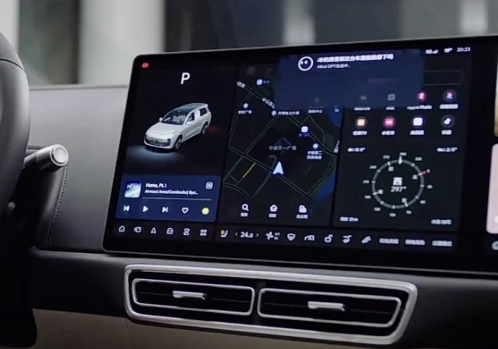
Many interfaces designed on the market at present add a lot of complicated functions, for the interface to present cumbersome and complex information to a certain extent will affect the driver in the use of the efficiency and increase the danger. For example, the interface design of Ideal Car (see Figure 1) has some room for optimization. The font size of the buttons at the bottom of the screen is small, and it is difficult for drivers to quickly recognize these buttons during driving, which may lead to inconvenient operation. At the same time, the interface layout lacks rationality, and some frequently used functions are hidden in the secondary menu, which increases the complexity of switching operations for drivers and is not conducive to improving operational efficiency. Therefore, the interface design should be more intuitive and simple to reduce the cognitive burden on drivers and ensure safe driving. When optimizing the design, it is especially necessary to pay attention to the size of the buttons, the distribution of functions, and the reasonableness of the hierarchical menu to ensure that drivers can operate easily and quickly.
Figure 1: Ideal car interface, from the web.
RESULT
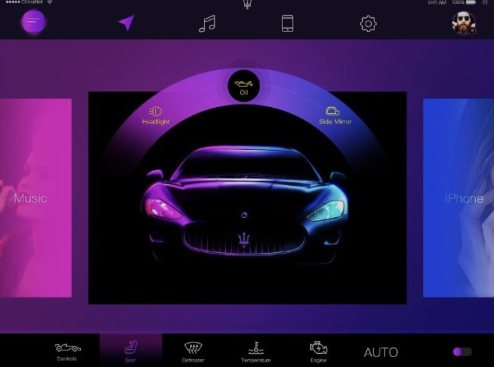
Color In order to bring drivers a better user experience, the color aspect is one of the very important elements, contemporary American visual arts psychologist Carolyn Brummer said “Color evokes a variety of emotions, expresses feelings, and even affects our normal physiological feelings.” In the driving process, drivers need to understand the dynamics of other vehicles, signals, road obstacles, etc., which is directly related to the activities of the environment, and has a direct impact on driving safety, but human attention is limited, sometimes due to the interface of the color is too prominent to cause the driver habitually shift their eyes on the screen (Figure 2). This can
606 Xinbei and Hualan
distract the driver’s attention from the road and traffic conditions, leading to a reduced sensitivity to the visual psychology in the forward field of view.
Figure 2: From the web.
User Experience The simplicity of the interface layout and the clarity of information expression in automobile HMI affect the user’s driving experience. Nowadays, most of the information interface designs in the HMI of major automobile brands emphasize the artistic expression of the interface, ignoring the convenience of the users. Therefore, in terms of user experience, first of all, the interface elements should be streamlined to avoid the driver being affected by the complexity of the interface information, and the designers should design the interface in such a way that the users can quickly find the information and functions they need. Secondly, clear layout and easy to understand icons should be used, and finally, clear interaction logic should be designed so that drivers can complete the operation naturally without thinking too much on the way, and clear guidelines and hints should be provided to guide the users to complete the operation and reduce the users’ incorrect operation and confusion. Therefore, as designers, it is very important to be able to effectively present complex information through design, so that users can access the information more easily.4 Therefore, at the user experience level, we need to sort out and layer complex information, and transmit it to the user through a reasonable interactive interface layout and effective interaction methods.
Personalization When targeting different groups of people, there should be appropriate models. For example, when facing the group of the elderly, large fonts, large icons and simplified symbols should be used in the visual elements to improve the driving experience of the elderly. Meanwhile, when targeting
Human Machine Interface Design for Intelligent Vehicle Systems 607
users of different genders, users can be allowed to customize the interface layout, color and theme, etc. At the same time, the user’s habits, such as frequently used functions and operations, etc., should be recorded in order to provide users with personalized recommendations and suggestions in subsequent interactions. Finally, it is necessary to collect users’ feedback for data analysis, which can be done by providing feedback channels and user surveys to understand users’ needs and expectations, and continuously optimize the personalization function in order to adjust and improve the personalization nature strategy in a timely manner.
Safety David Strayer (June, 2003) points out that visual/manual distractions may cause distractions, e.g., when a driver takes his/her eyes off the road to interact with a device, attention is diverted from the processing of information required for the safe operation of the vehicle, leading to cognitive distractions and, consequently, to safety hazards. According to Koutouriotis [7, the effects of different types of distraction tasks on driving performance remain unclear. To this end, the effects of driver distraction on eye movements, speed control and steering performance may be influenced by environmental factors (e.g., road curvature) as well as by other vehicles, as verified by a relevant experimental design. Therefore, the consequences of such interactions should be considered when evaluating the impact of in- vehicle tasks on road safety to more accurately determine the risks posed by driver distraction. At the same time, more detailed experiments and studies can provide directions for improving the design of future human-machine interfaces, thus reducing driver distraction behavior and improving driving safety.
CONCLUSION
Through multi-dimensional exploration and discussion, this research paper reveals the importance of intelligent vehicle human-machine interface design in enhancing user experience and driving safety, and provides a theoretical basis and practical reference for future interface design.
ACKNOWLEDGMENT
I am deeply grateful to my family and friends for their constant support and encouragement. Lastly, thanks to everyone who offered assistance during my research.
REFERENCES
Bloomer C M. Principles of Visual Perception [J]. D. van Nostrand Reinhold, 1976. Jianan, L., & Abas, A. (2020). Development of human-computer interactive interface for intelligent automotive. International Journal of Artificial Intelligence, 7(2), 13–21.
608 Xinbei and Hualan
Liu Xue, SHI Tiancong, YU Zhengtao. Analysis of human-computer interaction interface for intelligent vehicles [J]. Automotive Utility Technology, 2021, 046(010): 34–36. Norman D. A. Living with Complexity [M]. US: The MIT Press, 2010. Schmidt A, Dey A K, Kun A L, et al. Automotive user inter-faces: Human computer
interaction in the car[C]//28th Annual CHI Conference on Human Factors in Computing Systems, Atlanta, 2010: 3177–3180. Wu Kan, Hu Xinyuan, Men Longlong. Exploration of human-machine interactive interface design for driverless electric vehicles [J]. Hunan Packaging, 2021(3):100–104, 132. Strayer D L. Is the technology in your car driving you to distraction? [J]. Policy insights from the behavioral and brain sciences, 2015, 2(1): 157–165. Yang, Z., Zeng, J., Huang, X., & Lu, Y. (2022, June). Research on manmachine interface design based on intelligent vehicle. In International Conference on Human-Computer Interaction (pp. 276–285). Cham: Springer International Publishing.
LISTED IN THE AHFE DIGITAL BOOKSTORE CATALOGUE
Explore the complete digital volume
Intelligent Human Systems Integration (IHSI 2025): Integrating People and Intelligent Systems
Read this individual research paper free through the original publisher, or explore the full digital proceedings book.
ISBN 978-1-964867-36-6
Explore this ISBN in the AHFE Bookstore ↗Listed in the July 2026 bookstore catalogue; search by ISBN to confirm current availability · Digital book purchase optional