Jihyeon Kim, Chajoong Kim (2025). The effect of multi-sensory physical experiences in daily emotional self-tracking service for emotion self-awareness. In: Human Factors in Design, Engineering, and Computing. AHFE Open Access, vol. 199, pp. 29–39. https://doi.org/10.54941/ahfe1006815
This study examines the impact of physical interaction on reminiscing by developing a system comprising a physically interactive product and a digital app that visualizes collected data. It compares their effectiveness with mood trackers lacking physical elements. Reflection enhances social connections, strengthens family ties, and improves mental health. Though diaries aid emotion regulation, modern users prefer the convenience of mood-tracking apps. The study suggests that incorporating physical interaction enriches the reminiscence experience. It introduces "Reblower," inspired by Korean hand air blowers, which activates through handle-turning, allows users to place emotion-representative objects inside, and visualizes input via a mobile app. User surveys indicate that memories linked to physical interaction are more impactful. This research aims to guide future reflective product designs.
A recent study of 29 countries found that half of the population experiences at least one mental illness in their lifetime, with depression being the most common (McGrath et al., 2023). However, many people tend to avoid seeking treatment. But even without necessarily receiving professional treatment, efforts to observe oneself and try to make changes can help with depression. Among these methods, emotional regulation and emotional self- awareness are also positive factors (Demichelis et al., 2023; Suveg et al., 2009). Emotional self-awareness (ESA) involves identifying and understanding one’s emotions (Lane & Schwartz, 1987). ESA positively impacts mental health, alleviates depression, and includes emotion regulation, which is crucial for life goals (Bakker et al., 2016; Suveg et al., 2009). Self-monitoring enhances ESA by tracking various aspects of life, including emotions and mood (Lupton, 2016; Feng et al., 2021). Mood tracking, often done via mobile apps, improves self-awareness, self-reflection, and emotion regulation by linking emotions to other factors like diet and sleep. Prior research suggests multi-sensory elements enhance user experience (Campenhout et al., 2013)
and body movement aids emotion regulation (Long et al., 2021; Reimann et al., 2012). This study explores how multi-sensory experiences can amplify mood tracking benefits.
LITERATURE STUDY Emotional Self-Awareness (ESA)
Emotional awareness, a component of emotional intelligence (Salovey & Mayer, 1989), is the ability to recognize, understand, and express one’s own and others’ emotions (Lane & Schwartz, 1987). It involves identifying emotions, understanding their causes and effects, and regulating them adaptively. This is important for mental health and well-being. Emotional self-awareness (ESA) plays a key role in enhancing emotional intelligence and achieving social and emotional success. ESA is crucial for mental well- being, as it enhances emotional self-regulation (Barrett et al., 2001). Low ESA is linked to anxiety and depression, so improving ESA can help alleviate symptoms (Bakker & Rickard, 2018; Suveg et al., 2009).
Self-tracking improves mental health by increasing ESA (Kauer et al., 2012; O’Toole et al., 2014) and is effective in addressing anxiety, depression, and PTSD (Basoglu et al., 1992; Jarrett & Nelson, 1987; Ehlers et al., 2003). Apps using self-monitoring have been shown to boost ESA and reduce depressive symptoms (Morris et al., 2010; Kauer et al., 2012).
Mobile Mood Tracking Application Self-tracking in mental health involves monitoring symptoms or general emotional states (Schueller et al., 2021). Mobile mood tracking apps typically allow users to select emojis, words, or freely describe their mood.
Mood tracking supports emotional health, aiding conditions like bipolar disorder and depression (Nicholas et al., 2015). It enhances self-awareness and emotion regulation (Church et al., 2010; Gay et al., 2011).
Emotion Regulation Self-tracking can improve emotional awareness, which assists individuals in regulating their emotions and being aware of one’s own emotional states, and may reduce emotional activation by observing brain activity (Herwig et al., 2010). Emotion regulation is an attempt to influence when certain emotions are experienced by an individual and how these emotions are experienced and expressed (Gross et al., 2007). Emotion regulation involves (a) awareness and understanding of emotions, (b) acceptance of emotions, (c) the ability to control impulsive behavior and act on desired goals when experiencing negative emotions, and (d) the ability to use contextually appropriate emotion regulation strategies to modulate emotional responses to meet personal goals and situational needs (Gratz & Roemer, 2004).
Physical interaction involves using objects, gestures, and movements to engage with digital systems, enhancing user experience by combining physical
The Effect of Multi-Sensory Physical Experiences 31
and digital elements (Campenhout et al., 2013). This includes controls like buttons, sliders, and sensors that translate physical actions into digital commands. Products incorporating physical interaction tend to be more user-friendly, while digital-only applications may hinder engagement and usability.
Physical movement can also regulate emotions (Reimann, 2012), supported by research showing the link between body movement and emotional recall (Xu et al., 2017). Devices that facilitate physical interaction can help users relive memories and enhance engagement. For example, Tsai et al. (2014) found that digital images with physical materiality improve memory recall, and Petrelli et al. (2010) showed that FM radios, through auditory stimuli, fostered family interaction and easier access to past experiences.
Multi-Sensory Experience Interaction involves mutual influence, while experience results from observation and engagement (Oxford Dictionary, 2023). Product experience refers to psychological effects triggered by interaction (Hekkert & Schifferstein, 2007). Enhancing multi-sensory experiences strengthens user engagement (Lashkova et al., 2020) and facilitates richer product interactions (Schifferstein, 2011).
METHOD
Experimental Design This study examines the use and impact of Reblower, a multi-sensory emotion-tracking device. The experiment used an online survey with the Experimental Vignette Method (EVM) to minimize external influences. Participants with prior experience using emotion-tracking apps watched a video demonstrating Reblower, imagined using it, and provided subjective responses before and after the experience.
Experimental Materials Physical Prototype
Reblower is designed for emotion tracking in research, visually expressing emotions through colored lights. It features a reminder function that blinks lights at a set time to prompt users to record their emotions. When an emotional object is inserted, the objects-matching lighting changes color accordingly. Additionally, it plays ASMR trigger sounds to enhance immersion. Lastly, Reblower transmits emotional data to a mobile app for tracking and management. Reblower provides a multi-sensory experience through four key elements: 1) handle rotation (touch), 2) wood-burning sound during operation (hearing), 3) emotional object selection (touch, sight), and 4) light color change based on the object (sight) (see Table 1).
32 Kim and Kim
Table 1: Multi-sensory physical experience provided by Reblower.
Table available in the original PDF paper.
1) Handle Rotation (touch)
2) Wood-Burning Sound (hearing)
3) Emotional Object Selection (touch, Sight)
4) Light Color Change Based on the Object (sight)
Emotional Objects Emotional objects are key to using Reblower. These objects, which represent six basic emotions (anger, surprise, anxiety, disgust, happiness, and sadness) as defined by Ekman & Oster (1979), allow users to record emotions in the Reblower app. Research indicates that fewer choices lead to more efficient decisions (Torkamaan & Ziegler, 2020).
A workshop with four design graduate students aimed to enhance the empathy of these emotional objects. Participants were first introduced to sculptures expressing emotions (Isbister et al., 2006) and the six basic emotions. They then created objects reflecting these emotions and explained the reason behind their designs. The shapes and colors selected for each emotion were: red for anger, yellow for surprise, purple for disgust, indigo for anxiety, blue for sadness, and green for happiness. Insights from the workshop were analyzed using the affinity diagram method and discussed with additional design students. Table 2 shows the selected shapes and colors.
Table 2: Sample human systems integration test parameters (Folds et al., 2008).
Table available in the original PDF paper.
Type of Emotion Photo Type of Emotion Photo Afraid (Choking and twisted, or pinched) Disgust (Non-formal, with many protruding and twisted in parts)
Surprised (Disrupted and irregular shape)
Angry (Sea urchin shape - pointy tips spreading from the center)
Sadness (Slightly curved, but not rounded or twisted)
Happiness (Curved, smooth, simple outline, gentle partially protruding or compressed)
The Effect of Multi-Sensory Physical Experiences 33
Video Vignette The Experimental Vignette Method (EVM) is a research approach using vignettes to simulate user experiences. A vignette is ’a brief description combining features of a person, object, or situation’ (Atzmüller & Steiner, 2010). EVM is useful for testing products or systems that are difficult to implement due to technical or institutional constraints (Ringfort-Felner et al., 2022). It has been used to assess how people perceive events in virtual environments (Tromp & Hekkert, 2016) and is effective when experiments are hard to control or generalize (Aguinis & Bradley, 2014).
Given that daily emotion decisions can be unclear and influenced by various factors, EVM was chosen to gain meaningful results. Emotions can be significantly impacted by everyday elements like text messages or videos. To understand Reblower’s impact on emotions, participants were asked to imagine using the device and record emotional changes through vignettes.
Since everyday emotion decisions can be unclear, EVM was chosen to obtain meaningful results. Various life elements, like text messages or video clips, can significantly impact emotions. To understand Reblower’s effect, the survey asked participants to imagine using it and record emotional changes through video vignette. Initially, a third-person perspective video introduced Reblower, followed by a first-person perspective video to enhance immersion.
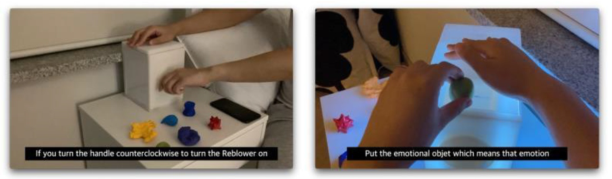
The third-person perspective video shows the Reblower in use: at the set time, its light flashes, prompting the user to turn the handle to activate it. They select an emotional object, place it inside, and the light changes to match the object’s color. The data is sent to a mobile app, and a notification confirms completion. After that, the user sees glowing lights and hears firewood burning. The first-person perspective video captures the user’s experience of daily emotional self-tracking (DEST), beginning with the blinking light notification, followed by activating Reblower, selecting an emotional object, and reflecting on their emotions while immersed in the soothing sensory elements. There are two screenshot images from the third- and first-person perspective video for example (Figure 1).
Figure 1: Screenshots of the third-person perspective (right) and of the first-person perspective (left).
Measurement Tools - Positive and Negative Affect Schedule (PANAS) To measure the experiment, we used The Positive and Negative Affect Schedule (PANAS). PANAS consists of 20 items that measure positive affect (PA) and negative affect (NA), and each emotion is rated on a five-point scale (Watson, Clark & Tellegen, 1988). The PANAS consists of 10 items for each
34 Kim and Kim
PA (e.g., interest, enthusiasm) and NA (e.g., anxiety, distress), with each total score range of 10 to 60.
In this study, the PANAS was used to analyze changes in emotions before and after using Reblower. Participants were asked to rate their emotions before and after watching a video of a Reblower to investigate whether their emotions changed.
Online Survey During the experiment, participants completed five surveys to assess their experience with Reblower, ESA, and emotional changes. Each survey measured the experience of using Reblower as an emotion tracking tool.
In the first survey, participants were introduced to the experiment, and their emotional state was assessed using the PANAS. They then learned to use Reblower and recorded their Daily Emotional Self-Tracking (DEST) experience with Reblower, followed by a PANAS survey to measure emotional changes before and after use.
Surveys two to five followed the same procedure: participants assessed their emotional state with PANAS, recorded their DEST experience imagining the use of Reblower, and completed PANAS again to track emotional changes.
Sample and Procedure This experiment involved participants familiar with the app to compare Reblower with existing mobile emotion tracking applications. Participants, aged in their 20s and 30s, were recruited voluntarily and through direct requests, resulting in data from six men and 13 women (average age: men 25.6, women 25.5 and overall 24.2). Over 10 days, they recorded their emotional state nightly at 9 p.m. via a survey link sent by text. The experiment was completed on a computer, and participants who finished all surveys were rewarded.
RESULTS
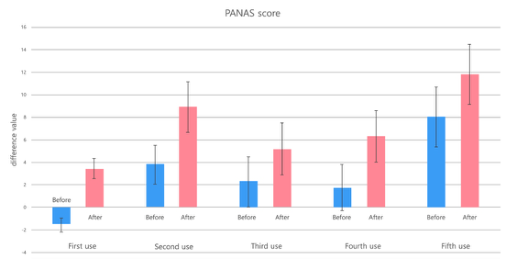
Positive and Negative Affect Schedule (PANAS) Score Change The average PANAS score generally increased after using Reblower (Figure 2), suggesting a positive emotional impact.
Figure 2: PANAS score average for each time of use (1st time ∼5th time).
The Effect of Multi-Sensory Physical Experiences 35
Multisensory Physical Experience Elements That Check Emotional States Every Day In the survey, participants evaluated how the device’s multisensory physical elements aided their daily emotional self-tracking (DEST). These elements included fire sounds, color-changing lights, a rotating handle, and emotional object selection. The hypothesis was that emotion regulation would be more effective with multisensory physical experiences, and results confirmed a positive impact. On a 1–5 scale, ‘spinning handle’ (3.7), ‘sound of operation’ (4), ‘emotional object selection’ (3.7), and ‘color-changing light’ (3.3) were all rated positively. Participants generally agreed that multisensory experiences benefited DEST.
The light color change received the lowest score, with 10 of 15 participants finding it helpful, while others felt the colors for negative emotions disrupted the room’s atmosphere. The steering wheel interaction also scored low, as six participants didn’t use it, though nine reported it helped them focus on emotions.
Emotional object selection ranked second highest, with 12 participants finding it helpful and six strongly agreeing. It aided in visualizing emotions, though some felt a stronger connection could be formed by creating their own objects.
The sound of burning firewood was rated the most effective, with 15 participants saying it helped recall emotions and focus on DEST. This aligns with research on ASMR sounds reducing stress and enhancing emotional arousal (Ohta & Inagaki, 2021; McGeoch & Rouw, 2020).
DISCUSSIONS AND CONCLUSION The study explores how multi-sensory physical experiences affect daily emotion self-tracking (DEST), which enhances emotional self-awareness and regulation. Multi-sensory physical interaction engages users and improves their experience.
The study hypothesized that such experiences would enhance emotional awareness during DEST. A device called Reblower was designed for testing, and results showed a positive emotional impact after use, though no significant changes in self-reflection ability after five uses. Elements like “rotating handle,” “sound activation,” “emotion object selection,” and “color-changing light” positively influenced DEST, with sound activation being the most effective.
The study used video demonstrations to minimize external influences but lacked a physical device for direct interaction, limiting the assessment of tactile experiences. Future research with a larger participant pool and a comparison group without mood-tracking experience could improve the generalizability of results.
This study explored whether multisensory physical experiences positively impact emotion regulation. The PANAS scores increased, suggesting that elements like handle rotation, sound, emotional object selection, and color lighting improved emotion confirmation (DEST), with the sound of firewood burning rated as the most helpful.
36 Kim and Kim
Key design implications include integrating body movement-based emotion regulation, providing customized sounds for emotional support, and enhancing emotion recognition through color and object selection.
ACKNOWLEDGMENT
This work was supported by the Technology Innovation Program (20018357, Development of CMF design for user biological and environmental information reactive printed electronic chameleon sheet) funded By the Ministry of Trade, Industry & Energy (MOTIE, Korea).
REFERENCES
Aguinis, H., & Bradley, K. J. (2014). Best Practice Recommendations for Designing and Implementing Experimental Vignette Methodology Studies. Organizational Research Methods, 17(4), 351–371. https://doi.org/10.1177/ 1094428114547952/ASSET/IMAGES/LARGE/10.1177_1094428114547952- FIG2. JPEG. Atzmüller, C., & Steiner, P. M. (2010). Experimental Vignette Studies in Survey Research. Https://Doi. Org/10.1027/1614–2241/A000014, 6(3), 128–138. https://doi.org/10.1027/1614–2241/A000014. Barrett, L. F., Gross, J., Christensen, T. C., & Benvenuto, M. (2001). Knowing what you’re feeling and knowing what to do about it: Mapping the relation between emotion differentiation and emotion regulation. Cognition & Emotion, 15(6), 713–724. https://doi.org/10.1080/02699930143000239. Basoglu, M., Marks, I. M., & Sengun, S. (1992). A Prospective Study of Panic and
Anxiety in Agoraphobia with Panic Disorder. The British Journal of Psychiatry, 160(1), 57–64. https://doi.org/10.1192/BJP.160.1.57. Campenhout, L., Frens, J., Overbeeke, K., Standaert, A., & Peremans, H. (2013).
Physical Interaction in a Dematerialized World. International Journal of Design. http://www.ijdesign.org/index.php/IJDesign/article/view/1124/554. Church, K., Hoggan, E., & Oliver, N. (2010). A study of mobile mood awareness and communication through mobimood. NordiCHI 2010: Extending Boundaries - Proceedings of the 6th Nordic Conference on Human-Computer Interaction, 128–137. https://doi.org/10.1145/1868914.1868933. Demichelis, O. P., Grainger, S. A., Hubbard, R. E., & Henry, J. D. (2023). Emotion
regulation mediates the relationship between social frailty and stress, anxiety, and depression. Scientific Reports 2023 13:1, 13(1), 1–8. https://doi.org/10.1038/ s41598–023-33749–0. Ehlers, A., Clark, D. M., Hackmann, A., McManus, F., Fennell, M., Herbert, C., & Mayou, R. (2003). A Randomized Controlled Trial of Cognitive Therapy, a Self- help Booklet, and Repeated Assessments as Early Interventions for Posttraumatic Stress Disorder. Archives of General Psychiatry, 60(10), 1024–1032. https:// doi.org/10.1001/ARCHPSYC.60.10.1024. Ekman, P., & Oster, H. (1979). Facial Expressions of Emotion. In Ann. Rev. Psychol.
J 979 (Vol. 30). www.annualreviews.org. Feng, S., Mäntymäki, M., Dhir, A., & Salmela, H. (2021). How Self-tracking and the Quantified Self Promote Health and Well-being: Systematic Review. J Med Internet Res 2021;23(9): E25171 Https://Www. Jmir. Org/2021/9/E25171, 23(9), e25171. https://doi.org/10.2196/25171.
The Effect of Multi-Sensory Physical Experiences 37
Gay, G., Pollak, J. P., Adams, P., & Leonard, J. P. (2011). Pilot Study of Aurora, a Social, Mobile-Phone-Based Emotion Sharing and Recording System. Https://Doi. Org/10.1177/193229681100500219, 5(2), 325–332. https://doi.org/ 10.1177/193229681100500219. Gratz, K. L., & Roemer, L. (2004). Multidimensional Assessment of Emotion
Regulation and Dysregulation: Development, Factor Structure, and Initial Validation of the Difficulties in Emotion Regulation Scale. Journal of Psychopathology and Behavioral Assessment, 26(1), 41–54. https://doi.org/ 10.1023/B: JOBA.0000007455.08539.94/METRICS. Gross, J. J., Richards, J. M., & John, O. P. (2007). Emotion Regulation in Everyday Life. Emotion Regulation in Couples and Families: Pathways to Dysfunction and Health., 13–35. https://doi.org/10.1037/11468–001. Hekkert, P., & Schifferstein, H. N. J. (2007). Introducing product experience. Product
Experience, 1–8. https://doi.org/10.1016/B978–008045089-6.50003–4. Herwig, U., Kaffenberger, T., Jäncke, L., & Brühl, A. B.(2010). Self-related awareness and emotion regulation. NeuroImage, 50(2), 734–741. https://doi.org/10.1016/ J. NEUROIMAGE.2009.12.089. Isbister, K., Höök, K., Laaksolahti, J., & Sharp, M. (2007). The sensual
evaluation instrument: Developing a trans-cultural self-report measure of affect. International Journal of Human-Computer Studies, 65(4), 315–328. https:// doi.org/10.1016/J. IJHCS.2006.11.017. Isbister, K., Höök, K., Sharp, M., & Laaksolahti, J. (2006). The sensual evaluation instrument. 1163–1172. https://doi.org/10.1145/1124772.1124946. Jarrett, R. B., & Nelson, R. O. (1987). Mechanisms of change in cognitive therapy
of depression. Behavior Therapy, 18(3), 227–241. https://doi.org/10.1016/ S0005–7894(87)80017–5. Kauer, S. D., Reid, S. C., Crooke, A. H. D., Khor, A., Hearps, S. J. C., Jorm, A. F., Sanci, L., & Patton, G. (2012). Self-monitoring Using Mobile Phones in the Early Stages of Adolescent Depression: Randomized Controlled Trial. J Med Internet Res 2012;14(3): E67 Https://Www. Jmir. Org/2012/3/E67, 14(3), e1858. https:// doi.org/10.2196/JMIR.1858. Lane, R. D., & Schwartz, G. E. (1987). Levels of Emotional Awareness: A
Cognitive-Developmental Theory and Its Application to Psychopathology. In Am J Psychiatry (Vol. 144, Issue 2). Lashkova, M., Antón, C., & Camarero, C. (2020). Dual effect of sensory experience: engagement vs diversive exploration. International Journal of Retail and Distribution Management, 48(2), 128–151. https://doi.org/10.1108/IJRDM- 09–2018-0204. Long, Z., Liu, G., Xiao, Z., & Gao, P. (2021). Improvement of Emotional Response
to Negative Stimulations With Moderate-Intensity Physical Exercise. Frontiers in Psychology, 12, 656598. https://doi.org/10.3389/FPSYG.2021.656598. McGeoch, P. D., & Rouw, R. (2020). How everyday sounds can trigger strong emotions: ASMR, misophonia and the feeling of wellbeing. BioEssays, 42(12), 2000099. https://doi.org/10.1002/BIES.202000099. McGrath, J. J., Al-Hamzawi, A., Alonso, J., Altwaijri, Y., Andrade, L. H.,
Bromet, E. J., Bruffaerts, R., de Almeida, J. M. C., Chardoul, S., Chiu, W. T., Degenhardt, L., Demler, O. V., Ferry, F., Gureje, O., Haro, J. M., Karam, E. G., Karam, G., Khaled, S. M., Kovess-Masfety, V., … Zaslavsky, A. M. (2023). Age of onset and cumulative risk of mental disorders: a cross-national analysis of population surveys from 29 countries. The Lancet Psychiatry, 10(9), 668–681. https://doi.org/10.1016/S2215–0366(23)00193–1.
38 Kim and Kim
Morris, M. E., Kathawala, Q., Leen, T. K., Gorenstein, E. E., Guilak, F., Labhard, M., & Deleeuw, W. (2010). Mobile Therapy: Case Study Evaluations of a Cell Phone Application for Emotional Self-Awareness. J Med Internet Res 2010;12(2): E10 Https://Www. Jmir. Org/2010/2/E10, 12(2), e1371. https://doi.org/10.2196/ JMIR.1371. Nicholas, J., Larsen, M. E., Proudfoot, J., & Christensen, H. (2015). Mobile Apps
for Bipolar Disorder: A Systematic Review of Features and Content Quality. J Med Internet Res 2015;17(8): E198 Https://Www. Jmir. Org/2015/8/E198, 17(8), e4581. https://doi.org/10.2196/JMIR.4581. O’Toole, M. S., Jensen, M. B., Fentz, H. N., Zachariae, R., & Hougaard, E. (2014).
Emotion differentiation and emotion regulation in high and low socially anxious individuals: An experience-sampling study. Cognitive Therapy and Research, 38(4), 428–438. https://doi.org/10.1007/s10608–014-9611–2. Ohta, Y., & Inagaki, K. (2021). Evaluation of the effect of ASMR on reduction of mental stress: EEG study. LifeTech 2021–2021 IEEE 3rd Global Conference on Life Sciences and Technologies, 88–89. https://doi.org/10.1109/ LIFETECH52111.2021.9391945. Oxford English Dictionary, s.v. “experience (n.),” July 2023, https://doi.org/10.1093/ OED/5485237439. Oxford English Dictionary, s.v. “interaction (n.),”July 2023, https://doi.org/10.1093/
OED/6216900333. Petrelli, D., Villar, N., Kalnikaite, V., Dib, L., & Whittaker, S. (2010). FM radio: Family interplay with sonic mementos. Conference on Human Factors in Computing Systems - Proceedings, 4, 2371–2380. https://doi.org/10.1145/ 1753326.1753683. Reimann, M., Feye, W., Malter, A. J., Ackerman, J. M., Castaño, R., Garg, N.,
Kreuzbauer, R., Labroo, A. A., Lee, A. Y., Morrin, M., Nenkov, G. Y., Nielsen, J. H., Perez, M., Pol, G., Rosa, J. A., Yoon, C., & Zhong, C. B. (2012). Embodiment in judgment and choice. Journal of Neuroscience, Psychology, and Economics, 5(2), 104–123. https://doi.org/10.1037/a0026855. Ringfort-Felner, R., Laschke, M., Sadeghian, S., & Hassenzahl, M. (2022). Kiro.
Proceedings of the ACM on Human-Computer Interaction, 6(GROUP). https:// doi.org/10.1145/3492852. Salovey, Peter., & Mayer, J. D. (1989). Emotional intelligence. Educational Leadership, 58(3), 14–18. https://doi.org/10.2190/dugg-p24e-52wk-6cdg. Schifferstein, H. N. J. (2011). Multi sensory design. Proceedings of the DESIRE’11
Conference on Creativity and Innovation in Design, 361–362. https://doi.org/ 10.1145/2079216.2079270. Schueller, S. M., Neary, M., Lai, J., & Epstein, D. A. (2021). Understanding People’s Use of and Perspectives on Mood-Tracking Apps: Interview Study. JMIR Ment Health 2021;8(8): E29368 Https://Mental. Jmir. Org/2021/8/E29368, 8(8), e29368. https://doi.org/10.2196/29368. Suveg, C., Hoffman, B., Zeman, J. L., & Thomassin, K. (2009). Common and specific
emotion-related predictors of anxious and depressive symptoms in youth. Child Psychiatry and Human Development, 40(2), 223–239. https://doi.org/10.1007/ s10578–008-0121-x. Tromp, N., & Hekkert, P. (2016). Assessing methods for effect-driven design: Evaluation of a social design method. Design Studies, 43, 24–47. https://doi.org/ 10.1016/J. DESTUD.2015.12.002.
The Effect of Multi-Sensory Physical Experiences 39
Tsai, W. C., Wang, P. H., Lee, H. C., Liang, R. H., & Hsu, J. Y. J. (2014). The Reflexive Printer: Toward making sense of perceived drawbacks in technology- mediated reminiscence. Proceedings of the Conference on Designing Interactive Systems: Processes, Practices, Methods, and Techniques, DIS, 995–1004. https:// doi.org/10.1145/2598510.2598589. Watson, D., Clark, L. A., & Tellegen, A. (1988). Development and Validation of
Brief Measures of Positive and Negative Affect: The PANAS Scales. Journal of Personality and Social Psychology, 54(6), 1063–1070. https://doi.org/10.1037/ 0022–3514.54.6.1063. Xu, Y., Hubener, I., Seipp, A. K., Ohly, S., & David, K. (2017). From the lab to the real-world: An investigation on the influence of human movement on Emotion Recognition using physiological signals. 2017 IEEE International Conference on Pervasive Computing and Communications Workshops, PerCom Workshops 2017, 345–350. https://doi.org/10.1109/PERCOMW.2017.7917586.
LISTED IN THE AHFE DIGITAL BOOKSTORE CATALOGUE
Explore the complete digital volume
Human Factors in Design, Engineering, and Computing
Read this individual research paper free through the original publisher, or explore the full digital proceedings book.
ISBN 978-1-964867-75-5
Explore this ISBN in the AHFE Bookstore ↗Listed in the July 2026 bookstore catalogue; search by ISBN to confirm current availability · Digital book purchase optional