Junjie Zhang, Jiayu Hua, Yifan Zhang (2026). Venting & Fidgeting Stress-Relief Toys: A Pilot Study on Positive Emotion Triggering and Stress-Relief Stability. In: Affective and Pleasurable Design. AHFE Open Access, vol. 204, pp. 272–281. https://doi.org/10.54941/ahfe1007353
Emotional well-being (EWB) is closely associated with physical health and daily functioning; however, economic growth and income increases do not necessarily translate into improvements in EWB. As everyday emotion regulation artifacts, stress-relief toys are widely used to support self-regulation through physical interaction, yet the emotional effects of different behavioral toy types remain insufficiently understood. This pilot study comparatively examines the emotion regulation effects of venting and fidgeting stress-relief toys, with a focus on positive emotion elicitation and stress-reduction stability. A mixed-methods approach was employed, integrating the Self-Assessment Manikin (SAM), the Product Emotion Measurement Instrument (PrEMO), subjective evaluations, and statistical analysis. Thirty-six university students evaluated six stress-relief toys (three venting-type and three fidgeting-type) using a Latin square design to control for order effects. The results reveal a clear dual contrast between the two toy types. Venting stress-relief toys are associated with stronger positive emotion elicitation and higher user preference, but their stress-reduction effectiveness is highly sensitive to design conditions. In contrast, fidgeting stress-relief toys demonstrate stable and robust stress reduction through attentional diversion, despite eliciting comparatively weaker positive emotions. Building on these findings, this study interprets the observed differences through response-focused emotion regulation mechanisms and proposes differentiated design guidelines for venting and fidgeting stress-relief toys. Given the relatively small and homogeneous sample, the findings should be interpreted as exploratory; nevertheless, the proposed guidelines offer practical human-centered design insights for balancing emotional appeal and stress-reduction stability, contributing to the scientific design of emotion-regulation products.
In recent years, stress-relief toys have gained increasing popularity online, with a continuous influx of new designs and varieties entering the market. Concurrently, a growing number of social media influencers specializing in stress-relief toy reviews have become prominent and well recognized. This prevalence reflects a rising demand for emotional well-being (EWB) in daily life. Today, the global economy is growing steadily, and higher incomes have improved people’s life evaluations; however, they do not necessarily Received February 5, 2026; Revised April 1, 2026; Accepted April 18, 2026; Available online July 20, 2026
Venting & Fidgeting Stress-Relief Toys 273 foster greater EWB (Kahneman & Deaton, 2010). EWB is defined as a collective term for psychological constructs such as life satisfaction, life purpose, and positive emotions (Feller et al., 2018). Studies have shown that positive emotions can accelerate the recovery of stress-related physiological indicators, such as heart rate and blood pressure, and significantly improve individuals’ work efficiency, creativity, and interpersonal relationship quality (Fredrickson & Levenson, 1998; Lyubomirsky, King, et al., 2005).
Emotions can be regulated, and stress-relief toys represent the productization of emotion regulation tools. Within the process model of emotion regulation, strategies are classified as antecedent-focused or response-focused (Gross, 1998). Antecedent-focused strategies target the causes of emotions, whereas response-focused strategies are applied after emotional response tendencies emerge. Because it is difficult for product design to intervene at the antecedent stage, stress-relief toys primarily operate through response-focused emotion regulation. Positive behaviors are known to elicit positive emotions and enhance emotional well-being (EWB); activities such as expressing gratitude, engaging in meaningful social interactions, and practicing mindfulness meditation have been shown to strengthen positive emotions, increase happiness, and improve coping abilities (Fredrickson et al., 2008; Lyubomirsky, Sheldon, et al., 2005) Stress- relief toys facilitate self-emotion regulation through physical manipulation and immediate feedback. Randomized controlled trials have identified stress balls as non-pharmacological stress-relief interventions during clinical procedures, demonstrating reductions in anxiety and pain perception (Şahan et al., 2025; Yüksel & Güneş, 2024). Similarly, fidget toys are recognized as self-regulation tools for alleviating anxiety and restlessness among adolescent and pediatric populations (Liu, 2025). Together, these findings support the efficacy of stress-relief toys as adjunctive non-pharmacological interventions for emotion regulation. Market-available stress-relief toys are commonly categorized into venting and fidgeting types (Ma, 2019). Venting behaviors function as bodily protective responses to high-arousal emotions such as anger, fear, and tension (Aragón et al., 2015), whereas fidgeting behaviors involve aimless movements elicited by exposure to irrelevant stimuli and serve to distract attention and reduce anxiety (Mehrabian & Friedman, 1986; Rotz & Wright, 2005). Accordingly, venting stress-relief toys discharge intense negative emotions through forceful manipulation, while fidgeting stress-relief toys alleviate tension by diverting attention through repetitive fine motor movements.
While existing research has confirmed the effectiveness of stress-relief toys in emotion regulation, the specific mechanisms through which different behavioral types of toys and their usage patterns influence emotions remain unclear. Accordingly, this study addresses the following research questions: RQ1. How do different behavioral types of stress-relief toys differ in their
effects on positive emotion elicitation and stress reduction? RQ2. What design guidelines can enhance the emotion regulation effectiveness of different behavioral types of stress-relief toys?
Unlike previous studies that merely validate efficacy, this research extends to the product design level. By integrating differences in efficacy and influencing factors between the two toy types, it addresses the limitations of venting and fidgeting stress-relief toys through the proposal of actionable design improvement guidelines. This approach bridges the gap between efficacy validation and design implementation, providing empirical support and practical pathways for the scientific design of emotion regulation products.
The current study is limited by inadequate sampling, such as small sample sizes and narrow population coverage. Future studies should expand the sample scope, diversify sample characteristics, verify the generalizability of the findings, and explore differences in user needs across populations to provide more precise support for product design optimization.
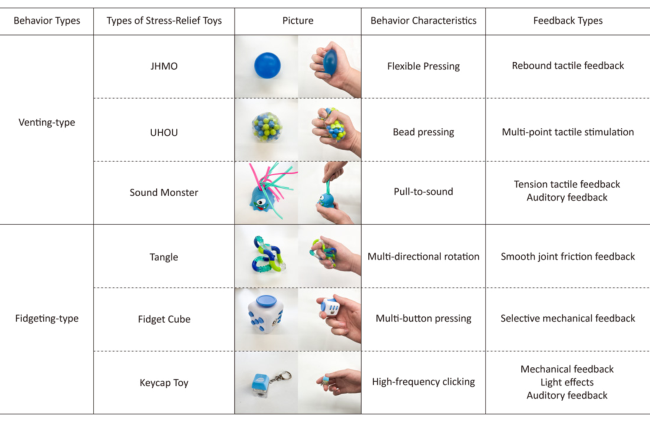
EXPERIMENTAL STRESS-RELIEF TOY SAMPLE SELECTION To verify the practical efficacy of venting and fidgeting stress-relief toys in positive emotion elicitation and stress reduction, this study selected six toys for the experiment, with three representative samples in each category. Venting stress-relief toys were required to support destructive manipulation, whereas fidgeting stress-relief toys were designed for repetitive fine motor movements. All toys featured differentiated designs in form, material, or function to provide diverse sensory feedback, thereby laying a foundation for subsequent design-level analysis. Notably, a uniform color scheme was applied to all experimental toys to minimize potential interference from color, ensuring a more precise assessment of the effects of different design elements. During the experiment, participants repeatedly manipulated each toy within a specified timeframe. Their emotional states were observed, and their perceived emotional experiences were quantitatively measured.
Figure 1: Classification of 6 experimental stress-relief toy types.
EXPERIMENTAL PARTICIPANT SELECTION Based on the power analysis results generated using G*Power software, this study recruited 36 university students aged 20–30 years. The participants, drawn from various provinces in China, had a balanced gender ratio of 1:1 (18 males and 18 females) and diverse academic backgrounds. This sampling strategy ensured geographical, gender, and disciplinary heterogeneity, minimizing the effects of sample homogeneity and providing demographic support for the internal validity of the findings.
EXPERIMENTAL PROCEDURE AND MEASUREMENT METHODS Each participant experienced all six stress-relief toys sequentially. A Latin square design was employed to counterbalance the presentation order, thereby eliminating order effects (Bradley, 1958). Participants manipulated each toy for a focused duration of 30 seconds. Following this structured interaction, they were allowed to explore the toy freely while completing the corresponding questionnaire, ensuring experimental continuity and capturing natural emotional states.
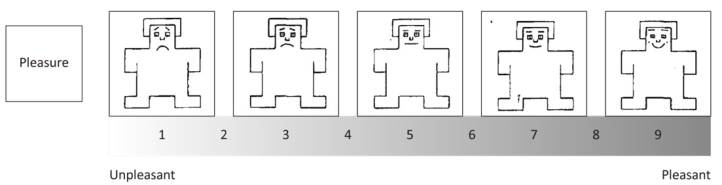
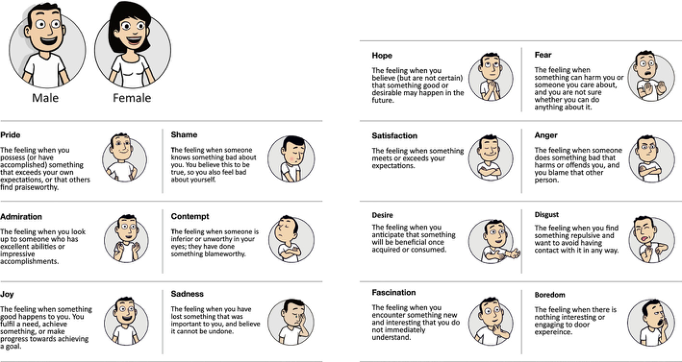
The research questionnaire integrated three dimensions: stress self- assessment, standardized scales, and subjective evaluation, providing comprehensive emotional data for subsequent analysis. Stress self-assessment (9-point scale) was administered before the experiment and after each toy trial; score differentials were used to quantify the stress-reduction efficacy of each toy type. The scale section combined the Self-Assessment Manikin (SAM) and the Product Emotion Measurement Instrument (PrEMO) for cross-validation. The SAM scale (9-point) focused on pleasure to quantify overall emotional states, while the PrEMO scale (7-point) assessed 14 discrete emotions to capture nuanced affective responses. In the subjective evaluation phase, participants ranked all toys after completing the full experience and provided justifications for their top-ranked (most preferred) and sixth-ranked (least preferred) choices, yielding user-centered insights to inform product design optimization.
Figure 2: The pleasure dimension of the SAM scale. (Bradley & Lang, 1994).Figure 3: The 14 emotions measured by the PrEMO scale. (Laurans & Desmet, 2017).
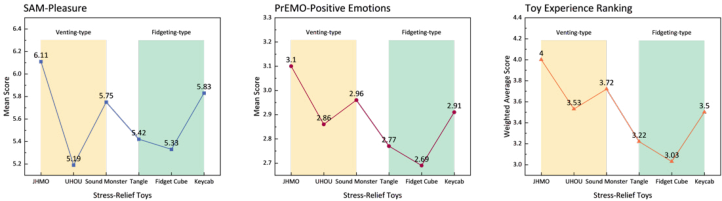
RESULTS: POSITIVE EMOTION ELICITATION EFFECTS Overall, triangulated evidence from the SAM pleasure scores (mean scores), PrEMO positive emotion ratings (mean scores across seven positive emotions), and toy experience rankings (weighted average scores) suggests that venting stress-relief toys tend to perform better than fidgeting stress- relief toys in positive emotion elicitation and user preference. Specifically, toy experience rankings were calculated using a weighted scoring method: Ranking Score = (Σ Frequency × Weight) / Number of Respondents,where higher weights were assigned to higher-ranked positions. Across all three measures, venting stress-relief toys—particularly JHMO and Sound Monster—showed a consistent advantage in positive emotional responses and experiential evaluations.
Figure 4: SAM - Pleasure, PrEMO - positive emotions, and toy experience ranking.
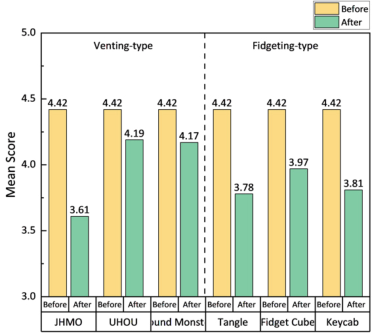
RESULTS: STRESS-RELIEF EFFECTIVENESS AND STABILITY DIFFERENCES Comparisons of pre- and post-experiment stress scores showed that all six stress-relief toys reduced stress to some extent. (Figure 5).
Paired-samples t-tests revealed clear differences in stress reduction efficacy and stability between toy types: among venting stress-relief toys,
Venting & Fidgeting Stress-Relief Toys 277 only JHMO produced a significant stress reduction (p < 0.001), whereas UHOU and Sound Monster showed non-significant effects, indicating unstable performance; in contrast, all three fidgeting stress-relief toys yielded significant stress reductions (all p < 0.05), demonstrating more stable stress- relief effects overall (Figure 6).
Figure 5: The changes in stress levels before and after using the stress-relief toy.Figure 6: Paired sample t-test for stress levels before and after using the stress-relief toy.
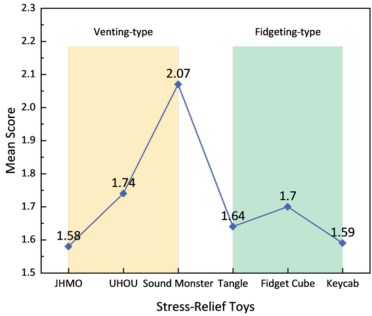
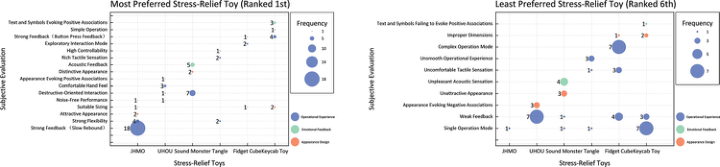
RESULTS: STRESS-RELIEF TOY DESIGN FACTOR EVALUATION This section examines user feedback on stress-relief toy design by integrating PrEMO negative emotion scores and participants’ ranking rationales. PrEMO results show that venting stress-relief toys exhibited significantly greater fluctuations in negative emotion scores than fidgeting stress-relief toys (Figure 7), indicating higher user sensitivity to their design details and stronger emotional impact. To further clarify this relationship, a coding-based qualitative analysis of participants’ subjective evaluations was conducted to explore the link between user preference and product design (Figure 8). The results indicate that both toy types received negative feedback related to design details during operation; however, design flaws in venting stress- relief toys directly triggered pronounced fluctuations in negative emotions, whereas fidgeting stress-relief toys showed relatively stable negative emotional responses. Overall, emotional feedback for venting stress-relief toys was strongly associated with design elements, while negative emotions related to fidgeting stress-relief toys were less sensitive to design differences.
Figure 7: PrEMO - Negative emotions.Figure 8: Evaluation of design factors for the most and least preferred stress-relief toys.
DUAL COMPARATIVE ANALYSIS OF EMOTION REGULATION EFFECTS BETWEEN TWO TYPES OF STRESS-RELIEF TOYS This study identifies a dual contrast in the emotion regulation profiles of venting and fidgeting stress-relief toys: venting stress-relief toys are associated with stronger positive emotion elicitation and higher user preference, yet their stress-reduction effectiveness is highly sensitive to design conditions, whereas fidgeting stress-relief toys, despite eliciting weaker positive emotions, exhibit more stable and robust stress-reduction outcomes. Rather than reflecting simple performance differences, this contrast highlights a fundamental divergence in response-focused emotion regulation mechanisms (Gross, 1998).
Venting stress-relief toys primarily operate through response modulation, a regulation strategy that directly intervenes in activated emotional states by altering their expressive intensity and experiential quality. This pathway enables the rapid discharge of high-arousal negative emotions and facilitates strong subjective engagement, which helps explain the heightened positive emotional responses and preferences often associated with venting stress- relief toys. However, response modulation requires continuous and well- aligned sensory intervention, making its regulatory effectiveness highly dependent on precise alignment between design features and users’ emotional needs. When feedback strength, material behavior, or sensory comfort fails to support this alignment, the continuity of emotional regulation is disrupted, resulting in a decoupling between positive emotion elicitation and actual
Venting & Fidgeting Stress-Relief Toys 279 stress reduction. This mechanism-level sensitivity explains the pronounced variability and design dependence observed in the stress-relief efficacy of venting stress-relief toys.
In contrast, fidgeting stress-relief toys rely on attentional deployment, an indirect response-focused regulation strategy that reduces emotional intensity by diverting attention away from stress-inducing stimuli. Through repetitive fine motor movements, these toys sustain attentional engagement and disengage users from negative emotional experiences, leading to more consistent stress reduction. Because attentional deployment primarily depends on the maintenance of attention rather than precise sensory matching, its effectiveness is less susceptible to individual design imperfections. As a result, fidgeting stress-relief toys demonstrate robust and stable stress-reduction effects even when their capacity to elicit positive emotions or subjective preference is comparatively limited.
Taken together, the fundamental difference between venting and fidgeting stress-relief toys lies in their mechanism sensitivity within the response- focused emotion regulation framework. Direct response modulation demands precise and continuous alignment between design parameters and emotional needs, whereas indirect attentional deployment achieves regulatory stability through sustained cognitive engagement. This theoretical distinction not only clarifies the contrasting emotional regulation profiles of the two behavioral toy types but also provides a principled foundation for their differentiated design optimization.
DESIGN GUIDELINES TO ENHANCE THE EMOTION REGULATION EFFECTIVENESS OF STRESS-RELIEF TOYS Based on empirical data and user evaluations, this study proposes a set of differentiated design guidelines tailored to the core characteristics of venting and fidgeting stress-relief toys. These guidelines aim to bridge the gap between emotional preference and stress reduction efficacy, providing general guidance for the scientific design of emotion-regulation products.
For venting stress-relief toys, which rely on response modulation, design should prioritize feedback effectiveness and mechanism alignment. Strong, controllable tactile or multisensory feedback is essential to support the discharge of high-arousal negative emotions. Materials and structures should be mechanically reliable and resistant to damage to ensure continuous emotional release during interaction. Emotion-adaptive design elements, such as cute or playful features that can trigger the “cute aggression” effect (Aragón et al., 2015), should be incorporated while carefully regulating feedback comfort to avoid disrupting stress reduction.
For fidgeting stress-relief toys, which operate through attentional deployment, design should focus on maintaining sustained attention with minimal cognitive load. Simple, repetitive fine motor interactions should be preserved as the core mechanism. Sensory richness can be enhanced through composite textures, subtle form variations, or differentiated buttons, provided that interaction complexity remains low. Incorporating positive emotion triggers that enhance pleasure and perceived control can
further improve user preference without compromising stress reduction stability.
Across both types, effective design should be grounded in a clear mapping between design parameters, sensory experience, and emotion regulation pathways. Aligning product features with their specific regulatory mechanisms enables stress-relief toys to move beyond basic functional efficacy toward more robust and experientially optimized emotion regulation outcomes.
CONCLUSION
This study employed a mixed-methods approach to compare the emotion regulation effects of venting and fidgeting stress-relief toys, focusing on positive emotion elicitation and stress-reduction stability. By integrating standardized emotion scales with subjective evaluations, the findings reveal a clear dual contrast between the two behavioral toy types. Venting stress-relief toys are associated with stronger positive emotional responses and higher user preference, yet their stress-reduction effectiveness is highly sensitive to design conditions. In contrast, fidgeting stress-relief toys demonstrate more stable and robust stress reduction through attentional diversion, despite eliciting comparatively weaker positive emotions.
From a theoretical perspective, this study advances understanding of stress-relief toys by distinguishing two response-focused emotion regulation pathways—response modulation and attentional deployment—and clarifying how these mechanisms differently shape emotional outcomes and design sensitivity. This mechanism-based interpretation extends existing empirical research by explaining not only whether stress-relief toys are effective, but why their effectiveness varies across behavioral types.
From a practical and human-centered design perspective, the proposed design guidelines translate these mechanism-level insights into actionable strategies for product optimization. By aligning design parameters with underlying emotion regulation pathways, designers can better balance emotional appeal and stress-reduction stability, thereby bridging the gap between affective preference and actual regulatory performance in stress- relief toys.
This study is limited by a relatively small and homogeneous sample, which may constrain the generalizability of the findings. Future research should expand participant diversity, incorporate advanced measurement techniques, and conduct longitudinal investigations to examine the persistence of emotion regulation effects, further supporting the scientific design of emotion- regulation products.
REFERENCES
Aragón, O. R., Clark, M. S., Dyer, R. L., & Bargh, J. A. (2015). Dimorphous expressions of positive emotion: Displays of both care and aggression in response to cute stimuli. Psychological Science, 26(3), 259–273. https://doi. org/10.1177/0956797614561044
Venting & Fidgeting Stress-Relief Toys 281 Bradley, J. V. (1958). Complete Counterbalancing of Immediate Sequential Effects in
a Latin Square Design. Journal of the American Statistical Association, 53(282), 525–528. https://doi.org/10.1080/01621459.1958.10501456 Bradley, M. M., & Lang, P. J. (1994). Measuring emotion: The self-assessment manikin and the semantic differential. Journal of Behavior Therapy and Experimental Psychiatry, 25(1), 49–59. https://doi.org/10.1016/0005-7916(94)90063-9 Feller, S. C., Castillo, E. G., Greenberg, J. M., Abascal, P., Van Horn, R., & Wells,
K. B. (2018). Emotional well-being and public health: Proposal for a model national initiative. Public Health Reports®, 133(2), 136–141. https://doi. org/10.1177/0033354918754540 Fredrickson, B. L., Cohn, M. A., Coffey, K. A., Pek, J., & Finkel, S. M. (2008).
Open hearts build lives: Positive emotions, induced through loving-kindness meditation, build consequential personal resources. Journal of Personality and Social Psychology, 95(5), 1045–1062. https://doi.org/10.1037/a0013262 Fredrickson, B. L., & Levenson, R. W. (1998). Positive emotions speed recovery from the cardiovascular sequelae of negative emotions. Cognition and Emotion, 12(2), 191–220. https://doi.org/10.1080/026999398379718 Gross, J. J. (1998). The Emerging Field of Emotion Regulation: An Integrative
Review. Review of General Psychology, 2(3), 271–299. (Sage CA: Los Angeles, CA). https://doi.org/10.1037/1089-2680.2.3.271 Kahneman, D., & Deaton, A. (2010). High income improves evaluation of life but not emotional well-being. Proceedings of the National Academy of Sciences, 107(38), 16489–16493. (world). https://doi.org/10.1073/pnas.1011492107 Laurans, G., & Desmet, P. M. A. (2017). Developing 14 animated characters for non-
verbal self-report of categorical emotions. Journal of Design Research, 15(3–4), 214–233. https://doi.org/10.1504/JDR.2017.089903 Liu, Y. (2025). The rise of sensory fidget toys: Origins, psychological principles, and their role in stress relief and mental health. SHS Web of Conferences, 213, 2027. https://doi.org/10.1051/shsconf/202521302027 Lyubomirsky, S., King, L., & Diener, E. (2005). The benefits of frequent positive
affect: Does happiness lead to success? Psychological Bulletin, 131(6), 803–855. https://doi.org/10.1037/0033-2909.131.6.803 Lyubomirsky, S., Sheldon, K. M., & Schkade, D. (2005). Pursuing happiness: The architecture of sustainable change. Review of General Psychology, 9(2), 111–131. https://doi.org/10.1037/1089-2680.9.2.111 Ma, J. (2019). Guidelines for designing stressful emotion relief toys for adults
[Master’s thesis, Auburn University]. (Auburn University ProQuest Dissertations & Theses). https://www.proquest.com/openview/fd7273ab81491b52ac59e132d4 e543c7/1?cbl=18750&diss=y&pq-origsite=gscholar Mehrabian, A., & Friedman, S. L. (1986). An analysis of fidgeting and associated individual differences. Journal of Personality, 54(2), 406–429. https://doi. org/10.1111/j.1467-6494.1986.tb00402.x Rotz, R., & Wright, S. D. (2005). Fidget to focus: Outwit your boredom–sensory
strategies for living with ADD. iUniverse. Şahan, S., Güler, S., Ceyhan, Y., & Özdemir, C. (2025). The effects of stress ball use on comfort and anxiety levels in hemodialysis patients: A randomized controlled trial. Mediterranean Nursing and Midwifery, 5(1), 47–52. https://doi.org/10.4274/ MNM.2024.24249 Yüksel, D., & Güneş, D. (2024). The effect of stress ball on anxiety and pain levels
in angiography: A randomized controlled trial. Cardiovascular Therapeutics, 2024(1). https://doi.org/10.1155/2024/5049092
LISTED IN THE AHFE DIGITAL BOOKSTORE CATALOGUE
Explore the complete digital volume
Affective and Pleasurable Design
Read this individual research paper free through the original publisher, or explore the full digital proceedings book.
ISBN 978-1-964867-80-9
Explore this ISBN in the AHFE Bookstore ↗Listed in the July 2026 bookstore catalogue; search by ISBN to confirm current availability · Digital book purchase optional