Meiqi Liu, Zhixian Zhu, Jie Chen, Yifan Zhang, Jiaqian Zhong, Yu Zhang (2026). Driver Takeover Performance under Different Driving Contexts and Non-Driving Tasks in Level 3 Automated Driving. In: Advances in Human Factors of Transportation. AHFE Open Access, vol. 224, pp. 341–350. https://doi.org/10.54941/ahfe1007862
In Level 3 (L3) automated driving, drivers may disengage from continuous control but must resume control when a takeover request (TOR) occurs. Drivers’ takeover readiness may be reduced by engagement in non-driving-related tasks (NDRTs), especially in more complex urban environments. However, limited evidence is available on how driving context and NDRT demand jointly affect takeover performance in L3 automation. To address this gap, we conducted a driving-simulator study with 18 licensed drivers using a 2 × 3 within-subject design that combined two driving contexts (highway and urban) and three NDRTs (music listening, entertainment video viewing, and news summarization). Takeover performance was evaluated using takeover reaction time (TRT), eye-tracking measures, heart rate variability (HRV), and subjective ratings of workload and situational awareness. Both driving context and NDRT demand affected takeover performance. Urban scenarios were associated with longer TRT, higher workload, and more dispersed visual attention than highway scenarios. Increasing NDRT demand was associated with poorer takeover performance, and news summarization produced the longest delays, greater off-road attention, slower gaze return after TOR, and reduced situational awareness. HRV measures further indicated higher physiological stress under high-demand NDRTs, particularly in urban conditions. These findings highlight the need for context-aware takeover support that accounts for both environmental complexity and NDRT demand.
INTRODUCTION & RELATED WORK In Level 3 (L3) automated driving, drivers are allowed to disengage from continuous vehicle control, but they remain responsible for resuming control when a takeover request (TOR) is issued. During automation, drivers often engage in non-driving-related tasks (NDRTs), which can reduce takeover readiness by diverting attention away from the roadway. Once a TOR occurs, drivers must rapidly reorient attention, rebuild situational awareness, and
execute control actions within a limited time window. This makes takeover performance a critical human-factors issue in conditional automation (Merat et al., 2014; Eriksson and Stanton, 2017; McDonald et al., 2019; Weaver and DeLucia, 2022).
A substantial body of research has shown that NDRTs can impair takeover performance by competing for visual, cognitive, and manual resources. Compared with low-demand tasks, more visually and cognitively demanding NDRTs are more likely to prolong takeover reaction time, disrupt gaze reallocation, and reduce takeover quality. Prior studies have further suggested that task characteristics such as modality, immersion, and cognitive demand influence not only how quickly drivers respond, but also how effectively they re-engage with the driving environment after TOR onset (Radlmayr et al., 2014; Naujoks et al., 2016; Gold et al. 2016; Jaussein et al., 2021; Liu et al., 2024). Takeover performance is also shaped by driving context. Compared with relatively structured highway scenarios, urban roads typically involve denser information, more potential conflict points, and greater perceptual uncertainty. Accordingly, the same NDRT may impose different takeover costs across driving environments. Existing studies have shown that traffic density, scenario complexity, and takeover lead time can significantly affect drivers’ visual scanning, reaction timing, and post-takeover stability, indicating that takeover should be understood as a context-sensitive process rather than a fixed response pattern (Zeeb et al., 2015; Petermeijer et al., 2017; Pipkorn et al., 2022; Zhang et al., 2019; Weaver and DeLucia, 2022).
To better explain the mechanisms underlying takeover behavior, recent studies have increasingly adopted multimodal measures, including behavioral, visual, physiological, and subjective indicators. Eye-tracking measures can reveal attentional disengagement from NDRTs and reallocation to roadway- relevant information, whereas HRV-related indicators provide an additional window into cognitive workload during automation and transition. However, limited evidence is available on how driving context and NDRT demand jointly shape takeover performance within one integrated framework. Therefore, this study examines takeover performance in L3 automated driving using a controlled driving-simulator experiment and multimodal measures. Specifically, we investigate how environmental complexity and task demand are associated with takeover timing, attention reorientation, workload, and perceived situational awareness (Broadbent et al., 2023; Hochgeschurz et al., 2021; Wu et al., 2021; Meteier et al., 2022; Lee et al., 2024).
METHOD
Study Design and Participants. We conducted a controlled driving-simulator experiment using a within-subject 2 × 3 factorial design. The independent variables were driving context (highway vs. urban roads) and NDRT type (listening to music, watching entertainment videos, and verbally summarizing news). A total of 18 licensed drivers were recruited, covering different genders, ages, and driving experience levels. All participants had basic experience with Level 2 automated driving. Each participant completed six takeover
Driver Takeover Performance Under Different Driving Contexts 343 trials (3 NDRTs × 2 contexts). To reduce order effects, the trial sequence was counterbalanced using a Latin-square scheme, and the experiment was conducted in two rounds.
Apparatus, Tasks, and Procedure. The experiment was conducted in a driving-simulator laboratory. Eye movements were recorded using wearable eye tracking, and ECG was collected for HRV analysis. After instructions and sensor calibration, participants completed six counterbalanced takeover trials, followed by post-trial questionnaires and a semi-structured interview.
Measures and Data Analysis. For reporting convenience, the six within- subject conditions are referred to as Highway-1 (music listening), Highway-2 (entertainment video viewing), Highway-3 (news/text reading with verbal summarization), Urban-1 (music listening), Urban-2 (entertainment video viewing), and Urban-3 (news/text reading with verbal summarization).
Takeover Reaction Time (TRT). TRT was defined as the interval from TOR onset to the first effective takeover response and was annotated from video recordings.
Eye Tracking. Eye-tracking measures included time to first fixation (TTFF) on roadway-related areas of interest (AOIs) after TOR onset, as well as fixation-based attention allocation within a predefined pre/post-TOR window. Trials with missing or invalid TTFF values were excluded.
HRV. ECG data were processed to obtain RR intervals and standard HRV indices (RMSSD, HF, LF/HF) for short-term workload assessment.
Subjective Measures and Interviews. Subjective workload, situational awareness, perceived safety, and interview feedback were collected after the trials.
Statistical Analysis. Primary outcomes, including TRT, eye-tracking metrics, HRV indices, and questionnaire scores, were analyzed using repeated- measures ANOVA in a 3 × 2 within-subject design.
RESULTS
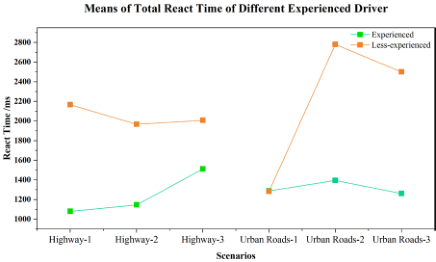
Takeover Reaction Time and Driving Experience Overall Trends in TRT. After excluding invalid data, descriptive analyses showed different TRT patterns across the two driving contexts (see Figure 1). In the highway condition, TRT increased progressively from Highway-1 to Highway-3. In the urban condition, TRT increased from Urban-1 to Urban-2 and then decreased slightly in Urban-3. Overall, highway scenarios showed a steady increase across task stages, whereas urban scenarios showed a peak at Stage 2.
Effect-size comparisons further suggested a clearer context effect on TRT than some pairwise differences among NDRTs (see Table 1). Urban conditions were associated with higher temporal cost than highway conditions, while text-based and video-based tasks generally produced longer TRT than music listening.
Effects of Driving Experience on TRT. Mean comparisons suggested a general advantage for more experienced drivers (see Figure 2). Except for Urban-1, the experienced group showed shorter TRT in five of the six conditions, with the difference appearing more pronounced under urban and
higher-demand task conditions. However, multiple outliers were excluded in Urban-1 and Highway-1, and the corresponding means should therefore be interpreted cautiously.
Figure 1: Overall trend of TRT across Highway 1–3 and Urban Roads 1–3. Conditions 1–3 denote music listening, entertainment video viewing, and news/text reading with verbal summarization, respectively.Table 1: Effect size comparison for takeover reaction time (Cohen’s dz; Driving context × NDRT).
NDRT Effect(Listening to Music – Reading Text) −0.501 12 NDRT Effect(Watching Video – Reading Text) −0.088 13
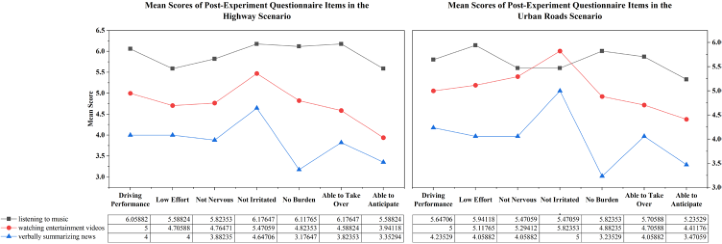
Subjective Ratings and Eye-Tracking Evidence Stage-wise Changes in Subjective Ratings (NASA-TLX/SA). Mean ratings on the NASA-TLX and situational awareness (SA) items suggested stage-wise differences across both highway and urban scenarios (see Figure 3). As task demand increased from music listening to entertainment video viewing and news browsing with verbal summarization, perceived driving and cognitive workload generally increased. A minor exception was observed for the “not irritated” item, where the ordering of the music and video stages differed between highway and urban scenarios.
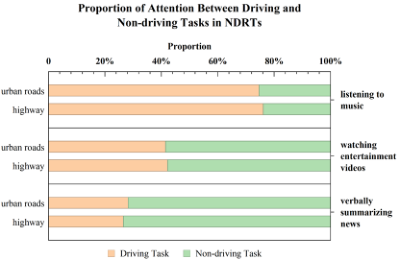
Attention Allocation Across Conditions. Attention allocation appeared to vary across contexts and NDRT types (see Figure 4). Higher-demand tasks were associated with a greater proportion of attention devoted to the NDRT interface and reduced roadway-oriented attention, especially in urban scenarios.
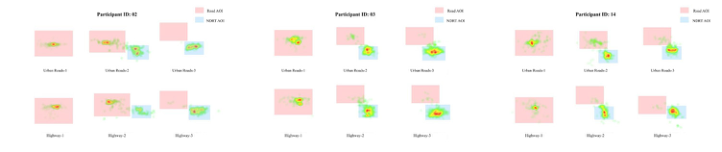
Illustrative Heatmap Comparison. Heatmaps from three representative participants provided qualitative support for the quantitative eye-tracking results (see Figure 5). Compared with music listening, video viewing and especially news summarization were associated with denser fixations on the NDRT interface, fewer roadway fixations, and slower visual return to the road after TOR onset.
Figure 3: Line chart of post-test questionnaire mean scores for highway and urban roads scenarios.Figure 4: Attention allocation proportions shown as a percentage stacked bar chart.Figure 5: Comparison of gaze heat maps for three participants, organized by task and scenario.
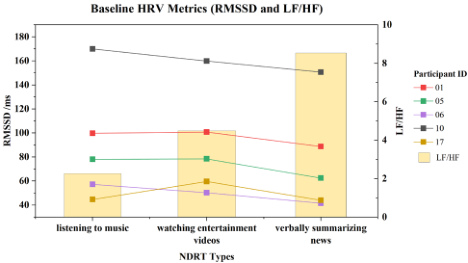
HRV and Interview Evidence Baseline HRV Results. HRV measures showed stage-dependent differences in RMSSD and LF/HF, consistent with task-related changes in physiological workload (see Figure 6). RMSSD was relatively higher during the music and video stages and decreased during the news summarization stage. In contrast, LF/HF peaked during news summarization, indicating higher physiological stress under this high-demand task.
Interview Findings. Interviews with 17 participants provided further qualitative support for the quantitative results. Participants generally perceived urban roads as more complex despite their lower speed, whereas highways were associated with higher speeds and potentially more severe consequences. Among the NDRTs, news retelling with verbal reporting was
consistently regarded as the most distracting task, while music listening was perceived as minimally disruptive. Trust in the automated system also varied with task demand: participants reported greater trust under low-distraction conditions and heightened vigilance when engaging in more demanding tasks. In addition, expectations for Level 3 automation focused more on comfort enhancement than on full replacement of driver control, with primary concerns centering on system reliability, distraction management, and more user-friendly interaction design.
Figure 6: Phase-wise comparison of baseline RMSSD and LF/HF.
DISCUSSION
Joint Effects of Driving Context and NDRT on Takeover Cost The findings indicate that both driving context and NDRT type were associated with differences in takeover performance. Compared with highway scenarios, urban roads were generally linked to longer takeover reaction time (TRT), higher perceived workload, and more dispersed visual attention. Across task stages, higher-demand NDRTs were associated with poorer takeover outcomes, with news summarization tending to be linked to the longest delay and the highest cognitive burden. Eye-tracking results further suggested that visually and cognitively demanding tasks reduced roadway-oriented attention and delayed gaze return after the takeover request (TOR), especially when participants were reading and verbally reporting news content.
These patterns can be interpreted in terms of attentional resource competition and task-switching cost. Urban roads require more frequent monitoring of traffic participants, signals, and potential conflict points, thereby increasing baseline perceptual and decision demands. When this environmental complexity is combined with a demanding NDRT, drivers must disengage from ongoing task processing, reallocate attention to the roadway, and rebuild situational awareness within a limited time window. This transition appears to be particularly difficult for news summarization, which combines visual intake, semantic processing, and verbal output. As a result, takeover becomes slower and more effortful than under low-demand tasks such as music listening.
Driver Takeover Performance Under Different Driving Contexts 347 HRV and interview findings provided converging support for this interpretation. Baseline HRV results showed a pattern consistent with higher physiological stress under high-demand NDRTs, particularly in the later task stage. Interview responses also indicated that participants regarded verbal reporting and news retelling as the most distracting task, whereas music listening was viewed as minimally disruptive. In addition, drivers with more experience tended to show faster takeover behavior under demanding conditions, suggesting that driving experience may partly buffer the negative effects of high cognitive load.
Design Implications These findings suggest three practical implications for L3 automated driving interface design. First, NDRT access should be managed in a context-sensitive manner, with more conservative task availability in complex urban scenarios. Second, takeover alerts should not only signal urgency but also facilitate rapid attentional redirection, especially when drivers are engaged in visually intensive tasks. Third, drivers with limited experience may require stronger takeover support under high-load conditions, such as clearer warnings or simplified task interruption guidance.
CONCLUSION, LIMITATIONS & FUTURE WORK This study showed that both driving context and NDRT type were associated with differences in takeover performance in L3 automated driving. Urban scenarios were generally associated with higher takeover cost than highway scenarios, while higher-demand NDRTs, especially news summarization, were linked to longer takeover reaction time, higher workload, greater attention reorientation difficulty, and poorer overall takeover outcomes. Converging evidence from effect-size comparisons, HRV trends, and interview feedback further supported the view that visually and cognitively demanding tasks increase takeover burden, particularly under more complex road environments.
Several limitations should be acknowledged. Effective sample sizes were reduced in some analyses after invalid-data exclusion, which may affect robustness. TRT was identified through manual video annotation, which may introduce measurement uncertainty. In addition, some eye-tracking interpretations were based on illustrative heatmaps from a small subset of participants and should therefore be treated as supportive rather than definitive evidence.
Future work should enlarge the sample, reduce invalid-data loss, and strengthen fully quantitative gaze analysis. It should also incorporate additional indicators of takeover quality beyond TRT. These improvements would support a more rigorous evaluation of context-sensitive and NDRT- aware takeover assistance strategies.
REFERENCES
Bazilinskyy, P., Petermeijer, S.M., Petrovych, V., Dodou, D. and de Winter, J.C.F.
(2018). Take-over requests in highly automated driving: A crowdsourcing survey on auditory, vibrotactile, and visual displays. Transportation Research Part F: Traffic Psychology and Behaviour, 56, 82–98.
Biondi, F.N. and Jajo, N. (2024). On the impact of on-road partially automated driving on drivers’ cognitive workload and attention allocation. Accident Analysis & Prevention, 200, 107537. Broadbent, D. P., D’Innocenzo, G., Ellmers, T. J., Parsler, J., Szameitat, A. J., and
Bishop, D. T. (2023). Cognitive load, working memory capacity and driving performance: A preliminary fNIRS and eye tracking study. Transportation research part F: traffic psychology and behaviour, 92, 121–132. Epple, S., Roche, F. and Brandenburg, S. (2018). The sooner the better: Drivers’ reactions to two-step take-over requests in highly automated driving. Proceedings of the Human Factors and Ergonomics Society Annual Meeting, 62(1), 1883– 1887. Eriksson, A. and Stanton, N.A. (2017). Takeover time in highly automated vehicles:
Noncritical transitions to and from manual control. Human Factors, 59(4), 689– 705. Gold, C., Damböck, D., Lorenz, L. and Bengler, K. (2013). ‘Take over!’ How long does it take to get the driver back into the loop? Proceedings of the Human Factors and Ergonomics Society Annual Meeting, 57(1), 1938–1942. Gold, C., Körber, M., Hohenberger, C., Lechner, D. and Bengler, K. (2016). Taking
over control from highly automated vehicles in complex traffic situations: The role of traffic density. Human Factors, 58(4), 642–657. Hochgeschurz, S., Müller, L., Jipp, M. and Soffker, D. (2021). Predicting takeover reaction time using physiological parameters in conditionally automated driving. IEEE Transactions on Human-Machine Systems, 51(3), 231–240. Holmqvist, K., Nyström, M., Andersson, R., Dewhurst, R., Jarodzka, H. and van
de Weijer, J. (2011). Eye Tracking: A Comprehensive Guide to Methods and Measures. Oxford: Oxford University Press. Jaussein, M., Wintersberger, P., Riener, A., Aretz, C. and Frison, A.-K. (2021). How do non-driving-related tasks affect engagement in automated driving? A review of the empirical evidence. Frontiers in Future Transportation, 2, 687602. Kim, H., Oh, H. and Yang, J.H. (2021). A study on re-engagement and stabilization
time based on situations and non-driving-related tasks in conditionally automated driving. Electronics, 10(3), 344. Klimesch, W. (1999). EEG alpha and theta oscillations reflect cognitive and memory performance: A review and analysis. Brain Research Reviews, 29(2–3), 169–195. Körber, M., Gold, C., Lechner, D. and Bengler, K. (2016). The influence of age on the
take-over of vehicle control in highly automated driving. Transportation Research Part F: Traffic Psychology and Behaviour, 39, 19–32. Lee, O., Currano, R., Miller, D., Kim, H., and Sirkin, D. (2024). Designing Visual Signals to Support Situation Awareness Recovery in Conditional Automated Driving. Proceedings of the 16th International Conference on Automotive User Interfaces and Interactive Vehicular Applications, 248-258. Li, S., Blythe, P., Guo, W., Namdeo, A., Edwards, S., Goodman, P. and Hill, G. (2019).
Evaluation of the effects of age-friendly human-machine interfaces on the driver’s takeover performance in highly automated vehicles. Transportation Research Part F: Traffic Psychology and Behaviour, 67, 78–100. Liu, Y., Wu, C., Zhang, H., Ding, N., Xiao, Y., Zhang, Q. and Tian, K. (2024).
Safety evaluation and prediction of takeover performance in automated driving considering drivers’ cognitive load: A driving simulator study. Transportation Research Part F: Traffic Psychology and Behaviour, 103, 35–52.
Driver Takeover Performance Under Different Driving Contexts 349 McDonald, A.D., Alambeigi, H., Engström, J., Markkula, G., Vogelpohl, T., Dunne,
J. and Yuma, N. (2019). Toward computational simulations of behavior during automated driving takeovers: A review of the empirical and modeling literatures. Human Factors, 61(4), 642–688. Merat, N., Jamson, A.H., Lai, F.C.H., Daly, M. and Carsten, O.M.J. (2014). Transition to manual: Driver behaviour when resuming control from a highly automated vehicle. Transportation Research Part F: Traffic Psychology and Behaviour, 27, 274–282. Meteier, Q., Navarro, J. and Mars, F. (2022). Relevant physiological indicators for
assessing workload in conditionally automated driving: A review. Frontiers in Computer Science, 3, 775282. Morales-Alvarez, W., Sipele, O., Léberon, R., Tadjine, H.H. and Olaverri-Monreal, C. (2020). Automated driving: A literature review of the take over request in conditional automation. Electronics, 9(12), 2087. Naujoks, F., Purucker, C. and Neukum, A. (2016). Secondary task engagement and
vehicle automation: Comparing the effects of different automation levels in an on-road experiment. Transportation Research Part F: Traffic Psychology and Behaviour, 38, 67–82. Parasuraman, R. and Jiang, Y. (2012). Individual differences in human–automation interaction: A review. Human Factors, 54(2), 203–220. Petermeijer, S.M., Bazilinskyy, P., Bengler, K. and de Winter, J.C.F. (2017). Take-over
again: Investigating multimodal and directional take-over requests to get the driver back into the loop. Applied Ergonomics, 62, 204–215. Pipkorn, L., Bärgman, J., Victor, T. and Tivesten, E. (2022). It’s about time! Earlier take-over requests in automated driving improve driver visual attention before the take-over. Transportation Research Part F: Traffic Psychology and Behaviour, 86, 237–252. Radlmayr, J., Gold, C., Lorenz, L., Farid, M. and Bengler, K. (2014). How traffic
situations and non-driving related tasks affect the take-over quality in highly automated driving. Proceedings of the Human Factors and Ergonomics Society Annual Meeting, 58(1), 2063–2067. Radhakrishnan, V., Merat, N. and Louw, T. (2022). Physiological indicators of driver workload during car-following in conditional automated driving. Transportation Research Part F: Traffic Psychology and Behaviour, 87, 409–425. Sonoda, K. and Wada, T. (2017). Displaying system situation awareness increases
driver trust in automated driving. IEEE Transactions on Intelligent Vehicles, 2(3), 185–193. Task Force of the European Society of Cardiology and the North American Society of Pacing and Electrophysiology (1996). Heart rate variability: Standards of measurement, physiological interpretation, and clinical use. Circulation, 93(5), 1043–1065. Van der Heiden, R.M.A., Kenemans, J.L., Donker, S.F. and Hagenzieker, M.P. (2021).
The effect of cognitive load on auditory susceptibility during automated driving. Human Factors, 64(7), 1195–1209. Weaver, B.W. and DeLucia, P.R. (2022). A systematic review and meta-analysis of takeover performance during conditionally automated driving. Human Factors, 64(7), 1227–1260. Wu, Y., Kihara, K., Takeda, Y., Sato, T., Akamatsu, M., Kitazaki, S., Nakagawa, K.,
Yamada, K., Oka, H. and Kameyama, S. (2021). Eye movements predict driver reaction time to takeover request in automated driving: A real-vehicle study. Transportation Research Part F: Traffic Psychology and Behaviour, 81, 355–363.
Yun, H. and Yang, J.H. (2020). Multimodal warning design for take-over request in conditionally automated driving. European Transport Research Review, 12(1), 1–11. Zhang, B., de Winter, J., Varotto, S., Happee, R. and Martens, M. (2019).
Determinants of take-over time from automated driving: A meta-analysis of 129 studies. Transportation Research Part F: Traffic Psychology and Behaviour, 64, 285–307.
LISTED IN THE AHFE DIGITAL BOOKSTORE CATALOGUE
Explore the complete digital volume
Advances in Human Factors of Transportation
Read this individual research paper free through the original publisher, or explore the full digital proceedings book.
ISBN 979-8-950676-00-0
Explore this ISBN in the AHFE Bookstore ↗Listed in the July 2026 bookstore catalogue; search by ISBN to confirm current availability · Digital book purchase optional