Zi Yi Zhang, Jing Li, Yu Zhang, Xiaoxiao Wang, Ying Luo, Chengqi Xue (2025). Dynamic adjustments of Correlated Color Temperature (CCT) in urban waterfront night lighting: effects on subjective aesthetic preferences. In: Human Systems Engineering and Design (IHSED2025): Future Trends and Applications. AHFE Open Access, vol. 198, pp. 237–246. https://doi.org/10.54941/ahfe1006781
As urbanization accelerates, urban waterfront nightscape lighting is essential for shaping a city's image and improving residents' well-being. However, the impact of dynamic color temperature changes on residents’ aesthetic preferences in urban nightscape lighting remains underexplored. This study utilizes the Unity platform to simulate the waterfront nightscape of Xuanwu Lake in Nanjing, Jiangsu Province, aiming to investigate the influence of dynamic lighting parameters—including Initial Correlated Color Temperature (CCT), CCT Gradient, Number of CCT Levels, and Frequency of Dynamic Effects—on residents’ subjective aesthetic preferences. Additionally, demographic factors such as age, region, and education level are analyzed. A total of 42 participants evaluated 135 waterfront nightscape lighting scenarios based on three dimensions: Overall Aesthetic Perception, Perceived Comfort of Speed, and Range of Color Perception.The results indicate that: (1) Initial CCT and CCT Gradient significantly affect Overall Aesthetic Perception, Perceived Comfort of Speed, and Range of Color Perception (p < 0.05). The highest rating for Overall Aesthetic Perception (M = 4.15) was observed when the Initial CCT was 3000K and the CCT Gradient was 1000K. (2) When the Initial CCT was 3000K, Perceived Comfort of Speed was rated highest (M = 4.16). Younger participants (aged 18–24) were more sensitive to changes in Frequency of Dynamic Effects, with excessively high frequencies leading to decreased comfort. (3) Initial CCT, Number of CCT Levels, and CCT Gradient significantly influenced Range of Color Perception (p < 0.001, p < 0.05, p < 0.05). A lower Initial CCT expanded the Range of Color Perception, with the highest value (M = 4.56) observed at an Initial CCT of 1000K. The Range of Color Perception was maximized when the Number of CCT Levels was 3 (M = 3.44) and when the CCT Gradient was 3000K (M = 3.45). (4) The 25–39 age group and residents from southern regions exhibited significantly stronger aesthetic preferences for dynamic lighting (p < 0.001). Gender had no significant effect on Overall Aesthetic Perception (p > 0.05). This study provides theoretical foundations and practical guidance for urban waterfront nightscape lighting design. We recommend that core waterfront buildings adopt an Initial CCT of 3000K, a CCT Gradient of 1000K, and a Frequency of Dynamic Effects of 2 seconds to accommodate diverse demographic preferences.
Urban waterfront lighting has become a key indicator of a city’s visual identity (Jiang et al., 2024). The intensity of urban lighting reflects not only the city’s development level but also the quality of life and its appeal to talent (Duque et al., 2019). Dynamic Lighting (DL), an emerging technology, enhances urban nightscapes and residents’ spatial experiences through the modulation of light color, brightness, and rhythm. DL refers to lighting whose parameters change over time and are perceptible to the human visual system. The dynamic lighting effect involves temporal changes in light properties, creating varying appearance patterns in public spaces to improve lighting quality and meet user expectations. Correlated Color Temperature (CCT) has been widely used in architectural lighting and to understand aesthetic preferences, such as the impact of illuminance and CCT on color preferences (Wang et al., 2020). Ojeda et al. (2023) examined second-order descriptors of color temperature, including its gradient and the quantity of related colors. Nightscape lighting design, through dynamic adjustments in light color, brightness, and rhythm, enhances both visual and emotional experiences, significantly improving the spatial experience for residents and visitors.
Research Questions Unfortunately, existing studies have not considered dynamic nighttime lighting data as an important reference when evaluating the aesthetic level of cities, and few have empirically explored the relationship between the two. Most existing research focuses on the aesthetic evaluation of static lighting (Hansen et al., 2022), with a lack of systematic investigation into how dynamic lighting parameters (such as color temperature gradient, motion effect frequency, etc.) affect subjective aesthetic preferences. The aesthetic effects of dynamic lighting involve a complex interaction between visual perception, emotional experience, and spatial cognition. Although studies have shown that dynamic lighting significantly affects atmosphere perception (Zheng et al., 2015) and mental health (Ming et al., 2009), there are several unresolved issues in current research on the dynamic effects of lighting on aesthetic preferences.
a. How does dynamic lighting affect residents’ aesthetic preferences? b. How do dynamic lighting parameters influence subjective aesthetic preferences? c. Do demographic factors moderate the aesthetic effects of dynamic lighting?
Some studies on PLE (Perceived Light Environment) do not consider changes in the speed and frequency of dynamic lighting. This study, using Xuanwu Lake in Nanjing as a case study, constructs a dynamic lighting environment. The research aims to address the following questions.
a. How do dynamic lighting parameters (initial color temperature, color temperature gradient, motion effect frequency) affect subjective aesthetic evaluation?
Dynamic Adjustments of Correlated Color Temperature (CCT) 239
b. Do demographic factors moderate the aesthetic effects of dynamic lighting? c. How can reasonable lighting parameters be designed to meet the aesthetic preferences of urban residents?
Participant Information A total of 42 residents from different backgrounds were recruited as participants for this study. The demographic information of the participants includes age group, education level, major, region (North or South of China), and gender. The background information of the participants is shown in Table 1.
Table 1: Participant information.
Table available in the original PDF paper.
Age Major Education Gender Region Level No. Level No. Level No. Level No. Level No.
Male Female
22 20 North South
12 30
18-24 25-39 >40
28 5 9
Arts Humanities Science
7 10 17
12 22 8
Undergraduate Graduate High school or lower
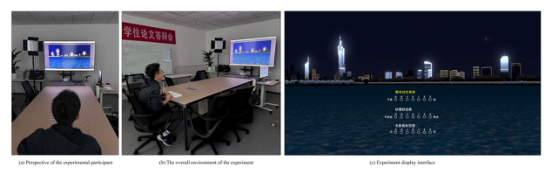
Experimental Equipment To investigate the lighting parameters related to aesthetic preferences for dynamic waterfront nightscape lighting, we conducted a field study on the waterfront lighting of Xuanwu Lake in Nanjing, China. Using the Xuanwu Lake and its surrounding buildings as the scene, we employed Unity3D programming software to render VR lighting scenes. The experimental materials include 135 panoramic dynamic videos of the Xuanwu Lake waterfront interface in Nanjing, with subjective evaluations based on three dimensions, and the videos were exported after modeling and rendering the Xuanwu Lake waterfront interface scene. The experiment was conducted in the Human Factors Engineering Laboratory at Southeast University, under dim laboratory conditions. The equipment used included a 4K display, a computer (Intel Core i7 processor, GTX 2060 graphics card), and a standard keyboard and mouse set.
Figure 1: Photographs taken during the experiment process.
Before the formal experiment, participants had ample time to familiarize themselves with the experimental rules and procedures. During the formal experiment, after reading the instructions, participants began the experiment
by pressing the spacebar and used the left and right arrow keys to rate the videos. The total time required for each participant to complete the entire experiment was approximately 60 minutes. This experiment focused on the color temperature dynamic effect of Xuanwu Lake’s nightscape lighting to extract the lighting parameters affecting aesthetic preferences. A total of 135 dynamic effect videos of the interface scenes were tested (3×3×3×5 = 135). Participants with different education levels, age groups, academic backgrounds, regions (north or south), and genders were analyzed for their aesthetic preferences regarding the color temperature dynamic effects. The dependent variables in this experiment included the overall dynamic aesthetic, comfort level (speed), and color perception range for each dynamic effect video.
The experimental materials include 135 panoramic dynamic effect videos of the Xuanwu Lake waterfront interface in Nanjing and three subjective evaluation scales (0-7). After modeling and rendering the Xuanwu Lake waterfront interface scene, the color temperature was linearly transformed within a specified range. The panoramic lighting design scheme is based on color temperature as the lighting indicator, from which lighting parameters such as color temperature quantity and dynamic effect frequency were extracted. According to the “Urban Nightscape Lighting Design Code,” the lighting levels are set based on the location and type of buildings, as follows: brightness is controlled as a variable, with the core buildings set at 25 cd/m2, secondary buildings, city walls, and vegetation at 5 cd/m2. These brightness values were chosen in accordance with the standards.
Table 2: Color temperature settings of the building in the dynamic lighting experiment.
Table available in the original PDF paper.
Controlled Variables Independent Variables Dynamic Effect Object Core Buildings, Vegetation Initial Color Temperature
The experimental procedure consists of 135 nightscape lighting design scenarios of Xuanwu Lake. Participants view the experimental instructions before starting the experiment. A “+” symbol appears for 500 ms before each image is displayed. Each image is shown for 5 seconds, followed by the appearance of the rating scale. Each image is displayed for 15 seconds, during which participants watch the dynamic effect video. Afterward, participants complete a subjective questionnaire. The subjective questionnaire is based on the scenic beauty evaluation method, with three evaluation dimensions designed. The three evaluation dimensions for the nightscape lighting design are: Overall Dynamic Aesthetic, Perceived Comfort of Speed, and Range of
Dynamic Adjustments of Correlated Color Temperature (CCT) 241
Color Perception, which are rated on a scale from 1 to 7 (1 being the worst and 7 being the best). The experimental flow diagram is shown in Figure 2.
Figure 2: Experimental flowchart.
Figure available in the original PDF paper.
RESULT
Overall Dynamic Aesthetic The main effect test results indicate that Initial Color Temperature (χ2 = 195.918, p < 0.001) and Color Temperature Gradient (χ2 = 110.742, p = 0.005) have a significant impact on Overall Dynamic Aesthetic, while the main effects of Number of Color Temperature Levels and Dynamic Effect Frequency are not significant (p > 0.05). The optimal values are an Initial Color Temperature of 3000K (M = 4.35) and a Color Temperature Gradient of 1000K (M = 4.71). Pairwise comparison results show that the Overall Dynamic Aesthetic score for an Initial Color Temperature of 3000K (mean = 4.35) is significantly higher than for other color temperatures (p < 0.01), but there is no significant difference compared to 5000K. No significant differences are observed between 5000K and 7000K, and between 7000K and 17000K. The highest rating for the Color Temperature Gradient is 5000K (mean = 3.94), which is significantly higher than for 1000K (p < 0.001). There is no significant difference between 3000K and 5000K (p > 0.05). The interaction effect test results show that the interaction between Initial Color Temperature and Color Temperature Gradient on Overall Dynamic Aesthetic is significant (Wald Chi-Square = 69.961, df = 8, p < 0.001). The highest Overall Dynamic Aesthetic score is observed when the Initial Color Temperature is 3000K and the Color Temperature Gradient is 1000K. The interaction between Initial Color Temperature and Number of Color Temperature Levels on Overall Dynamic Aesthetic is significant (Wald Chi-Square = 68.729, df = 8, p < 0.001). The highest Overall Dynamic Aesthetic score is observed when the Initial Color Temperature is 3000K and the Number of Color Temperature Levels is 3.
The interaction effect between Initial Color Temperature and Dynamic Effect Frequency is significant (Wald Chi-Square = 72.373, df = 8, p < 0.001). The highest Overall Dynamic Aesthetic score is observed when the Initial Color Temperature is 3000K and the Dynamic Effect Frequency is 3 seconds. The interaction effect between Color Temperature Gradient and Dynamic Effect Frequency is significant (Wald Chi-Square = 24.326, df = 4, p < 0.001). The highest Overall Dynamic Aesthetic score is observed when the Color Temperature Gradient is 5000K and the Dynamic Effect Frequency is 3 seconds.
The main effect results indicate that age, region (north or south), education level, and major have a significant impact on Overall Dynamic Aesthetic
(p < 0.001), while gender does not significantly affect Overall Dynamic Aesthetic (p = 0.170 > 0.05). Age has a significant effect on Overall Dynamic Aesthetic (p < 0.001), with the 25–39 age group providing higher ratings for Overall Dynamic Aesthetic, significantly higher than the 18–24 and 40+ age groups (p < 0.001). The 40+ age group gave lower ratings for Overall Dynamic Aesthetic. Individuals from the southern region (avg. = 4.00) rated Overall Dynamic Aesthetic significantly higher than those from the northern region (avg. = 3.72). The group with a high school education or below rated Overall Dynamic Aesthetic higher, while the master’s degree group rated it lower.
The interaction effect results show that the interaction between Initial Color Temperature and Gender is significant (Wald Chi-Square = 82.475, df = 4, p < 0.001). When the Initial Color Temperature is 3000K, Overall Dynamic Aesthetic scores the highest for both males and females. The interaction between Initial Color Temperature and Age is significant (Wald Chi-Square = 52.133, df = 8, p < 0.001). As age increases, the influence of Initial Color Temperature on Overall Dynamic Aesthetic decreases. For the 18–24 age group, the highest Overall Dynamic Aesthetic score occurs when the Initial Color Temperature is 5000K. The interaction between Initial Color Temperature and Region (north or south) is significant (Wald Chi-Square = 54.204, df = 4, p < 0.001). In the southern region, the highest Overall Dynamic Aesthetic score occurs when the Initial Color Temperature is 3000K. The interaction between Initial Color Temperature and Education Level is significant (Wald Chi-Square = 26.830, df = 8, p = 0.001). For participants with a high school education or below, undergraduate, and master’s degrees, the highest Overall Dynamic Aesthetic score occurs when the Initial Color Temperature is 3000K. The interaction between Initial Color Temperature and Major is significant (Wald Chi-Square = 57.157, df = 12, p < 0.001). The interaction between Color Temperature Gradient and Age is significant (Wald Chi-Square = 12.561, df = 4, p = 0.014). For the 25–39 age group, the highest Overall Dynamic Aesthetic score occurs when the Color Temperature Gradient is 3000K. The interaction between Dynamic Effect Frequency and Age is significant (Wald Chi-Square = 16.083, df = 4, p = 0.003). For the 25–39 age group, the highest Overall Dynamic Aesthetic score occurs when the Dynamic Effect Frequency is 1 second. As age increases, the influence of Initial Color Temperature on Overall Dynamic Aesthetic gradually decreases.
Perceived Comfort of Speed The main effect results indicate that Initial Color Temperature (χ2 = 70.948, p < 0.001) and Dynamic Effect Frequency (χ2 = 6.835, p = 0.033) have a significant effect, while Color Temperature Gradient (p = 0.410) and Number of Color Temperature Levels (p = 0.052) do not show significant main effects. The highest perceived comfort of speed rating occurs at an Initial Color Temperature of 3000K, and the highest rating is observed at a Dynamic Effect Frequency of 2 seconds (M = 4.07). High-frequency changes (1 second) cause discomfort in younger groups (p = 0.003). Pairwise
Dynamic Adjustments of Correlated Color Temperature (CCT) 243
comparison results show that the rating for an Initial Color Temperature of 3000K (mean = 4.16) is significantly higher than for cooler tones (e.g., 7000K, mean = 2.74). A Dynamic Effect Frequency of 3 seconds (slow changes) received the highest rating from the younger group (18-24 years) (mean = 4.07, p < 0.001), while the 40+ age group showed no sensitivity to frequency changes. When the Initial Color Temperature is 1000K, the rating for a Number of Color Temperature Levels of 4 is significantly higher than for 2 (mean = 3.67 vs. 2.91, p < 0.001), indicating that increasing color levels at lower temperatures enhances comfort. Age (χ2 = 80.265, p < 0.001), Major (χ2 = 110.463, p < 0.001), Education Level (χ2 = 64.632, p < 0.001), and Region (χ2 = 44.517, p < 0.001) significantly influence the perceived comfort of speed ratings. Demographically, the 25–39 age group provided the highest rating (mean = 4.25), significantly higher than the 18–24 years (mean = 3.79) and 40+ years groups (mean = 3.14). The undergraduate group had the highest rating (mean = 4.03), significantly higher than the master’s degree group (mean = 3.73) and the high school or lower education group (mean = 3.42). The southern region group (mean = 3.88) rated the perceived comfort of speed significantly higher than the northern region group (mean = 3.58, p < 0.001).
The interaction effects show that the 18–24 age group is more sensitive to changes in Initial Color Temperature, with the highest rating at 3000K (mean = 3.98). The 25–39 age group shows the most significant preference for 3000K (mean = 4.95, p < 0.01). The 18–24 age group is sensitive to changes in Dynamic Effect Frequency, with the highest rating at 3 seconds (mean = 4.07, p < 0.001), while the 40+ age group shows no significant difference. Participants with no background in a specific field showed a significantly higher preference for Initial Color Temperatures between 3000K and 5000K compared to other color temperatures (mean = 4.85–4.93, p < 0.001). The art major group rated 3000K significantly higher than 17000K (p < 0.001). The northern region group showed a significant interaction effect between Color Temperature Gradient of 5000K and Dynamic Effect Frequency of 3 seconds (mean = 3.74 vs. 3.36, p = 0.018), indicating a preference for slow changes.
Range of Color Perception The main effect results show that Initial Color Temperature, Color Temperature Gradient, and Number of Color Temperature Levels have a significant impact on the Range of Color Perception (p < 0.001, p = 0.007 < 0.05, p = 0.029 < 0.05), while Dynamic Effect Frequency does not significantly affect the Range of Color Perception (p = 0.056). Post hoc multiple comparisons show significant differences between Initial Color Temperatures of 1000K (avg. = 4.56), 3000K (avg. = 3.97), 7000K (avg. = 2.74), and 17000K (avg. = 2.42). The highest Range of Color Perception occurs at 1000K. The Color Temperature Gradient of 3000K provides the highest Range of Color Perception. When comparing Color Temperature Gradients of 3000K and 5000K, no significant difference in Range of Color Perception is found (p = 0.744 > 0.05). The Range of
Color Perception is significantly lower when comparing Color Temperature Gradients of 1000K (avg. = 3.20) and 3000K (avg. = 3.45) (p = 0.004 < 0.05). The Range of Color Perception is also significantly lower when comparing Color Temperature Gradients of 1000K (avg. = 3.20) and 5000K (avg. = 3.42) (p = 0.010 < 0.05). The Number of Color Temperature Levels of 2 (avg. = 3.40) is significantly higher than 4 (avg. = 3.23) (p < 0.05). The Number of Color Temperature Levels of 3 (avg. = 3.44) is significantly higher than 4 (p = 0.012 < 0.05). The Range of Color Perception is highest when the Number of Color Temperature Levels is 3. The interaction effects show that when the Initial Color Temperature is 1000K, there is a significant difference in the Range of Color Perception between Color Temperature Gradients of 1000K (avg. = 4.46) and 3000K (avg. = 4.71) (p = 0.036 < 0.05). Age, Major, Region (North or South), and Gender have a significant impact on the Range of Color Perception (p < 0.001), while Education Level does not significantly affect the Range of Color Perception (p = 0.840). The Range of Color Perception for the 18–24 age group (avg. = 3.14) is lower than that for the 25–39 age group (avg. = 3.54), with a statistically significant difference (p = 0.000 < 0.05). The 18–24 age group (avg. = 3.14) also has a lower Range of Color Perception compared to the 40+ age group (avg. = 3.39), with a difference of –0.25, which is statistically significant (p = 0.045 < 0.05). The 25–39 age group (avg. = 3.54) has a higher Range of Color Perception compared to the 40+ age group (avg. = 3.39), with a difference of 0.15, but this difference is not statistically significant (p = 0.309 > 0.05).
The interaction effects show that Education Level and Color Temperature Gradient significantly influence the Range of Color Perception. For those with a high school education or below, there is no significant difference in the Range of Color Perception between Color Temperature Gradients of 1000K, 3000K, and 5000K. For participants with an undergraduate education, there is no significant difference in the Range of Color Perception between Color Temperature Gradients of 3000K and 5000K. However, when comparing Color Temperature Gradients of 1000K (avg. = 3.71) and 3000K (avg. = 3.57), the Range of Color Perception is significantly different (p = 0.002 < 0.05). There is also a significant difference in the Range of Color Perception between 1000K (avg. = 3.71) and 5000K (avg. = 3.02) (p < 0.001). For participants with a master’s degree, the Range of Color Perception between Color Temperature Gradients of 1000K (avg. = 2.93) and 3000K (avg. = 3.36, p = 0.005 < 0.05), and 5000K (avg. = 3.68, p < 0.001) showed significant differences (p = 0.034 < 0.05). Individuals from the southern region (avg. = 3.61) have a higher Range of Color Perception compared to those from the northern region (avg. = 3.11), with a difference of 0.50, which is statistically significant (p = 0.000 < 0.05). Males (avg. = 3.53) also show a higher Range of Color Perception compared to females (avg. = 3.18), with a difference of 0.35, which is statistically significant (p = 0.000 < 0.05).
Dynamic Adjustments of Correlated Color Temperature (CCT) 245
DISCUSSION
Overall Aesthetic: There exists a transition zone for the Initial Color Temperature between 3000K and 7000K, during which changes in color temperature have a relatively small impact on Overall Dynamic Aesthetic. The Color Temperature Gradient of 5000K (M = 3.94) received the highest score.
Perceived Comfort of Speed: In summary, Initial Color Temperature, Dynamic Effect Frequency, Age, Major, and Education Level significantly affect Perceived Comfort of Speed ratings. Younger groups (18–24 years) are more sensitive to changes in color temperature and dynamic effects, with higher frequencies decreasing comfort. Lower education levels generally correspond to higher comfort ratings, and southern residents rated comfort higher than northern ones. Warmer tones enhance comfort. Initial Color Temperature and Color Temperature Gradient significantly influence Overall Aesthetic, with the highest ratings at 3000K. Younger and more educated groups tend to rate Overall Aesthetic higher, and southern residents rate it significantly higher than northern ones.
Range of Color Perception: Low Initial Color Temperatures (1000K) significantly expand the Range of Color Perception (M = 4.56). As Initial Color Temperature increases, the Range of Color Perception decreases. The Color Temperature Gradient has no significant impact on color perception between 3000K and 5000K or between 3 or 4 levels. Individuals with lower education levels are less sensitive to color temperature changes. There is a significant regional difference, with southern residents showing a higher Range of Color Perception than those from the north. Based on these findings, urban waterfront nightscape lighting design should prioritize 3000K to enhance aesthetics, with Color Temperature Gradients of 1000K and 3000K significantly impacting overall appeal. In southern regions, dynamic changes (e.g., 3 levels of color temperature) can be used, while northern regions should emphasize stability.
CONCLUSION
Considering the preferences of different groups, it is recommended to use a Dynamic Effect Frequency of 2 seconds in the lighting design for urban waterfront interfaces. This frequency satisfies the preference for dynamic changes among younger groups and those in the arts while avoiding visual discomfort for older groups and those with science and engineering backgrounds, thus balancing and accommodating the aesthetic preferences of different populations. Southern regions can increase color layers and dynamic changes, while northern regions should focus on stability and brightness in lighting.
ACKNOWLEDGMENT
The authors are grateful to the participants who dedicated their time and effort to this study.
REFERENCES
Chen, Z., Yu, X., Wang, C., Khanh, T. Q., & Liu, Q. (2025). ‘Limitations of correlated colour temperature in visual perception and its implications for evaluating the colour rendition quality of indoor lighting’, Building and Environment, 269. Duque, J. C., Lozano-Gracia, N., Patino, J. E., Restrepo, P., & Velasquez, W. A.
(2019). ‘Spatiotemporal dynamics of urban growth in Latin American cities: An analysis using nighttime light imagery’, Landscape and Urban Planning, 191. Hansen, E. K., Bjorner, T., Xylakis, E., & Pajuste, M. (2022). ‘An experiment of double dynamic lighting in an office responding to sky and daylight: Perceived effects on comfort, atmosphere and work engagement’, Indoor and Built Environment, 31(2), pp. 355–374. Jiang, Z., Li, Z., & Wang, J. (2024). ‘Are cities under bright lights more innovative?
Evidence from China’, Heliyon, 10(16). Karamouzi, A., Papalexopoulos, D., Stavridou, A., Tzimopoulou, S., & Varoudis, T. (2013). ‘DLD, Dynamic Lighting Design Parametric interactive lighting software in urban public space’, Ninth International Conference on Intelligent Environments (IE 2013), pp. 1–7. Kim, T., Kim, Y., Jeon, H., Choi, C. S., & Suk, H. J. (2021). ‘Emotional response to in-car dynamic lighting’, International Journal of Automotive Technology, 22(4), pp. 1035–1043. Liu, M., Fan, Y., Ma, J. A., Zhang, B. G., & Ieee (2009). ‘Investigation and
experiment of dynamic light disturbance’, 2009 Symposium on Photonics and Optoelectronics (SOPO 2009), pp. 1–5. Lu, Y., Li, W., Xu, W., & Lin, Y. (2019). ‘Impacts of LED dynamic white lighting on atmosphere perception’, Lighting Research & Technology, 51(8), pp. 1143–1158. Ming, L. I. U., Jian, M. A., Xiao-ming, S. U., & Bao-gang, Z. (2009). ‘Effects of
dynamic obtrusive light on vision, psychology and emotion’, Chinese Ergonomics, 15(4), pp. 21–24. Ojeda, J., Romero, J., & Nieves, J. L. (2023). ‘Understanding the effect of correlated colour temperatures on spatio-chromatic properties of natural images’, Vision Research, 208. Wang, Y., Liu, Q., Gao, W., Pointer, M. R., Huang, Z., Chen, W., & Wu, J. (2020).
‘Interactive effect of illuminance and correlated colour temperature on colour preference and degree of white light sensation for Chinese observers’, Optik, 224. Zheng, S. Q., Luo, R., Ye, M., & Ieee (2015). ‘The effect of dynamic light on human alertness’, 2015 12th China International Forum on Solid State Lighting (SSLChina), pp. 1–5.
LISTED IN THE AHFE DIGITAL BOOKSTORE CATALOGUE
Explore the complete digital volume
Human Systems Engineering and Design (IHSED2025): Future Trends and Applications
Read this individual research paper free through the original publisher, or explore the full digital proceedings book.
ISBN 978-1-964867-74-8
Explore this ISBN in the AHFE Bookstore ↗Listed in the July 2026 bookstore catalogue; search by ISBN to confirm current availability · Digital book purchase optional