Weigang Wang, Xinyue Wang, ChengQi Xue (2023). Aesthetics Evaluation Method of Chinese Characters based on Region Segmentation and Pixel Calculation. In: Intelligent Human Systems Integration (IHSI 2023): Integrating People and Intelligent Systems. AHFE Open Access, vol. 69, pp. 561–568. https://doi.org/10.54941/ahfe1002877
With the increasing demand for using and the great enrichment of Chinese fonts, how to quickly evaluate the beauty of fonts has become an important issue in the current design. However, Chinese characters are difficult to judge and quantify, and have strong aesthetic subjectivity. At the same time, the evaluation of Chinese characters is abstract, which is difficult to meet the application needs of today's rapid font design and evaluation.Based on the attributes and aesthetic characteristics of Chinese characters, this paper calculate and verify the beauty of Chinese characters. According to the traditional Chinese character aesthetic evaluation index - balance and stability, this paper evaluates the Chinese character font. First, the Chinese characters are placed in a 600*600 pixel rectangular box and divided into 25 small 120*120 pixel rectangular boxes to realize the quintuple segmentation of Chinese characters. Secondly, the left-right and up-down balance degree, left-right balance degree, stability degree and their corresponding pixel calculation methods are proposed as the indicators to evaluate the beauty of modern Chinese characters. According to the calculation method proposed in this paper, the five Chinese characters of the two fonts are selected to calculate their left-right balance index, upper-lower balance index and stability respectively, and calculate the average value as the beauty of the font. In addition, subjective evaluation experiments are conducted to verify whether the calculation method can reflect the user's subjective feelings.In the discussion, the possible future directions are put forward and given.
With the vigorous development of mobile Internet, people’s reading carrier has changed dramatically. From paper carrier to electronic carrier, words play an important role in information transmission. Due to the increasing demand for Chinese characters in various carriers and the great enrichment of Chinese fonts, more stringent requirements are put forward for the current design industry.
In the field of font design, some achievements have been made in the rese- arch of English fonts. However, how to effectively evaluate the aesthetics of Chinese Fonts is a difficult problem. First of all, Chinese characters are difficult to judge and quantify. At the same time, in history, the evaluation
of Chinese characters is often more abstract, which is difficult to meet the application needs of today’s rapid font design and evaluation. Then, how to quantify the characteristics of Chinese characters through data will be of guiding significance to the analysis of the aesthetic characteristics of Chinese fonts.
Based on the attributes and aesthetic characteristics of Chinese characters, this paper uses MATLAB to calculate and verify the beauty of Chinese cha- racters. In this paper, the quintuple method and central theory are selected as the theoretical basis for the subsequent calculation, the existing methods of interface beauty research and beauty calculation are analyzed and sum- marized, and the three indicators of left-right balance, up-down balance and stability are proposed, as well as the corresponding pixel calculation method. The subjective evaluation method is used to verify the feasibility of the three beauty index calculation methods. Finally, the results are analyzed, discus- sed and summarized, and the improvement space of the designed calculation method is given.
THE ATTRIBUTES AND AESTHETICS OF CHINESE CHARACTERS The main attributes of Chinese characters include: 1) informative. As a symbol, Chinese characters naturally have the function of visual ideogra- phic symbols, and can be presented in the form of the smallest individual - “word”; 2) Aesthetics. The aesthetic design of Chinese characters can expand the use scene of Chinese characters, make Chinese characters get rid of the limitations of simply being an information carrier, and thus rise to give people a beautiful experience (Xiaoli Zhang, 2016).
In Chinese traditional ancient books, there are countless aesthetic ideas about Chinese characters, including “calm ambition, no excitement, no calendar”, “impartiality”, “balance of potential and body”, “smooth and stable”, etc. it is not difficult to see that balance and stability are the two basic aesthetic characteristics of Chinese characters. The balance of anci- ent Chinese characters includes upper and lower balance and left and right balance, while contemporary Chinese character design mainly focuses on left and right balance, and generally does not consider upper and lower balance (Jinse Zhao, 2009). Yanjing Wang (2018) investigates the concept of the cen- ter of gravity of Chinese characters, and clarifies the definition of the center of gravity combined with the practice of Chinese character art.
RESEARCH AND CALCULATION OF INTERFACE AESTHETICS Similar to Chinese characters, the interface bears the function of transmit- ting information and has certain aesthetic characteristics, which reflects the relationship between its design parameters and the perceptual factors of user experience. NGO et al. (2003) have studied and calculated the beauty of the interface under different layouts from 13 angles by making the inter- face elements rectangular, so as to obtain the comprehensive beauty of the interface. Liu et al. (2006, 2009, 2014) further expanded the calcu- lation method of interface beauty by using the regional pixel calculation
Aesthetics Evaluation Method of Chinese Characters based on Region Segmentation 563
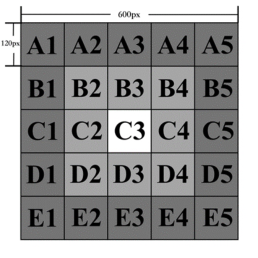
Figure 1: Five equal division of Chinese characters.
method. Lei Zhou (2013) analyzes the perceptual intention structure of inter- face beauty, points out that interface balance, proportion, simplicity and echo are the key potential factors affecting user aesthetic experience, puts forward 12 indicators, and constructs the calculation system of interface beauty. Referring to the above interface beauty calculation method, NGO and Liu used numerical values, coordinates and other quantitative interface parame- ters, and combined with the user’s subjective feelings, constructed a series of interface beauty calculation methods, which played an enlightening role in the calculation idea of this paper.
CHINESE CHARACTER REGION SEGMENTATION According to research on the segmentation method of Chinese character idiom lattice of Zhongyuan Li (2009), using the five equal division method can not only retain the guiding function of traditional idiom lattice on Chinese character writing, but also intuitively reflect the proportional rela- tionship of Chinese character structure. This method divides each side of the rectangular box for writing Chinese characters into five equal parts, and finally forms twenty-five small cells. The specific division is shown in Figure 1. In this paper, the reference quintuple method is used as the main method of region segmentation in the beauty calculation of Chinese characters.
After segmentation, the 600*600 pixel rectangular box is divided into 25 rectangular boxes with 120*120 pixels and labeled respectively, as shown in Figure 1.
PIXEL CALCULATION Calculation of Left-Right and Up-Down Index
According to the aesthetic theory of Chinese characters, when people watch the characters in the rectangular box, the ratio of the area occupied by Chi- nese characters in A1, B1, C1, D1, E1, A2, B2, C2, D2, E2 to the area of the area and the ratio of the area occupied by Chinese characters in A4, B4, C4, D4, E4, A5, B5, C5, D5, E5 to the area of the area make the subjects feel left-right balance.
The following is the calculation formula of left-right balance index:
Equations and mathematical formulas are available in the original paper PDF.
DensityLeft DensityRight
Among them, BalanceLR is the index of left-right balance of Chinese cha- racters, DensityLeft is the ratio of the area of Chinese characters in the left area to the area of the rectangular box, DensityRight is the ratio of the area of Chinese characters in the right area to the area of the rectangular box.
The closer the BalanceLR is to 0, the more balanced the left and right Chinese characters appear.
Among them, DensityLeft and DensityRight is respectively: DensityLeft = SA1 + SA2 + SB1 + SB2 + SC1 + SC2 + SD1 + SD2 + SE1 + SE2
Sx refers to the area of Chinese characters in the small rectangular box labeled x.
Similarly, according to the left-right balance index, the calculation method of the upper and lower balance index is deduced:
Calculation of Stability The stability in product design can be divided into practical stability and visual stability, while there is only visual stability in Chinese characters. According to the method of enhancing the sense of stability in product design, it can be concluded by analogy that the factors affecting the visual stability of Chinese characters include the density of the lower half of the font, the shape of Chinese characters, the floor area of the font, etc.
According to the above principle, the stability can be calculated by the following formula:
Where, SDEsum is the sum of the area occupied by Chinese characters in the small rectangular boxes of lines D and E, SABCDEsum is the total area of Chinese characters in all small rectangular boxes. The greater the Stability value, the more stable the appearance of Chinese characters.
Aesthetics Evaluation Method of Chinese Characters based on Region Segmentation 565
Table 1. Left-right, up-down balance index and stability of font 1.
Where, the calculation formulas of and SDEsum and SABCDEsum are: SDEsum = SD1 + SD2 + SD3 + SD4 + SD5 + SE1
+ SC5 + SD1 + . . . + SD5 + SE1 + . . . + SE5 Sx refers to the area of Chinese characters in the small rectangular box labeled x.
SUBJECTIVE EVALUATION In subjective evaluation, six Chinese characters with high frequency are scre- ened out and they have no practical significance or relevant connection. The same font size (130) and weight of two fonts are used to make them appear in a rectangular box with a fixed size (600*600 pixels) respectively.
Then, a questionnaire was designed with Likert scale, and the subjects were invited to evaluate their upper and lower balance, left and right balance and stability respectively. In the design of this questionnaire, abstract sentences and professional vocabulary about the aesthetics of Chinese characters are avoided to ensure that the evaluation results are not affected by personal understanding and knowledge level.
RESULT
Calculation of Left-Right, Up-Down Balance Index and Stability This paper uses MATLAB to segment and export the large rectangular box image with 600*600 pixels, and calculates the number of pixels occupied by Chinese characters in each small rectangular box. Table 1-table 6 shows the number of pixels in each region of 6 Chinese characters (2 fonts) formed after processing.
The left-right, up-down balance index and stability of the two Chinese characters are shown in the Table 1 and Table 2.
According to the data in Table 1 and Table 2, it can be seen that under the six common Chinese characters, the average left-right balance degree of font 1 is 0.329, the average upper and lower balance degree is 0.382, and
Table 2. Left-right, up-down balance index and stability of font 2.
the average stability degree is 0.407; Under the six more common Chinese characters, the average left-right balance degree of font 2 is 0.129, the average upper and lower balance degree is 0.385, and the average stability degree is 0.417.
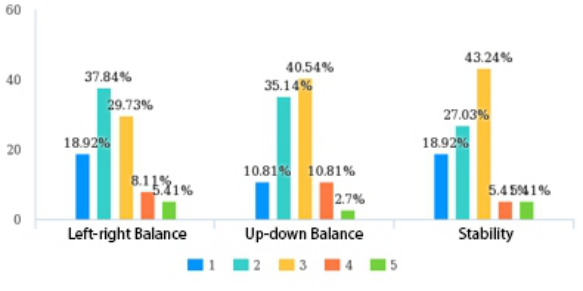
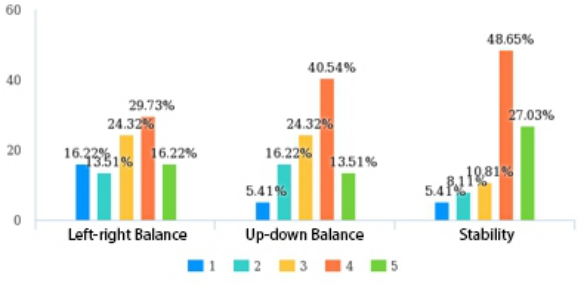
Results of Subjective Evaluation A total of 37 questionnaires were collected, of which 37 were valid. The questionnaire adopts Likert 5-point scale method, with a minimum of 1 point and a maximum of 5 points. In the subjective evaluation of handwritten fonts, the average score of upper and lower balance is 2.43 points, the average score of left and right balance is 2.59 points, and the average score of stability is 2.51 points; In the subjective evaluation of round fonts, the average score of upper and lower balance is 3.16 points, the average score of left and right balance is 3.41 points, and the average score of stability is 3.84 points. As shown in Figure 2 and Figure 3.
DISCUSSION
This paper puts forward a beauty calculation method for modern Chinese character fonts, including the degree of upper and lower balance, the degree of left and right balance and the degree of stability, and puts forward a
Aesthetics Evaluation Method of Chinese Characters based on Region Segmentation 567
Figure 3: Subjective evaluation score of font 2.
feasible calculation method, and then uses subjective evaluation to verify this calculation method.
According to Table 1 and Table 2, the left-right balance index of font 2 is significantly better than font 1, the up-down balance index of these two fonts are almost the same, and the stability of font 2 is slightly better than font 1.
According to Figure 2 and Figure 3, in the subjective evaluation, the evalu- ation of left-right balance, up-down balance and stability of font 2 is higher than the evaluation of font 1.
Compare the calculated left-right balance index, up-down balance index and stability with the subjective evaluation, in terms of the degree of left- right balance and stability, the trend of calculation results and subjective evaluation is relatively consistent, however, in terms of the up-down bala- nce index, the calculation results cannot significantly reflect the subjective evaluation.
In this paper, there are still many deficiencies, which will be improved in the future. For example, few samples of Chinese characters and fonts are selected in this paper, which is difficult to form a practical significance and guiding role for Chinese character font design. In the future, more font samples should be used for testing.
In addition, the calculation methods in this paper still need improvement. When improving this methods, eye movement technology can be considered to capture human eye data and visual weight should be given to each small rectangle box to calculate the index more accurately.
REFERENCES
Chien-Yin Lai, Pai-Hsun Chen, Sheng-Wen Shih, et al. (2009). Computational models and experimental investigations of effects of balance and sym- metry on the aesthetics of text-overlaid images. Human-Computer Studies 68(1):41–56. David Chek Ling Ngo, Lian Seng Teo, John G. Byrne. (2003). Modelling interface
aesthetics. Information Sciences 152 25–46. Jinse Zhao. (2009). A brief discussion on the aesthetic characteristics of Chinese character forms. Sinogram Culture(04):88–90.
Lei zhou, Chengqi Xue, Wencheng Tang, Jing Li, Yafeng Niu. (2013). Aesthetic Evaluation Method of Interface Elements Layout Design. Journal of Computer-Aided Design & Computer Graphics 25(05) 758–766. Michael Bauerly, Yili Liu. (2006). Computational modeling and experimental inve-
stigation of effects of compositional elements on interface and design aesthetics. Human-Computer Studies 64(8):670–682. Mien-Tsung Tsai, Kuo-An Wang, Yili Liu & Jen-Shin Hong. (2014). Perceived Visual Aesthetics of Text-Overlaid Images: Computational Models and Experimental Research for White-Space Fraction, International Journal of Human-Computer Interaction 30:1, 1–23. Xiaoli Zhang, Junqi Duan. (2016). User’s Individual Needs Oriented Parametric
Design Method of Chinese Fonts. Design(02):115–117. Yanjing Wang, Shixia Zhu. (2018). Barycenter Concept of Chinese Typeface Deisgn.
Packaging Engineering 39(24) 39–42. Zhongyuan Li. (1999). The principle of the use of the golden section of the character grid. Painting & Calligraphy Art(03).
LISTED IN THE AHFE DIGITAL BOOKSTORE CATALOGUE
Explore the complete digital volume
Intelligent Human Systems Integration (IHSI 2023): Integrating People and Intelligent Systems
Read this individual research paper free through the original publisher, or explore the full digital proceedings book.
ISBN 978-1-958651-45-2
Explore this ISBN in the AHFE Bookstore ↗Listed in the July 2026 bookstore catalogue; search by ISBN to confirm current availability · Digital book purchase optional