Yaning Li, Yu Zhang, Yumeng Yang, Tang Zihan, Zhenxian Hu, Chengxi Xie, Ziao Pan, Chengye Chen, Tuoda Qi, Zhixian Zhu, Qian He, Shumin Li, Yuan Yin, Ji Han, Peter Childs, Gaetano Cascini, Meng Li (2024). The Effects of Short-term Meditation on the Creativity of Novice Designers: A Pilot Design Task Study using TTCT-Figural Assessment. In: Creativity, Innovation and Entrepreneurship. AHFE Open Access, vol. 125, pp. 51–60. https://doi.org/10.54941/ahfe1004720
1 School of Mechanical Engineering, Xi’an Jiaotong University, Xi’an, 710049, China ↗
2 Joint School of Design and Innovation, Xi’an Jiaotong University, Xi’an, 710049, China; XJTU-POLIMI Joint School of Design and Innovation, Politecnico di Milano, Milan 20156, Italy ↗
3 Department of Mechanical Engineering, Politecnico di Milano, Milan, 20156, Italy ↗
4 Dyson School of Design Engineering, Imperial College London, London, SW7 2AZ, United Kingdom ↗
5 Business School, University of Exeter, Exeter, EX4 4QJ, United Kingdom ↗
Creativity is long regarded as one of the fundamental traits that indicates design capability. The concept of creativity encompasses the capacity to produce innovative and novel concepts or ideas, to devise or articulate imagination and intellect, and to stimulate the potential of imagination and ingenuity embodying their capacity to conceive, craft, and develop innovative ideas for products. Previous studies have revealed the connection and functionality between meditation and creativity. However, general creativity measurements, which studies to date have mainly focused on, might not be able to demonstrate the performance of designers in a creative process adequately.Therefore, this study applied a design task-based evaluation with traditional TTCT assessment, which might be more suitable to describe the creative performance of novice designers. The study aims to explore: (1) the relationship between short-term meditation and creativity; (2) the effects of short-term meditation on the design qualities in design tasks of novice designers.42 first-year design students were recruited and were divided into meditation group (n=24) and control group (n=18). Participants conducted a demographic survey and the Torrance Tests of Creative Thinking (TTCT, in its figural variant) firstly. The meditation group was then given a 110-minute audio tape-based meditation intervention, and the control group was given a 110-minute audio tape intervention, which is a recording of scientific articles. Both interventions were performed twice a week on the weekends. After that, TTCT was given to the participants again. Then each participant received an interview on the changes in mood state and creativity. After the TTCT on the second day, the participants completed the Design with Morphological Table Task (DwMT) to assess their design qualities in a product design task. Through data analysis, TTCT results indicate that short-term meditation can significantly improve the creativity of novice designers and the meditation group outperformed the control group significantly in fluency and elaboration. DwMT results show that the meditation group significantly provided better design qualities than the control group.
Creativity is the ability to create works that are both original and appropriate. One of the basic principles of design is also innovation (Dieter Rams, 1980), so one of the essential abilities a designer has is creativity. There are 4Ps of creativity: person, process, product and press (Rhodes, 1961). Creativity is characterised by processes with phases of divergence and convergence (Childs et al. 2022). In this process, a person uses skills to produce novel and valuable ideas, solutions, and products (Chulvi & González Cruz, 2016). Therefore, the main factors in assessing product creativity are novelty and practicality (Taura, 2011).
The popularity of meditation in the Western world over the past 40 years, building on centuries and millennia of practice across different cultures, has led to extensive research on its physiological and behavioural effects, including creative performance (Murphy et al., 2004). Previous studies have explored the relationship between creativity and meditation, and research on the link between creative performance and meditation has shown that overall creative performance is improved after meditation training (Ball, 1980; Colzato et al., 2012; Ding et al., 2011; Ding et al., 2014a; Ding et al., 2014b; Ren et al., 2011; Strick et al., 2012), but the reverse has also occurred (O’Haire & Marcia, 1980; Otis, 1974). Another study taking the TTCT-FormB test to measure creative thinking skills found an unsupported relationship between three years of meditation experience and creative per- formance. However, some meditators scored relatively high on the originality of graphics (O’Haire & Marcia, 1980). These sources of differences may be due to measurement errors in the TTCT or other factors, such as aspects of the subjects’ personality and mood. Previous research investigated the effects of a seven-day intervention as a short-term meditation on the creativity. The effects of short-term meditation less than seven days, single and successive meditations on the creativity are ignored in the existing research.
This paper aims to explore the possibility whether short-term meditation can improve the creativity of the novice designers. As for the assessment meth- ods of the creativity, the current methods may only partially or abstractly reflect the results. On the contrary, task-based assessment method is more appropriate to evaluate designer’s creative performance in real scenarios together with traditional method. Therefore, a specific design task was used to assess the creativity of the novice designers together with TTCT-Figural in this study.
The research questions of this study are: RQ1: What are the effects of short-term meditation on the creativity of the novice designers?
RQ2: How does short-term meditation affect novice designers’ design qualities in design tasks?
Accordingly, the proposed hypotheses of this study are: H1 (for RQ1): A single short-term meditation intervention cannot signifi- cantly improve the creativity of novice designers.
H2 (for RQ1): Successive short-term meditation interventions can signifi- cantly improve the creativity of novice designers.
H3 (for RQ2): Successive short-term meditation interventions can signifi- cantly improve the design qualities of novice designers in design tasks.
The Effects of Short-Term Meditation on the Creativity of Novice Designers 53
METHODOLOGY
Participants The study was conducted in XJTU-POLIMI Joint School of Design and Innovation in Xi’an Jiaotong University. Forty-two eligible first-year design students with little design experience were recruited. Inclusion criteria for the recruitment included no previous experience of meditation practice. They were randomly divided into a meditation group (n = 24) and a control group (n = 18). All participants voluntarily joined in the experiment and provided informed consent.
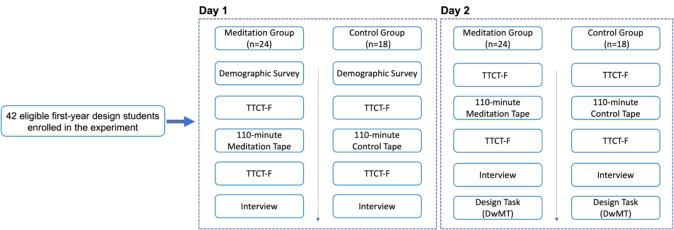
Procedures The study began with the Torrance Test of Creative Thinking–Figural (TTCT-F), lasting for 3 minutes. The demographic survey was used to collect basic information on age and gender. Then, the meditation group received a 110-minute meditation intervention accompanied by an audio tape for med- itation, while the control group received a 110-minute control intervention accompanied by a tape of scientific articles. The whole intervention con- tains 105-minute audio-based guided intervention and 5-minute preparation period in order to let subjects understand the aim of this study and adjust their sitting postures. As this study is a comparative project with the study con- ducted by Ding et al., (2014), the researchers aimed to discover the effects of the extreme short-term meditation intervention which only contains two-day practices. The compared study applied a seven-day meditation intervention with 30-minute practice for each day; to ensure the total time is equal, this study adopted 2-day intervention with 105-minute practice for each day. Both tapes are recorded by the same person and the same speed of speech as the audio applied to the meditation group, to ensure the scientific nature of the protocol design (Norris et al., 2018). The interventions were provided twice on a weekend. After the intervention, participants conducted the TTCT-F again and received a personal interview. At the end of the experiment on the second day, participants conducted a design task (DwMT). The procedures of this study are shown in Figure 1.
Figure 1: The protocol of the meditation interventions in two days..
Torrance Test of Creative Thinking–Figural (TTCT-F) The Torrance Test of Creative Thinking (TTCT) was used to assess partici- pants’ creativity performance. There are two principal versions: TTCT-Verbal
and TTCT-Figural. In this experiment, only TTCT-Figural was used to evaluate participants’ figure-related creativity. The TTCT-F consists of the following five subsections (Alabbasi et al., 2022): (a) Fluency, which is the numbers of figural-relevant responses to the stimulus, reveals the level of idea generation. (b) Originality, which is the numbers of unusual relevant responses determined by statistical infrequency, reveals the level of idea orig- inality. The scoring procedure needs to count all the relevant answers to produce a uniqueness statistic table, and then give a score based on the per- centage of each answer. (c) The abstractness of the title reveals the level of capturing critical information and the ability of synthesising and organis- ing thinking. (d) Elaboration, which is the number of added elements based on the minimum necessary of response, reveals the level of imagination and exposition of detail. (e) Resistance to premature closure reveals the ability to stay open and tolerate ambiguity long enough to come up with a creative response. For the purpose of article, Abstractness of title and Resistance to premature closure will not be discussed. The raw scores (Fluency, Original- ity, Elaboration) in each activity are converted to standard scores by z-score normalization. Each subscale was rated by a single proficient scorer with previous experience in a training of scoring TTCT who was blind to the conditions of the participants.
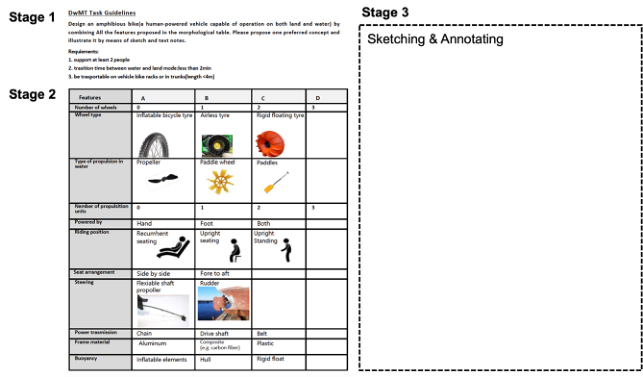
Design With Morphological Table Task (DwMT) The task, consisting of three chronological stages, required participants to design an amphibious bicycle based on the requirements in 15 minutes (see Figure 2). The instructions showed participants the detailed requirements of this task (Li et al., 2023). The morphological table (Childs, 2019) provided 3 aspects of design requirements and 11 features of an amphibious bicycle, serving as a detailed guideline for the participants.
Figure 2: Three stages of DwMT: (upper left) stage 1: reading the requirements (lower left) stage 2: analysing and selecting part of the solutions from morphological table (right) stage 3: sketching.
The Effects of Short-Term Meditation on the Creativity of Novice Designers 55
In order to clarify how creativity is manifested under this design task, the design quality was scored according to the assessment criteria listed in Table 1. The task and assessment criteria are adopted from the former research conducted by two authors of this study (Li et al., 2023). The design task was rated by a single proficient scorer with 20-year experience in design education who was blind to the conditions of the participants.
Table 1. Assessment criteria of DwMT.
Table available in the original PDF paper.
Viability Explicit Use of the Matrix
Clarity-Level of Detail (only Sketch) To assess the presentation of the design
To assess the implementability of the design
To assess whether the design contains the features provided and meets the given design requirements in the morphological table Score Criteria Score Criteria Score Criteria
2 Barely understandable
2 Does not work/ make sense
2 3 or fewer features and 1 design requirement 5 Understandable but superficial
5 Likely not working 5 4–6 features and 1 design requirement 7 Clear and with some details
7 New research required, possible
7 6–7 features and 2 design requirements 10 Clear and detailed 10 Workable 10 8 or more features and 2 design requirements
Interview An interview was provided to each participant to learn more about their subjective perception about their changes in mood state and creativity. The questions asked in the interview are introduced in Table 2.
Table 2. Questions asked in the interview.
Table available in the original PDF paper.
Day Dimension Question Day 1 Changes in mood state Compared to the mood state when you entered the lab, do you feel any changes in your mood state? How does the mood state change? Please use some adjectives to describe your current mood or inner state. Day 1 Changes in creativity
Compared to the TTCT-F you did when you entered the lab, do you have any changes in your creative thinking, problem-solving and fluency in the process of doing TTCT-F? Day 2 Changes in mood state
Compared to the mood state you had when you entered the lab in the first day, do you have any changes in your mood now? Please use some adjectives to describe your current mood or inner state. Day 2 Changes in creativity
Compared to the TTCT-F you did when you entered the lab in the first day, do you have any changes in your creative thinking, problem-solving and fluency in the process of doing TTCT-F?
Statistical Analysis The scores of TTCT-F and DwMT are analyzed using IBM SPSS version 26. Descriptive statistics of each of TTCT-F and DwMT were calculated, includ- ing median and interquartile range (IQR). The differences between the meditation group and the control group in DwMT were tested using the Mann-Whitney U test (non-normally distributed). Meanwhile, the differences of and TTCT-F between two groups were tested using the Mann-Whitney U test (non-normally distributed). The comparison of each dimensions of TTCT-F between the pre-test and the post-test in the same group were tested using Wilcoxon signed-rank test(non-normally distributed). A p-value of <0.05 was considered as statistically significant.
RESULTS
Through data analysis, the results are consistent with the research hypothesis and are introduced in detail as follows.
Scores of TTCT-F In the pre-test of the first day (see Table 3), the Mann-Whitney U test shows no significant difference in TTCT-F (Fluency, Originality, Elaboration, p>.05) between the meditation group and the control group.
Table 3. Descriptive statistic for TTCT-F of participants in pre-test of day 1.
Note: Statistically significant results with p<0.05.
After the first intervention, compared to the pre-test (see Table 4), the meditation group shows no significant difference between the pre-test and post-test in TTCT-F (Fluency, Originality, Elaboration, p>.05, Wilcoxon Signed Rank Test). The results are consistent with the research hypothesis.
Table 4. Descriptive statistic for TTCT-F of meditation group in pre and post-test of day 1.
Note: Statistically significant results with p<0.05.
The Effects of Short-Term Meditation on the Creativity of Novice Designers 57
Meanwhile, compared to the pre-test (see Table 5), the control group shows no significant difference between the pre-test and post-test in TTCT-F (Fluency, Originality, Elaboration, p>.05, Wilcoxon Signed Rank Test). The results are consistent with the research hypothesis.
Table 5. Descriptive statistic for TTCT-F of control group in pre and post-test of day 1.
Note: Statistically significant results with p<0.05.
In the pre-test of the second day (see Table 6), the Mann-Whitney U test shows no significant difference in TTCT-F (Fluency, Originality, Elaboration, p>0.05) between the meditation group and control group.
Table 6. Descriptive statistic for TTCT-F of participants in pre-test of Day 2.
Note: Statistically significant results with p<0.05.
After the second intervention, compared to the pre-test (see Table 7), the Wilcoxon Signed Rank Test reveals that the meditation group obtained sig- nificantly better scores in Fluency (0.51vs0.77, p<0.05) and Elaboration (0.29vs0.33, p<0.05). In sum, the meditation group performed significantly better than pre-test after the meditation intervention (0.63vs1.68, p<0.05). The results are consistent with the research hypothesis.
Table 7. Descriptive statistic for TTCT-F of meditation group in pre and post-test of day 2.
Note: Statistically significant results with p<0.05.
Meanwhile, compared to the pre-test (see Table 8), the control group obtained significantly worse scores in Elaboration (-0.22vs-1.05, p<0.05) and total scores than pre-test (0.15vs-0.77, p<0.05). The results are consistent with the research hypothesis.
Table 8. Descriptive statistic for TTCT-F of control group in pre and post-test of day 2.
Note: Statistically significant results with p<0.05.
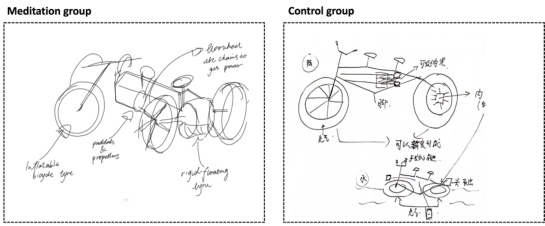
Scores of Design Quality in DwMT The representative design tasks done by participants from both groups are shown in Figure 3. In the descriptive statistic for DwMT (see Table 9), the meditation group’s median score of Clarity is significantly higher than the control group; the meditation group’s median score of Viability is signifi- cantly higher than the control group; the meditation group’s median score of Explicit use of matrix is significantly higher than the control group; the meditation group’s median total score of all the dimensions is significantly higher than the control group.
Figure 3: Representative design tasks from meditation and control group.Table 9. Descriptive statistics for DwMT.
Table available in the original PDF paper.
Dimension Total DwMT Median
Meditation DwMT Median
Control DwMT Median Clarity 5.00 6.00* 5.00 Viability 5.00 5.00* 2.00 Explicit use of matrix 5.00 7.00* 5.00 Total score of DwMT 15.00 17.00* 12.00
Note: Statistically significant results with p<0.05.
The Effects of Short-Term Meditation on the Creativity of Novice Designers 59
In the Hypothesis test summary for DwMT, the Mann-Whitney U Test show significant difference between meditation group and control group on Clarity, Viability, Explicit use of matrix and total score, the significant differ- ence is 99.99%, the significance level is.050. The results are consistent with the research hypothesis.
Interview In the interview on the first day, 10 out of 18 participants in the control group reported that their mood state after the intervention did not change much, instead, they felt a little dull. For the creative performance in TTCT-F, 13 out of 18 participants felt little changes in agility and mental dispersion after the intervention compared to when they entered the lab. On the other hand, 23 out of 24 participants in the meditation group said that they felt calmer and more relaxed after the intervention than when they first entered the lab. For the TTCT-F, 21 out of 24 participants reported that they completed the test more smoothly after the meditation compared to when they first entered the lab, and their thinking became more agile and creative, with a lot of new ideas coming into their minds.
On the second day, 11 out of 18 participants in the control group felt little changes in mood state compared to the first day. For the TTCT-F, 14 out of 18 participants thought that there was no significant improvement compared to the first day. Instead, 19 out of 24 participants in the meditation group felt calmer and more relaxed compared to the first day. For the TTCT-F, all the participants in the meditation group noticed that they had more ideas than the first day.
CONCLUSION
This study aimed to explore the effects of short-term meditation on the cre- ativity of novice designers. A pilot study using the TTCT-figural assessment was undertaken with a sample of 42 design students. Based on the results, the following conclusions are obtained from this study. Firstly, short-term meditation can improve the creativity of novice designers, especially in flu- ency and elaboration indicated by TTCT. Secondly, short-term meditation can improve the design qualities of novice designers in a specific design task.
However, the current study has some limitations. Firstly, neurophysiologi- cal measures, such as electroencephalography (EEG), would provide a more comprehensive understanding of the differences between the two groups from a neuroscience perspective. Secondly, we only used interview to investigate the effects of meditation on mood state, rather than using quantitative data to undertake measurements. Thirdly, we only recruited 42 participants in the study. In the future more participants need to be enrolled in to obtain more reliable results representative of a wider population. The study fur- ther explores the relationship between short-term meditation, creativity and design quality in a specific design task, contributing to the creativity research in the design society.
ACKNOWLEDGMENT
The authors would like to acknowledge all the participants from JSDI.
REFERENCES
Alabbasi, A. M. et al. (2022) ‘What do educators need to know about the torrance tests of creative thinking: A comprehensive review’, Frontiers in Psychology, 13. doi: 10.3389/fpsyg.2022.1000385. Ball, O. E., 1980. The effects of Transcendental Meditation (TM) and the TM Sidhis
Program on verbal and figural creativity (TTCT), auditory creativity (S&I), and hemispheric dominance (SOLAT). Childs, P. R. N., 2019. Mechanical design engineering handbook, 2nd edition.
Butterworth Heinemann. Childs, P., Han, J., Chen, L., Jiang, P., Wang, P., Park, D., Yin, Y., Dieckmann, E.
and Vilanova, I., 2022. The creativity diamond—A framework to aid creativity. Journal of Intelligence, 10(4), p. 73. Colzato, L. S., Szapora, A. and Hommel, B., 2012. Meditate to create: the impact of focused-attention and open-monitoring training on convergent and divergent thinking. Frontiers in psychology, 3, p. 116. Ding, X. Q., Li, S., and Tang, Y. Y., 2011. Short-term meditation improves creativity.
Second World Congress on Positive Psychology Poster Abstracts, p. 167. Ding, X., Tang, Y. Y., Cao, C., Deng, Y., Wang, Y., Xin, X., and Posner, M. I., 2015.
Short-term meditation modulates brain activity of insight evoked with solution cue. Social cognitive and affective neuroscience, 10(1), pp. 43–49. Ding, X. Q., Tang, Y. Y., Tang, R. X., and Posner, M. I., 2014. Improving creativity performance by short-term meditation. Behavioral and Brain Functions, 10, p. 9. Li, S., Becattini, N., Cascini, G. (2023) ‘EEG Variations as a Proxy of the Qual-
ity of the Design Outcome’, in Proceedings of the International Conference on Engineering Design (ICED23), Bordeaux, France, 24–28 July 2023. doi: 10.1017/pds.2023.154. Murphy, M. and Donovan, S., 1999. The physical and psychological effects of meditation: A review of contemporary research with a comprehensive bibliography 1931–1996 (2nd ed.). Institute of Noetic Sciences. Norris CJ, Creem D, Hendler R and Kober H (2018) Brief Mindfulness Medita-
tion Improves Attention in Novices: Evidence From ERPs and Moderation by Neuroticism. Front. Hum. Neurosci. 12:315. doi: 10.3389/fnhum.2018.00315. O’Haire, T. D., & Marcia, J. E., 1980. Some personality characteristics associated with Ananda Marga meditators: A pilot study. Perceptual and Motor Skills, 51, pp. 447–452. Otis, L. S., 1974. The facts on transcendental meditation: III. If well-integrated but
anxious, try TM. Psychology Today, 7, pp. 45–46. Rhodes, M. (1961). An analysis of creativity. The Phi Delta Kappan, 42(7), 305–310. Ren, J., Huang, Z. H., Luo, J., Wei, G. X., Ying, X. P., Ding, Z. G., et al., 2011.
Meditation promotes insightful problem-solving by keeping people in a mindful and alert conscious state. Science China. Life Sciences, 54, pp. 961–965. Rams, D., 2012. Ten principles for good design. bit. ly/QUk4gY, retrieved Sept. Strick, M., Van Noorden, T. H. J., Ritskes, R. R., De Ruiter, J. R., and Dijksterhuis, A., 2012. Zen meditation and access to information in the unconscious. Consciousness and Cognition, 21, pp. 1476–1481. Taura, T. and Nagai, Y., 2011. Discussion on Direction of Design Creativity Research
(Part 1) - New Definition of Design and Creativity: Beyond the Problem-Solving Paradigm. Design Creativity 2010. Springer, London, pp. 3–8. Vicente, C. and aCarmen, G., 2016. The influence of design methodology on a designer’s emotional parameters and on design results. Dyna, 83(196), pp. 106–112.
LISTED IN THE AHFE DIGITAL BOOKSTORE CATALOGUE
Explore the complete digital volume
Creativity, Innovation and Entrepreneurship
Read this individual research paper free through the original publisher, or explore the full digital proceedings book.
ISBN 978-1-964867-01-4
Explore this ISBN in the AHFE Bookstore ↗Listed in the July 2026 bookstore catalogue; search by ISBN to confirm current availability · Digital book purchase optional