Yu Zhang, Yaling Zeng, Chongbin Li, Jing Huang, Liu Yang (2022). Assessing Drivers’ Trust in Automated Driving Systems: An Integrated Study. In: Human Factors in Transportation. AHFE Open Access, vol. 60, pp. 338–347. https://doi.org/10.54941/ahfe1002465
At present, the automatic driving system is accelerating the evolution from L2 assistant driving system to L5 with the advanced automatic driving function in full scenarios. The drivers’ trust in automated driving systems has been proved to be one of the most important factors that affect drivers’ acceptance of automated driving technology. It is also a primary determinant of understanding how to promote productive interaction between drivers and automated driving systems. This paper presents two mixed-method studies that combine demographic and experimental methodologies to assess trust in AVs. 1131 drivers with different driving experiences were investigated on their initial trust in AVs through an online questionnaire. Twenty-six participants evaluated dynamic trust in six sessions of varying road complexity in an L3 automated driving simulator. Data collected included subjective measures of trust, behavior, and physiological measures through ECG and GSR. The results show that drivers’ initial trust related to individuals’ disposition includes age, driving years, gender, driving experience, perceived risks, acceptance of new technology, and the perception of risk. As well as drivers’ initial learned trust depends on the understanding of AVs technology, driving capacity, and the experience of AVs. The dynamic trust changes with the understanding of AVs performance and the external environment. For higher-risk events such as pedestrians and obstacles, the audible reminder can effectively enhance drivers’ situational awareness and trust as a strong reminder to supplement the visual channel in automated driving systems. These findings provide an effective basis for further research and design related to improving the trust in AVs.
At present, the automatic driving system is accelerating the evolution from L2 assistant driving system to L5 with the advanced automatic driving function in full scenarios through gradually decreasing the takeover rate from automa- ted driving to manual driving. It means that automated systems free drivers from the cognitive workload of having to focus on monitoring traffic and performing driving tasks. Meanwhile, drivers will face the gradual transfer of the control right to automated systems and how to coordinate with them to be safe.
Numerous studies showed trust plays an important role in influencing an individual’s inclination to use the autonomous system. Parasuraman and Riley (1997) propose that a user’s trust level of the automation can
Assessing Drivers’ Trust in Automated Driving Systems: An Integrated Study 339
cause misuse, disuse, or abuse. Many studies have utilized a variety of different automated systems in diverse experimental paradigms to iden- tify factors that impact users’ trust. Hoff and Bashir (2015) proposed a human-automation trust model that revealed three layers: dispositional trust, situational trust, and learned trust based on a systematic review of empi- rical research. That can be applied to design procedures that encourage appropriate trust. Trust is seen as essential to the success of new intelligent technology design and implementation, especially in automated driving in recent ten years (Ekman, Johansson and Sochor, 2018; Wintersberger et al., 2020) Most of the current research associated with AVs recognizes trust as the essential factor influencing drivers’ acceptance of automation technology. The American Automobile Association (AAA) reported that only one-in-ten (12%) U.S. drivers would trust to ride in a fully self-driving vehicle and 28% are unsure in March 2020. Körber, etc. (2018) examined and found that trust in an automated driving system is positively correlated with reliance on the automated driving system. An online survey with 443 U.S. drivers showed significant differences in AV expectations based on age, gender, edu- cation, driving experience, personality traits, and so on (Zhang, Yang and Robert, 2021). The initial level of trust seems to be crucial in further trust calibration and modulating the effect of automation performance (Manchon, Bueno and Navarro, 2021). That is, trust formation is a dynamic process. Changes in trust over time are influenced by factors related to user intera- ction with the system (Ekman, Johansson and Sochor, 2018). In previous research, the highlighted factors that affect dynamic trust in human-machine interactions include: 1) Automated system-related factors, such as automa- ted system performance (Hancock et al., 2011), HMI design such as more anthropomorphic features (Waytz, Heafner and Epley, 2014) and providing both “how and why”messages to explain AV actions(Koo et al., 2015), auto- mated driving styles(Manchon, Bueno and Navarro, 2021), and so on; 2) Drivers learned factors, such as technical competence (Choi and Ji, 2015), perceived ease of use and perceived usefulness (Zhang et al., 2019); 3) situ- ational factors: the specific events, uncertain situations and road complexity (Holthausen et al., 2020). Trust is a primary determinant of understanding how to promote productive interaction between drivers and automated driving systems.
Making automated vehicles commercially available is therefore reliant upon understanding how to trust in AVs is built, maintained, and fluctu- ated over time. The goal of our research is to build a framework of factors that affect drivers’ initial trust in AVs and to study how drivers’ trust dynamic changes and adjusts in the process of interacting with AVs. However, much trust assessment is based on questionnaires or experiments in laboratories alone, and not on a combination of behavioral, physiological, and subjective measures of trust. Therefore, we presented an integrated study that combines demographic and experimental methodologies to assess trust in AVs. Data collected included subjective measures of trust, behavior, and physiological measures through ECG and GSR.
METHODOLOGY
A Trust Assessment Framework Hoff and Bashir (2015) proposed a three-layered trust model, which inclu- des dispositional, situational, and learned trust based on a systematic review of empirical research. Dispositional trust represents an individual’s endu- ring tendency to trust automation that is influenced by culture, age, gender, and personality. Situational trust includes the external environment and the operator. The external variability depends on the type of system, system complexity, task difficulty, workload, perceived risks, perceived benefits, organizational setting, and the framing of the task. In the context of driving, this may involve weather conditions, traffic, and road complexity. Inter- nal variability includes self-confidence, subject matter expertise, mood, and attentional capacity. Learned trust represents users’ evaluations of a system drawn from experience or the current interaction. It can be divided into two categories: initial learned trust that is based on preexisting knowledge included attitudes, reputation of system or brand, experience with system or similar technology, and understanding of system; dynamically learned trust depends on system performance during the interaction, which including relia- bility, validity, predictability, dependability, timing of error, difficulty of error, type of error and usefulness.
The framework above is a general summary of trust in automation, and measures vary. Based on this framework, we propose an approach to measure the trust in AVs according to the characteristics of autonomous driving and drivers (see Table 1).
Initial Trust Assessment Questionnaire Design. Firstly, the framework of the trust model is verified and the main factors affecting the initial trust are summarized by a demogra- phic questionnaire survey for drivers in China. There were two parts to this questionnaire. The first part collected the demographic information of users, including age, gender, driving experience, and autonomous driving experie- nce; The second part investigated the dispositional and the learned factors in the trust framework with a 7-point Likert scale.
Participants. A total of 1131 valid questionnaires were obtained; the ratio of users with AVs experience to users non-AVs experience was 654:479 (see Table 2).
Dynamic Trust Assessment Experiment Design. The experiment was conducted on the simulated driving system. A VR helmet (HTC Vive Pro Eye) was used for displaying experi- mental scenes and recording the participants’ gaze data. Click data Program developed based on Logitech g29 driver was used to collect the real-time acce- leration and braking data. iMotions was used to record ECG and GSR data synchronously. Subjects had a questionnaire to assess their trust in AVs after each task on the simulator. GSR is divided into SCR (phase skin conductivity)
Assessing Drivers’ Trust in Automated Driving Systems: An Integrated Study 341
Table 1. Integrated approach to assess the trust in AVs.
Perceived risks Acceptance of new technology Perceived safety risks
Reputation of AVs Understanding of AVs technology Driving capacity Experience of AVs Initial trust Dynamic trust
Subjective scales Self-report
Self-reported trust after each session Behavioral
Accelerating and braking times Physiological
Measuring Methods
ECG
GSR
Questionnaire AD simulator HTC Vivi Pro Eye ECG and GSR
Table 2. Demographic characteristics of the initial trust in AVs questionnaires.
Table available in the original PDF paper.
Gender Age Driving years Experience of AVs group Percentage Item Percentage Item Percentage Male (85.15%) Yes No 18-25 1.50% <1 year 1-2year 3-6 year >6 year
5.22% 9.64% 26-30 age 3.36% 31-35 age 5.48% 36-40 age 2.65% >40 age 3.36%
Table 3. Experiment scenarios.
Table available in the original PDF paper.
Session number Complexity Included events 1 Medium Cut in, Pedestrian, Crossing 2 High Large curvature curve, Crossing 3 High Cut in, Tunnel 4 Low Cut in, Highway, Crossing 5 Medium Cut in, Pedestrian, Large curvature curve, Crossing 6 Low Cut in, Obstacles, Pedestrian ahead, Crossing
and SCL (basic skin conductivity). The peak value of SCR represents that the person is stimulated by emergencies and the conductivity increases.
Experiment Tasks. This experiment has designed six sessions according to daily traffic scenarios (see Table 3) with different road complexity, including six types of events: cut-in, obstacles, pedestrian, large curvature curve, high- way, and so on. Auditory reminders of different events were provided as a supplement to visual reminders according to the subjects’ choices before the experiment.
Participants. Twenty-six participants aged 18-50 years old participated in the experiment. The participants carried out 5-minute training to operate the simulated driving system and completed six sessions in random order.
RESULTS AND DISCUSSION
Factors Analysis that Affect Initial Trust in AVs One-way analysis of variance (ANOVA) was used to examine potential diffe- rences in initial trust in AVs based on individual differences. The alpha level of all statistical tests was set to 0.05. The responses are summarized is shown in Table 4. Initial trust in AVs were significantly different among age (F = 2.462, p = 0.044 < 0.05), driving years (F = 3.333, p = 0.019 < 0.05), gender (F = 5.698, p = 0.017 < 0.05), Driving experience (F = 34.816, p < 0.001), experience of AVs (F = 97.393, p < 0.001), driving capacity (F = 12.138, p < 0.001), acceptance of new technology (F = 52.601, p < 0.001), understan- ding of AV technology (F = 33.716, p < 0.001), privacy risks (F = 71.979, p < 0.001), and perceived safety risks (F = 57.826, p < 0.001). There was no significant difference among reputation of AVs (F = 2.146, p = 0.117).
There were significant differences in driving capacity (T = 6.136, p < 0.001), acceptance of new technology (T = 3.836, p < 0.001), driving expe- rience ((T = 7.141, p < 0.001), understanding of AV technology (T = 6.968, p < 0.001), reputation of AVs (T = -3.604, p < 0.001), perceived privacy risk (T = -2.688, p < 0.001) between male and female groups. Male have higher evaluation on their driving ability (mean = 5.78 > 4.99), higher acceptance of new technology (mean = 6.35 > 6.04), relatively more mature driving expe- rience (mean = 5.45 > 4.39), higher understanding of AV technology (mean = 5.31 > 4.36), less trust in AVs (mean = 4.4 < 4.87) and less concern about perceived privacy risk (mean = 4.47 < 4.88) (see Table 5).
Assessing Drivers’ Trust in Automated Driving Systems: An Integrated Study 343
Table 4. Analysis results of assessment of initial trust in AVs.
Table available in the original PDF paper.
Trust Item Number Mean St. dev. F P Experience of AVs** No 479 4.32 1.538 97.393 <0.001 Yes 652 5.25 1.589 Driving years * <1 year 52 4.37 1.547 3.333 0.019 1-3 years 82 4.52 1.565 3-6 years 170 4.82 1.619 >6 years 827 4.93 1.641 Gender* Male 963 4.91 1.643 5.698 0.017 Female 168 4.58 1.553 Age* 18-25 Age 17 5.35 1.902 2.462 0.044 26-30 Age 254 4.84 1.546 31-35 Age 415 4.86 1.645 36-40 Age 250 5.05 1.621 >41 Age 195 4.61 1.685 Driving capacity** -1 40 4.20 1.884 12.138 <0.001 0 364 4.60 1.450 1 727 5.03 1.680 Acceptance of new technology** -1 9 2.89 2.205 52.601 <0.001 0 183 3.87 1.369 1 939 5.07 1.592 Driving experience** -1 115 4.16 1.819 34.816 <0.001 0 361 4.49 1.416 1 655 5.19 1.631 Understanding of AV technology** -1 89 4.06 1.540 33.716 <0.001 0 503 4.60 1.498 1 539 5.24 1.674 Reputation of AVs -1 174 4.66 1.880 2.146 0.117 0 619 4.86 1.511 1 338 4.97 1.705 Privacy risks** -1 427 4.29 1.405 71.979 <0.001 0 474 4.92 1.453 1 230 5.79 1.693 Perceived safety risks** -1 154 3.87 1.774 57.826 <0.001 0 677 4.80 1.442 1 300 5.51 1.683
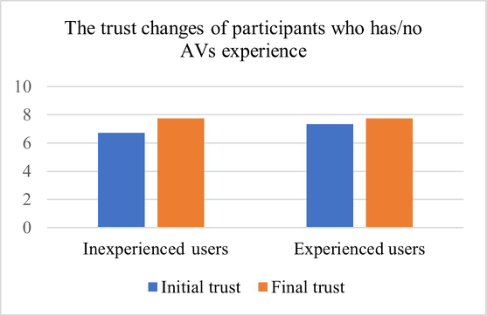
Factors Analysis that Affect Dynamic Trust in AVs By comparing the trust scores of all participants before and after the expe- riment, we found that the final trust of most participants was improved compared with the initial trust. There was a significant difference between final trust and initial trust (by a non-parametric test, P = 0.028 <0.05). Analy- sis of the statistical data found that participants with AVs experience had higher initial trust than those without. After the experiment was comple- ted, the increase in trust was more pronounced among participants with no experience of AVs (see Figure 1).
Table 5. Analysis results of gender.
Table available in the original PDF paper.
Acceptance
Understanding Reputation
Perceived
Gender Driving capacity
Driving experience
of AVs privacy
of new technologies
of AV technology
risk Male Mean 5.78 6.35 5.45 5.31 4.40 4.47 St. dev. 1.258 0.978 1.776 1.505 1.679 2.011 FemaleMean 4.99 6.04 4.39 4.36 4.87 4.88 St. dev. 1.597 1.014 1.824 1.664 1.523 1.789 T 6.136 3.836 7.141 6.968 -3.604 -2.688 p 0.000 0.000 0.000 0.000 0.000 0.008
Figure 1: The trust changes of participants who has/no AVs experience.
In this experiment, the effects of audible reminders on situational aware- ness and trust in AVs were comparatively analyzed. The level of situation awareness was scored with a score of 1 to 5. In the situation of pedestrians and obstacles with audible reminders, the participants’ perception, under- standing of the current situation, and prediction of the future situation and trust had higher scores than those without audible reminders, as shown in Table 6. For the situation of pedestrians and obstacles, the score with audi- ble reminders was significantly higher than that without audible reminders in the perception (p<0.01) and understanding (p<0.01) of the current situa- tion. The results indicated that for higher-risk events such as pedestrians and obstacles, the audible reminder can effectively enhance drivers’ situational awareness and trust as a strong reminder to supplement visual channel in automated driving systems.
According to the average score of the participants, the complexity of the experimental session was 2, 3, 1, 5, 6, and 4 from large to small, as shown in Figure 2. Paired Wilcoxon signed rank test was performed on the scores. It was found that there was no significant difference between the scores of sessions 1, 5, and 6, and there were significant differences among the others. It shows that sessions 1, 5 and 6 can be used at the same complexity level. The complexity of six sessions was divided into four levels: session 4 was
Assessing Drivers’ Trust in Automated Driving Systems: An Integrated Study 345
Table 6. Analysis results of audible reminders for pedestrians and obstacles.
Table available in the original PDF paper.
Dimension Perception Understanding Prediction Trust With audible reminders Mean 4.5 4.8 4.5 8 St. dev. 0.707 0.422 0.85 1.054 Without audible reminders Mean 2.5 3.5 4 6.5 St. dev 0.707 0.707 0 0.707 T 3.651 3.662 1.861 1.89 p 0.004 0.004 0.096 0.088
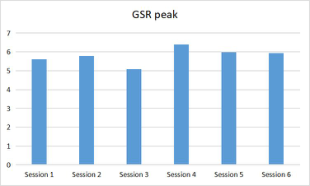
Figure 2: The analysis of road complexity, trust and physiological measures.
level 1, sessions 1, 5, and 6 were level 2, session 3 was level 3, and session 2 was level 4. Relabel each session with the value of grade division to find the correlation between road complexity and various indicators.
The renewed road complexity classification was negatively correlated with the average peak times of SCR (r = -0.602) and trust (r = -0.687); and it was positively correlated with heart rate (r = 0.639). To some extent, the results can explain that the more complex the road conditions, the higher the heart rate, the more nervous the participants were during the experiment, and the lower the trust, which is related to situational trust factors such as drivers worried about the performance of the automated driving system to deal with the complex situation.
CONCLUSION
This study assessed drivers’ initial and dynamic trust in AVs from the perspe- ctive of individual dispositional, learned, and scenarios factors. Findings in this study emphasize the importance of individual differences in understan- ding how to trust in AVs is built, maintained, and fluctuated over time in the process of interaction between humans and AVs. More specifically, higher initial trust in AVs is more often generated by drivers who are younger, male,
have more driving years, more experience of AVs, higher driving capacity, higher acceptance of new technology, more understanding of AV technology, and less privacy risk and safety awareness. The dynamic trust changes with the understanding of the performance of the AVs and the external environ- ment. Trust in AVs increased after experiencing how the system responded to different events in traffic, especially among those who had not experienced AVs. The audible reminder is an effective way to enhance situational aware- ness in high-risk scenarios, which helps to perceive and understand sudden changes in the environment. The results of this study provide an effective basis for further research and design related to improving the trust in AVs.
REFERENCES
Choi, J.K. and Ji, Y.G. (2015) ‘Investigating the Importance of Trust on Adopting an Autonomous Vehicle’, International Journal of Human–Computer Interaction, 31(10), pp. 692–702. doi:10.1080/10447318.2015.1070549. Ekman, F., Johansson, M. and Sochor, J. (2018) ‘Creating Appropriate Trust in Automated Vehicle Systems: A Framework for HMI Design’, IEEE Transactions on Human-Machine Systems, 48(1), pp. 95–101. doi:10.1109/THMS.2017.2776209. Hancock, P.A. et al. (2011) ‘A Meta-Analysis of Factors Affecting Trust in Human-
Robot Interaction’, Human Factors: The Journal of the Human Factors and Ergonomics Society, 53(5), pp. 517–527. doi:10.1177/0018720811417254. Hoff, K.A. and Bashir, M. (2015) ‘Trust in Automation: Integrating Empirical Evidence on Factors That Influence Trust’, Human Factors: The Journal of the Human Factors and Ergonomics Society, 57(3), pp. 407–434. doi: 10.1177/0018720814547570. Holthausen, B.E. et al. (2020) ‘Situational Trust Scale for Automated Driving (STS-
AD): Development and Initial Validation’, in 12th International Conference on Automotive User Interfaces and Interactive Vehicular Applications. Automoti- veUI ‘20: 12th International Conference on Automotive User Interfaces and Interactive Vehicular Applications, Virtual Event DC USA: ACM, pp. 40–47. doi:10.1145/3409120.3410637. Koo, J. et al. (2015) ‘Why did my car just do that? Explaining semi-autonomous driving actions to improve driver understanding, trust, and performance’, Inter- national Journal on Interactive Design and Manufacturing (IJIDeM), 9(4), pp. 269–275. doi:10.1007/s12008-014-0227-2. Körber, M., Baseler, E. and Bengler, K. (2018) ‘Introduction matters: Manipulating
trust in automation and reliance in automated driving’, Applied Ergonomics, 66, pp. 18–31. doi: 10.1016/j.apergo.2017.07.006. Manchon, J.B., Bueno, M. and Navarro, J. (2021) ‘Automation, Expert Systems Calibration of Trust in Automated Driving: A Matter of Initial Level of Trust and Automated Driving Style?’, Human Factors: The Jour- nal of the Human Factors and Ergonomics Society, p. 001872082110528. doi: 10.1177/00187208211052804. Waytz, A., Heafner, J. and Epley, N. (2014) ‘The mind in the machine: Anthropomorphism increases trust in an autonomous vehicle’, Journal of Experimental Social Psychology, 52, pp. 113–117. doi: 10.1016/j.jesp.2014.01.005.
Assessing Drivers’ Trust in Automated Driving Systems: An Integrated Study 347
Wintersberger, P. et al. (2020) ‘Explainable Automation: Personalized and Adaptive UIs to Foster Trust and Understanding of Driving Automation Systems’, in 12th International Conference on Automotive User Interfaces and Interactive Vehicu- lar Applications. New York, NY, USA: Association for Computing Machinery (AutomotiveUI ‘20), pp. 252–261. doi: 10.1145/3409120.3410659. Zhang, Q., Yang, X.J. and Robert, L.P. (2021) ‘Individual Differences and Expe-
ctations of Automated Vehicles’, International Journal of Human–Computer Interaction, pp. 1–12. doi: 10.1080/10447318.2021.1970431. Zhang, T. et al. (2019) ‘The roles of initial trust and perceived risk in public’s acceptance of automated vehicles’, Transportation Research Part C: Emerging Technologies, 98, pp. 207–220. doi: 10.1016/j.trc.2018.11.018.
LISTED IN THE AHFE DIGITAL BOOKSTORE CATALOGUE
Explore the complete digital volume
Human Factors in Transportation
Read this individual research paper free through the original publisher, or explore the full digital proceedings book.
ISBN 978-1-958651-36-0
Explore this ISBN in the AHFE Bookstore ↗Listed in the July 2026 bookstore catalogue; search by ISBN to confirm current availability · Digital book purchase optional