Tianxiong Wang, Liu Yang, Xian Gao, Tong Yu, Qiang Yu (2023). Optimization and decision making of design solutions for product development of wickerwork lamps. In: Kansei Engineering. AHFE Open Access, vol. 101, pp. 1–13. https://doi.org/10.54941/ahfe1002986
With the popularity of the concept of sustainable traditional wickerwork, wickerwork lamps have become the most popular craft. When customers purchase wickerwork luminaire products, Kansei consensus has become a key factor influencing the communication between manufacturers and customers. Therefore, this paper establishes a three-level evaluation grid diagram driven by user attractiveness through Miryoku engineering to clarify the key perceptual appeal and design elements. Secondly, to solve the problem of subjectivity and uncertainty in product design solution preference, the design solution evaluation and preference method is proposed. For the key perceptual factors, the gray correlation analysis is used to comprehensively assess the priority order of evaluation indicators. Finally, the Vikor was used to evaluate representative product design solutions to obtain the best ranking of alternatives, and then the best product design solution was selected. The results show that the method takes into account the subjectivity and uncertainty of the decision making process in the selection of design solutions, which can effectively improve the objectivity and accuracy of the solution evaluation results and provide more objective and effective reference suggestions for designers to measure the quality of design results.
Cultural elements have been considered as an important source of inspiration for art (Qin and Ng, 2020). Many designers and researchers have endeavo- red to interpret and translate physical forms derived from cultural traditions into modern artistic practices (Swan, 2018). The culturally meaningful design can support the sustainable role of designed objects in contemporary cultu- ral contexts and increase the cultural satisfaction of consumers (Chai et al., 2015). Traditional Chinese culture has a long history, after five thousand years of precipitation, it has formed a traditional culture rich in national characteristics, which is not only rich in connotation but also has a certain national representation. How to effectively inherit and develop Chinese tradi- tional culture is a key issue. The “Opinions of the General Office of the State
Council on Strengthening the Protection of China’s Intangible Cultural Heri- tage” released in 2005 puts forward the basic policy of “protection-oriented, salvage first, reasonable utilization, inheritance and development” for the protection of intangible cultural heritage. On the other hand, we should also actively guide the reform of the image of intangible cultural heritage artistic image art (Zhang and Tsai, 2021). Based on keeping the national tradition and cultural characteristics as much as possible, integrating modern elements, and giving full play to the advantages of traditional crafts, and exploring the innovative development of traditional skills so as to better adapt to the needs of modern society. This has also become an urgent task to revitalize traditional crafts.
The intangible cultural heritage of handicraft category is the wisdom of labor and experience accumulated by the nation in the long process of social evolution, and its expressions are diverse and its connotations are simple. Wickerwork is one of the traditional Chinese folk crafts. From the early Paleolithic period, primitive people used plants with high tenacity to make various containers and wrappings in their lives, and used various methods to make different types of woven products. As China’s intangible cultural heritage, Anhui Funan wickerwork handicraft could not only reflect the long history of folk art, but also the satisfaction of traditional skills for the deve- lopment of people’s spiritual needs. Academics usually focus on the cultural genes implanted in the form and structure of cultural products for redesign research, and lamps products are closely related to the modern people’s daily life, which is one of the important ways to spread and continue the wicke- rwork culture. However, in the development process of Funan wickerwork craft products, there is a lack of user preference-centered product satisfaction evaluation (Chen et al., 2022), which is a very important part of research and development. Hence, how to make the wickerwork products effectively meet consumer expectations, through the innovation of design methods to accu- rately grasp the psychological feelings of the wickerwork products to users seems very necessary.
In essence, the design concept assessment phase is both important and challenging (Lai et al., 2021). Multi-attribute Composite Decision Making (MCDM) has received significant attention in design concept evaluation due to the diversity and complexity of the evaluated attributes. Most of the resea- rch on design concept evaluation has focused on improving the determination of index weights and evaluation methods, and researchers have used various means to explore effectively, among which the vikor method has a grea- ter advantage in obtaining the ideal solution and the incommensurability between data processing, and this method is a good multi-attribute decision making method by maximizing group benefits and minimizing individual regrets to obtain a compromise solution accepted by decision makers.
Therefore, this study attempts to adopt a novel approach, it is achieved by a hybrid analytical approach combining of GRA model with vikor to achieve effective decision making for product innovation solutions. Firstly, by appl- ying the EGM method to qualitatively obtain user perceptual claims, and then extract the key claims based on the number of user mentions and esta- blish evaluation items based on the Lower-item. Then, the weight values of
Optimization and Decision Making of Design Solutions 3
the evaluation design items of wickerwork products are determined by GRA. On this basis, the potential wickerwork cultural and creative products in the market are further ranked by the vikor model, so that the products that meet users’ emotional demands are systematically identified and prioritized for screening. The feasibility and effectiveness of the method is verified by taking the wickerwork lighting product design as an example.
LITERATURE REVIEW
Wickerwork Product Industry of China The wickerwork products are quite popular in China, Japan and other Sou- theast Asian countries (Paspirom and Rugwongwan, 2018). In China, the Funan wickerwork craft after years of development has been transformed from the traditional meaning of wickerwork to cover the traditional wicke- rwork home, decoration, art and other wickerwork wood culture industry, the production of wickerwork craft products have nearly 10,000 varieties, wickerwork crafts sell well in the European and American markets, which has become a local rural specialty industry and pillar industry (Wang, 2016).
In 2021, the output value of the county-wide wickerwork culture industry in Funan exceeded 10 billion yuan, and the export of wickerwork was nearly $400 million, accounting for 87% of the county’s export earnings. Funan wickerwork has been approved 1133 patents, 81 innovation teams of skills and product research and 430 researchers. Funan also have 156 non-genetic inheritors of wickerwork skills at all levels, and 2618 professional wickerw- ork technicians. Funan county has been built as the largest domestic export base of wickerwork, in 2022 January-May, wickerwork culture export per- formance enterprises accumulated exports of 147 million dollars, which is accounting for 84.92% of the county’s total export ratio. Currently, Funan county has built 83,000 acres of wickerwork planting base, the annual output of 280,000 tons of wickerwork, 14 towns and villages about 130,000 peo- ple engaged in willow production and operation, farmers increased income of nearly 500 million, medium-sized and above 62 enterprises, including 17 wickerwork enterprises approved high-tech enterprises, and four natio- nal cultural key export enterprises, and two provincial cultural key export enterprises.
Although the production of a wide range of Funan willow products, but the innovative design is very little, most of the product style is relatively sin- gle, low value, most of the product categories are still stuck in the traditional meaning of expression, such as traditional utensils, baskets and hats, etc., many product styles and types have a certain age, the appearance of the shape and modern aesthetic gap is large, the weaving skills is single, and relatively simple product shape can not meet the aesthetic standards and requirements of modern society, and can no longer meet the needs of consumers and the market (Jin et al., 2020; Zhang and Zhang, 2020), which could result in the industry being severely detached from the market and the products lacking in innovation. Therefore, it is necessary to incorporate some modern adva- nced design concepts and fashion elements to make the products innovative. Through the “redesign”of willow intangible cultural heritage handicrafts, the
intangible cultural heritage handicrafts formed in specific traditional com- munities and folk customs can obtain the ability to regenerate, while helping the development of regional tourism economy, and maintaining the cultural, regional and national characteristics of intangible cultural heritage, and enha- ncing cultural diversity and the cultural identity of intangible cultural heritage groups, which has great significance to the realization of the inheritance of intangible cultural heritage.
GST The Gray system theory (GST) was proposed by Professor Deng Julong of Huazhong University of Science and Technology in 1982 (Li et al., 2007). Gray system theory is based on the uncertain system with some information known and some information unknown. Through the analysis of develo- pment of known information, and to achieve correct cognition and effective monitoring of system operation and evolution laws (Nagpal et al., 2014). In GST, the integrity of the message can be represented by gray scale. The system that fully knows the information is represented by white, and the system that does not know the information is represented by black, and the system that partially knows and partially does not know the information is represented by gray. The whole gray system is a system that changes dynamically with time (Liu and Tong, 2018).
For the factors between the systems, the measure of the correlation size that changes with different objects is called the “gray correlation degree”. Based on quantitative analysis, the numerical relationship between the vari- ous subsystems (or factors) in the system is used to analyze the similarity of curves between system factors and system behavior (Sun et al., 2015). Essen- tially, the main difference of gray relational analysis (GRA) and traditional mathematics is that the gray relational analysis provides a summary framew- ork for analyzing the sequence relationship or system behavior, and the gray relational analysis can be carried out even if the amount of information used for analysis is small by using this framework (Kang, 2020). Therefore, it is widely used in the system analysis, management decision-making and Kan- sei Engineering (KE) (Liu and Tong, 2018; Hsiao et al., 2016; 2017). In this study, the gray relational analysis method is considered in the process of wei- ght analysis of evaluation index elements, and the mechanism of association between design elements and style features is further explored.
The “gray correlation coefficient” metric was proposed to measure the closeness between the comparison alternative and the benchmark alternative (reference series) as follows (Wang, 2015): Establishing comparison levels: Suppose X denotes an m × n matrix to collect the evaluation of the performance levels of n dimensional elements in m alternatives, where xi(k) denotes element k of alternative i, m is the number of a series of alternatives, and n denotes the number of criterion attributes.
[Equation or mathematical symbol available in the original paper PDF]
[Equation or mathematical symbol available in the original paper PDF]
Equations and mathematical formulas are available in the original paper PDF.
Optimization and Decision Making of Design Solutions 5
The reference series setting: The elements of the reference series are set by their corresponding maximum rating scale, which is also similar to the ideal solution.
(maxxi(j)
, (minxi(j)
j ∈J
j ∈J) i i
Where J indicates the greater the revenue the better the project,bJ indicates the smaller the cost, the better the project.
Calculating the “gray scale” between the target series and the reference series using the deviation matrix:
[Equation or mathematical symbol available in the original paper PDF]
Equations and mathematical formulas are available in the original paper PDF.
, xi(j) and xr(j) denote the jth element of the target sequence and the reference sequence, respectively.
Calculating the gray correlation coefficient:
xi(j) −xr(j)
(5) ∀j
∀i min
xi(j) −xr(j)
(6) ∀j
∀i max
In general, the ξ ∈(0, 1) is set to 0.5. The gray correlation is the average of gray correlation coefficients:
n X γ (xi(j), xr(j)) (7)
VIKOR In order to address the shortcomings of the traditional TOPSIS, a multi- attribute decision making method based on ideal solutions, the VIKOR method, was proposed by Opricovic in 1998 (Opricovic, 1998). This method focuses on ranking and selection from a set of alternatives in the presence of conflicting criteria. In some cases, the actual alternatives possess several non- comparable and conflicting criteria and there may be no solution that satisfies all criteria simultaneously (Park et al., 2011). A compromise solution to a problem with conflicting criteria can help decision makers reach a final solu- tion. The VIKOR method focuses on compromise ranking/selection from a set
of alternatives for ranking alternatives and generating compromise solutions in the presence of conflicting and incomparable criteria. The method iden- tifies solutions for multi-criteria optimization of complex systems (Tiwari et al., 2016). To assume that each alternative is evaluated according to multidi- mensional criteria, the VIKOR generates a ranking index based on measure of proximity to the ideal alternative (Wang and Wu, 2014). The ranking index was developed from an aggregation function LP - metric in compromise plan- ning (Steuer et al., 1997). The VIKOR method uses a linear normalization method to eliminate standard units and determine a compromise solution that represents the maximum group utility for the majority and the mini- mum individual regret for the majority, respectively (Opricovic and Tzeng, 2004). Thus, the VIKOR is particularly powerful in settings where decision makers are unable or do not know how to express their preferences in the early stages of product development (Opricovic and Tzeng, 2004). Due to its unique advantages, VIKOR has been widely used in various decision making domains such as material selection, product development, and robot selection (Wang and Wu, 2014; Jahan et al., 2011; Devi, 2011).
In the calculation process of Vikor, the preferred solution needs to be deter- mined. Determining the best solution is divided into two steps: 1. Sort the values of Qi, Si and Ri in order from smallest to largest to get three sor- ting sequences; 2. Sort the alternatives from smallest to largest by Q. The 1st alternative is the best solution when it satisfies the following two conditions.
Condition 1 acceptable advantage: Q(S(2))—Q(S(1))≥1/(M-1); Condition 2 The decision process has acceptable stability: such as sorting according to Si and Ri, S(1) still ranked first
If one of the above two condi- tions is not satisfied, a set of compromise solutions is obtained (Jahan et al., 2011).
METHOD
In order to meet the needs of users and speed up the product develo- pment process, this study proposes a product form design decision-making method driven by user attraction through the combination of gray theory and VIKOR. In particular, this method helps to develop customer-oriented produ- cts and provides a scientific basis for the selection of product design schemes. Through the application of EGM, the key design elements and demand items of products are discussed from the perspective of user attractive factors. Then through SD method and gray relational analysis to obtain the relationship between modeling features and perceptual images, obtain the objective wei- ght of each index, and then screen out key modeling items. Then, by applying VIKOR to the preference analysis of customer demand schemes, the product design schemes that meet the needs of users are screened out so as to guide the positioning and development of product conceptual design, and the best ranking of alternative schemes is obtained. Thus, the best product design solution is screened out.
Analysis of Product Form Attractiveness Factors Evaluation Gird Method (EGM), as an expert evaluation tool of Miryoku Engineering, was further developed by Sanui in 1996 based on the repertory
Optimization and Decision Making of Design Solutions 7
grid method (Kelly, 1955) proposed by Kelly (1955), and its goal is to extract consumer language to understand the evaluation items and various factors that constitute the grid, and to structure the imagery of the upper level of attractiveness factors through in-depth investigation of individuals seman- tics and the hierarchical relationship between the specific attraction features of the lower layer, and to evaluate the original items of the upper and lower levels from abstract to figurative, thus visualizing and fixing the consumer value structure (Shen et al., 2015), which has been widely used by experts in recent years in the design of products (Ho and Hou, 2015; Shen, 2013; Wang and Zhou, 2021). The specific research methods of the EGM qualitative research method are as follows:
1. Firstly, select the more classic experimental samples in the market, show all the product sample pictures in front of the user after printing them out in the form of A4 printing paper, so that the user selects his own favorite sample pictures. 2. Ask the user about the specific reasons for liking the sam- ple pictures, and determine the key reason for the sample to attract the user, which is the middle item in the attractive factor of the product. 3. To further ask the user about the reasons for liking the result is the lower morpholo- gical feature of the attractive factor for the product. 4. Then, further ask the specific morphological feature of the product to the user’s psychological feeling, the result is the upper perceptual imagery of the attractive factor of the product. 5. To investigate the upper, middle and lower position of all the sample images that the user likes, and connect the corresponding items by straight lines to show the hierarchy relation. 6. The KJ simplification method is used to merge the same or similar upper level (perceptual imagery) and lower level (specific styling features), and the number of times after the mer- ger is equal to the sum of all user mentions before the merger, so as to build the evaluation construction diagram of product appeal factors, and structure the hierarchical relationship and correlation between the imagery semantics of the upper level and the specific styling attraction features of the lower level.
In this paper, we selected sample of complete wickerwork luminaire forms for in-depth interviews. A wide sample of 45 products that fit the scope of the study was collected by reviewing magazines, websites and other sources. After focus group discussions, a total of 20 representative wicke- rwork luminaire products were selected by excluding samples with overly exaggerated and highly familiar appearance. In order to reduce the interfere- nce of background, light, shadows and colors to the subjects, all samples were cropped using the 2D software PHOTOSHOP for the next step of analysis.
In order to obtain qualitative reference information, six highly engaged expert groups were recruited for experimental interviews, they were 3 men and 3 women, aged 26 to 38, all with more than five years of industrial design experience. The experts were invited to compare the wickerwork luminaire products, interviewed from the perspective of pro and con, like and dislike, and asked the sample about the original evaluation items of specific attracti- veness (middle) and the performance characteristics of specific attractiveness (lower) and the emotional factors (upper) through the EGM method, and
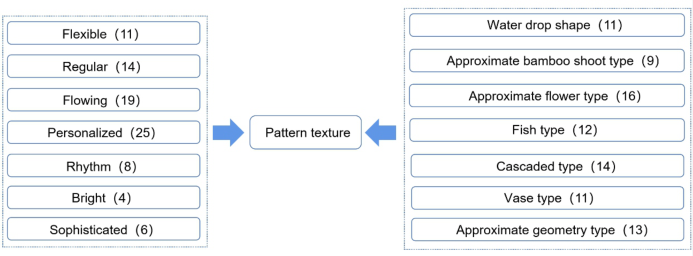
each interview lasted about 45 minutes. After the interview, in order to avoid the problem of too many items easily generating user fatigue, similar words and specific styling features were further merged through the KJ method, thus forming a logic diagram of the attractiveness hierarchy of the wickerw- ork lamps and lanterns products. The attractiveness features analysis about the styling of the wickerwork lamps products is shown in Fig. 1.
Extracting Key Emotional Words Based on the interview results, 10 Kansei words were initially obtained. If these 10 perceptual words were subsequently used as design targets, too many words would undoubtedly increase the burden on the subject. To handle this problem, based on the number of user mentions, personalized was the highest number (32), thus selecting personalized perceptual words as the key appeal to further explore, which could reduce the number of factors needed to explain the subject. Specifically, the number of perceptual evaluations of Funan wickerwork lamps in descending order is shown in Table 1.
To Identify Key Features of Wickerwork Lighting Products By deconstructing the morphological elements of wickerwork lamps, we extracted the most important design features of their shapes and established design feature items, so as to accurately analyze the correspondence between morphological design and customer satisfaction. Given that gray correlation analysis is based on a “small sample, poor information”gray system, the gray analysis model is constructed to establish the quantitative relationship betw- een product form characteristics and user perceptual imagery. Through EGM interviews, the specific design features of the products that attract users were
Figure 1: The hierarchical diagram.Table 1. Mentions number of perceptual words.
Optimization and Decision Making of Design Solutions 9
obtained, and on this basis, the specific types of design variables of wickerw- ork product form were deduced, and eight evaluation indexes of wickerwork lighting product form features were constructed (see Table 2).
93 subjects (43 males and 50 females, with more than 3 years of product design experience, aged between 25 and 45 years) formed a research team to perceptually assess the morphological satisfaction of 10 wickerwork lighting products, and to derive the rating values of 10 samples on the personali- zed perceptual semantic. Next, to take the personalized vocabulary as the reference sequence and the other 8 evaluation indicators as the comparison sequence. Hence, the gray correlation degree (GRD) of eight evaluation indi- cators was calculated. Table 3 shows the values of evaluation item weights derived from the experimental results.
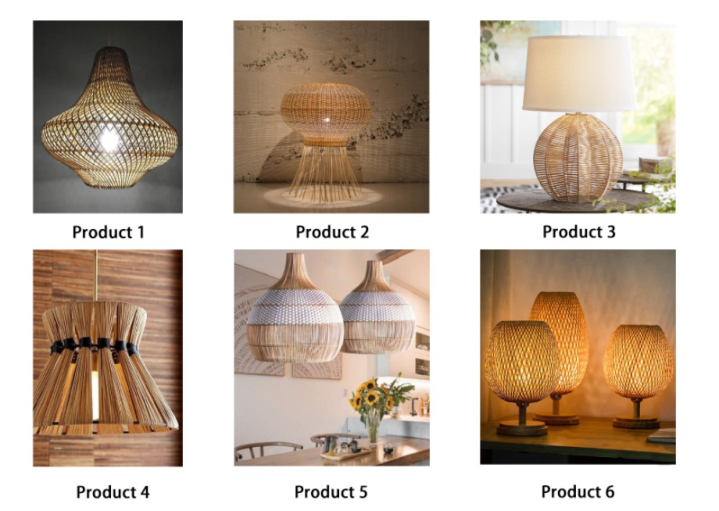
VIKOR Completes Prioritization Decision for Wickerwork Lighting Products Using VIKOR to analyze the decision information after normalization, based on the weight values derived from Table 3, 48 decision makers consisting of 4 design faculty members, 4 product managers, and 40 design graduate students began to reasonably evaluate the 8 evaluation indexes involving the 6 Funan wickerwork lamps product design solutions P1, P2, P3, P4, P5, P6, and 6 wickerwork lamps products are shown in Figure 2.
To handle product design solution evaluation decision information based on the VIKOR method, and to calculate the Si, Ri and Qi, separately, 1≤i ≤10. The results of the calculations are shown in Table 4. According to the experimental results, the solutions are ranked in order of their compromise values Qi from smallest to largest, and the first ranking is solution P5, the second ranking is P1, the third ranking is P6, followed by P2, P4, P3. To verify the reasonableness of the results, we examine the compro- mise solution to determine the two conditions of the first case: firstly, since Q(P1) - Q(P5) ≥1/(i-1)(i = 6), Therefore, condition 1 is satisfied. Secondly,
Table 2. The funan wickerwork lamps morphological features element project.
Table available in the original PDF paper.
Design elements No. Item Morphological 1 Similar in form to plants 2 The shape has geometric characteristics 3 The trend of the shape 4 The styles of form 5 The unity of lighting function and form 6 Personalized artistic forms 7 Similar in form to animals 8 Forms with traditional cultural elements
the value of P5 is the first ranking among Si and Ri values and is more sta- ble, so it satisfies condition 2. Therefore, the solution P5 is the best design solution.
CONCLUSION
In the traditional craft sales market, a good design of wickerwork lamps can distinguish one’s products from many homogeneous competitions, attract consumers’ attention, and increase product sales, which has positive impli- cations for the heritage and sustainability of traditional crafts. The main objective of this study is to develop a framework for evaluating traditio- nal wickerwork lamps products that combines the GRA and Vikor on the platform of evaluation structure established by Miryoku engineering. Firstly, the representative upper-level Kansei factors, and 2 original causes, and 16
Optimization and Decision Making of Design Solutions 11
lower-level specific design conditions based on EGM of 8 experts. Secondly, the impact values of key evaluation items were obtained by the GRA calcula- tion method. Finally, the priorities of the wickerwork lamps design solutions were evaluated based on the Vikor, and the feasibility and effectiveness of this proposed method were verified by example analysis.
The GRA method was used to establish a more objective weighting model for the evaluation of design solutions. The Vikor method is used to get the best ranking of alternative solutions, and then the best product design solution is selected. Based on the GRA and Vikor composition of the design solu- tion evaluation and selection method can effectively improve the objectivity and accuracy of solution evaluation results, so as to provide reference for designers to preferably select product design solutions.
ACKNOWLEDGEMENTS
This research was supported by the Project of Philosophy and Social Science Planning of Anhui Province in 2022 (AHSKQ2022D148).
REFERENCES
A Kelly, G., The Psychology of Personal Constructs. Norton: New York, 1955. Chai, C.; Bao, D.; Sun, L.; Cao, Y., The relative effects of different dimensions of traditional cultural elements on customer product satisfaction. Int. J. Ind. Ergon. 2015, 48, 77–88. Chen, Z.; Zhong, P.; Liu, M.; Ma, Q.; Si, G., A novel integrated MADM method for
design concept evaluation. Sci. Rep. 2022, 12, (1). Devi, K., Extension of VIKOR method in intuitionistic fuzzy environment for robot selection. Expert Syst. Appl. 2011, 38, (11), 14163–14168. Ho, C. H.; Hou, K. C., Exploring the Attractive Factors of App Icons. KSII Trans.
Internet Inf. Syst. 2015, 9, (6), 2251–2270. Hsiao, S.-W.; Lee, C.-H.; Chen, R.-Q.; Yen, C.-H., An intelligent system for fashion colour prediction based on fuzzy C-means and gray theory. Color Res. Appl. 2016, 42, (2), 273–285. Hsiao, S.-W.; Lin, H.-H.; Ko, Y.-C., Application of Grey Relational Analysis to
Decision-Making during Product Development. EURASIA Journal of Mathema- tics, Science and Technology Education 2017, 13, (6). Jahan, A.; Mustapha, F.; Ismail, M. Y.; Sapuan, S.; Bahraminasab, M., A comprehensive VIKOR method for material selection. Materials & Design 2011, 32, (3), 1215–1221. JIN, J.; Chu, Q.; Wang, Z., EXPLORATION OF INNOVATIVE DESIGN OF TRA-
DITIONAL HANDICRAFT——TAKE HUANG GANG WICKERWORK AS AN EXAMPLE. Design 2020, 33, (15), 147–149. Kang, X., Combining Grey Relationship Analysis and Neural Network to Develop Attractive Automobile Booth Design. Comput Intell Neurosci 2020, 2020, 8863727. Lai, Z.; Fu, S.; Yu, H.; Lan, S.; Yang, C. In A Data-driven Decision-making Approach
for Complex Product Design Based on Deep Learning, 2021 IEEE 24th Internati- onal Conference on Computer Supported Cooperative Work in Design (CSCWD), 2021; IEEE: 2021; pp. 238–243. Li, G.-D.; Yamaguchi, D.; Nagai, M., A grey-based decision-making approach to the supplier selection problem. Math. Comput. Modell. 2007, 46, (3-4), 573–581.
Liu, C.-Y.; Tong, L.-I., Developing Automatic Form and Design System Using Integrated Grey Relational Analysis and Affective Engineering. Applied Sciences 2018, 8, (91), 1–22. Nagpal, G.; Uddin, M.; Kaur, A., Grey Relational Effort Analysis Technique Using
Regression Methods for Software Estimation. The international arab journal of information technology 2014, 11, (5), 437–446. Opricovic, S. Multicriteria Optimization of Civil Engineering Systems. University of Belgrade, Belgrade, 1998. Opricovic, S.; Tzeng, G.-H., Compromise solution by MCDM methods: A com-
parative analysis of VIKOR and TOPSIS. Eur. J. Oper. Res. 2004, 156, (2), 445–455. Park, J. H.; Cho, H. J.; Kwun, Y. C., Extension of the VIKOR method for group decision making with interval-valued intuitionistic fuzzy information. Fuzzy Optimization and Decision Making 2011, 10, (3), 233–253. Paspirom, G.; Rugwongwan, Y. In A Perception Study on Buying Decision Factors
of Thai Fish-Shaped Wickerwork (Souvenir) Between Thais and Malaysian Con- sumers, 4th Association-of-Behavioural-Researchers-on-Asians (ABRA) Interna- tional Conference on Quality of Life (AQoL) Conference Location Istanbul, TURKEY, 2018; E-IPH LTD UK Location SHEFFIELD: 2018; pp. 3–8. Qin, Z.; Ng, S., Culture as inspiration: A metaphorical framework for designing products with traditional cultural properties (TCPs). Sustainability 2020, 12, (17), 7171. Sanui, J., Visualization of users’ requirements: Introduction of the Evaluation Grid
Method. In The 3rd Design & Decision Support Systems in Architecture & Urban Planning Conference, 1996; pp. 365–374. Shen, K. S., Measuring the sociocultural appeal of SNS games in Taiwan. Internet Research 2013, 23, (3), 372–392. Shen, K.-S.; Chen, K.-H.; Liang, C.-C.; Pu, W.-P.; Ma, M.-Y., Measuring the functio-
nal and usable appeal of crossover B-Car interiors. Hum. Factors Ergon. Manuf. Serv. Ind. 2015, 106–122. Steuer, R.; Qi, Y.; Hirschberger, M., Multiple criteria decision making. North– Holland. New York: 1997. Sun, S.; Zhang, Q.; Huang, k.; Wang, P.; Yin, A., Research on Micro Milling
Burr Based on Grey Correlation Analysis Method. China Mechanical Engineering 2015, 26, (15), 2036–2040. Swan, K. S., Design Roots: Culturally Significant Designs, Products and Practices.
The Design Journal 2018, 21, (6), 873–878. Tiwari, V.; Jain, P. K.; Tandon, P., Product design concept evaluation using rough sets and VIKOR method. Adv. Eng. Inf. 2016, 30, (1), 16–25. Wang, C.-H., Integrating Kansei engineering with conjoint analysis to fulfil market
segmentation and product customisation for digital cameras. Int. J. Prod. Res. 2015, 53, (8), 2427–2438. Wang, C.-H.; Wu, C.-W., Combining conjoint analysis with Kano model to optimize product varieties of smart phones: a VIKOR perspective. Journal of Industrial and Production Engineering 2014, 31, (4), 177–186. Wang, T.; Zhou, M., Integrating rough set theory with customer satisfaction to con-
struct a novel approach for mining product design rules. J. Intell. Fuzzy Syst. 2021, 41, (1), 331–353. Wang, Y., Research on the Present Situation and Development of wickerwork Technology in Huaihe River of Anhui Province. Popular literature and art 2016, (19), 41–42.
Optimization and Decision Making of Design Solutions 13
Zhang, L.; Zhang, X., Research on Fusion Application of FuNan wickerwork and Ceramic Materials. JOURNAL OF GUANGXI NORMAL UNIVERSITY FOR NATIONALITIES 2020, 37, (3), 84–87. Zhang, W.; Tsai, S.-B., An empirical study on the artificial intelligence-aided quan-
titative design of art images. Wireless Communications and Mobile Computing 2021, 2021.
LISTED IN THE AHFE DIGITAL BOOKSTORE CATALOGUE
Explore the complete digital volume
Kansei Engineering
Read this individual research paper free through the original publisher, or explore the full digital proceedings book.
ISBN 978-1-958651-77-3
Explore this ISBN in the AHFE Bookstore ↗Listed in the July 2026 bookstore catalogue; search by ISBN to confirm current availability · Digital book purchase optional