Sho Hasegawa, Masashi Yamada (2023). A Statistical Analysis of History of Japanese Light Novels. In: Kansei Engineering. AHFE Open Access, vol. 101, pp. 87–94. https://doi.org/10.54941/ahfe1002996
In recent years, cool Japan anime, video games and manga have been recognized as important export-oriented merchandise in Japan. Another recent Japanese genre is light novels. Light novels are one of the genres of novels and construct a part of recent Japanese pop culture. In Japan recently, the anime, manga and live-action films have been adapted from the original light novels. Light novels were chiefly read by high and junior-high school student previously, but the range of the readers has been expanding widely in recent years. However, light novels have not been statistically studied yet. In the present study, 533 titles of popular light novels published in 2004-2020 were investigated to clarify the trends in the genre.Numbers were counted for each of 129 items, data of published year, publisher, label, platform first appeared on, length of time from the first publication to the release of the anime adaptation, length of time from the first publication to the manga adaptation and so on for each year. And a 17 x 129 cross-tabulation table was constructed. Then it was analyzed by correspondence analysis and cluster analysis.The results of the correspondence analysis showed a three-dimensional solution with a cumulative contribution ratio of 64 %. Each year was plotted on the three-dimensional space, then cluster analysis was performed on the plots with Ward’s method. The results of the cluster analysis showed that the plots could be divided into four periods; 2004-005, 2006-2015, 2016-2017 and 2018-2020.The results showed that KADOKAWA’s labels were popular between 2004 and 2014, but the other publishers’ labels which collect novels appearing in individuals’ private home pages or posted on web-sites became popular in recent years. The most important part of the business strategy of light novels is mass-production, which means a large number of works and writers are needed. As such, it stands to reason that internet novel submission sites have become an important source for publishers.The results also showed that it only took one or two years to produce anime for many titles between 2006 and 2014, but in recent years, the period of time has increased to four years and the number of cases where no anime was produced has also increased. Additionally, manga based on the light novels tends to be published within one year. This suggests that the center of the multimedia strategy of light novels has shifted from anime to manga. Since the mid-2010s, tablet devices and e-comics applications have rapidly developed. This has enabled publishers to rapidly produce and publish manga based on the original light novels. Moreover, it now takes longer to produce anime, because the quality of frames and productions costs have increased. Therefore, anime studios tend to select an original work of light novel carefully, observing the sales of the e-manga adaptation.
The light novel is a genre of novels which oriented to teens. Light novels are playing a part of current Japanese pop culture. According to the “ORICON Entertainment Market Research 2020,” the light novels were sold in total 32.5 million copies and 28.37 billion yen (about 220 million dollars) in 2020, although they are gradually declining. The light novels are easy to read and include anime-like illustrations. The name of the genre, “light novel” has been used for more than 25 years, expanding the range of readers to 10–40 years old now. The circumstances of the light novels seem to have been quite changed during the 25 years. In the present study, historical changes of the light novels of 533 titles of popular light novels published in 2004–2020 based on numerical data.
METHODS
A guide book entitled “This Light Novel is Amazing!” is annually publi- shed by Takarajima-sya. This guide book shows the sales ranking of the light novels for that year. In total 553 titles of the light novels appeared in the ran- kings during 2004–2020 were collected. In the present study, five categories
Non-internet platforms, Sh¯osetsuka ni Nar¯o, Kakuyomu, The other internet platforms Length of time from the first publication to the anime adaptation (years) 0, 1, 2, 3, 4, 5, 6, 7, 9, 10, 14, 16, 22, No manga adaptation Length of time from the first publication to the manga adaptation (years)
of label, publisher, platform first appeared on, length of time from the first publication to release of the anime adaptation, and length of time from the first publication to the manga adaptation, and in total 117 items listed in Table 1 were prepared.
Table 1 shows the list of the categories and items. Numbers of each of the 117 items were counted for each year, and a 17 × 117 cross-tabulation table was constructed. These numerical data were collected from a website, “Hanmoto.com” managed by several publishers, a retrieval service “Webcat Plus” managed by the National Institute of Informatics, an internet shopping site, “Amazon”, and official web sites of the light novel titles and the labels. The cross-tabulation table was used for correspondence analysis.
RESULTS AND DISCUSSION
The results of the correspondence analysis showed a three-dimensional solu- tion with the cumulative contribution ratio of 64 %. The results showed clear clusters of the years on the I-III axes plane, although a similar tendency was
A Statistical Analysis of History of Japanese Light Novels 89
observed on the I-II axes plane. The following results are illustrated on the I-III axes plane.
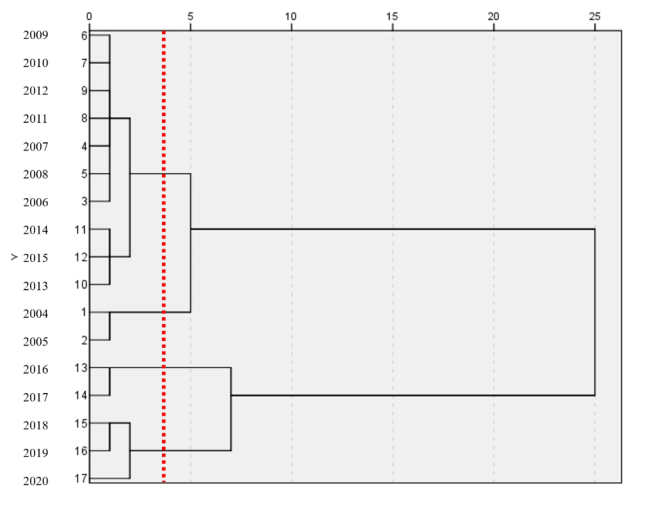
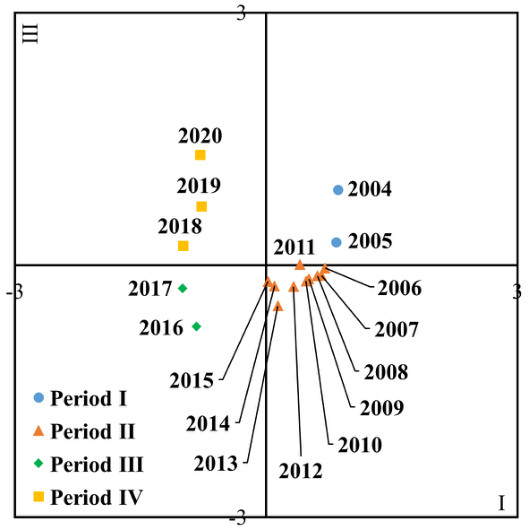
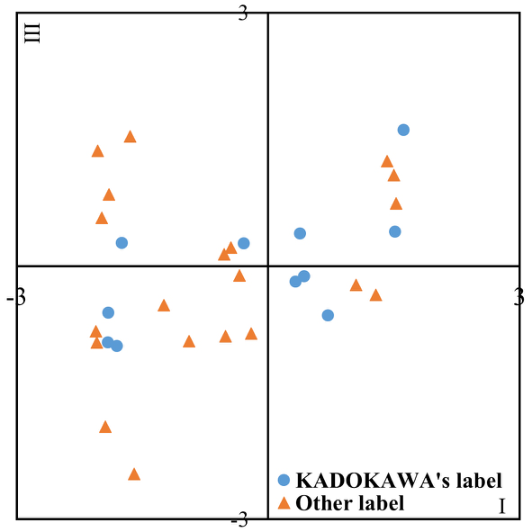
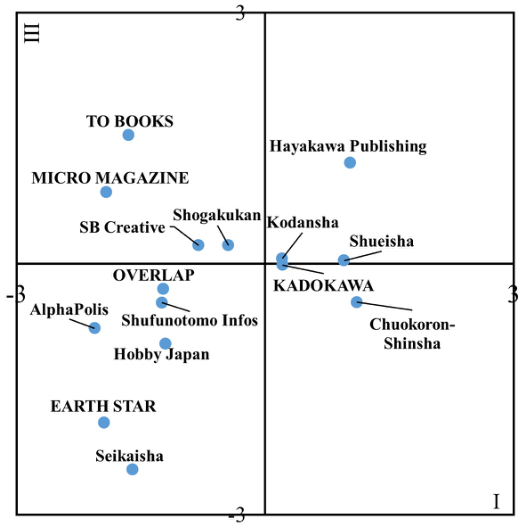
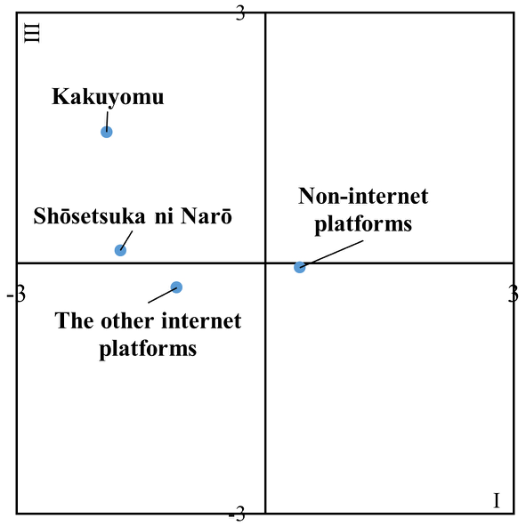
The results of cluster analysis with Ward method showed four clusters; 2004–2005 (period I), 2006–2015 (period II), 2016–2017 (period III) and 2018–2020 (period IV). Figure 1 shows the resulting dendrogram of the clu- ster analysis and Figure 2 shows the plots of the years on the I-III plane. Figure 3 shows the plots of the labels of the light novels, appearing more than four works in the cross-tabulation table on the I -III plane. Nearer the distance between the plots of a label and a year, stronger the tie between the label and the year. Contrasting Fig. 2 and Fig. 3, many labels belonging to the publi- sher KADOKAWA are plotted near the periods I and II. This means that most of the popular light novels were published from the labels of KADOKAWA. In fact, almost 70% of the popular light novels were published in the labels of KADOKAWA during 2000-2009. Figure 3 also shows that many labels belonging to the other publishers, plotted in the area of the periods III and IV. This means that many novels became to be published from the labels of the other publishers. Figure 4 shows the plots of the publishers. In Fig. 4, KADOKAWA, Kodansha and Shogakukan are placed in the central position. This means that these three publishers have been constantly publishing many popular light novels throughout 2004-2020. Figure 5 shows the plots of the platforms where the novels first published. In Fig. 5, “The other internet platform” which includes many personal websites, the KADOKAWA’s novel submission site “Kakuyomu” and another novel submission site “Shosetsuka ni Naro” are places near the periods of III and IV.
Figure 1: Results of cluster analysis for years.
90 Hasegawa and Yamada
Figure 2: Plots of the years.Figure 3: Plots of the labels of light novels.
A Statistical Analysis of History of Japanese Light Novels 91
Figure 4: Plots of the publishers.Figure 5: Plots of the platforms where first appeared on.
92 Hasegawa and Yamada
The most important point to succeed in the light novel business is mass- production, which implies that the publishers need to maintain many talen- ted writers and have them write many novels. A head-quarter officer of KADOKAWA, Enomoto (2008) described that one of the most difficult point for a new label to enter into the light novel business is maintaineing writers. In recent years, UGC (User Generated Contents), content created by com- mon users became to be popular, thanks to the development of the internet circumstances.
The plots in Fig. 5 show that the writers of the light novels were recruited from these UGC sites, recently. The UGC sites allowed the new labels into the light novel market. In fact, Sato who was the president of KADOKAWA described that “the publishers have to manage a source for rerouting new talents,” and he started to manage the UGC site “Kakuyomu,” aiming for surviving in the new era.
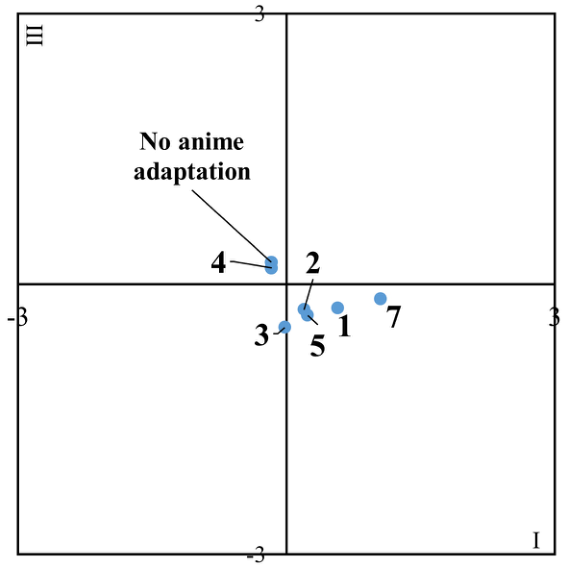
Figure 6 shows the plots of the length of time from the first publication to the release of the anime adaptation. Figure 6 shows that it took one or two years to be published in the period II, but many titles took three years for anime adaptation in the period III, and four years for the period IV. The plots show that the light novels ranked in the sales list rapidly adapted to anime works in the late ‘00s and early’ 10s, whereas it takes a longer time for anime adaptation recently.
Figure 6: Plots of the length of time from the first publication to the anime adaptation (years).
A Statistical Analysis of History of Japanese Light Novels 93
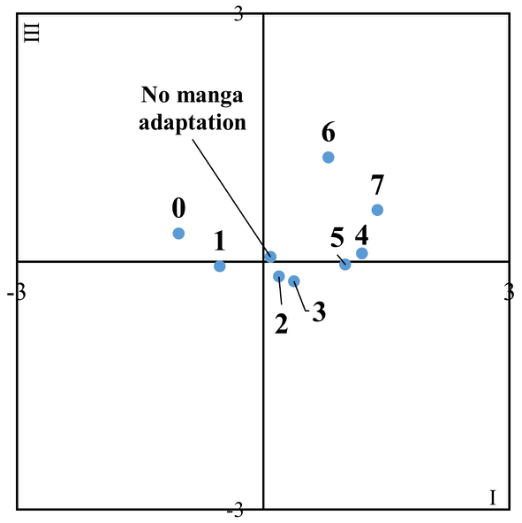
Figure 7: Plots of the length of time from the firstpublication to the manga adaptation (years).
Figure 7 shows the plots of the length of time to the manga adaptation. Figure 7 shows that it took more than four years in the period I to be ada- pted in manga, but it took two to three years in the period II. The length of the time for the manga adaptation is shortened to 0 or one year for the periods of III and IV. Figures 6 and 7 suggests that the center of the media-mix strategy of the light novels shifted from the anime adaptation to the manga adapta- tion. This may be correlated with the spread of e-comics since mid-’10s. Only small number of popular manga works which could be sold many copies were appeared in paper magazines. In’ 10s, American and Japanese companies started to release electronic reading devices, and comic apps were released by publishers and IT companies. This situation enabled publishers to release manga works without printing on paper. Then, the publishers released many manga works based on light novels through these e-comic devices. Moreover, readers became to access unpublished light novels easily. In the ‘00s the mul- timedia strategy of light novels aimed to be adapted for anime works directly. However, the quality of anime works improved and it takes a longer time for producing anime, also the budget of anime works increased recently. There- fore, anime studios tend to select a light novel for anime adaptation carefully, observing the sales of e-comics based on the light novels.
CONCLUSION
In the present study, 533 titles of popular light novels published in 2004–2020 were investigated using the correspondence analysis and the cluster analysis.
94 Hasegawa and Yamada
The results showed that the chronicle changes of the light novels were closely related to the internet media in recent years.
REFERENCES
Amazon: https://www.amazon.co.jp/ Arcadia: https://www.mai-net.net/ Enomoto, A. (2008) Light novel literature theory. Tokyo, Japan: NTT Publishing. Hanmoto.com: https://www.hanmoto.com/ Ichiyanagi, H., Kume Y. (2009) Introduction to light novel studies. Tokyo, Japan: Seikyusha. Kakuyomu: https://kakuyomu.jp/ Ohashi, T. (2016) “The current state of reading by junior high and high school stu-
dents and its problems: The position of light novels, Japanese language education, and reading instruction” Tokai Gakuen University Research Notes Humanities Research Editor, 21(9-21), 14-15. Ohashi, T., Yamanaka, T. (2020) Novel survival strategies light novels, media and gender. Tokyo, Japan: Seikyusha. ORICON Entertainment Market Research 2020. (2021) Tokyo, Japan: ORICON-
Research. Sato. T. (2021) The complete history of KADOKAWA’s media mix creation and development of subcultures. Saitama, Japan: KADOKAWA. Shosetuka ni Naro: https://syosetu.com/ This Light Novel is Amazing! 2021. (2020) Tokyo, Japan: Takarajimasha. Webcat Plus: https://webcatplus.nii.ac.jp/
LISTED IN THE AHFE DIGITAL BOOKSTORE CATALOGUE
Explore the complete digital volume
Kansei Engineering
Read this individual research paper free through the original publisher, or explore the full digital proceedings book.
ISBN 978-1-958651-77-3
Explore this ISBN in the AHFE Bookstore ↗Listed in the July 2026 bookstore catalogue; search by ISBN to confirm current availability · Digital book purchase optional