Akane Fuchigami, Masashi Yamada (2024). Effects of Color of Clothes on the Impressions of a Male Character in a Video Game. In: Human Factors in Virtual Environments and Game Design. AHFE Open Access, vol. 137, pp. 143–149. https://doi.org/10.54941/ahfe1004996
Clothes are one of the important factors which express personalities. It is true in the cases of characters appearing in video games. It is thought that colors play an important role to determine the impressions for the clothes and the person who wears them. In the present study, effects of color of the clothes on the impressions of a male character appearing in a video game are investigated. In the video game “CODE VEIN,” a player selects a human avatar and the design of the clothes the character wears. The avatars and the clothes are produced by 3D modeling. In the present study, a male character and three shapes of clothes were selected. The clothes were painted in one color. The color was selected from the set of ten fundamental colors in the Munsell’s hue circle (red, yellow-red, yellow, green-yellow, green, blue-green, blue, purple-blue, purple and red-purple) and three achromatic colors (white, gray and black). In total, 39 different stimuli in which a male character wearing different clothes were constructed. Fifteen students of Kanazawa Institute of Technology participated in the perceptual experiment. The participants sat in a darkroom and watched a monitor display EIZO Flex Scan SX2462W. Each stimulus was presented on the display and the participants were requested to rate their impressions for the stimulus using 25 semantic differential scales. The rated scores were averaged over the participants and the averaged scores were used for factor analysis. The results of the analysis showed that the impression space was spanned by activity, potency and evaluation factors. The stimuli with warm colors (red, yellow-red, yellow and red-purple) were perceived as active. In contrast, cool colors and achromatic colors (blue-green, blue, purple-blue, grey and black) were perceived as passive. The results of the multiple-comparison tests showed that activity was greatly affected by hue. Red and black clothes were perceived as powerful. In contrast, green-yellow, green red-purple clothes were perceived as powerless. Among the achromatic colors, black was powerful, white was powerless and grey was intermediate. This implies that the brightness of the color affects the potency. On the evaluation factor, blue-green and white clothes were perceived as pleasant but purple-blue and purple were perceived as unpleasant. These results may reflect the cultural background. White colors are used for white coats of doctors, which should be clean. In contrast, purple-blue and purple are often used as the symbol colors of poisons. This might evoke the unpleasant impression for these colors. Then a multiple regression analysis was performed with the degree of preference as the criterion valuable and three factor scores as the explanatory valuables. The results showed that preference was determined by the evaluation and potency factors: The character wearing pleasant and powerful clothes were preferred and vice versa. Achromatic colors also tended to be preferred.
Clothes are one of the important factors that express a character’s personal- ity. The two factors which construct the clothes are shape and color. Yamada, Yanagida and Yoneda (2015) and Oosawa and Yamada (2016) showed that the colors are the important factor to determine the impressions of charac- ters (Bandai Namco Entertainment Inc., 2019; Oosawa and Yamada, 2016). Therefore, it is thought that the color of the clothes is a very important factor of determining the impressions of a character.
In the present study, a male character was selected from the 3D model characters in CODE VEIN (2019). CODE VEIN is a game software released by Bandai Namco Entertainment Inc. that allows players to customize the character design of the main characters. Using this function, how the impres- sions of a character changed by changing the color of the clothes of a male character was measured.
character who was constructed by a 3D model in the CODE VEIN was used as stimulus. Ten basic colors in the Munsell color system (Red, Yellow-Red, Yellow, Green-Yellow, Green, Blue-Green, Blue, Purple-Blue, Purple, Red- Purple) and three achromatic colors (White, Gray, Black) were prepared, and these 13 colors were used for painting the three types of cloths of a male char- acter. In total, 39 experimental stimuli were constructed for the experiment. The stimuli were presented on the screen of Eizo Flex Scan SX2462W. Fif- teen participants from Kanazawa Institute of Technology were requested to watch each of them and rate their impressions using 25 seven-step bipolar SD (semantic differential) scales. The participants were also requested to rate the degree of the preference for each stimulus. The experiment was conducted in a soundproof darkroom. The order of the stimuli was randomized for each participant.
RESULTS AND DISCUSSION
The rated scores were averaged over the participants, and factor analysis with the principal factor method and varimax rotation was performed using the mean scores. The results of the factor analysis showed that the cumulative contribution rate for the three factors reached to 78% (Table 1). The factors were labeled as activity, potency and evaluation after the scales which showed large values of loadings for the factors.
Effects of Color of Clothes on the Impressions of a Male Character in a Video Game 145
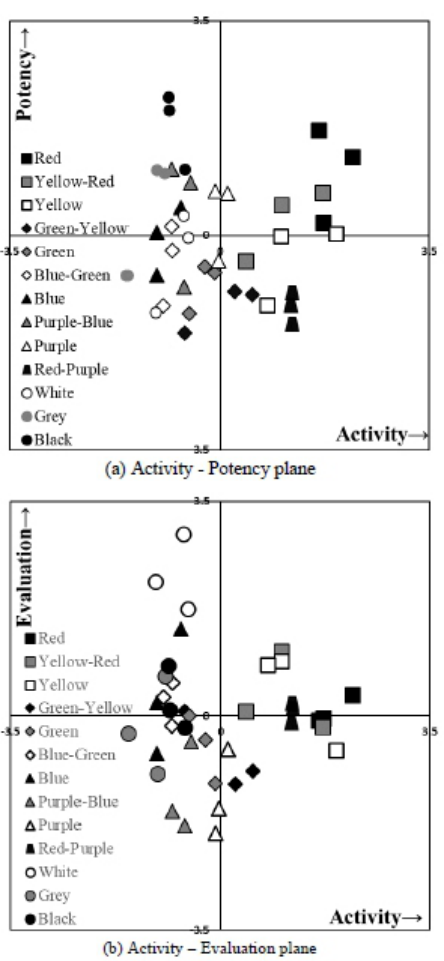
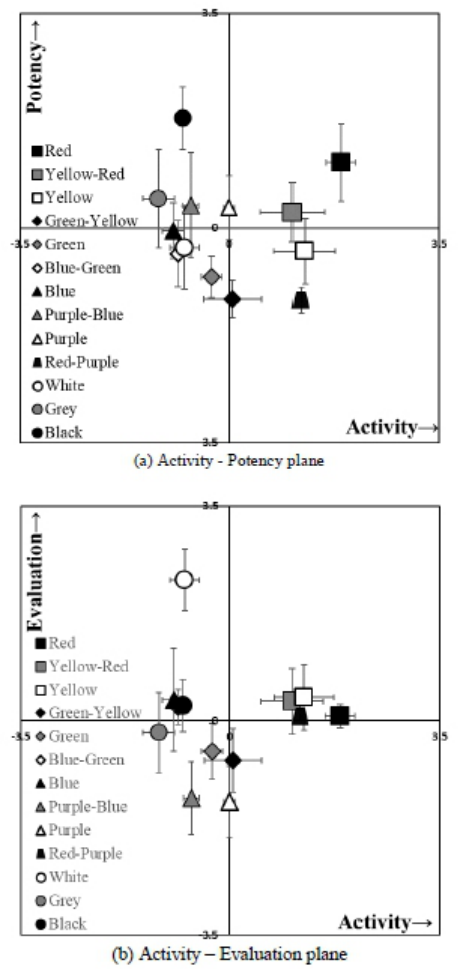
The colors of the stimuli were plotted on the three-dimensional impression space (Fig. 1). It was noticed that the plots on the activity-potency corre- sponded to the color circle. To test the significance of the color of the clothes on the impressions, one-way ANOVAs were performed (Table 2). Table 2 shows that the significance levels of the effects of the color are less than 5%. This implies that the color was significantly affected on the impressions. Figure 2 shows the centroids with standard deviations for each color.
Figure 1: Impressions of the stimuli.
146 Fuchigami and Yamada
Table 2. Results of the ANOVAs.
Table available in the original PDF paper.
Factor df F P color activity 12 24.858 .000 potency 12 4.633 .001 evaluation 12 5.900 .000
Figure 2 shows that Red, Yellow-Red, Yellow, and Red-Purple clothes are perceived as active, while Blue-Green, Blue, White, Gray, and Black are per- ceived as inactive. This implies that the clothes with a warm color is perceived as active, while a cool color and an achromatic color is perceived as inactive.
Figure 2 shows that the impression of the activity does not change largely among the achromatic colors. This suggests that the brightness of the col- ors does not affect the activity largely. The three attributes of the colors are brightness, saturation and hue, so saturation and/or hue should affect the activity. In Fig. 2, only one pair of an inactive chromatic color, Green and an achromatic color, Gray showed a significant difference in the activity, and no significant difference was observed in the other pairs in the significance level of 5%. This suggested that hue is more largely affected the activity rather than the saturation.
In Fig. 2, Red and Black showed high degrees of the potency, while Green- Yellow, Green, Red-Purple showed low degrees of the potency. The degrees of the potency were White < Gray < Black for the achromatic colors. This sug- gested that the brightness affects the potency. To confirm whether this was also true for chromatic colors, a point on the clothes was sampled and the brightness was measured on the monitor screen for all clothes. The point was selected under the conditions; “not where the light is hitting,” “not where the shadow is falling,” and “not where the wrinkles are.” The resulting positions were similar for all clothes. The colors of the sample points were projected on the screen and the brightness of them were measured using a color lumi- nance meter Konica Minolta CS-100A. The luminance Y measured by the CS-100A corresponds to the brightness in the L*a*b* color space. In this way, the brightness was determined. Table 3 shows five stimuli which pos- sess the highest degrees of the potency and five stimuli which possess the lowest degrees of the potency. Table 3 also shows the luminance Y for each stimulus. Table 3 shows that the stimulus with high potency indicate a low value of the luminance Y, and vice versa. This implied that the brightness largely affected the potency.
Figure 2(b) shows that White possess high degrees of evaluation, while Purple-Blue and Purple showed low degrees. The SD scales of “beautiful- ugly” and “pleasant-unpleasant” showed high factor loadings for the evalua- tion factor. The evaluation factor may correlate with the cultural background. The color of White, which showed high degrees of evaluation, are used for white coats of doctors. The participants might associate the cleanliness with White. On the other hand, Purple-Blue and Purple associates with poison in Japanese community, therefore these colors might lead the ugly and unpleas- ant impressions. In the series of “Disney Villains” films produced by Walt Disney Studio, the color of purple is used as a symbol of magic. When the
Effects of Color of Clothes on the Impressions of a Male Character in a Video Game 147
colors of a costume include purple, a character who wear the costume always uses magic to do bad things. This also might associate the Purple-Blue and Purple with ugly and unpleasant impressions. Fig. 2(b) shows that Yellow- Green also possess a low degree of evaluation. In the “Disney Villains” series, the yellow-green color is used to show an evil magician uses magic.
Figure 2: Centroids of the impressions for different colors.
148 Fuchigami and Yamada
Table 3. Brightness of the colors of the clothes.
Table available in the original PDF paper.
Ranking # of stimulus Color Y 1 26 Black 10.6 2 13 Black 0.5 3 1 Red 14.5 4 14 Red 17.9 5 8 Purple-Blue 3.6 35 32 Blue-Green 22.4 36 37 White 67.7 37 31 Green 24.2 38 36 Red-Purple 27.8 39 30 Green-Yellow 40.8
In the final step of the present study, the preferable colors for the clothes of the male character was investigated. A multiple regression analysis was per- formed using the factor scores of each factor as independent variables and the degree of the preferences as the dependent variable. The results showed a high value of the coefficient of determination as 0.74. The multiple regres- sion coefficients showed that a character with beautiful and powerful clothes is preferred. Table 4 shows five stimuli which possess the highest degrees of preference. Table 4 shows that achromatic colors are preferred. In the present study, the clothes are painted in single colors. Black or white clothes are pop- ular in the real world, but clothes with a single chromatic color is rarely seen. This may lead the unfamiliar feeling for them, and not preferred.
Table 4. Preferred stimulus.
Table available in the original PDF paper.
Ranking # of stimulus Color
1 26 Black 2 24 White 3 13 Black 4 14 Red 5 39 Black
CONCLUSION
In the present study, a male character wore three different shapes of clothes painted in 13 single colors. The results showed that the impressions were significantly affected by the color than the shape. The impression space was spanned by three factors; activity, potency and evaluation. The activity was largely affected by hue. The potency was largely affected by the brightness. The evaluation might be largely affected by cultural background.
REFERENCES
Bandai Namco Entertainment Inc. (2019); Code Vein, PLJS-36037.
Effects of Color of Clothes on the Impressions of a Male Character in a Video Game 149
Oosawa, S., Yamada, M. (2016); Impressions of characters in the Japanese magical girl anime metaseries, “Pretty Cure,” Advances in Affective and Pleasurable Design: Proceedings of International Human Factors and Ergonomics Conference, pp. 165–170. Yamada, M., Yanagida R., Yoneda, R. (2015); A study on impressions of monster
design in Pokemon, Proceedings of International Symposium of Affective Science and Technology, pp. 1–6.
LISTED IN THE AHFE DIGITAL BOOKSTORE CATALOGUE
Explore the complete digital volume
Human Factors in Virtual Environments and Game Design
Read this individual research paper free through the original publisher, or explore the full digital proceedings book.
ISBN 978-1-964867-13-7
Explore this ISBN in the AHFE Bookstore ↗Listed in the July 2026 bookstore catalogue; search by ISBN to confirm current availability · Digital book purchase optional