Kaito Miyoshi, Masashi Yamada (2025). Effects of Motion Speed on the Impressions of Monster Characters Appearing in the Video Game Dragon Quest. In: Affective and Pleasurable Design. AHFE Open Access, vol. 164, pp. 250–254. https://doi.org/10.54941/ahfe1006081
Dragon Quest is one of the most popular series of video games. In this series, a player travels the fantasy world, battling with various cute and unique monsters in the itinerary. Not only the appearance of the monsters is designed as cute, but also the motions of them are designated to be perceived as cute in recent titles. The present study focuses on the attacking motions of the monsters. The attacking motions included downward swinging of the sword, downward punching motion, filling the power in their body, and so on. The attacking motions of 21 monsters that appeared in Dragon Quest Monsters: The Dark Prince were selected, and their speed were varied in seven steps; the speed multiplied by 0.5 to the original speed (x0.5), x0.63, x0.8, 1.0(original speed), x1.26, x1.58 and x2.0, and in total 147 motion stimuli were prepared. Ten participants watched each stimulus displayed on a screen and were requested to rate the impressions using semantic differential method. The mean values for the 24 seven-step bipolar scales were analyzed by factor analysis. The results of the analysis showed that the impression space for the motions were spanned by quickness, powerfulness and pleasantness with the cumulative contribution rate of 0.78. The results showed that the quickness did not increased but the powerfulness and pleasantness largely declined when the speed was faster than the original for most of the monsters. The quickness decreased largely but powerfulness and pleasantness did not change largely when the speed was slower than the original. The powerfulness was largely determined by the size of the monsters and the pleasantness was determined by the appearance of the monsters, regardless of the motion speed. Moreover, multiple-regression analyses were performed using the degrees of cuteness, preferability and coolness as dependent variables and the factor scores of the stimuli in the quickness, powerfulness and pleasantness as independent valuables. The results of the analyses showed that the pleasant stimuli were perceived as cute and preferable. Both a large monster with a slow motion and a small monster with a fast motion were perceived as cool. It was concluded that the speed of the motions was set at the fastest level where the monsters were perceived as pleasant and powerful in the game.
Dragon Quest is one of the series of roll-playing video games. The first title of the series was published in 1986 in Japan, and released in 2005 in North America, previously this title was called Dragon Warrior in North America. The series continue to the present and became very popular all over the world. In this series, a player travels the fantasy worlds, battling with various monsters in the itinerary. The most impacted factor for the popularity of the series is that the characters, including monster characters, were designed as very cute and unique. For example, a small monster called
Effects of Motion Speed on the Impressions of Monster Characters 251
Slime, which the player first encounters, is designed as very cute. These characters were designed by Akira Toriyama, who is also famous as the manga artist of Dragon Ball. In recent years, not only the appearance but also the motions of the characters are designated as cute in the series, thanks to the developed CG technology. The present study focuses on the attack motions of the monsters and the relation of the speed of the attack motions and the impressions of them were investigated to clarify how the speed of the motions was designated.
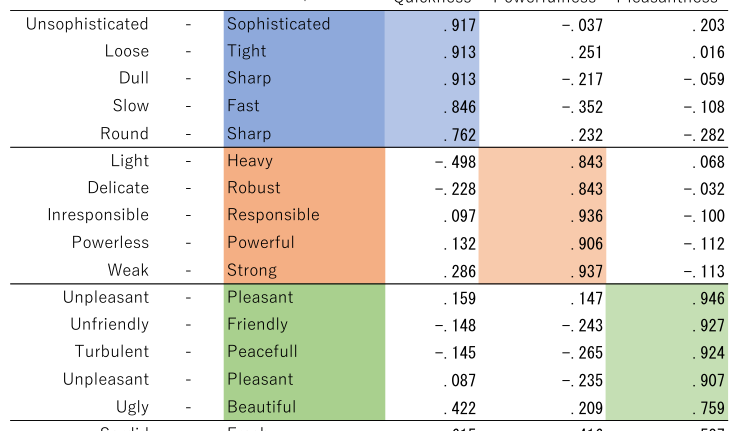
EXPERIMENTAL METHOD Dragon Quest Monsters 3: The Dark Prince, published by Square Enix in 2023, is one of the titles of the Dragon Quest series. In this game, a player recruit monsters and command them to progress through the story. The monsters show attack motions just before they attack an enemy in the game. The attack motions include downward swinging of the sword, downward punching motion, filling the power in their body, and so on. The game includes the function of “Monster Library” which shows the detailed information about each monster. The function shows the attack motions of the monsters in the library. In the present study, the attack motions of 21 monsters were captured to use as materials. Then, the speed of the material motions was changed in seven steps; the speed multiplied by 0.5 to the original speed (×0.5), ×0.63, ×0.8, ×1.0 (original speed), ×1.26, ×1.58 and ×2.0, and in total 147 motion stimuli were prepared. Each of the motion stimuli was presented on the LCD display of Eizo Flex Scan SX2462W. Ten participants from Kanazawa Institute of Technology watched the motion stimulus, then were requested to rate their impressions for it, using semantic differential method (Osgood, Suci and Tannenbaum, 1957). Twenty-four bipolar seven-step scales listed in Table 1 were used in the present study. Moreover, the participants also rated the degrees of preference, coolness and cuteness for each stimulus. The experiment was conducted in a dark room. The order of the stimuli was randomized for each participant to minimize the effects of the order.
RESULTS AND DISCUSSION
The rated scores of were averaged over the participants for each stimulus and each scale. The mean scores for the 24 semantic scales were used for factor analysis with principal factor method and Varimax rotation. The results of the analysis showed a tree-factor solution with the cumulative contribution rate of 0.72. Table 1 shows the factor loadings. The three factors were labelled as quickness, powerfulness and pleasantness, respectively, after the scales which showed large loadings for the factors.
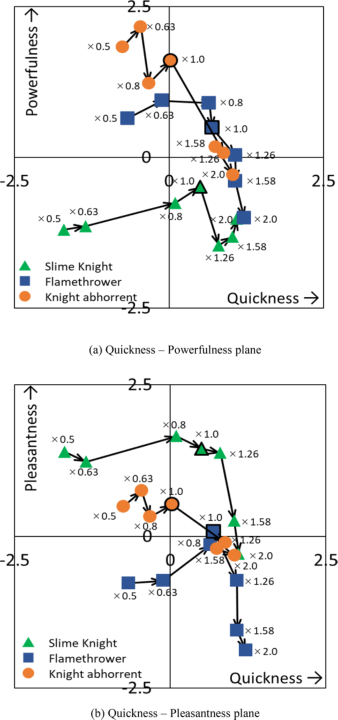
Figure 1 shows the examples of the impressions for three monsters, Slime Knight, Flamethrower and Knight abhorrent. Slime Knight is a small-size, Flamethrower is a middle-size and Knight abhorrent is a large-size monster. A large size mark indicates the original speed and the arrowheads show the faster speeds. Figure 1 shows that the quickness increases as the speed
252 Miyoshi and Yamada
increases, but the powerfulness and the pleasantness steeply decline when the speed over the original ones.
Table 1: Semantic differential scales and their factor loadings.
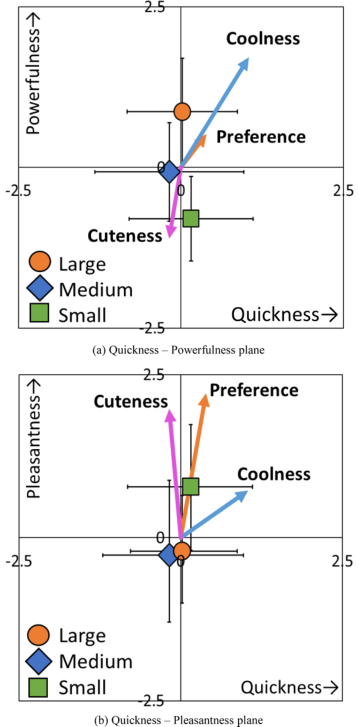
Then, the stimuli were divided into three groups according to the size of the monsters, large-size, middle-size and small-size monsters. Figure 2 shows the centroids of the impressions for the different sizes. Figure 2 shows the powerfulness is largely affected by the size: Large monsters are perceived as powerful and small monsters are perceived as powerless.
Finally, multiple-regression analyses were performed using the each of the degrees of preference, coolness and cuteness as dependent variable and the factor scores of the stimuli in the quickness, powerfulness and pleasantness as independent valuables. The results are shown in Table 2. The coefficient of determination, R2 showed as high as over 0.73. Figure 2 indicates the preference, cuteness coolness and cuteness as vectors in the impression space. The vectors of the cuteness and preference are almost along with the pleasantness. This implies that a pleasant monster was perceived as cute and preferable. The vector of the coolness depends on all factors, quickness,
Effects of Motion Speed on the Impressions of Monster Characters 253
powerfulness and pleasantness. Then the stimuli which showed high values on the coolness scale were observed. It was found that there were two types of coolness in the attack motion. One was the type where a stylish monster moves quickly and the other is the type where monster moves slowly. The stimuli in both types were perceived as cool.
The results of the present study showed that the original speed used was designated at the fastest speed which is perceived as pleasant and powerful in Dragon Quest Monsters 3: The Dark Prince.
Table 2: Results of the multiple-regression analyses.
Figure 1: Examples of the impression changes as a function of motion speed.
254 Miyoshi and Yamada
Figure 2: Impressions of different body size of the monsters. The vectors show the results of the multiple-regression analyses.
CONCLUSION
In the present study, attack motions of the monsters appearing in Dragon Quest Monsters 3: The Dark Prince were focused on. The speed of the attack motions was varied and used as stimuli in a perceptual experiment, using semantic differential method. The results showed that the impression space of the motions was spanned by three factors, quickness, powerfulness and pleasantness. The results showed that the original motion speed was designated as the fastest speed which does not decline the powerfulness and pleasantness in the game.
REFERENCE Osgood, C. E., Suci, G. J., Tannenbaum, P. H. (1957) The measurement of meaning, Urbana, IL, University of Illinois Press.
LISTED IN THE AHFE DIGITAL BOOKSTORE CATALOGUE
Explore the complete digital volume
Affective and Pleasurable Design
Read this individual research paper free through the original publisher, or explore the full digital proceedings book.
ISBN 978-1-964867-40-3
Explore this ISBN in the AHFE Bookstore ↗Listed in the July 2026 bookstore catalogue; search by ISBN to confirm current availability · Digital book purchase optional