Recently, the widespread use of e-commerce and online services has significantly increased the demand for logistics. Simultaneously, a shortage of drivers, largely owing to a declining workforce, has emerged as a critical issue. In response, there has been growing interest in autonomous driving technologies as a means of alleviating the burden on drivers. Level 3 autonomous driving, also referred to as conditional automation, allows vehicles to operate autonomously under certain conditions. However, the driver must control the vehicle outside these conditions. When transitioning from autonomous to manual driving, a takeover request (TOR) warning is issued by the system to prompt the driver to regain control. Previous studies have indicated that adjusting the level of tension caused by a TOR warning can improve driving performance after the warning is issued. However, limited research has focused on the specific warnings used in level 3 autonomous driving, especially those issued when the driver is fully disengaged from the driving task. Additionally, repeated exposure to warnings may result in habituation and thereby reduce the warning effectiveness over time.
The increasing demand for logistics, driven by the rapid expansion of e-commerce and online services, has placed considerable strain on the transportation industry. This problem is further exacerbated by the ongoing decline in the labor force, which has led to a shortage of professional drivers. Consequently, automated driving technologies have emerged as promising solutions for alleviating the burden on drivers while simultaneously addressing these challenges. Among these technologies, SAE J3016 defines Level 3 automated driving as a system that enables drivers to temporarily disengage from continuous road monitoring. However, Level 3 systems operate within limited domains and require drivers to re-take control when the system encounters situations beyond its capabilities. To effectively
manage this transition, a TOR is issued, typically through auditory, visual, or multimodal alerts.
Previous studies on warnings have largely explored the effects of different sensory modalities, such as auditory and visual cues, as well as the impacts of driver distraction. However, a significant research gap remains regarding the comparison of various TOR methods in Level 3 automated driving systems, particularly when drivers are fully disengaged from driving tasks. In such situations, it is critical to design TORs that can successfully reengage drivers while avoiding excessive tension or confusion. Moreover, studies have suggested that calibrating warning intensities to elicit an optimal level of driver tension can enhance driving performance after an alert. This finding is based on studies related to conventional driving. However, it is reasonable to assume that similar results can be observed in Level 3 automated driving, where drivers are fully disengaged from the driving task. Earlier studies also established that humans tend to habituate to repeated warnings, which causes their perception of the importance of alerts to diminish over time. This phenomenon is expected to occur in the presence of driving warnings. If drivers become desensitized to repeated TORs, the alerts may lose their effectiveness, fail to function as intended, and ultimately compromise the ability of the system to prompt safe transitions to manual control. Therefore, it is crucial to understand how habituation affects the perception and efficacy of TORs to improve their designs.
This study aims to identify the impact of TOR presentation methods and repetitions on driver engagement and physiological responses. We compared single and repeated warnings to examine how these variations influenced driver tension and subsequent performance. These findings are expected to provide valuable insights into the design of TOR systems that minimize habituation while maintaining effective driver engagement in Level 3 automated driving. By enhancing the safety and reliability of TOR systems, this research contributes to the broader adoption of level 3 automation and lays the groundwork for a smoother transition toward higher levels of automated driving while ensuring driver safety and usability. This study aims to identify the impact of TOR presentation methods and repetitions on driver engagement and physiological responses. We compared single and repeated warnings to examine how these variations influenced driver tension and subsequent performance. These findings are expected to provide valuable insights into the design of TOR systems that minimize habituation while maintaining effective driver engagement in Level 3 automated driving. By enhancing the safety and reliability of TOR systems, this research contributes to the broader adoption of level 3 automation and lays the groundwork for a smoother transition toward higher levels of automated driving while ensuring driver safety and usability.
INVESTIGATING THE INFLUENCE OF THE REPEATED PRESENTATION OF TOR WARNINGS ON DRIVERS’ TENSION To investigate the influence of repeated TOR warnings on driver tension, we examined the warnings using biometric data and a subjective evaluation
Investigating the Influence of Takeover Request Warning Methods on Driver Tension 129
questionnaire. The experimental content was developed using the Unity real- time development platform. The experiment was conducted with 12 male participants (22.7 ± 1.0 years old). This study was approved by the Ethics Committee for Research Involving Human Subjects of Saitama University (R6-E-14). Informed consent was obtained from all the participants.
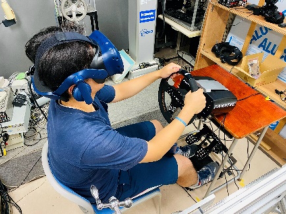
Driving Task The driving simulator used in this experiment is shown in Figure 1. The participants were tasked with driving on a simulated highway featuring two lanes in one direction and a road width of 3.5 m. To account for the operational conditions of Level 3 automated driving, the experiment aimed to replicate a congested road environment, with both the participant’s vehicle and other vehicles traveling at speeds of 30–40 km/h. The driving distance was unlimited, and the experimental task was concluded after eight TOR warnings were presented. During manual driving, the participants were instructed to maintain a safe distance and drive at a constant speed whenever possible.
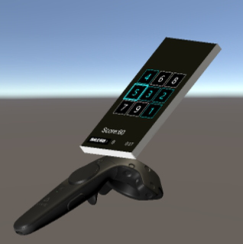
Secondary Task The secondary task interface is shown in Figure 2, and the controller is shown in Figure 3. The participants were tasked with selecting numbers 1 through 9 that were displayed randomly on the screen in ascending order using the controller. To ensure complete disengagement from driving, the task involved both visual attention and manual interactions. A smartphone-like interface was attached to the tip of a virtual reality (VR) controller, and the task was performed using a touchpad on the controller.
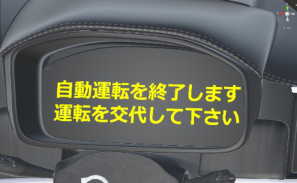
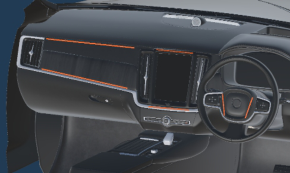
Experiment Condition In this experiment, three types of TOR warnings were presented: an alarm sound, a warning message displayed on a speed monitor, and a change in the color of the indicator lights. The warning message is shown in Figure 4, and the indicator light is shown in Figure 5. The parameters associated with the warnings are listed in Table 1, and each parameter is assigned to either a high- or low-intensity level of perceived tension. The warning parameters were selected to closely match or resemble those of the actual products.
Figure 3: Controller.Figure 4: Alert message on monitor.
The experimental conditions consisted of three scenarios: a weak condition (under which all warnings were presented at low intensity), a combination condition (under which the intensity of the warnings varied by the TOR), and a switch condition (under which the overall intensity of the warnings changed by the TOR). A summary of the experimental conditions is provided in Table 2. In the switch condition, the intensified warnings were presented in the third and sixth trials, and all other warnings were presented at the low-intensity level.
Experiment Protocol In the experiment, skin conductance (SC) was measured to assess physiological habituation, and a subjective evaluation questionnaire was used to assess psychological habituation. A multichannel biofeedback device (NeXus10 MARKII, MindMedia) was used for SC measurements. As the hands were occupied while driving, the sensors were attached to the left sole of the foot to avoid interference with the driving task. The participants
Investigating the Influence of Takeover Request Warning Methods on Driver Tension 131
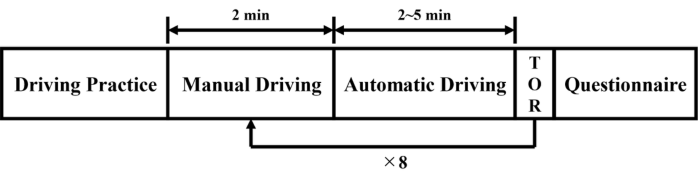
underwent sufficient practice with both the driving and secondary tasks before receiving detailed explanations of the TOR. The experimental protocol is illustrated in Figure 6. During the experiment, the participants performed the secondary task until the TOR was presented during autonomous driving, at which point they quickly switched to manual driving. The TOR was set to occur randomly within 2–5 min of the start of autonomous driving. The participants were instructed to focus on a secondary task during autonomous driving. After a TOR was presented, the participants drove manually for 2 min before resuming autonomous driving. This process was repeated for a total of 8 sets. Furthermore, from the second set onward, after the start of autonomous driving, participants completed a questionnaire related to the warning.
Sound Monitor Indicator Light Stimulus Intensity Strong 1000 Hz, 5.0 s Square Wave 80 dB Text Color : Red Pulse Interval:0.1 s Color: Red Pulse Interval:0.1 s Weak 400 Hz, 5.0 s Square Wave 70 dB
Analysis Method In the experiment, skin conductance (SC) was measured to assess physiological habituation, and a subjective evaluation questionnaire was used to assess psychological habituation. For SC measurements, a multichannel biofeedback device (NeXus10 MARKII, MindMedia) was used. As the hands were occupied while driving, the sensors were attached to the left sole of the foot to avoid interference with the driving task. The participants underwent sufficient practice with both the driving and secondary tasks before receiving detailed explanations of the TOR. The experimental protocol is illustrated in Figure 6. During the experiment, the participants performed the secondary task until the TOR was presented during autonomous driving, at which point they quickly switched to manual driving. The TOR was set to occur randomly within 2–5 min of the start of autonomous driving. The participants were instructed to focus on a secondary task during autonomous driving. After the TOR was presented, the participants drove manually for 2 min before resuming autonomous driving. This process was repeated for a total of 8 sets. Furthermore, from the second set onwards, after the start of autonomous driving, participants completed a questionnaire related to the warning.
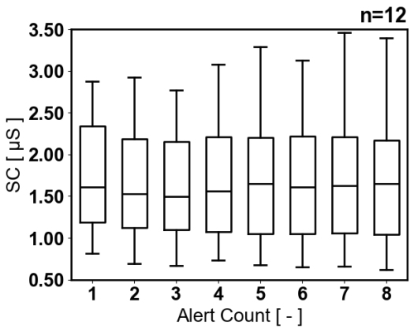
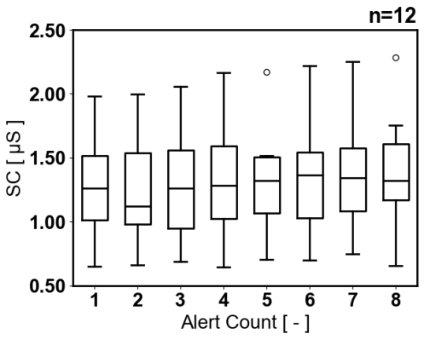
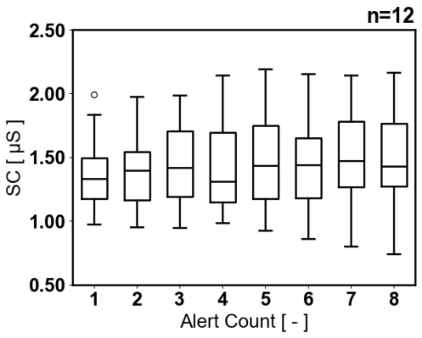
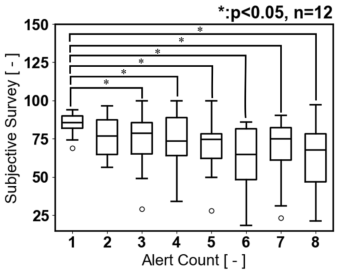
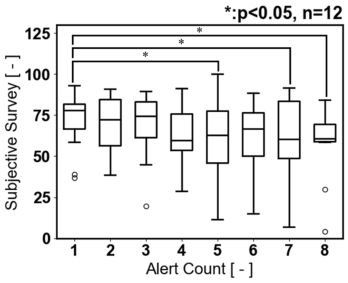
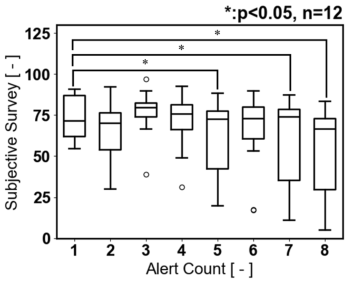
Experimental Results In all the experiments, the driver switch after the TOR presentation was successful. The results of the SC measurements after the warning presentation for each condition are shown in Figures 7, 8, and 9, and those of the subjective evaluation questionnaire are shown in Figures 10, 11, and 12. For both the SC and the subjective evaluation questionnaire, Dunnett’s test was conducted with a significance level of 5% to compare the data from the first TOR presentation and subsequent data across the seven groups. For the SC, no significant differences were observed in any of the conditions across all data points. Regarding the subjective evaluation questionnaire, in the weak condition, a significant decrease in tension was observed from the third trial onwards. In both combination and switch conditions, significant decreases in tension were observed in the fifth, seventh, and eighth trials, indicating a trend toward habituation. In the post-experiment questionnaire, participants in the combination condition generally reported experiencing higher levels of tension, whereas those in the switch condition reported feeling higher tension during intensified warning presentations.
Investigating the Influence of Takeover Request Warning Methods on Driver Tension 133
Figure 7: Comparison of SC under the weak condition.Figure 8: Comparison of SC under the combination condition.Figure 9: Comparison of SC under the switch condition.Figure 10: Comparison of subjective survey under the weak condition.Figure 11: Comparison of subjective survey under the combination condition.Figure 12: Comparison of subjective survey under the switch condition.
DISCUSSION
For the SC, no significant differences were observed in any of the conditions, and the trend was nearly parallel across all groups. These results suggest that physiological habituation is unlikely to become apparent within a short period. Therefore, reconsidering the experimental conditions, such as increasing the number of experimental task sets, is necessary to accurately observe physiological habituation.
Investigating the Influence of Takeover Request Warning Methods on Driver Tension 135
Regarding the subjective evaluation questionnaire, the habituation process was clearly observed under weak conditions. From the third trial onward, the intensity of the impressions significantly decreased, indicating that when weak warnings were repeatedly presented in a monotonous manner, their effectiveness as warnings diminished relatively quickly. In the combination condition, although the occurrence of habituation was delayed compared with that in the weak condition, habituation began after the fifth trial. This condition is effective for preventing short-term habituation but seems to be less effective for long-term habituation. To further delay the occurrence of habituation, it is necessary to reconsider conditions such as increasing the types of warnings or changing presentation patterns. Under the switch condition, habituation occurred similarly to that under the other conditions. However, no significant decrease was observed during the third and sixth trials when the warnings were presented at a higher intensity. These results suggest that high tension can be temporarily induced by strengthening warnings during the habituation process. In particularly dangerous situations, where tension should be induced, adjusting the overall intensity of the warning may allow for more effective warning presentations. However, because psychological habituation occurs more quickly than physiological habituation, long-term habituation may also occur. Therefore, similar to the other conditions, reconsidering the experimental conditions, such as by increasing the number of experimental task sets, is necessary to obtain more accurate results.
CONCLUSION
In this study, we conducted an experiment to evaluate the effects of different TOR presentation methods on driver tension during Level 3 automated driving. We investigated both physiological and psychological habits. No physiological habituation was observed. However, psychological habituation tended to appear at an early stage. In addition, the findings suggest that modifying the warning presentation method may be effective in preventing psychological habituation. In future research, we will refine the experimental conditions to further investigate long-term habituation.
REFERENCES
Kaizuka, T. and Nakano, K. (2020) ‘Effects of urgency of audiovisual collision warnings on response time and accuracy of steering’, International Journal of Intelligent Transportation Systems Research, 18, pp. 90–97. Kim, S. and Wogalter, M. S. (2009) ‘Habituation, dishabituation, and recovery effects
in visual warning’, Proceedings of the Human Factors and Ergonomics Society Annual Meeting, 53(20), pp. 1612–1616. SAE International (2025) Surface vehicle recommended practice. Available at: https://wiki.unece.org/download/attachments/128418539/ SAE%20J3016_202104.pdf?api=v2 (Accessed: [insert date of access]). Yoshida, F. and Kodama, M. (1987) ‘Examination of personal space through physiological responses and psychological evaluation’, Japanese Journal of Psychology, 58(1), pp. 35–41. (in Japanese).
LISTED IN THE AHFE DIGITAL BOOKSTORE CATALOGUE
Explore the complete digital volume
Affective and Pleasurable Design
Read this individual research paper free through the original publisher, or explore the full digital proceedings book.
ISBN 978-1-964867-40-3
Explore this ISBN in the AHFE Bookstore ↗Listed in the July 2026 bookstore catalogue; search by ISBN to confirm current availability · Digital book purchase optional