Taiga Fukuzawa, Kazunori Kaede, Keiichi Watanuki (2026). Effects of Viewpoint Presentation Methods on Driving Workload in Vehicle Teleoperation Systems. In: Advances in Human Factors of Transportation. AHFE Open Access, vol. 224, pp. 265–271. https://doi.org/10.54941/ahfe1007854
The growing demand for logistics in Japan coupled with severe driver shortages has accelerated the development of teleoperational systems for autonomous vehicles. This technology allows a remote operator to supervise and intervene when autonomous driving is not feasible, thereby enabling a single operator to effectively manage multiple vehicles. Although previous studies suggest that alternative perspectives, such as bird’s-eye views or virtual-reality-based visualizations, can improve situational awareness, their specific impact on operator workload remains insufficiently explored. This study aimed to identify optimal viewpoint presentation methods by examining their influence on both mental and physiological workloads. In our experimental protocol, participants navigated courses modeled after standard driver’s license training routes, which required a moderate level of driving skill. We evaluated operator experience through validated questionnaires focusing on situational awareness and task difficulty. Physiological stress levels were analyzed using skin conductance to provide objective data. The findings clarify the viewpoints that are most effective under varying operational scenarios, offering critical insights for designing efficient remote driving interfaces and improving overall system safety.
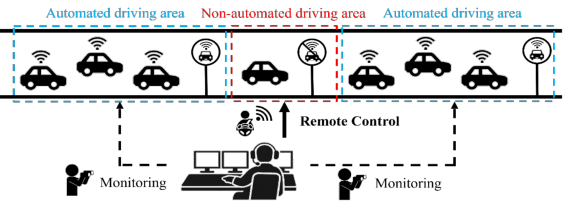
Recently, the demand for logistics has increased owing to the widespread adoption of mail-order services and online platforms. Meanwhile, the shortage of drivers caused by the declining labor population has become a serious issue. As a potential solution to this problem, the practical implementation of teleoperation systems in automobiles is attracting increasing attention. An overview of the proposed system is shown in Fig. 1.
Automotive teleoperation is a technology in which an operator located at a remote site monitors an autonomous vehicle and intervenes manually when necessary (Sugimachi et al., 2020). When an autonomous vehicle operates within its operational design domain, the operator only performs monitoring tasks. In contrast, when a vehicle encounters situations in which autonomous driving is difficult, the operator intervenes remotely using manual control.
This mechanism enables a single operator to manage multiple autonomous vehicles, thereby alleviating driver shortages and expanding operational domains.
Previous studies on viewpoint presentation methods for operators in automotive teleoperation have suggested the effectiveness of not only the conventional cockpit view but also third-person and top-down views. In addition, the introduction of virtual reality (VR) systems is expected to enhance situational awareness. Furthermore, the perceived difficulty of situational awareness and vehicle operation affects driving workload, and reducing driving workload leads to improved driving performance.
However, the effects of different viewpoint presentation methods on driving workload and the characteristics and effectiveness of each viewpoint in specific scenarios have not been sufficiently investigated. Therefore, this study aimed to identify an optimal viewpoint presentation method for operators by experimentally clarifying the effects of different viewpoint presentation methods on driving workload and the characteristics of each viewpoint.
EVALUATION OF THE EFFECT OF DIFFERENCES IN VIEWPOINT PRESENTATION METHODS ON OPERATOR WORKLOAD To evaluate the effects of viewpoint presentation methods in teleoperation on the driving workloads of operators, assessments were conducted using physiological data and subjective questionnaire measures. The experimental content was developed using the real-time development platform Unity. The experiment was conducted with 11 male participants (mean age: 23.5 ± 1.2 years).
This study was approved by the Ethics Committee for Human Subject Research of Saitama University (approval no. R6-E-14). Informed consent was obtained from all the participants prior to the experiment.
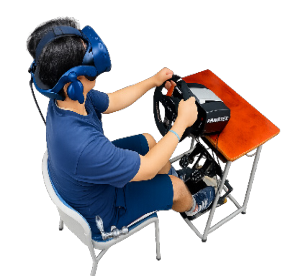
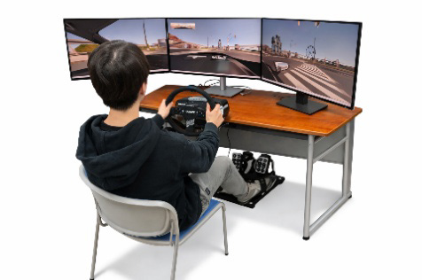
Driving Task The monitor-based driving simulator (monitor-based DS) used in this experiment is shown in Fig. 2, and the head-mounted-display-based driving simulator (HMD-based DS) is shown in Fig. 3. The participants performed a driving task in which they operated a vehicle on a road, simulating a general driving environment using each driving simulator.
The driving scenarios in the task were designed to assess driving skills based on standard driver-training guidelines and related references.
Figure 1: Schematic of an automotive teleoperation system.
Effects of Viewpoint Presentation Methods on Driving Workload 267 View Point
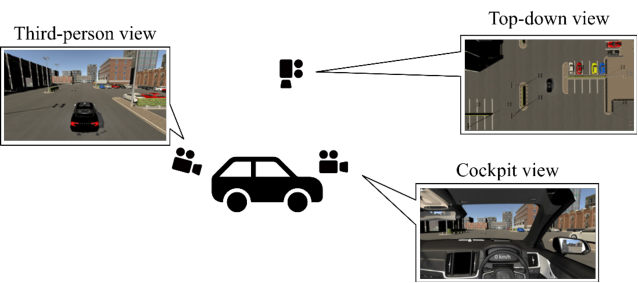
The schematics of each viewpoint are shown in Fig. 4. The cockpit view is defined as the perspective corresponding to the scene observed from the driver’s seat. The third-person view is defined as a perspective in which the vehicle is viewed from an elevated position behind it. The top-down view is defined as the perspective in which the vehicle is viewed directly from above.
For the third-person view, rearview mirrors and side mirrors were used to confirm the area behind the vehicle. In this experiment, six experimental conditions were used, consisting of three viewpoints for each monitor-based and HMD-based DS. The tasks for each condition were performed on different days.
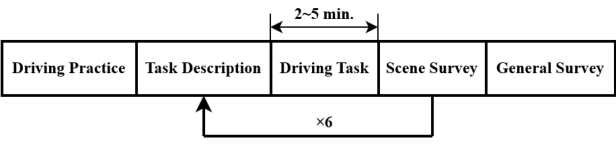
Experiment Protocol The experimental protocol is illustrated in Fig. 5. After sufficient driving practice, the participants received detailed instructions regarding the experimental tasks. In each driving scenario, the participants were first provided with a thorough explanation of the task, after which they performed the driving task as instructed and completed a questionnaire evaluating the viewpoint for that specific scenario.
After completing all the tasks, the participants responded to a comprehensive questionnaire regarding their overall evaluation of the viewpoint.
Figure 2: Monitor-based DS.Figure 3: HMD-based DS.Figure 4: Camera positions for viewpoints: cockpit, third person, and top down.Figure 5: Experiment protocol.
Evaluation Metrics Subjective evaluation questionnaires were administered after each driving task and after the completion of all the experimental tasks. After each driving task, a questionnaire based on the system usability scale (SUS) was administered to evaluate system usability.
After the completion of the experiment, a comprehensive questionnaire based on the NASA Task Load Index (NASA-TLX) was administered to assess the workload for each of the 17 driving skills required to obtain a driver’s license with respect to driving under each viewpoint.
Experimental Results Among the 11 participants, five reported physical discomfort owing to VR sickness during the experiment using the HMD-based DS; therefore, their experiments were terminated.
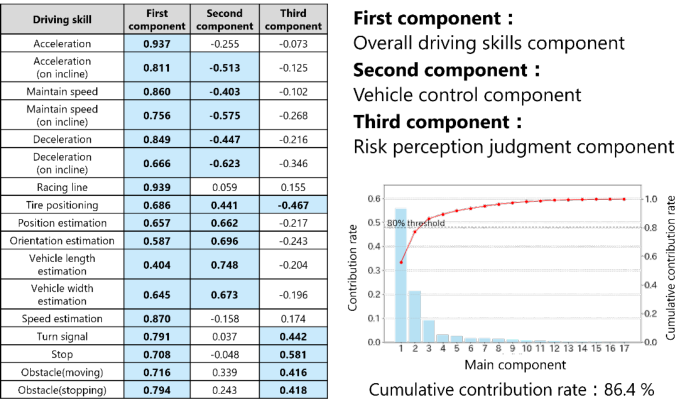
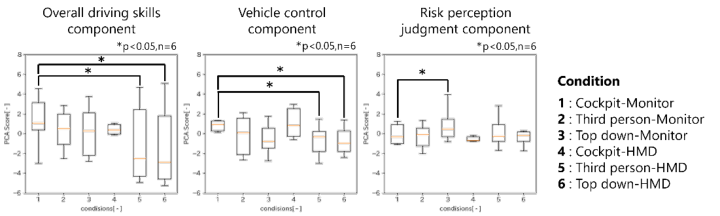
Principal component analysis (PCA) was conducted on the NASA-TLX scores for the 17 driving skills required for driving. Three components were extracted: comprehensive driving skills, vehicle control, and hazard perception and judgment. The PCA results are shown in Fig. 6 and Fig. 7. For each extracted component, principal component scores were calculated for each viewpoint condition, and Dunnett’s test with a significance level of 5% was performed using the conventional cockpit view (monitor condition) as a control. The results indicated that, under VR conditions, the workload for both the comprehensive driving skill and vehicle control components was significantly reduced, suggesting the effectiveness of the HMD-based presentation, as well as the third-person and top-down views.
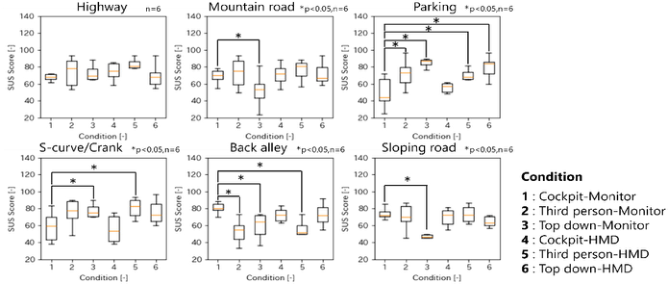
Effects of Viewpoint Presentation Methods on Driving Workload 269 The SUS scores for each driving scenario are shown in Fig. 8. They were calculated for each viewpoint condition in each scenario, and Dunnett’s test with a significance level of 5% was conducted using the conventional cockpit view (monitor condition) as the control. The results showed no significant differences between highway and mountain roads. In contrast, for the parking and S-curve/crank scenarios, the SUS scores for the third-person and top-down views were significantly higher. Furthermore, for the back- alley and sloping road scenarios, the SUS scores for the third-person and top-down views were significantly lower. In addition, for the top-down view in the sloping road scenario, the monitor condition showed a significantly lower score than the conventional method, whereas no significant difference was observed in the HMD condition.
Figure 6: The NASA-TLX questionnaire was used to assess the skills required for driving, and factor analysis was performed.Figure 7: The conventional Dunnett test uses the cockpit-monitor-view as the baseline and has a significance level of 5%.Figure 8: The conventional Dunnett test uses the cockpit-monitor-view as the baseline and has a significance level of 5%.
DISUCUSSION The driving skills required for vehicle operation were evaluated using the NASA-TLX, and factor analysis was conducted. The results indicated that the third-person and top-down views tended to yield lower overall driving workloads, as well as lower workloads associated with vehicle control. In addition, in scenarios, such as parking and S-curve/crank, where it is necessary to confirm the vehicle position, orientation, and surrounding environment, the SUS scores tended to be higher than those of the conventional method. This is considered to be due to the wider field of view, which facilitates the understanding of both the vehicle and its surroundings, thereby reducing the driving workload through an increased sense of security.
In contrast, in scenarios, such as highways, mountain roads, and back alleys, where a continuous confirmation of the forward direction is required, the SUS scores for the third-person and top-down views were lower. This is likely because the forward area of the vehicle in the third-person view and the direction of travel in the top-down view could not be sufficiently perceived, leading to an increased driving workload owing to uncertainty.
Regarding the SUS scores for the top-down view in the sloping road scenario, the monitoring condition showed significantly lower scores than the conventional method. According to the free-description questionnaire, under the monitoring condition, it was difficult to perceive the elevation changes of the road, which, in turn, made speed control more difficult, resulting in lower SUS scores. However, no significant differences were observed in the HMD condition. This is presumably because elevation changes, which were difficult to perceive under the monitoring conditions, were better recognized using the HMD. Although the number of scenarios requiring stereoscopic perception was limited in this experiment, and no significant differences were confirmed, the results suggest that the HMD condition may be advantageous over the monitor condition in situations where stereoscopic perception is required.
Regarding the HMD condition, nearly half of the participants experienced physical discomfort owing to VR sickness. In this experiment, the third- person and top-down views were designed as perspectives following the vehicle from above, behind, or directly above, which may have amplified
Effects of Viewpoint Presentation Methods on Driving Workload 271 the perceived motion relative to the vehicle trajectory, thereby inducing VR sickness. Therefore, preventing VR sickness caused by motion amplification, and presenting visual information using an HMD in scenarios requiring stereoscopic perception, may reduce an operator’s driving workload.
CONCLUSION
In this study, a teleoperation experiment using both a monitor and HMD was conducted to investigate the effects of different viewpoint presentation methods on the operator’s workload in an automotive teleoperation system. The driving workload was evaluated from three viewpoints: cockpit view, third-person view, and top-down view.
The results indicate that the third-person and top-down views are advantageous in scenarios where a confirmation of the vehicle state and surrounding environment is required, whereas they are not suitable for scenarios that require the continuous monitoring of the area in front of the vehicle or the direction of travel. In addition, in scenarios requiring stereoscopic perception, such as a top-down view in a sloping road environment, the HMD condition has potential advantages.
Future studies will focus on mitigating VR sickness to further validate the advantages of stereoscopic perception and investigate hybrid viewpoint presentation methods that leverage the characteristics of each viewpoint to achieve a more efficient viewpoint presentation for operators.
REFERENCES
Kim, S. and Wogalter, M.S. (2009) ‘Habituation, dishabituation, and recovery effects in visual warning’, Proceedings of the Human Factors and Ergonomics Society Annual Meeting, 53(20), pp. 1612–1616. SAE International (2025) Surface vehicle recommended practice. Available at: https://
wiki.unece.org/download/attachments/128418539/SAE%20J3016_202104. pdf?api=v2 (Accessed:2025.12.25). Sugimachi, T., Gwak. J. and Suda, Y. (2020) ‘Research on the driving characteristics of remotely controlled automobiles (First report)’, The Japan Society of Mechanical Engineers, 72, pp. 191–194. Yoshida, F. and Kodama, M. (1987) ‘Examination of personal space through
physiological responses and psychological evaluation’, Japanese Journal of Psychology, 58(1), pp. 35–41. (in Japanese).
LISTED IN THE AHFE DIGITAL BOOKSTORE CATALOGUE
Explore the complete digital volume
Advances in Human Factors of Transportation
Read this individual research paper free through the original publisher, or explore the full digital proceedings book.
ISBN 979-8-950676-00-0
Explore this ISBN in the AHFE Bookstore ↗Listed in the July 2026 bookstore catalogue; search by ISBN to confirm current availability · Digital book purchase optional