Takuto Adachi, Keiichi Watanuki, Kazunori Kaede (2025). Effects on player perception of jumping extensions with varying trajectories in VR. In: Affective and Pleasurable Design. AHFE Open Access, vol. 164, pp. 1–11. https://doi.org/10.54941/ahfe1006055
In conventional games, such as roleplaying and action games, players control characters using a remote control or control panel. This often greatly expands the physical capabilities of the characters, leading to improved game entertainment and a sense of exhilaration. However, in recent years, head-mounted displays (HMDs) have become increasingly popular in the entertainment field. Instead of remote controls, player movements are often synchronized with those of the characters in the game. This provides a superior sense of autonomy and immersion in the gameplay experience, compared with the experiences provided by existing games. Meanwhile, as the player’s physical abilities are strongly reflected in the characters, the range in which a character’s physical abilities can be expanded is limited. Such a drastic expansion of physical abilities as in existing games would cause a sense of discomfort. Therefore, we propose a method that can extend physical capabilities without causing discomfort. The proposed method will lead to the further expansion of the VR game experience. Methods such as redirected walking and jumping have been proposed to augment movement in a virtual space. These methods only extend physical capabilities such that they are unrecognizable, which is smaller than the range of extensions in conventional games. Therefore, this study focuses on the “jumping” action to establish an extension method that can significantly extend physical abilities without discomfort. The VIVE Tracker was attached to the waist and instep of both feet of each experimenter, and the corresponding position coordinates were obtained. The height of each leap was multiplied by the value to be extended. The effects of significant dilatation were investigated in a simple manner. The results suggest that the sense of motor subjectivity might decrease owing to a misalignment between the sensation of jumping and visual information. Next, we investigated the factors that caused the decrease in the sense of motor initiative and the timing of the perception of the sensory gap. We found that the factor that decreases the sense of motor subjectivity is the sense of speed and that subjects perceive the gap when they are ascending. Therefore, we evaluated the effects of changing the leap trajectory on the players.Five jumping trajectories were selected: a parabolic trajectory, warp trajectory, trajectory with the apex shifted forward, trajectory with the apex shifted backward, and gradual trajectory near the apex. The questionnaire asked about the sensation, impression, mood, subjectivity of the leap, and timing of discomfort. These results suggest that cognitive abilities differ between acceleration and deceleration. In addition, unrealistic jumps decrease the sense of subjectivity. In the future, we will conduct experiments to evaluate the differences in cognition owing to acceleration and deceleration and aim to propose an optimal extension method.
In television and smartphone games such as action- and role-playing games, players control in-game characters through controllers and control panels, and the physical abilities of the characters are often higher than those of real people. This expansion of the physical capabilities in games contributes significantly to their exhilaration and entertainment value. However, the market for virtual reality (VR) games using head-mounted displays (HMDs) has been expanding in recent years, and VR games often synchronize the movements of characters with those of real players. This provides a superior sense of physicality and immersion in gameplay compared to existing games. However, because the player’s physical abilities are strongly reflected in the character, it is difficult to significantly expand the physical abilities of the player as in existing games, because they would be uncomfortable and the game may lack a sense of exhilaration and entertainment. Therefore, we believe that proposing a method to effectively expand players’ physical abilities in VR games without compromising their sense of autonomy and immersion will improve the exhilaration and entertainment value of VR games and lead to further expansion of the game experience.
Currently, redirected walking and jumping have been proposed as methods for augmenting real-world movements in the VR space. These augmentation methods are limited to extending the physical capabilities within a range that is unrecognizable to the player, and because the extension magnification is smaller than that of conventional games, they are unlikely to improve the exhilaration and entertainment value of games. Therefore, it is necessary to propose an expansion method that does not impair the sense of motor subjectivity, even if it is recognized to achieve the same effect as that in conventional games through expansion.
In this study, the motion subject to the extension was “jumping,” which is a basic human motion commonly used in daily life and games. In redirected jumping, which also targets jumping, the range of unrecognizable vertical jumps has been shown to be 0.06 to 2.20 times larger than that of unrecognizable vertical jumps (Hayashi et al., 2019). In our previous study, we investigated the effects on players when they extended their leaps significantly beyond the above range, that is, within the range that can be recognized (Adachi et al., 2023). The results showed that a large jump extension causes a gap between the player’s jump sensation and visual information, and decreases the sense of motor initiative. In addition, players may feel discomfort when they extend their jumps, particularly when they fall. Next, we investigated the effects on the sensation, timing, and impression of discomfort (the discrepancy between the player’s sensation of jumping and the visual information) that occur when the player makes a large jump extension. The results showed that the senses with particularly large discrepancies were speed and height. It was also suggested that a higher sense of levitation and time may lead to an increase in the sense of exhilaration. A sensation of discomfort was observed during ascent. These results suggest that changing the trajectory during jumping may reduce the sense of discomfort and increase the sense of exhilaration (Adachi et al., 2024). In this study, we evaluated the effects of jumping extensions with changed trajectories on players using six subjective questionnaires.
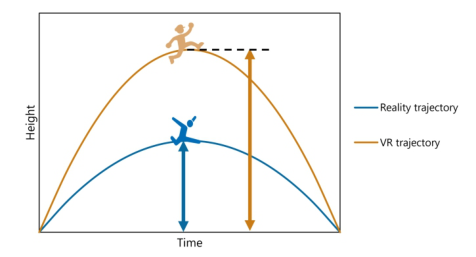
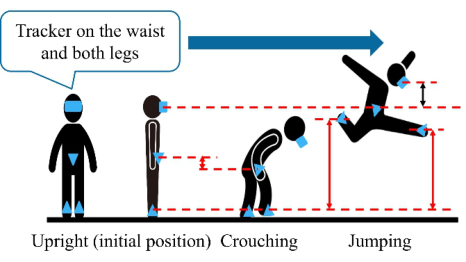
LEAP EXTENSION SYSTEM The system constructed in this study comprises an HMD (VIVE Pro Eye, HTC), a motion tracker (VIVE Tracker, HTC), and a control PC. The tracker was attached to the waist and instep of both feet, and the position coordinates of each foot were acquired. As shown in Figure 1, a series of jumping movements were classified into three states: upright, crouching, and jumping. The coordinates of the HMD and tracker in the upright state were used as the initial positions of the corresponding body positions. When the coordinates of the waist on the vertical axis were less those of the initial position, the subject was classified as crouching. The jumping height was defined as the difference between the HMD coordinates and initial position in the jumping state. The jump height was extended by applying a specific magnification factor to the jump height to change the jump height in the VR space. Figure 2 shows an image of this extension. Leap extension was performed by changing
Effects on Player Perception of Jumping Extensions With Varying Trajectories in VR 3
the trajectory using animation curves, which are functions of unity. The ratio of the dwell time estimated from the preliminary experiments to the time spent in the leaping state was obtained. The height was calculated in the animation curve, and the leap was extended by applying a specific multiplier to the value. For the intermittent trajectories, the jump was extended by multiplying the specified jump height by a specific factor once the trajectory was determined to be in a jumping state.
EXPRIMENTS TO EVALUATE THE EFFECT OF TRAJECTORY CHANGE ON LEAPFROG EXTENTION The experiment was performed on ten adult males (23.2 ± 0.4 years).
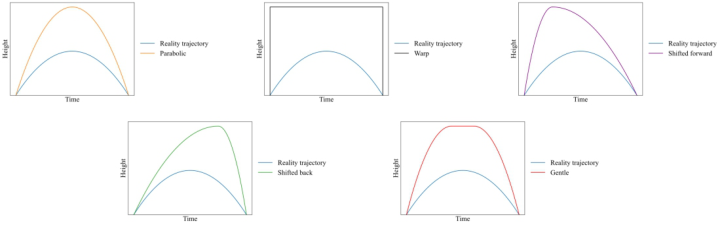
The magnification of leap extension was set to 51.5 (= 2.205) fold based on the power law in sensory quantities and 2.20-fold, which is the maximum magnification of leap extension in previous studies, to the extent that it is unrecognizable. The jumping trajectory was set under five conditions: a normal jumping trajectory (parabolic), trajectory that warps to the apex at the moment of jumping (warp), trajectory with the same duration of stay but shorter rise and fall times (shifted forward), trajectory with the same
Figure 1: Sequence of jumping movements.Figure 2: Image of the leapfrog extension.
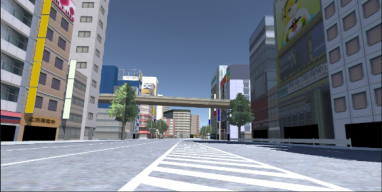
duration of stay but longer rise and fall times (shifted back), and trajectory with a gradual amount of change near the apex (gentle). These five conditions are illustrated in Figure 3. The ratio of the rise time to fall time was set to 1:4 and 4:1 for the forward and backward inclined trajectories, respectively, considering that this would reduce the gap in speed. The sense of floating improves with longer dwell time, which may lead to an increase in the sense of exhilaration. We considered that a gentle trajectory near the apex and a warp trajectory would increase the dwell time by increasing the time spent near the apex. In addition, we instructed the participants to set the jumping height to 0.25±0.03 m, taking into consideration the subjective feeling of jumping and fatigue during the experiment. The environment of the VR space in which the participants jumped was set in a city, as shown in Figure 4, because many of the objects are familiar in daily life, and their sizes and shapes are easy to imagine.
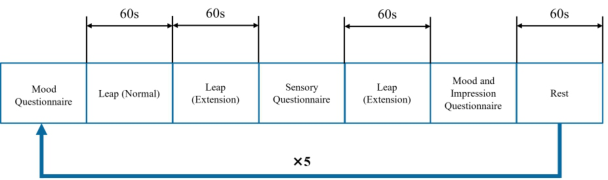
After explaining the outline of the experiment, questionnaire method, and items to the experiment participants, the HMD and motion tracker were attached to them, and a practice task was conducted to familiarize them with jumping in the VR space and to obtain a sense of jumping at the specified jumping height. In the practice task, the participants performed the test and moved on to the experimental task only after completing the test. The condition for completing the test was the ability to jump within a specified jumping height range for five consecutive jumps. The experimental task was conducted according to the procedure illustrated in Figure 5. The participants
Figure 3: Five leap trajectories used in the experiment.Figure 4: VR environment during the experiment.
Effects on Player Perception of Jumping Extensions With Varying Trajectories in VR 5
were first asked to complete a questionnaire about their mood. Next, they performed a normal jump for one minute with no change in trajectory or extension. The participants then jumped for one minute under one of five randomly selected conditions. The participants were then compared and asked to complete a sensory questionnaire. The participants were then asked to jump again for one minute under the same conditions, and questionnaires were administered regarding their impressions, moods, subjective feelings of jumping, and timing of the onset of the sense of discomfort. A one-minute break was taken after completion of the questionnaire, and the same trials were conducted for all five conditions. The participants were instructed not to jump with their ankles alone but to jump with their knees and backs bent.
Evaluation Methods In this experiment, a subjective evaluation questionnaire was used to investigate the effects of sensations, impressions, mood, subjective feelings of jumping, timing of discomfort, and feelings of jumping trajectory.
For the questionnaire on sensations, eight sensations that occurred during jumping were selected: speed at the time of ascent, speed at the time of fall, height, force, weight, floating, time, and gravity. Velocity sensation was measured for each condition. The following sensations were measured for each condition: speed of ascent and descent, height at the apex, force of kicking the ground, weight of body, floating sensation, length of time in air, gravity, and feeling of being pulled downward. Each of these eight senses was selected for the following reasons. Speed and height were two of the most important sensations in this study, because they were obtained as a result of the jumping motion. In addition, the questionnaire was divided into two sections for the sense of speed: one for ascending and the other for descending because the speed varied between ascending and descending under the conditions of this experiment. The senses of force, weight, time, and gravity were considered from the physical equation describing the physical phenomenon of jumping. The sense of levitation was selected because it is a typical sensation that can be felt during the extension of jumping and because it cannot be replaced by other sensations, such as exhilaration and dynamism, which can be replaced by questionnaires on impressions.
The questionnaire on impressions was rated from 0 to 1 using a visual analog scale for the two factors extracted in a previous study: entertainment and reality factor (Adachi et al., 2024). The entertainment factor contributes to positive feelings such as fun and interest, while the realism factor is judged based on daily experiences such as realism and predictability.
Figure 5: Experimental protocol.
The questionnaire on mood was administered using a two-dimensional mood scale, and “activeness,” “stability,” and “comfort” were calculated for each. The higher the score of “vitality,” “stability,” and “comfort,” the higher the score of “vitality,” “stability,” and “comfort,” respectively, the calmer and more positive the mood.
The questionnaire regarding the subjective feeling of jumping was administered using a 7-point Likert scale ranging from -3 (very little feeling) to 3 (very much feeling).
In the questionnaire regarding the timing of the feeling of discomfort, participants were asked to choose “yes” or “no” for the presence or absence of a feeling of discomfort after jumping. If they chose “yes,” they were asked to select one of six timing options: “at takeoff,” “during ascent,” “at the top,” “during descent,” “at landing,” and “after that. The questionnaire allowed multiple responses for each of these timing options.
The questionnaire on the trajectory of the leap asked the participants how they perceived the trajectory of the leap in each condition, and they were asked to describe the trajectory of the leap in handwriting so that the characteristics of the trajectory of the leap could be understood. If it was difficult to describe the trajectory, respondents were asked to supplement the description with words.
RESULT
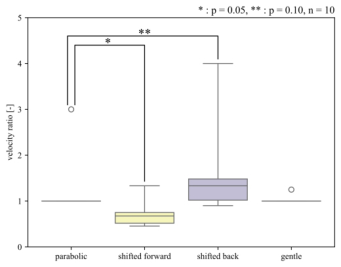
For the velocity ratio between ascent and descent in the four conditions excluding the warp trajectory (i.e., intermittent trajectory), we computed the ratio of the response value for the sensation of speed during descent to that during ascent. Figure 6 shows the velocity ratios for each condition. Using the parabolic extension as the baseline, Dunnett’s test at the 5% significance level revealed a significant difference with the shifted forward trajectory, and at the 10% significance level, a significant difference with the shifted back trajectory was observed.
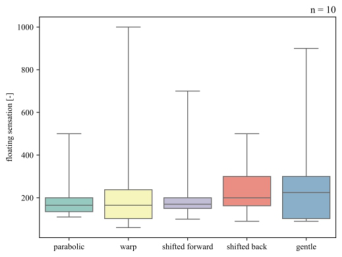
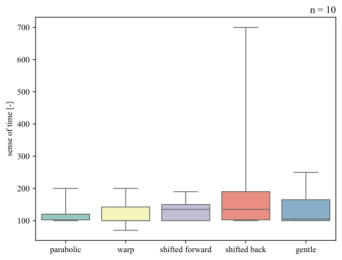
Figures 7 and 8 show the response values for the senses of floating and time, respectively, for each condition. For each of these response values, using the parabolic extension as the baseline and performing Dunnett’s test at a 5% significance level for the other four conditions, no significant differences were observed.
Figure 6: Comparison of velocity ratios for four conditions except warp trajectory.
Effects on Player Perception of Jumping Extensions With Varying Trajectories in VR 7
To determine how the eight jump sensations selected in this study interrelate and identify the sensations that most strongly affect the player, principal component analysis was conducted using the response results for each sensation across all conditions. The responses were classified into five principal components: motor perception, time, jump dynamics, and physical and spatial perception, with the principal component loadings for each shown in Table 1.
Figure 7: Comparison of floating conditions.Figure 8: Comparison of time sense conditions.Table 1: Principal component loadings.
Table available in the original PDF paper.
Time Component
Physical Component
Jump Dynamics Component
Spatial Perception Component
The Motor Perception Component Speed at the 0.738 -0.035 -0.630 –0.119 0.000 time of ascent
Speed at the
0.846 –0.116 –0.478 0.132 –0.054
time of fall Height 0.795 0.472 -0.004 –0.136 0.291 Gravity 0.761 –0.382 0.329 0.247 0.260
Continued
Table 1: Continued time component physical component the motor perception component jump dynamics component spatial perception component
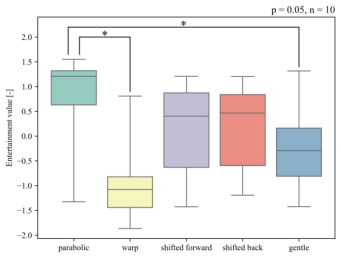
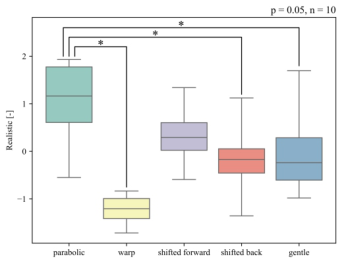
Figures 9 and 10 present the response values for entertainment and realism, respectively. The obtained response values were standardized for each experimental participant. Using parabolic extension as the baseline, Dunnett’s test at a 5% significance level was performed for the other four conditions. The results indicated that for entertainment, significant differences were found between the warp and gentle trajectories, and for realism, significant differences were observed between the warp, shifted back, and gentle trajectories.
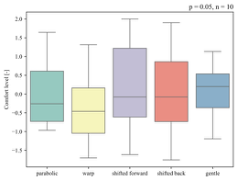
From the responses to the mood questionnaire, the values for “activation,” “stability,” and “comfort” before and after the experimental tasks for each condition were calculated. For “comfort,” the responses were standardized for each experimental participant; the results are shown in Figure 11. Furthermore, using the parabolic extension as the baseline, Dunnett’s test at a 5% significance level for the other four conditions revealed no significant differences between the conditions.
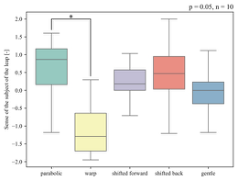
Finally, based on the responses to the questionnaire on the sense of agency in jumping, the responses were standardized for each experimental participant, using the parabolic extension as the baseline. Dunnett’s test at a 5% significance level on the other four conditions showed a significant difference with the warp trajectory. The response results are shown in Figure 12.
Figure 9: Comparison of entertainment conditions.
Effects on Player Perception of Jumping Extensions With Varying Trajectories in VR 9
CONSIDERATION Based on the analysis results of the velocity ratio and the questionnaire results on the jump trajectories, it was considered that the experimental participants perceived the characteristics of each of the five trajectories.
Regarding the shifted forward trajectory, the results of Dunnett’s tests on realism and the sense of agency in jumping did not show a significant difference from the parabolic trajectory. This may be attributed to the way in which humans perceive movements during jumping. For the shifted-back trajectory, because a significant difference from the parabolic trajectory was observed in realism, it is possible that to induce discomfort, which, in turn, leads to a decrease in realism. From these findings, it can be inferred that the necessary visual information for perceiving a jump is the falling phase from near the apex to landing, as illustrated in the figure. Regarding motor perception during the ascent phase, internal sensory feedback, such as
Figure 10: Comparison of conditions of realism.Figure 11: Comparison of comfort level conditions.Figure 12: Comparison of conditions for leaping subjectivity.
vestibular and proprioceptive sensations, is thought to play a more dominant role than visual cues. Therefore, the shifted forward trajectory extension is considered the most appropriate for maintaining a sense of agency during jumping.
Regarding the warp trajectory, the results of Dunnett’s test on the sense of agency while jumping showed a significant difference from the parabolic trajectory. This suggests that the continuity of movement is important for eliciting a sense of agency.
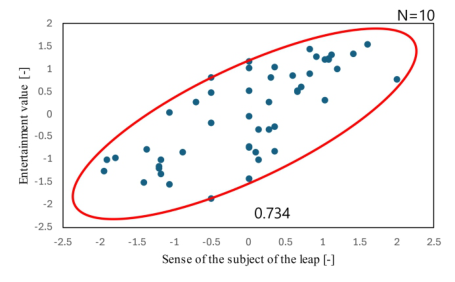
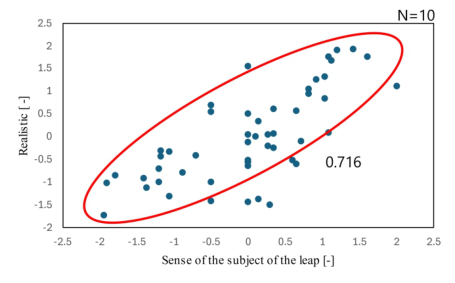
Pearson’s correlation analysis between the sense of agency in jumping and entertainment and realism revealed a positive correlation in each case. These relationships are illustrated in Figures 13 and 14. Based on these findings, it can be concluded that the sensation of jumping contributes to the enhancement of entertainment and realism.
Figure 13: The relationship between entertainment and the sense of subjectivity of the leap.Figure 14: The relationship between realism and the sense of subjectivity of the leap.
Effects on Player Perception of Jumping Extensions With Varying Trajectories in VR 11
CONCLUSION
In this study, we investigated the effects on players when the trajectory of the leap was changed, and the leap was extended vertically in the VR space. In the experiment, players experienced five different leaping trajectories and answered a subjective questionnaire. The results of the experiment suggest that visual information during ascent may not be used much in the perception of jumping. Therefore, the extension of the shifted forward trajectory was considered most useful. In the future, we aim to propose an optimal extension method by evaluating the optimal ratio of the ascent time to the fall time in a shifted forward trajectory.
REFERENCES
Adachi, T. Watanuki, K. Kaede, K. Osawa, Y. (2023) “Effects of Displacement of Bodily Sensation and Visual Information on Mood during Leap Extension in Virtual Space”, in: Proceedings of the 24th System Integration Division, pp. 2172–2175. Adachi, T. Watanuki, K. Kaede, K. Osawa, Y. (2024) “Factor of Discomfort
During Jumping Extended in Virtual Space”, in: 15th International Conference on Applied Human Factors and Ergonomics, Affective and Pleasurable Design, Vol. 123, pp. 8–17 Hayasi, D. Fujita, K. Takashima, K. Lindeman, R. Kitamura, Y. (2019) “Redirected Jumping: A method for manipulating the amount of movement during jumping in VR”, in: Virtual Reality Society of Japan, Volume 24, No. 4 pp. 341–350.
LISTED IN THE AHFE DIGITAL BOOKSTORE CATALOGUE
Explore the complete digital volume
Affective and Pleasurable Design
Read this individual research paper free through the original publisher, or explore the full digital proceedings book.
ISBN 978-1-964867-40-3
Explore this ISBN in the AHFE Bookstore ↗Listed in the July 2026 bookstore catalogue; search by ISBN to confirm current availability · Digital book purchase optional