Ryo Ono, Keiichi Watanuki, Kazunori Kaede (2025). Consideration of Visibility in the Kuiper Belt Focusing on the Placement of Objects. In: Affective and Pleasurable Design. AHFE Open Access, vol. 164, pp. 76–84. https://doi.org/10.54941/ahfe1006062
The purpose of this study was to investigate the ability of the Kuiper Belt to identify object shapes. In the experiment, 10 participants performed a gaze input task simulating simple menu item selection and completed questionnaires. Task completion time and error rate were used as objective measures, and usability was used as a subjective measure. During the evaluation, a Friedman test was conducted for each indicator. As a post-test, a Steel–Dwass test was conducted on the indicators for which significant differences were found. These results suggest that usability may deteriorate rapidly when the number of objects placed is 10 or more. In addition, objects were identified by referring to their vertex positions, suggesting that objects with similar vertex positions tended to be misrecognized.
In recent years, virtual reality (VR) has been utilized in a wide range of fields, including education and entertainment. Head-mounted displays (HMDs) have significantly evolved in line with this trend. In addition to their higher resolution and lighter weight, the number of products equipped with eye measurement systems, such as the Vive Pro Eye (HTC) and Meta Quest Pro (Meta Platforms), has been increasing. Therefore, eye gaze input technology has attracted significant attention as a pointing operation method for VR environments. Gaze input technology refers to technology that analyzes the gazing point using the corneal reflex method or electro-oculography and applies it to device operation, text input, and other operations.
In many cases, the gaze judgment of the eye gaze input is based on the time that the user’s gaze remains on a gazing object. Therefore, the system cannot determine whether the user is gazing at the target intentionally or if the user is gazing at the target while looking for another target. This is known as the Midas touch problem, and many studies have been conducted to solve it. The input flags in this method are used to confirm the gaze selection of
Consideration of Visibility in the Kuiper Belt Focusing on the Placement of Objects 77
the user. Penkar et al. proposed a method for separating the gazing targets from their labels. In their experiments, they investigated factors such as the appropriate dwell time and button size by performing a simple computational task using the proposed method. The results showed that a combination of shorter dwell times and larger buttons significantly improved accuracy. Choi et al. proposed a gaze input system using a region called the Kuiper Belt as a solution for the Midas touch problem in VR scenes. In their experiments, they verified the usefulness of gaze interaction in the Kuiper Belt in a menu item selection task by using colors in a VR environment. The results showed that the system can significantly reduce the false selection rate and cognitive load, suggesting that usability can be improved while suppressing the Midas touch problem by using the Kuiper Belt for gaze interaction.
However, in the peripheral vision area, visual acuity decreases exponentially as one moves away from the center of vision. Hence, only a rough overview of the entire object can be obtained. Therefore, the number of objects that can be recognized in the Kuiper Belt region is limited. Therefore, the purpose of this study was to gain insight into the visibility of objects presented on the Kuiper Belt by investigating participants’ abilities to identify the shapes of gazing objects in the Kuiper Belt. In the experiment, participants were given a task in which they had to select a randomly displayed shape with their gaze, and visibility was evaluated in terms of the task outcome and usability.
EXPERIMENTAL DESIGN Location and Size of Objects Presented in the Experiment
In previous studies, the Kuiper Belt was defined as a region with a viewing angle of 25–45
. This range is based on the knowledge that most human gaze data are primarily within 25
of the central fossa and that the maximum range of motion of the human eye is approximately 45
. Previous studies suggested that the size of each menu item should be 12
. It was also suggested that the top menu item should be placed at a viewing angle of 32–37
and that the left, right, and bottom menu items should be placed at viewing angles of 32
–42
. Considering the findings of previous studies and the viewing angle of the HMD, the size of each menu item was set to 12
, and each position was set to 32
.
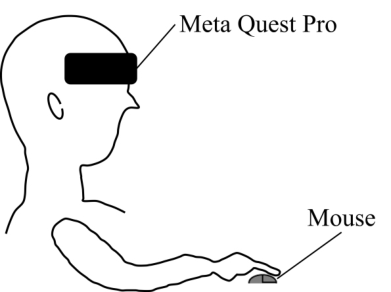
Experimental Flow The experimental setup is illustrated in Figure 1. An HMD (MetaQuest Pro, MetaPlatforms) was used to present the experimental environment. The experimental content was created using the Unity game engine.
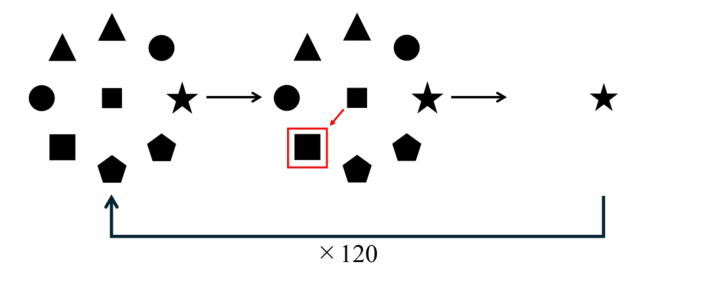
The gaze input task in this experiment was designed to simulate simple menu item selection, as shown in Figure 2. First, the correct black shape was presented at the center of the screen, and the participants selected the same shape from the objects in the Kuiper Belt. Next, the object in the Kuiper Belt disappeared, and the user gazed at the object in the center of the screen. At this time, the object in the center of the screen was changed
to the shape that would be the correct answer for the next trial. After the object in the center of the screen was selected, the surrounding objects were presented again. This sequence of actions was counted as a trial in the eye- input task and was repeated 120 times for each condition. In this experiment, the number of surrounding objects changed under four conditions: 6, 8, 10, and 12 (conditions 6, 8, 10, and 12 are referred to as “conditions 6, 8, 10, and 12,” respectively). The participants answered a usability questionnaire using a mouse while wearing the HMD.
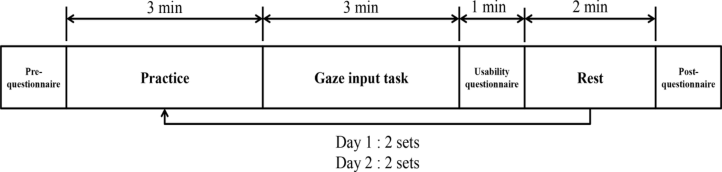
The flow of the experiment was as follows. The experiment was conducted on 10 healthy male subjects (23.0±0.7 years old). The experiment was divided into two conditions, each of which lasted for two days. Figure 3 shows the schedule of the experimental flow. The participants completed a questionnaire on eye strain and practiced the eye gaze input task for a maximum of 2 min. The eye-handling task, which comprised 2 min of rest with the eyes closed and 1 min of the usability questionnaire were repeated in 1 of 2 sets. Finally, the participants answered a questionnaire on eyestrain.
Consideration of Visibility in the Kuiper Belt Focusing on the Placement of Objects 79
Questionnaire Used in the Experiment The questionnaire on eyestrain was based on the Subjective Symptoms Survey developed by the Working Group for Occupational Fatigue. The questionnaire was designed to answer the items listed in Table 1 on a five- point scale: “Not at all applicable (1),” “Slightly applicable (2),” “Slightly applicable (3),” “Fairly applicable (4),” and “Very often applicable (5).” As shown in Table 1, these items were classified into five indices: “sleepiness (I),” “instability (II),” “discomfort (III),” “sluggishness (IV),” and “fogginess (V).” Each index can be evaluated as a score from 1 to 5 by obtaining the average value of the responses to each item. This questionnaire was administered to ascertain whether the participants were in a state of normal measurability, and the participants whose scores were less than 4 for all evaluation indices before the start of the experiment were included in the analysis. The usability questionnaire used the questionnaire items shown in Table 2. The questionnaire was designed to be answered on a visual analog scale, with 0 indicating a negative evaluation of the questionnaire items and 100 indicating a positive evaluation. At the beginning of the experiment, the intentions of the questions were fully explained to each participant. Each participant was subsequently asked to evaluate the items using the same evaluation criteria under all conditions.
Figure 3: Experimental protocol.Table 1: Questionnaire content of the subjective symptoms survey.
Table available in the original PDF paper.
No. Questionnaire Item Applicable Indicator Groups 1 Head feels heavy III 2 Feel irritable II 3 Eyes feel dry V 4 Feel sick III 5 Feel restless II 6 Feel sluggish III 7 Eyes feel tired V 8 Shoulders feel stiff IV 9 Head feels fuzzy III 10 Neck feels stiff I 11 Hands or fingers hurt IV 12 Feel dizzy III 13 Feel sleepy I 14 Feel unmotivated I
Continued
Table 1: Continued No. Questionnaire Item Applicable Indicator Groups
Table available in the original PDF paper.
15 Feel anxious II 16 Things look blurry V 17 Whole body feels sluggish I 18 Feel depressed II 19 Arms feel heavy IV 20 Hard to organize thoughts II 21 Want to lie down I 22 Eyes keep twitching V 23 Lower back hurts IV 24 Eyes feel watery V 25 Feel short of breath IV
Table 2: Usability questionnaire content.
Table available in the original PDF paper.
Item Questionnaire Item A Operation feels difficult B Typed keys are easy to find C Mentally stressful to move line of sight D Physically stressful to move line of sight E Mentally stressful to keep line of sight fixed F Physically stressful to keep line of sight fixed G Feel discomfort when typing text H Got used to the operation quickly I Want to use it again
RESULTS AND DISCUSSION
The results of the Subjective Symptoms Survey revealed that all participants had a subjective symptom index of less than 4. Therefore, all collaborators were considered free from any conditions that would interfere with the experiment and were included in the analysis.
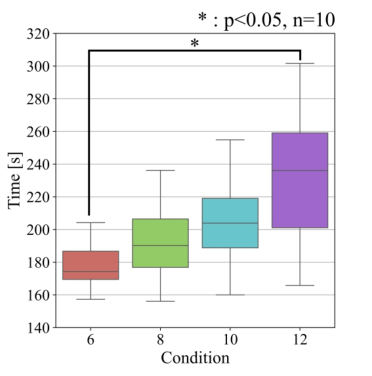
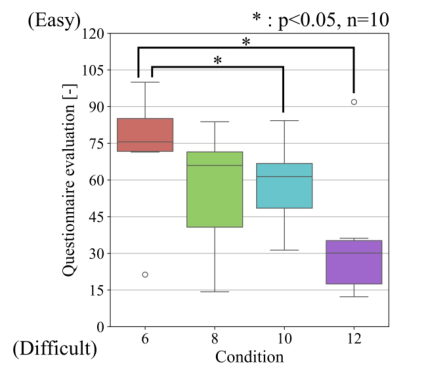
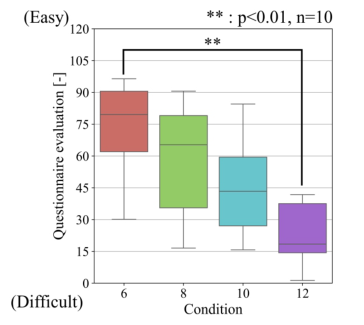
Comparison of the Number of Objects Presented on the Kuiper Belt Friedman tests were conducted at a 5% level of significance for each measure, and significant differences were found in the task completion time, number of incorrect entries, and items A, B, C, E, G, and H. In addition, Steel–Dwass tests were conducted at a 5% level of significance for these items as post- tests. As shown in Figures 4, 5, and 6, condition 6 was significantly shorter than condition 12 in terms of the task completion time, condition 6 scored significantly higher than did conditions 10 and 12 for item A, and condition 6 scored significantly higher than did 10 for item B. The mean error rates for conditions 6, 8, 10, and 12 were 0.917%, 1.583%, 2.917%, and 4.000%, respectively. These results indicate that the error rate increases as the number of gazing targets increases, especially after condition 10, where the amount of change tends to be relatively large.
Consideration of Visibility in the Kuiper Belt Focusing on the Placement of Objects 81
These results suggest that the usability and error rate may rapidly be adversely affected when the number of objects placed in the Kuiper Belt is 10 or more. This phenomenon is thought to be related to a phenomenon called crowding, in which an object becomes difficult to identify because of the surrounding stimuli in the periphery of the visual field. Previous research on crowding suggested that if the distance between objects is not properly secured, it becomes difficult to distinguish letters from objects placed in close proximity, ultimately resulting in reduced visibility. Therefore, in this experiment, the distance between the objects in condition 10 was close to this critical distance, which is thought to have reduced operability and visibility.
Figure 4: Comparison of task completion time.Figure 5: Comparison of questionnaire content A.
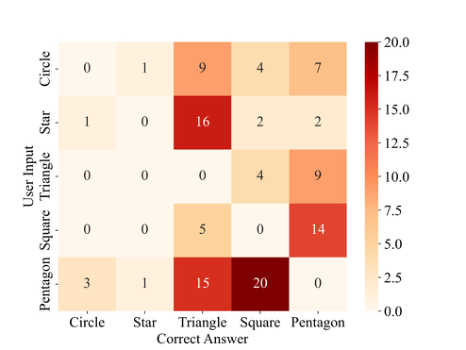
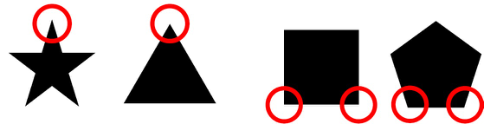
Ability to Identify Objects in Kuiper Belt We focused on cases in which the user made an incorrect entry during a task. The relationship between the shape entered by the user and the correct answer is shown in the heatmap in Figure 7. The results showed that users tended to input more incorrect answers when presented with polygonal shapes. These results may be related to the low visual acuity in the peripheral vision area. Visual acuity in the peripheral vision region is significantly lower than that in the central vision region. Hence, the entire object could have been perceived as blurred. Therefore, the vertex at which the shape of an object changes abruptly is considered an important factor in the perception of the object as a whole. Therefore, it is considered that object identification in the Kuiper Belt is performed with reference to vertex positions and that icons with similar vertex positions tend to be misrecognized. Therefore, it is necessary to select objects to be placed on the Kuiper Belt in consideration of this point.
Figure 6: Comparison of questionnaire content B.Figure 7: Heatmap of correct answers and user input when participants make mistakes.
Consideration of Visibility in the Kuiper Belt Focusing on the Placement of Objects 83
Figure 8: Similarities between figures that were frequently incorrectly entered. In the left example, the upper vertex positions of the star and the triangle are similar, and in the right example, the lower vertex positions of the square and the pentagon are similar.
CONCLUSION
In this study, we conducted an experiment on the gaze selection of randomly displayed shapes and evaluated the visibility in terms of task outcome and usability to investigate the ability to discriminate object shapes in the Kuiper Belt. The results showed that usability and error rates tended to worsen when the number of objects placed in the Kuiper Belt was 10 or more. Therefore, it is suggested that the number of eye interactions in the Kuiper Belt should be less than 10. In addition, the objects placed on the Kuiper Belt were identified based on their vertex positions. Therefore, it is suggested that objects with similar vertex positions are more likely to be misrecognized and that icons should be selected carefully. In the future, we will develop and study design principles that can accommodate the visibility characteristics obtained in this experiment.
ACKNOWLEDGMENT
During this research, I received invaluable and thoughtful guidance from Professor Watanuki and Associate Professor Kaede, for which I am deeply grateful. I also extend my sincere thanks to the laboratory members who offered a variety of insightful suggestions and to everyone who participated in the experiments.
REFERENCES
Choi, M., Sakamoto, D. and Ono, T. (2023) ‘Kuiper Belt: Utilizing the “Out-ofnatural Angle” region in the eye-gaze interaction for virtual reality’, Transactions of Information Processing Society of Japan, pp. 400–416. Foulsham, T., Walker, E. and Kingstone, A. (2011) ‘The where, what and when
of gaze allocation in the lab and the natural environment’, Vision Research, 51, pp. 1920–1931. Jacob, R. J. K. (1991) ‘The use of eye movements in human-computer interaction techniques: What you look at is what you get’, ACM Transactions on Information Systems (TOIS), 9(2), pp. 152–169. Komatsubara, A. (2019) Human error = Human error. Maruzen Publishing,
pp. 29–32. Kurzawski, J. W., Burchell, A., Thapa, D., Winawer, J., Majaj, N. J. and Pelli, D. G.
(2023) ‘The Bouma law accounts for crowding in 50 observers’, Journal of Vision, 23(8), pp. 1–34.
Miura, T. (1998) ‘Visual attention and traffic safety focusing on useful field of view’, Journal of the Illuminating Engineering Institute of Japan, pp. 180–184. Ministry of Internal Affairs and Communications (2023) 2023 White Paper
on Information and Communication Technology. Available at: https:// www.soumu.go.jp/johotsusintokei/whitepaper/ja/r05/html/nd131210.html [Accessed 19 Mar. 2025]. Mohan, P., Goh, W. B., Fu, C. W. and Yeung, S. K. (2018) ‘DualGaze: Addressing the Midas touch problem in gaze-mediated VR interaction’, in 2018 IEEE International Symposium on Mixed and Augmented Reality Adjunct (ISMAR- Adjunct), pp. 79–84. Penkar, A. M., Lutteroth, C. and Weber, G. (2012) ‘Designing for the eye: Design
parameters for dwell in gaze interaction’, in Proceedings of the 24th Australian Computer-Human Interaction Conference, pp. 479–488. Stahl, J. S. (1999) ‘Amplitude of human head movements associated with horizontal saccades’, Experimental Brain Research, 126, pp. 41–54. Working Group for Occupational Fatigue (2013) Subjective Symptoms Survey.
Available at: http://square.umin.ac.jp/of/service.html [Accessed 19 Mar. 2025].
LISTED IN THE AHFE DIGITAL BOOKSTORE CATALOGUE
Explore the complete digital volume
Affective and Pleasurable Design
Read this individual research paper free through the original publisher, or explore the full digital proceedings book.
ISBN 978-1-964867-40-3
Explore this ISBN in the AHFE Bookstore ↗Listed in the July 2026 bookstore catalogue; search by ISBN to confirm current availability · Digital book purchase optional