Ayaka Iguma, Masashi Yamada (2022). Correspondence Analysis on the Production Staff for the Anime Series Nintama Rantaro. In: Kansei Engineering. AHFE Open Access, vol. 40, pp. 109–113. https://doi.org/10.54941/ahfe1001768
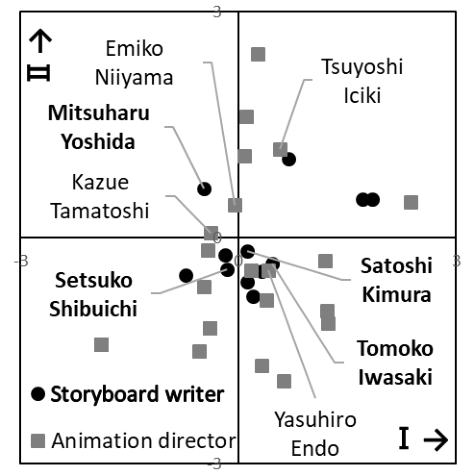
Nintama Rantaro is a long running TV anime series in Japan, which is produced by a large number of staff members. In the present study, 228 episodes of this series were selected to analyze the relationships among the staff members and the elements in the episodes, using correspondence analysis and cluster analysis. Numbers of storyboard writers, animation directors, screenplay writers and directors, and factors of the stories, e.g., representative expressions, motions of the main characters and emotions of the main characters, were counted, and a cross-tabulation table was constructed. The results of the correspondence analysis of the table showed that a three-dimensional space illustrated the correlations in the table with the cumulative contribution ratio of 42 %. The results of the cluster analysis with Ward’s method showed four clusters. Each of the four clusters coincided to each quadrant on the plane spanned by the first two dimensions. In the first quadrant, an animation director Tsuyoshi Ichiki was plotted. In the same quadrant, fighting motions of the main characters were plotted. Tsuyoshi Ichiki is one of the most proficient anime directors for battle scenes. Therefore, this indicates that the animation of episodes which includes battle scenes is chiefly directed by Tsuyoshi Ichiki in Nintama Rantaro. In the second quadrant, experienced animation directors, Emiko Niiyama and Kazue Tamari were plotted as well as a screenplay writer, Mitsuharu Yoshida who frequently writes the screenplay for the initial episode of a season. Moreover, characteristic expressions in Nitama Rantaro, such as the escape of the soul from the body, use a regional dialect “bayai” instead of “baai”, and the appearance of a character with breaking the screen, were plotted in this quadrant. This implies that the experienced animation directors and the screenplay writer use characteristic expressions especially for the initial episode of a season. In the third quadrant, an animation director Setsuko Shibuichi, who previously directed animations with sad stories, was plotted. The sad emotion of a main character is also plotted in the same quadrant. This indicates that for a sad episode, Setsuko Shibuichi directed the animation. In the fourth quadrant, screenplay writers, Satoshi Kimura and Kazuko Iwasaki are plotted as well as an animation director, Yasuhiro Endo, and various directions of motions of the characters are also plotted. This means that they are proficient dynamic motions of characters. In this way, the relationships among the staff members and the elements of the anime episodes are clarified in the context of Nintama Rantaro.
In recent years, anime (Japanese animation), video games and manga (Japa- nese cartoons) have been called “cool Japan” content and recognized as important export-oriented merchandise in Japan. In the process of producing an anime, many staff members play various roles. For example, a screenplay writer writes characters’ motions and speech lines in texts, whereas a story- board writer plans and indicates camera blockings, screen configurations, action of the characters, speech lines and their timings, using a lot of pictures based on the screenplay. A director directs all sections of anime production whereas an animation director especially directs the facial expressions of the characters and unifies the quality of the pictures. In the case of a long run- ning anime series, a large number of staff members are pooled and contribute to the work, because different combinations of the members produce diffe- rent episodes. Nintama Rantaro is a long running TV anime series which has been broadcasted by NHK (Nippon Hoso Kyokai, Japan Broadcasting Corporation), from 2003 to the present. The series includes a large number of episodes and different groups of the episodes sometimes show different atmospheres. The members possess different proficiencies and the specific combinations of the members may provide different atmospheres. In the pre- sent study, the relationships among the staff members and elements in the episodes are analyzed in the context of Nintama Rantaro.
Among the pool of the staff for the Nintama Rantaro, storyboard writers, animation directors, directors and screenplay writers, who meet at least one of the following criteria, were selected; 1) a member who worked for the Nintama Rantaro series for a long time, 2) a member who has an experience of directing anime, 3) a member who uses characteristic expressions, and/or, 4) an animation director who draws all original pictures for an episode. Con- sequently, 57 staff members were selected, then 228 episodes, for which the members were on the credits, were collected.
There were four categories of the staff members, i.e., the storyboard writer, animation director, director and screenplay writer. And the individuals in the categories were treated as items, in the present study. For example, there were nine individuals in the storyboard writer category. These nine individuals were items in the storyboard writer category. In the same way, 61 individuals in the other three categories were treated as items. Moreover, elements in the episodes, e.g., gesture of the main characters, representative expression in the series, emotion of the main characters, were also treated as categories. These twelve categories were subdivided into 383 items.
A staff member for the Nintama Rantaro, Tao Hatsumi mentioned that “The storyboard writers take the most important position for the anime expressions in the Nintama Rantaro series” on Twitter (Hatsumi, 2019a). She also wrote that “The different combinations of staff members use dif- ferent expressions and the differences among the different combinations are larger than the differences among the different seasons” (Hatsumi, 2020).
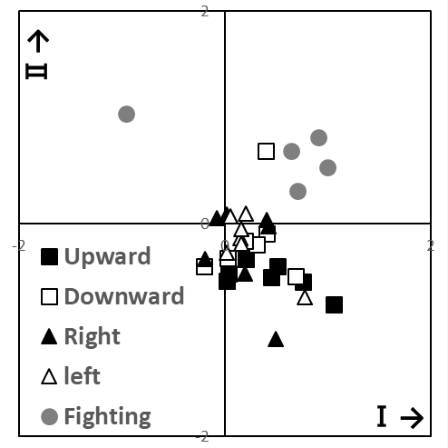
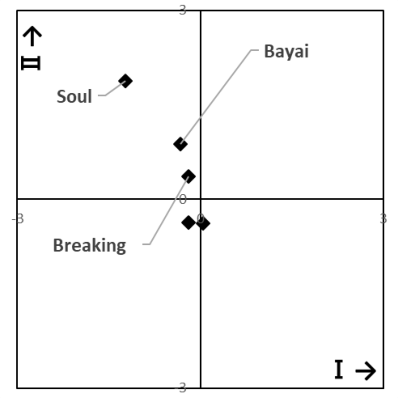
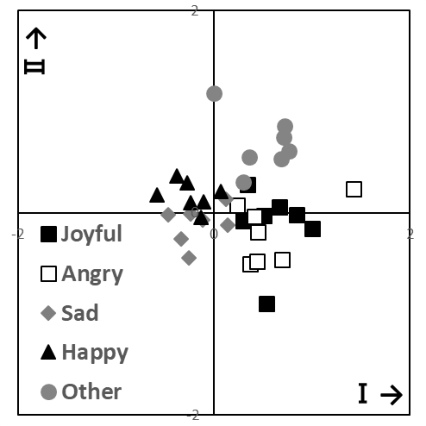
Therefore, for each of the nine items (individuals) in the storyboard wri- ter category, numbers of each item in the other 15 categories were counted, and a 9 × 431 cross-tabulation table was constructed. This table was analy- zed using correspondence analysis to clarify the relationships between the combinations of the staff members and the expressions (Benzécri, 1992). The results of the cluster analysis showed that a three-dimensional solution illu- strated the relationships in the table with a cumulative contribution ratio of 42%. Then the plots of the storyboard writers on the three-dimensional space were analyzed using cluster analysis with Ward’s method. The results showed four clusters and each of the clusters coincided with each quadrant on the first two-dimensional (I-II) plane as shown in Figure 1. The correspon- dence analysis showed the plots of the items of the other categories on the same space. Figure 1 also shows the plots of the animation directors on the I-II plane. The important items of the other categories were plotted through- out Figure 2-4. Figure 2 shows the gestures of the main characters. Figure 3 shows the plots of the representative expressions in the series and Figure 4 shows the emotions of the main characters for every minute.
RESULTS AND DISCUSSION
In the first quadrant in Figure 1, an animation director Tsuyoshi Ichiki is plotted, whereas Figure 3 shows the fighting action in the same quadrant. This implies that Tsuyoshi Ichiki frequently directs animation for the episo- des which includes fighting scenes in the Nintama Rantaro series, because
Correspondence Analysis on the Production Staff for the Anime Series Nintama Rantaro 111
Figure 1: Plots of the storyboard writers and animation directors.Figure 2: Plots of the actions by the main character. Upward, downward, left and right indicate the directions of motions.
he is one of the most proficient animation directors for the fighting actions. In fact, Tao Hatsumi (2016) mentioned that “I want to ask Tsuyoshi Ichiki to direct animation for fighting actions” on Twitter. In the second quadrant of Figure 1, experienced animation directors, Emiko Niiyama and Kazue Tamari were plotted as well as a screenplay writer Mitsuharu Yoshida who
112 Iguma and Yamada
Figure 3: Plots of representative expressions. “Bayai” indicates saying bayai instead of baai, “Breaking” indicates the breaking the screen when a character appears, and “Soul” indicates the escape of a soul from a body, respectively.
frequently writes the screenplay for the initial episode of a season. In the same quadrant in Figure 3, representative expressions in the series of Nin- tama Rantaro are plotted. They include the escape of a soul from a body, speaking using a regional dialect by using “bayai” instead of “baai”, and marking the appearance of a character by breaking the screen. These results suggest that the experienced animation directors and screenplay writers pro- duce the initial episode of a season, using representative expressions in the Nintama Rantaro series.
In the third quadrant of Figure 1, an animation director Setsuko Shibuichi is plotted. In the same quadrant in Figure 4, the sad emotions of the main cha- racters are plotted. Shibuichi previously directed the popular anime The Glass Rabbit, which includes very sad scenes, and wrote the storyboard for the tra- gic anime Les Misérables: Girl Cosette. This implies that Setsuko Shibuichi is proficient at expressing sad stories and frequently writes the storyboards for sad episodes in the Nintama Rantaro series.
Finally, in the fourth quadrant of Figure 1, storyboard writers, Satoshi Kimura and Kazuko Iwasaki are plotted as well as an animation director, Yasuhiro Endo. The same quadrant in Figure 2 shows that the main chara- cters move in various directions. In other words, the actions of the characters are very dynamic when the combination of Kimura, Iwasaki and/or Endo pro- duced the episodes. Hatsumi (2018a) criticized Kimura by commenting that “The characters play with dynamic motions in his storyboards”. She also commented on Iwasaki, when she noted that “The density in the picture is extraordinarily high and there is no room on the screen, when Iwasaki wrote the story-board” (Hatsumi, 2018b). Moreover, Hatsumi (2019b) mentioned that “Endo is standard for dynamic motions”. These comments suggest that Kimura, Iwasaki and Endo are proficient at expressing dynamic actions and
Correspondence Analysis on the Production Staff for the Anime Series Nintama Rantaro 113
Figure 4: Plots of the emotions of the main characters.
they frequently take a part of producing the episodes that include dynamic action scenes in the Nintama Rantaro series.
CONCLUSION
As described above, the relationships between the combinations of the staff members and the elements of the episodes are clarified in the context of the series of the anime, Nintama Rantaro, using the correspondence analysis and the cluster analysis.
REFERENCES
Benzécri, J.-P. (1992). Correspondence analysis handbook. New York: Marcel Dekker. Hatsumi, T. (2016). [@hatsumidashiyo]. (November 10) Twitter: https://twitter.com/
hatsumidashiyo/status/796653458682249216 (accessed December 24, 2021). Hatsumi, T. (2018a). [@hatsumidashiyo]. (May 3) Twitter: https://twitter.com/hats umidashiyo/status/991976135121489922 (accessed December 24, 2021). Hatsumi, T. (2018b). [@hatsumidashiyo]. (August 24) Twitter: https://twitter.com/
hatsumidashiyo/status/1032923206393323520 (accessed December 24, 2021). Hatsumi, T. (2019a). [@hatsumidashiyo]. (March 20) Twitter: https://twitter.com/ha tsumidashiyo/status/1108362908801482752 (accessed December 24, 2021). Hatsumi, T. (2019b). [@hatsumidashiyo]. (September 6) Twitter: https://twitter.com/
hatsumidashiyo/status/1169904449357090816 (accessed December 24, 2021). Hatsumi, T. (2020). [@hatsumidashiyo]. (April 27) Twitter: https://twitter.com/hats umidashiyo/status/1254668243043639297 (accessed December 24, 2021).
LISTED IN THE AHFE DIGITAL BOOKSTORE CATALOGUE
Explore the complete digital volume
Kansei Engineering
Read this individual research paper free through the original publisher, or explore the full digital proceedings book.
ISBN 978-1-958651-16-2
Explore this ISBN in the AHFE Bookstore ↗Listed in the July 2026 bookstore catalogue; search by ISBN to confirm current availability · Digital book purchase optional