Xiaoxue Zhang (2022). Mining design elements of household medical products based on user comments. In: Kansei Engineering. AHFE Open Access, vol. 40, pp. 96–103. https://doi.org/10.54941/ahfe1001766
With the change of people's health concept, the increase of sub-health population and the aggravation of population aging, the proportion of family self-care in China's medical system has gradually increased, and the popularization of household medical products is unstoppable. Due to the lack of research on the user needs of household medical products, the problems of inconvenient use and unsightly shape of existing household medical products are gradually emerging. Therefore, it is very necessary to mine the real needs of users and study the user satisfaction degree of products.This paper uses user online comment mining technology to mine the characteristics and design elements of household medical products concerned by Chinese users. Firstly, we use the web crawler technology to obtain the online comment data of household medical products from the e-commerce platform, and then mine the product features concerned by users from the comment text, which provides designers with the main design elements of household medical products. Then the product features are clustered by different topics, and finally the user attention degree of product features with different topics is calculated. It is found that users of different types of household medical products pay different attention to the product characteristics of different topics, but the product characteristics of rehabilitation products are similar to treatment products in the user's attention.
Household medical products mainly refer to medical devices suitable for the public to use outside the hospital for the purpose of detection, trea- tment, health care and rehabilitation. They have the advantages of safety and reliability, simple operation, small volume and convenient carrying (Xie, 2012). With the continuous increase of urban sub-health population and the acceleration of population aging process, household medical devices can pro- mote the daily care and treatment of common and chronic diseases of the elderly in the family environment (Fu, 2012), which is conducive to reducing hospitalization services, improving the utilization efficiency of health resou- rces and more cost-effective. Household medical devices make patients more
Mining design elements of household medical products based on user comments 97
active in treatment, which is conducive to disease prevention and control (Kaufman, 2009), and improve the quality of life of patients. When medi- cal devices are popularized to every family, people’s demand for them will not stop at the satisfaction of functions, which also means that users will have higher and stricter standards and requirements for the modeling and use mode of household medical products. Therefore, the household design of medical products should pay attention to strengthening the research on users’ needs and usability, coordinating and balancing various factors, and deepening the user-centered design concept (Yang, 2013). Since 2014, China’s e-commerce of medical device has made amazing development (Wei, 2014). Users can buy medical devices on various e-commerce platforms and leave relevant comments. These online comments contain rich information and are of great value to product design. To sum up, this paper will use the method of online comment mining to extract and study the product features and design elements of household medical products concerned by Chinese users.
Data Sources According to the function and purpose of household medical products, we can roughly divide them into four types: therapeutic instruments, detection, rehabilitation and health care (Sun, 2011). In this study, data collection was carried out for these four types of products. From July 2021 to August 2021, the author captured the online comment data of three to five products with the highest sales of four types of household medical products on JD platform, with a total of 75900 comment data.
By observing the original online comment data, combined with the rese- arch purpose of this paper, the author takes the system default comments, comments with insufficient information, too short comments and repeated comments in the obtained data as the invalid comments of this experiment, and eliminates these invalid data. 72465 comments remained after cleaning (see Table 1).
Product Feature Mining Guo C. D. et al. (2016) Proposed a commodity feature mining method, which mines commodity candidate features by expanding user dictionary and introducing synonym list, calculates weight by TF-IDF, and finally considers user emotion index as the basis for selecting commodity features. Based on this method, this paper extracts the commodity characteristics and design elements of four types of household medical products. Feature mining meth- ods include word segmentation, extracting candidate feature sets, selecting commodity features and so on.
Step 1 Word Segmentation and Part-of-Speech Tagging This paper adopts a free software named KH Coder which is used for weighted text analysis or text mining, performs word segmentation and part- of-speech tagging on the comment text. It is worth noting that because there are many colloquial expressions in user comments and many proper nouns in the field of medical products, words such as “awesome” and “sputum
suction tube”will appear in the comment corpus, which cannot be recognized by the original dictionary built in the software during the word segmenta- tion process. Therefore, after the preliminary word segmentation, the author observed the word segmentation results, supplemented and constructed the domain dictionary related to each product - Tag dictionary, which makes up for the error of word segmentation using the software original dictio- nary. Then, the new dictionary is used to segment the corpus twice, and the part-of-speech tagging is carried out on the segmentation results.
Step 2 Candidate Feature Pruning and Word Frequency Analysis Select all candidate words tagged as noun, propernoun and TAG from the separated words, and take them out to form the feature candidate set S0. The feature candidate set S1 is obtained by pruning the single word words in S0, such as “force”, “point”, “head”, and words unrelated to product features, such as “easy to use” and “diabetes”.
Step 3 Synonym Merging and Substitution In order to make the product features more prominent, it is necessary to merge and replace the synonyms of the original corpus based on the fea- ture candidate set. For the candidate feature words in feature set S1, a synonym forest is introduced for synonym merging. For example, the words “appearance”, “shape” and “molding” are merged into a candidate fea- ture “appearance”, forming a synonym replacement document T0. Write a python program, input the original corpus C0 and document T0, complete the synonym replacement and output the replaced comment corpus C1, prune the candidate features of C1 again to obtain the feature candidate set S2.
Step 4 High Frequency Feature Extraction Calculate the word frequency of the words in the feature candidate set S2, use the quartile method to obtain the quartile position of the word frequency,
Mining design elements of household medical products based on user comments 99
reserve the feature words with the word frequency value in the upper quartile interval to obtain the feature set S3, and complete the mining of product features.
According to the process, the feature sets of four types of household medical products are mined respectively (see Table 2).
Product Feature Clustering In order to make the product features mined from user comments hierarchical and degraded, the author has carried out LDA topic clustering on the crawled user comment data, and obtained four comment topics, which are:
Topic 1 basic attributes. These words describe the basic attributes of the product itself, including the quality, function, price, efficacy and other cha- racteristic information of the product. Paying attention to this topic can understand the general needs of physical products concerned by users.
Topic 2 additional services. It refers to relevant services other than the characteristics of the product concerned by users, such as logistics express, customer service, technical guidance, information support and other forms of services.
Topic 3 user experience. It reflects the user’s experience and feeling when interacting with the product in the process of using the product. Household medical product is a typical experience product, which will bring rich user experience to the user. These experiences come from the stimulation of the product to the user’s five senses, or may be the user’s pure subjective feeling.
Topic 4 product design. It is the user’s description of product design in the comments, generally including the description of product material, shape and color. Through the research on this topic, we can understand the user’s preference for product appearance design.
These four topics represent the four primary topics that users pay atten- tion to product features. Through the observation and analysis of the product feature set obtained in the previous article, it can be found that these pro- duct features can be classified into the above four topics according to their meaning, and can be further classified to obtain twelve secondary topics (see Table 3).
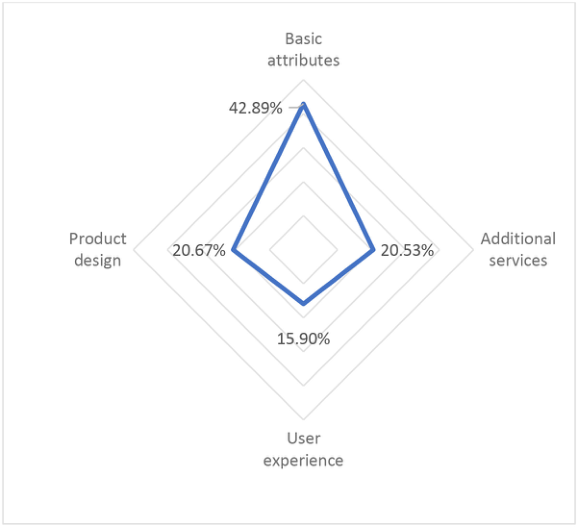
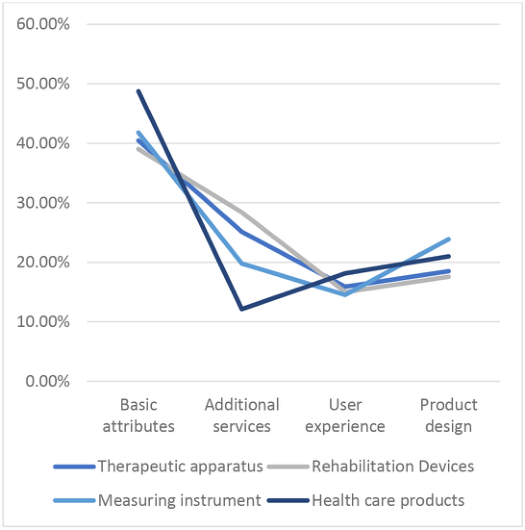
Users’ Attention to Different Topics By calculating the frequency of product feature words under each topic, we can get the degree of attention of each user to different topics. By drawing the calculation results into a broken line diagram, we can observe the differences of product features concerned by users among the four types of household medical products (see Figure 1 and Figure 2).
By observing the calculation results, we can find that users pay different attention to different topics (see Figure 1): a) Chinese users pay the most attention to the basic attributes of household medical products, which shows that the basic attributes of household medical products are the most concerned by users when purchasing, and users will give priority to evaluating the quality, price, function and efficacy of products.
100 Zhang and Yu
Table 2. Feature set of four types of household medical products (part).
b) Chinese users pay almost the same attention to the design of household medical products and additional services. Although the additional functi- ons are not the attributes of the products, because the data of this study
Mining design elements of household medical products based on user comments 101
Table 3. Product feature set after classification (part).
Table available in the original PDF paper.
Product Features
Primary Theme
Secondary Theme
Basic attributes
Quality defect, error, accuracy, sensitivity and durability Function Bluetooth, infrared, spectrum Effect effect, fog amount, particle, suction, concentration Price special price, cost performance and price Additional services Logistics delivery, express, package, receiving and logistics per- sonnel Service customer service, guidance, video, gifts, after-sales
User experience
Voice mute, prompt tone, noise, voice, sound size Use easy to operate, intelligent, portable, humanized and easy to learn Feel temperature, pain, hygiene, comfort, fear frosted, plastic, soft, metal, aluminum alloy Texture of material
Product design
Parts fuselage, button, base, interface and screen Colors black, white, gold, silver Appearance atmosphere, grade, fashion, sense of science and tech- nology, appearance Packing of products
comes from the e-commerce platform, users often evaluate the transpor- tation of goods and the services of stores in online comments. Due to the particularity of medical products, users need professional guidance and services to correctly install and use household medical products, There- fore, there are many descriptions of products and additional services in the comments; After the basic attributes and user experience are met, users will have higher needs for product modeling and design, and their aesthetic preferences for products will be reflected in online comments. c) Chinese users pay less attention to the user experience of household medical products In addition, we can also find that users pay different attention to different types of household medical products (see Figure 2):
a) Users of therapeutic instruments and rehabilitation products pay close attention to their needs. b) Users of testing products and health care products pay more attention to basic attributes than the other two types of products. c) Users of testing products and health care products pay more attention to user experience and product design than rehabilitation products and therapeutic.
102 Zhang and Yu
Figure 1: User attention of different topics.Figure 2: User attention of different types of products.
Mining design elements of household medical products based on user comments 103
CONCLUSION
This paper conducts text mining on users’ online comments of Chinese house- hold medical products, and obtains the product features that users pay most attention to. These product features are the design elements that designers must consider when designing products. The excellence of these design ele- ments greatly affects users’ satisfaction with products, so they can be used as the focus of household medical product designers when designing. On this basis, this paper also clusters the product features obtained, and finds that users pay different attention to the product features of different themes. At present, Chinese users pay more attention to the basic features such as the function and efficacy of household medical products, and pay less attention to the product design and user experience; Users of different types of househ- old medical products pay attention to different product themes, but the user concerns of therapeutic products and rehabilitation products are very similar, so they can refer to each other or combine them in follow-up research.
REFERENCES
Fu, M., & Tanno, W. B. . (2012). Medical devices in the home: a unique challenge for the fda. Work, 41(3), 361. Guo, C. H., & Zhang, Y. T. (2016). A commodity feature mining method based on
network comments. Journal of information, 35(1), 7. Kaufman, Diana, Weick-Brady, & Mary. (2009). Homenet: ensuring patient safety with medical device use in the home. Home Healthcare Nurse: The Journal for the Home Care and Hospice Professional, 27(5), 300–307. Sun, Y. Y., & Tan, J. (2011). Current situation and Prospect of domestic medical
devices in China. China medical device information, 17(2), 2. Wei, L. P. Research on online shopping acceptance behavior of household medical software from the perspective of B2C supply chain. Xie, J. X. (2012). Thoughts on the development of China’s household medical device
industry during the 12th Five Year Plan period China medical device information. China medical device information, 18(4), 6. Yang, X. L. (2013). Humanized design of household medical products. (Doctoral dissertation, Qilu University of Technology).
LISTED IN THE AHFE DIGITAL BOOKSTORE CATALOGUE
Explore the complete digital volume
Kansei Engineering
Read this individual research paper free through the original publisher, or explore the full digital proceedings book.
ISBN 978-1-958651-16-2
Explore this ISBN in the AHFE Bookstore ↗Listed in the July 2026 bookstore catalogue; search by ISBN to confirm current availability · Digital book purchase optional