Eva-Maria Jakobs, Bianka Trevisan, Robert Schmitt (2021). Gender-Sensitive Product Design by Kansei Engineering: An Application Example Using Kano-Questionnaire. In: Advances in Affective and Pleasurable Design. AHFE Open Access, vol. 14. https://doi.org/10.54941/ahfe100572
1 Institute of Linguistics and Communication Studies, HCI-Center, RWTH Aachen University, Campus-Boulevard 57, 52062 Aachen, Germany ↗
2 Production Metrology and Quality Management, Laboratory for Machine Tools and Production Engineering WZL, RWTH Aachen University, Steinbachstraße 19, 52062 Aachen, Germany ↗
The paper presents a quantitative study based on the Kano-model to gender-sensitive product design by adapting the Japanese user-centered approach of Kansei Engineering. Underlying assumption of the approach is that products are not only perceived by functionality, but essentially by emotions such as joy of use and satisfaction for the fulfilment of user-centered product requirements. Thereby, the customers’ satisfaction is investigated by applying the Kano-method, a procedure to structure product requirements and to determine their influence on customers’ satisfaction. In this study, product designers overtake the role of the customer in order to bridge perspective gaps between customers and designers of products. Thereby it is analyzed, how designers perceive and evaluate products, which requirements they claim as relevant and satisfying, and to what extent the gender plays a role. The results of the study indicate that for the creation of designers’ (as customers’) satisfaction, the same product requirements are – more or less – relevant for both genders. However, there are slight differences in the perception and evaluation of product requirements observable. While women place great importance on hedonic characteristics such as attractiveness, the men are rather indifferent regarding product requirements.
Consumers expect from a product that it is not only a useful object, but also that the product meets his needs and desires. This includes, in particular, an attractive design that motivates the consumer for use and, thereby, evokes a feeling of pleasure. If these product requirements are met, the customer is satisfied with his choice. Anyway, often products are not customer-centered designed. Reasons for this are, among others, divergent perspectives of customers (users) and product designers (perspective gap). For instance, the customer product impression relies on personal expectations (Lindgaard and Dudek, 2002) whereas the designer creates products according to his professional (design guidelines) and personal view (mental concept of the object). To get closer to a user-centered design, it has to be investigated how designers perceive and evaluate products and which requirements they claim as relevant and satisfying. Thereby, the assumption is that the emotional perception of products not only varies rolerelated but also by gender.
User-centered approaches such as Kansei Engineering (Nagamachi, 1995) offer one way to close this perspective gap. Kansei Engineering describes a methodology to collect and transfer customer’s product feelings, impressions (in Japanese Kansei), and demands during the development process of a product into product properties. A main assumption of this approach is that products are not only perceived via their functionality, but also by properties that can be felt and experienced.
In the interdisciplinary project “Gender-Specific Kansei Engineering (Design Lab)” (runtime: 2009–2010), funded by the German Excellence Initiative, the Kansei Engineering approach was adapted. Experts from communication science and mechanical engineering investigated, which methods are appropriate for supporting designers in the process of user-centered product design. The aim was to define methods that allow designers to identify user requirements and to help transform these into product properties. Thereby, the influence of gender on the process of product perception (user perspective) and product design (designer perspective) is investigated.
The present paper reports the application of the Kano-method (Kano, 1984) for the investigation of gender sensitivity in product design. The Kano-method is a procedure to structure customer requirements and to determine their influence on customers’ satisfaction. These requirements are divided into basic, performance, and excitement requirements according to the Kano-model. The Kano-method is conducted in two steps. In a pre-study, relevant product requirements are identified. In the main study, the product requirements are quantified regarding the categories of the Kano-model. As stimuli, blood pressure monitors of varying quality, maturity, and type are given. The study is lead by the assumption that female designers are more sensitive to product requirements that relate to the attractiveness and hedonic quality of a product while male designers stress more pragmatic product aspects (Jakobs et al., 2008).
The paper is structured as follows. First, approaches for affective and pleasurable design are presented such as Kansei Engineering and Kano-method. In this context, the objectives of the associated project, where the present study is conducted, are described. Second, the study design is depicted and results presented. Third, the results are discussed regarding gender perspectives and methodical aspects. Finally, a conclusion and an outlook are given.
APPROACHES FOR AFFECTIVE AND PLEASURABLE DESIGN Kansei Engineering
Kansei Engineering describes a three-step methodology by which customer impressions, feelings, and demands concerning a product can be collected and transferred into product properties during the development process (Nagamachi, 1995) (see Figure 1).
Figure 1. Steps of the Kansei Engineering process (Nagamachi, 1995) The assumption is that products – according to the Japanese expression Kansei, which means “total emotions” – are not only perceived via their functionality. Moreover, they are perceived by properties that can be felt and experienced. Thus, the psychological feeling must be identified for the product development process. Therefore, in Kansei Engineering, product concepts are collected by methods such as participating observation, semi-structured interview, or questionnaire (Kansei Engineering System). The collected product-related impressions, feelings, and demands are objectified and result in the final (product) design solution.
Figure available in the original PDF paper.
In the past, the approach was used for the design of different products such as welding helmets or industrial handling equipment (e.g. electrical driven warehouse reach truck) (Schütte, 2002, 2005). Thereby, the most successful examples of product development using Kansei Engineering is Mazda's sports car Miyata. Recent case studies use Kansei Engineering for user-centered optimization of brassieres, word sound image, and housing (Nagamachi and Lokman, 2011). In the present paper and in the reported project, the approach is used for the enhancement of medical products, concerning the influence of gender and role on the product development process.
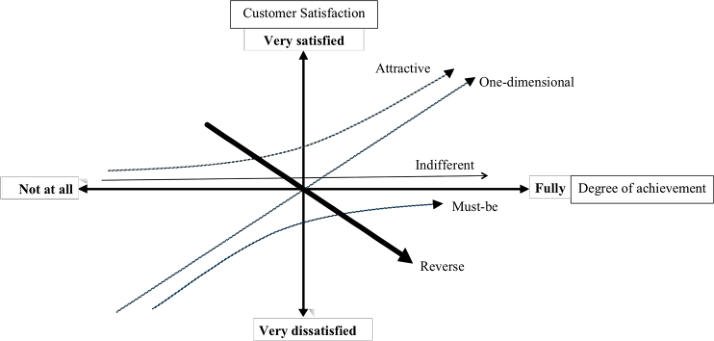
Kano-method The Kano-method is an approach to structure customer requirements and to determine their influence on customers’ satisfaction. Thereby, customers’ satisfaction can be fulfilled in different gradations (very satisfied, fully, very dissatisfied, not at all) (see Figure 2).
Figure 2. Kano-model of customers’ satisfaction (According to Gustaffson, 1996) In the Kano-questionnaire, requirements are – according to the Kano-model – segmented into five categories: attractive, one-dimensional, must-be, indifferent, and reverse (Kano, 1984). They can be defined as follows:
Must-be requirement: Basic features, which are so fundamental, that the customer only become aware of non- compliance (implicit expectations). If the basic requirements are not fulfilled, dissatisfaction arises; in contrast, if they are fulfilled, no satisfaction arises. The benefits increase is very low. Example: protection against rust for cars.
One-dimensional requirement: The customer is aware of the performance characteristics: they eliminate dissatisfaction or create customer satisfaction, depending on the degree of fulfilment. Example: fuel consumption of a car.
Attractive requirement: Benefit-creating characteristics which the customer does not expect, necessarily. They characterize the product against the competitors and raise enthusiasm. A small increase in performance can lead to a disproportionate benefit. Differentiations against the competitors may be low, but the benefits enormous. Example: special equipment such as the Concierge service.
Indifferent requirement: Features, which are both in the presence as well as in the absence of no importance for the customer. Therefore, they cannot donate satisfaction, but also do not lead to dissatisfaction. Example: sunroof.
Reverse requirement: If they exist, they lead to dissatisfaction; if they are missing, they do not lead to satisfaction. Example: rust stains.
In the questionnaire, each category is represented by two questions: a functional and a dysfunctional question. The functional question refers to existing (conscious) properties, the dysfunctional question relates to non-existing (subconscious) product properties. Thus, questions are raised regarding the opposite (non) existence of the different quality properties of an object. The maximum number of opposite questions per data collection is about 8-10.
Usually, the method is used in product profile planning for structuring customer needs. Especially for complex products with many different customer requirements the use of the questionnaire is recommended. Areas of application are, for example, the hotel industry (Giesbert, 2008), websites of financial service providers (Buhl et al., 2007), or the food retail sector (Heinlein et al., 2013).
Design Lab: projects objectives The aim of the project is to test appropriate methods for the collection of gender- and role-specific concepts, needs, and quality requirements of products with the intention of improving the process of product design. The basic assumption of the project is that people – depending on role and gender – evaluate and perceive products differently, which was also suggested in previous studies (Xue and Yen, 2007; Trevisan et al., 2014/in press). Users have divergent demands concerning a product in comparison to product designers. Thus, the project combines both: the user perspective and the designer perspective. Here, studies for the investigation of the user perspective serve to determine gender-related needs, wishes, and sticky or hidden requirements linked to products. In contrast, studies for the investigation of the designer perspective serve to analyze what they assume as user-centered requirements for medical devices, what they consider to be a pleasant and affective design, and how they act when designing products.
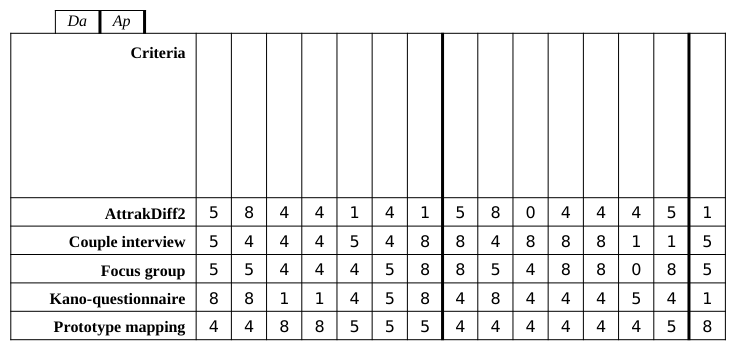
To achieve a more user-centered product design, the Kansei Engineering-approach is adapted and modified according to the project’s objectives and completed by the perspective of gender- and role-sensitivity. For this purpose, five selected methods are examined (Trevisan et al., 2012): the Kano-questionnaire (Kano, 1984) and AttrakDiff2-questionnaire (Hassenzahl et al., 2003), couple interview (Przyborski and Wohlrab-Sahr, 2008), focus group (Morgan, 1997), and prototype mapping (Mangasser-Wahl, 2000). The methods are evaluated with respect to the following criteria: data quality and application effort. Data quality is a complex rating scale including the sub- criteria gender aspects, role aspects, hedonic quality, pragmatic quality, domain applicability, result quantity, and result quality. The criteria application effort subsumes the sub-criteria handling complexity (o=operator, p=participant), adjustment effort, planning effort, data collection effort, data analysis effort and fix to variable effort. Three evaluators rated each method concerning data quality and application effort by Harvey Balls (Tullis and Albert, 2008). The evaluation is summarized in an evaluation portfolio (see Table 1).
Table 1. Evaluation portfolio for the appropriation of methods for user-centered design (excellent 4 90- 100%, very good 5 80-89%, good 8 70-79%, fair 1 60-69%, poor 0 <60%) (Trevisan et al., 2012).
STUDY DESIGN Pre-Study
The Kano-study was carried out in a two-step-procedure: a pre-study (focus groups) and a main study (Kano- questionnaire). In the pre-study, relevant product features or user requirements are identified in focus group-studies (Trevisan et al., 2014/in press). In focus groups, the interviewer leads the participants and gives them gradually tasks to be solved (Morgan, 1997), for example, “Mention typical components of the blood pressure monitor”. Thereby, the participants are triggered by an interview guideline.
In this study, the focus groups were organized homogeneous by gender; highly advanced design students represent the professional guild of designers (f=13, m=14). Parallel to the study, the students designed in class medical devices. Thus, the students had insights and knowledge about patients’ quality requirements on medical devices. All students were aged between 20 and 30 years. The focus groups took about 60 minutes per group; they were recorded by audio recorder and camera. All participants consented to the recording of video data and the use of the anonymized data for research purposes. In this study, the evaluation object was a medical device (a blood pressure monitor) represented by four different stimuli (products) (see Table 2).
Table 2. Study stimuli of the focus groups: blood pressure monitors.
Table available in the original PDF paper.
Device A is awarded with a quality seal by the German consumer protection organization (Stiftung Warentest) and is in the price range between 20 and 25 Euros. Device B did not receive a quality seal. It can be purchased in discount shops for 10 to 15 Euros. Product C is also tested by German consumer protection organization. The device received a rather poor rating (adequate). Product D is a rarity among the blood-pressure monitors: blood pressure is measured on patients finger. It was produced in the 90ties and is not more sold anymore. The focus groups started with the exploration of the evaluation objects; in this phase, the designers got the chance to try out the four product models. None of the products has already been used or known by them prior to the study.
The data analysis and evaluation was conducted in three steps. First, the focus group discussions were transcribed. Second, the transcripts were coded bottom-up using the content analysis software MaxQDa. Third, product components or requirements are selected from the interview data that were used in the Kano-questionnaire. The selection was led by two criteria: Named in the focus groups and relevant component of blood pressure monitors. The selection includes the following components: left/right handed, button, cuff, display, surface, guidance, feedback, switch, pump, clearance, and edge.
Main Study In the main study, the Kano-method is conducted. The questionnaire is applied in the designer group.
Initially, the Kano-questionnaire is designed, which took approximately 2-3 hours. For each identified product feature of the pre-study opposite questions (functional vs. dysfunctional) are developed. Thereby, the questions are formulated as if the user would respond; in our study, the designers overtake the role of the user. As a best-practice example, the questionnaire design described in Sauerwein et al. (1996) served. Figure 3 shows an extract of the Kano-questionnaire.
Figure 3. Example of a contrasting question pair with answering opportunities from the Kanoquestionnaire (Adapted from Sauerwein et al., 1996)
Figure available in the original PDF paper.
To each question, five possible answers are given. Responses of the type That would make me very happy. state that the respondent rate the requirement with like. The response “I expect that.” sets a requirement as must-be. If the respondent replies with “That does not matter to me.” he has a neutral opinion towards the requirement. The response “I accept that barely.” sets a requirement as acceptable. Responses of the type “That would bother me very much.” show that a participant does not like a feature. The response possibilities and the method are explained to the participating design students prior to the study; as evaluation object, the medical device blood pressure monitor served. For the completion of the questionnaire, the designers had 10 minutes. Discussions between the respondents were not permitted during the questioning period.
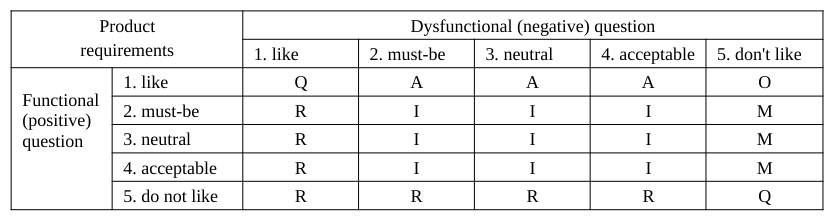
After data collection, the answers of the participants are coded (e.g. A) according to the evaluation table of Sauerwein et al. (1996), in which for each response pair (e.g. Functional=1.like + Dysfunctional=3.neutral) a category of the Kano-model (e.g. attractive) is assigned. The evaluation table including all categorized response pairs is shown in Table 3.
Table 3. Kano evaluation table (A=attractive, M=must-be, R=reverse, O=one-dimensional, I=indifferent, Q=questionable) (Adapted from Sauerwein et al., 1996)
The codes A (attractive), M (must-be), R (reverse), O (one-dimensional), and I (indifferent) correspond to the categories of the Kano-model as described before. The code Q (questionable) indicates a vague result, i.e., it is assumed that the respondent has ticked the wrong answer or the question was not understood. Normally, answers do not fall into this category.
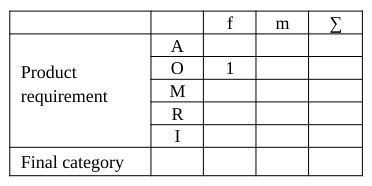
Finally, the results of the frequency analysis for each product requirement are transmitted in a result table. Thereby, each assigned combination is counted as 1, i.e., if for a product requirement three times in total the combination functional=1.like and dysfunctional=3.neutral occurs, for the category O a 3 is entered. The counting of entries is done for each gender separately as shown in Table 4.
Table 4. Table of results (f=female, m=male, A=attractive, M=must-be, R=reverse, O=onedimensional, I=indifferent, Q=questionable) (Adapted from Sauerwein et al., 1996) f m ∑
Hence, the whole evaluation process includes three components: (1) the questionnaire, (2) the evaluation table, and (3) the table of result. The process is exemplarily depicted in Figure 4.
Figure 4: Evaluation process (f=female, m=male, A=attractive, M=must-be, R=reverse, O=onedimensional, I=indifferent, Q=questionable) (Adapted from Sauerwein et al., 1996)
Figure available in the original PDF paper.
RESULTS
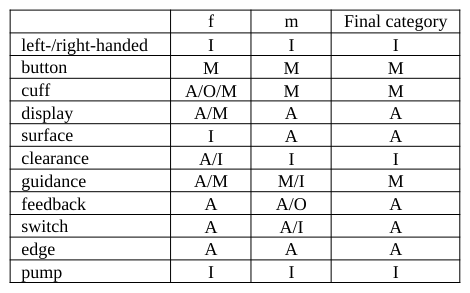
A first result indicates that none of the product requirement is assigned finally to the categories one-dimensional (O) or reverse (R) (see Table 6). Mainly, product requirements reached as final category attractive (A, n=5). These are display, surface, feedback, switch, and edge. The remaining product requirements are distributed evenly (nM=3, nI=3) across the categories must-be (M: button, cuff, guidance) and indifferent (I: left-/right-handed, clearance, pump). Anyway, the results are not based on clear decisions of the participants: In the female group, the product requirements cuff, display, clearance, and guidance achieved multiple final categories; in the male group, the product requirements guidance, feedback, and switch are assigned to multiple final categories. Matching categories between the genders exist only for the product requirements left-/right-handed, button, edge, and pump. Thereby, only one product requirement is categorized multiply by both genders: guidance. The overview of evaluation results per product requirement and gender is given in Table 5.
Table 5. Overview of evaluation results per product requirement and gender f m Final category left-/right-handed I I I button M M M cuff A/O/M M M display A/M A A surface I A A clearance A/I I I guidance A/M M/I M feedback A A/O A switch A A/I A edge A A A pump I I I
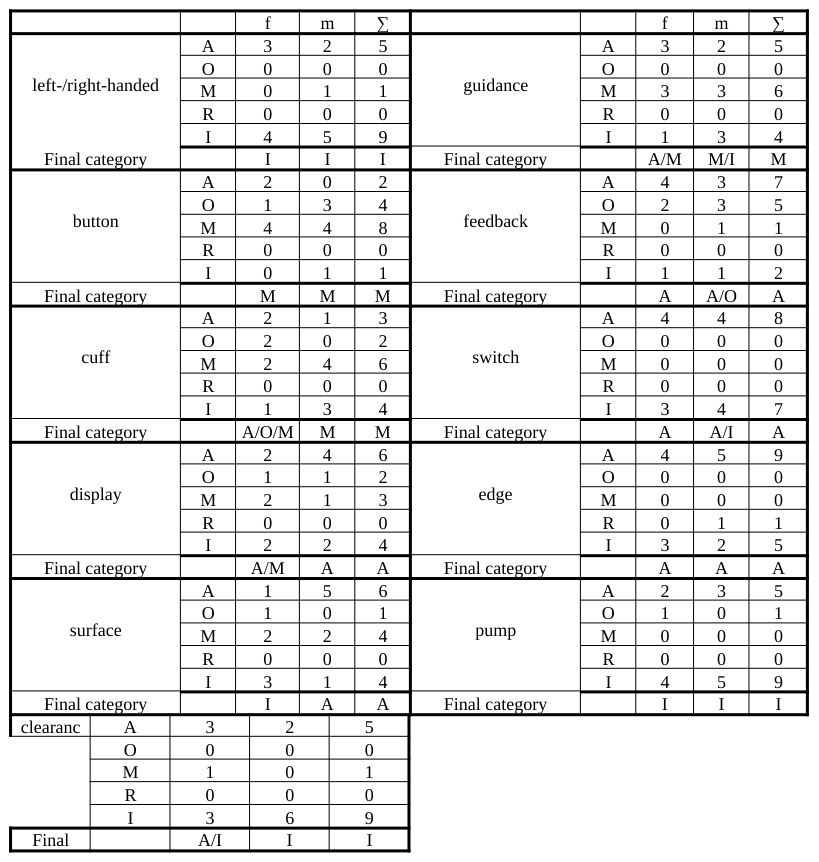
Taking a closer look at the results it turns out that the answer numbers of both genders are relatively low considered separately (see Table 6). High entries per category are rarely reached, i.e., only for the categories attractive (A) and indifferent (I) (left-/right-handed (I): nm=5, edge (A): nm=5, surface (A): nm=5, pump (I): nm=5, clearance (I): nm=6). The category one-dimensional is found primarily among the female responds.
Table 6. Detailed view of evaluation results per product requirement and gender f m ∑ f m ∑
DISCUSSION
Gender perspectives on designers’ satisfaction The results of the study indicate that for the creation of designers’ satisfaction, the same product requirements are – more or less – relevant for both genders. However, there are slight differences in the perception and evaluation of product requirements observable.
Looking at the results obtained by the female respondents, it is clearly visible that – including the multiply categorized product requirements – the category attractive (A, n=7) outweighs. According to Hassenzahl et al. (2003), the attractiveness refers to the overall impression of a product, which is attributable to the hedonic quality perception. Hence, the general assumption or belief that women are more interested in hedonic product properties (e.g. surface feel) (Jakobs et al., 2008) can be confirmed for the investigated participants.
Contrarily, at the male group the categories attractive (A, n=5) and indifferent (I, n=5) – including the multiply categorized product requirements – outweight. Thus, the male designer concentrates on the one hand in the same way as female designer on the attractiveness of product requirements. On the other hand, male designers are often indifferent (I) concerning product requirements, i.e., neither the presence nor the absence of a product requirement donates satisfaction or dissatisfaction. In parts, the category indifferent (I) is assigned to product requirements that achieved among the female designers the evaluation result attractive (A), such as clearance, guidance, and switch. In conclusion, the common assumption that men stress more pragmatic quality requirements is negated for this particular male designer group. However, at this point, gender-sensitivity for product requirements is most obvious.
Surprisingly, the requirement one-dimensional (O) emerged only twice, which leads to the conclusion that the product requirements are not perceived as performance characteristics for medical devices. Hence, even if they exist, from the perspective of the investigated designers these characteristics do not eliminate dissatisfaction or create satisfaction, depending on the degree of fulfilment. The non-occurrence of the requirement reverse (R), however, is a satisfying result: None of the assumed blood pressure monitor-requirements leads by existence to dissatisfaction nor does the missing of a requirement lead to satisfaction.
In this context, it must be examined in further studies whether this result is an effect of small sample size (number of participants) or an effect of other factors such as participants’ age and their proximity to the education. There may be gender-related perception changes in the course of professional life in the sense of a reinforcement, modification, or reversion. Moreover, investigations might focus the question whether and to what extent gender-specific views vary product- and domain-related – are they predominantly evident with regard to consumer goods and services or also with regard to complex technologies such as energy systems (Trevisan et al., 2014, in this proceedings). The consideration of complex technologies would simultaneously mean an extension of the Kansei Engineering approach towards new sectors and product types. In addition, a comparative study should be conducted with users of blood pressure monitors, in order to compare and cross-validate, to what extent the role-and gender-related perspectives and satisfaction degree match or mismatch. Previous studies have shown that depending on role, differences in product perception can be observed (Trevisan et al., 2011, 2012; Trevisan et al., 2014/in press). As a follow up, the evaluation criteria data quality and application effort may be re-evaluated for the Kano-questionnaire considering the conclusions given above (see Table 1).
Methodical aspects A major advantage of the Kano-method is a better understanding of customer requirements by the classification in basic-, performance- and excitement-requirements. The classification is used as an aid in decision-making about which requirements must be specially monitored in product design. A major disadvantage is the fact that the application is only useful for complex products with many clearly distinguishable product requirements. Taking this into consideration, the extension to complex technologies such as energy systems seems recommendable, e.g., in the context of acceptance research for the identification of acceptance promoting and inhibiting factors.
Moreover, the required effort for data evaluation can vary, depending on the evaluation method. If the responses are classified according to the given classes and the mean is calculated, less effort is caused than by approaches such as the customers’ satisfaction coefficient (CS coefficient) (Berger et al., 1993) or the transfer and interpretation of category-relations according to the evaluation rule M>O>A>I suggested by Sauerwein et al. (1996). In addition, the evaluation can be simplified with software support.
To summarize, the questionnaire can be used to complement and validate the results of qualitative methods such as focus group-discussion. The main disadvantage of the Kano-questionnaire is its monotony, which the participants explicitly mentioned in our study. If more then ten questions are used, the attention of the participants can – due to the repetitive nature of the questions – be reduced or disappear. With this background, the study should be repeated with other participants, with a minor number of product requirements, and other product types.
CONCLUSION AND OUTLOOK In the present study, the Kano-method was successfully applied. Gender-related differences of designers in the perception and evaluation of products could be identified, exemplarily. In this context it is assumed that a change in the participants circle (customer vs. designer) as well as the investigation of products from other sectors is promising in the light of role-related phenomenon and product-specific evaluation.
Moreover, the results imply that it is useful to integrate methods and techniques of user-centered and gender-related product design into product designers’ education due to the fact that common assumptions on gender perspectives are negated in this study, partly. This includes methods and approaches such as Kano-questionnaire, user tests, quality function development, or Kansei Engineering as well as interdisciplinary views on the object. Melles and Wölfel (2014) came to a similar conclusion for postgraduate students.
ACKNOWLEDGMENTS
This research was funded by German Excellence Initiative.
REFERENCES
Berger, C., Blauth, R., Boger, D., Bolster, C., Burchill, G., DuMouchel, W., Pouliot, F., Richter, R., Rubinoff, A., Shen, D., Timko, M., Walden, D. (1993), "Kano’s Methods for Understanding Customer-defined Quality", in: Center for Quality Management Journal Volume 4, pp. 3-36 Buhl, H.U., Kundisch, D., Schackmann, N., Renz1, A. (2007), “Spezifizierung des Kano-Modells zur Messung von
Kundenzufriedenheit”, in: Wirtschaftsinformatik 2007 – eOrganisation: Service-, Prozess-, Market-Engineering, Obwerweis, A., Weinhardt, C., Gimpel, H., Koschmider, A., Pankratius, V., Schnizler, B., (Ed.). pp. 879-912 Giesbert, A. (2008), “Anwendung des Kano-Modells und dessen Weiterentwicklung anhand von ausgewählten Dienstleistungsunternehmen”. Master thesis. University of St. Gallen. Gustaffson, A. (1996), “Customer focused product development by conjoint analysis and QFD”. Dissertation No. 418, Linköping
University, Sweden. Hassenzahl, M., Burmester, M., Koller, F. (2003), “AttrakDiff: Ein Fragebogen zur Messung wahrgenommener hedonischer und pragmatischer Qualität”, in: Mensch & Computer. Interaktion in Bewegung, Ziegler, J., Szwillus, G. (Ed.). pp. 187-196 Heinlein, M., Cilingir, A., Borchert, N., Worschech, N. (2013), “Praktische Anwendung des KANO-Modells im deutschen
Lebensmitteleinzelhandel”, in: Marketing in Forschung und Praxis: Jubiläumsausgabe zum 40-jährigen Bestehen der Arbeitsgemeinschaft für Marketing. Berlin, pp. 773-792 Jakobs, E.-M., Lehnen, K., Ziefle, M. (2008) “Alter und Technik. Eine Studie zur altersbezogenen Wahrnehmung und Gestaltung von Technik”, Aachen: Apprimus. Kano, N. (1984), “Attractive quality and must-be quality”, in: Journal of the JSQC Volume 14 No 2, pp 39-48 Lindgaard, G., Dudek, C. (2002), “User satisfaction, aesthetics and usability: Beyond reductionism”, in:17th Proceedings of the
IFIP (International Federation for Information Processing) World Computer Congress, Montreal (2002) Mangasser-Wahl, M. (2000), “Von der Prototypentheorie zur empirischen Semantik. Dargestellt am Beispiel von Frauenkategorisierungen”. Frankfurt a.M. u.a. Melles, G., Wölfel, C. (2014), “Postgraduate Design Education in Germany: motivations, under-standings and experiences of
graduates and enrolled students in Master's and Doctoral Programs”, in: Design Journal Volume 17, pp. 115–136 Morgan, David L. (1997), “Focus groups as qualitative research”. Thousand Oaks. Nagamachi, M. (1995), “Kansei Engineering: A new ergonomic consumer-oriented technology for product development”, in: Int.
J. of Industrial Ergonomics Volume 15 No 1. pp. 3-11 Nagamachi, M., Lokman, A.M. (2011), “Innovations of Kansei Engineering”. Boca Raton. Przyborksi, A., Wohlrab-Sahr, M. (2008), “Qualitative Sozialforschung”. Oldenbourg. Sauerwein, E., Bailom, F., Matzler, K., Hinterhuber, H.H. (1996), “The Kano Model: How to Delight Your Customer”, in: Preprints Volume I of the IX. International Working Seminar on Production Economics, pp. 313 -327 Schütte, S., Eklund, J., Arnold, K., Burkhardt, D. (2002), “Designing feelings into welding helmets”, in: Proceedings of the 34th
Annual Congress of the NES, Norrköping. Schütte, S. (2005), “Engineering Emotional Values in Product Design. Kansei Engineering in Development. Department of Mechanical Engineering”, Linköping. Trevisan, B., Willach, A., Jakobs, E.-M., Schmitt, R. (2011), “Gender-Specific Kansei Engineering: Using AttrakDiff2”, in:
Electronic Healthcare, Szomszor, M., Kostkova, P. (Ed.). Berlin, Heidelberg: Springer [LNICST; 69]. pp. 167–174 Trevisan, B., Steinmeier, B., Jakobs, E.-M. (2012), “Evaluation of user-centred methods in product design: a holistic approach”, in: Int. J. of Design Engineering Volume 5 No 2, pp. 107-121 Trevisan, B., Schmitt, R., Jakobs, E.-M. (2014/in press), “Gender- and Role-Specific Product Perception”, in: Gender-UseIT
2014 (#GUI2014): HCI, Web-Usability und UX unter Gendergesichtspunkten, Marsden, N., Kempf, U. (Ed.). de Gruyter. Trevisan, B., Eraßme, D., Hemig, T., Kowalewski, S., Kluge, J., Himmel, S., Borg, A., Jakobs, E.-M., Ziefle, M. (2014), “Facebook as a source for human-centred engineering. Web Mining-based reconstruction of stakeholder perspectives on energy systems”, in: Proceedings of the 1st International IBM Symposium on Human Factors, Software, and Systems Engineering (AHFE 2014) Tullis, T., Albert, B. (2008), “Measuring the User Experience: Collecting, Analyzing, and Presenting Usability Metrics”,
Burlington. Xue, L., Yen, C.C. (2007), “Towards Female Preferences in Design. A Pilot Study”. Int. Journal of Design Volume 3, pp.11-27
LISTED IN THE AHFE DIGITAL BOOKSTORE CATALOGUE
Explore the complete digital volume
Advances in Affective and Pleasurable Design
Read this individual research paper free through the original publisher, or explore the full digital proceedings book.
ISBN 978-1-4951-2109-8
Explore this ISBN in the AHFE Bookstore ↗Listed in the July 2026 bookstore catalogue; search by ISBN to confirm current availability · Digital book purchase optional