Masaaki Kurosu, Ayako Hashizume (2021). Description of Subjective Impression for the Service Experience. In: Advances in Affective and Pleasurable Design. AHFE Open Access, vol. 14. https://doi.org/10.54941/ahfe100555
The goal of the service activity is to give customers a positive impression on their experiences. Recently, the service quality is discussed in the context of the “user experience”. But it should be noted that the quality of service experience is different from that of user experience for the product in terms of its intangibility, inseparability of production and consumption, heterogeneity and perishability as was proposed by Zeithaml et al. (1985). The important point of the discussions on the user experience that we can apply to the service experience is that the quality of experience should be analyzed and discussed not from the stance of the manufacturer (or the service-provider) but from that of the user (or the customer). In other words, designers and engineers cannot design the user experience per se but can only design “for” the user experience. Because of this fact, we should put more emphasis on the subjective aspects, i.e. affective and pleasurable aspects, of the service activity.
Since 1980s and especially in 1990s, the importance of usability has been recognized among stakeholders for the design of artifacts, especially ICT-related systems and products and such ISO Standards as ISO9241-11:1998 and ISO13407:1999 (now revised as ISO9241- 210:2010) have been accepted by many industry people. Since then, the usability was regarded as one of the important quality characteristics of the systems and products.
But, in 1998, a new concept of UX (user experience) was proposed by Norman. He wrote “I invented the term because I thought human interface and usability were too narrow” (Merholz & Norman 2007). Since then, the concept of UX has gradually been used among industry people instead of the usability and now it replaced the position of usability as a holistic goal concept of the artifact design. A simple replacement of the concept of usability by that of UX is illogical considering the difference of connotations of both concepts.
Regarding the concept of the UX, Hassenzahl (2003) differentiated the pragmatic attributes and the hedonic attributes where the usability is regarded as a part of the former. The word “hedonic” was used because “functions and attributes it subsumes are strong potentials for pleasure – much stronger than pragmatic functions and attributes” and can be represented as “outstanding, impressive, exciting and interesting” (p.35). There are some others such as Jordan (esp. 2002), who put emphasis on the subjective aspect. Jordan proposed three- layered structure where the functionality is the base, then comes the usability and the pleasure at the top.
This article deals with the notion of experience in a wider scope than Hassenzahl and conducts the analysis of words that can be used to represent the experiencee and to evaluate its degree.
The Concept of Experience The differentiation between the pragmatic attributes and the hedonic attributes are reasonable. But in this article, authors prefer to use the term "quality charcteristic". Hence the former is named as the objective quality characteristics and the latter as the subjective quality characteristics. One reason is that such characteristics as usability, reliability, and performance can be measured and can be represented as numeric values, thus can be regarded as objective. Anotherr reason is that the word hedonic is only referring positive aspects although subjective aspects will sometimes be positive but sometimes be negative. Hence authors adopted the term subjective quality characteristics as a generic term. These are drawn in Figure 1.
A fundamental question arises if these two characteristics are enough considering an artifact that has sufficient level of objective quality characteristics and subjective quality characteristics but has less or almost no meaning to the user. An extreme example could be the situation where iPhone was given to the blind people. iPhone itself has enough level of objective quality characteristics and subjective quality characteristics in general, but will be meaningless for blind people. Another example would be the iPhone given to a baby. Thus, we will have to consider about the match between the characteristics of the user and the context of use of the systems and products. Kurosu (2012) proposed the meaningfulness in addition to two attributes of Hassenzahl. Although the match to the user characteristics and the context of use will have to be considered to a certain degree with regard to the usability, the measure of usability is usually considered in terms of the “specified user” or the “intended user” (ISO13407). In other words, the system or the product is not necessarily usable to the whole variety of users in all kinds of situation.
Usability Engineering
Objective (Pragmatic) Quality Characteristics -Usability -Reliability -Functionality -Performance, etc.
Subjective (Hedonic,
Meaningfulness -Matching to the user characteristics and the context of use
Kansei Engineering (Sensibility Engineering)
Kansei) Quality Characteristics -Outstanding -Impressive -Exciting -Interesting, etc.
User Experience Design
Experience Engineering
Figure 1 The meaningfulness as a third component of the experience in addition to the objective quality characteristics and the subjective quality characteristics As can be seen in Figure 1, the traditional “usability engineering” has been dealing with the usability as one element of the objective quality characteristics. And the “user experience design” deals with both of the objective quality characteristics and the subjective quality characteristics. “Kansei engineering”, though not yet popular in Western countries, is an academic domain that considers about the subjective quality characteristics (Nagamachi 1989). In addition to both groups of quality characteristics, there is the meaningfulness for the reason that was written in the previous paragraph.
The reason why there is the term “experience engineering” is that it is necessary to consider the service in addition to the system and the product and the recipients of service should not simply be called the user. For example, we don’t "use" the teacher at the school and don’t "use" doctors and nurses at the hospital but receive their service activities. Such services constitute other aspects of our experience in addition to the system and the product. Hence, the authors propose to use the simple word of “experience” instead of “user experience”.
Products/Systems and Services Previous usability engineering has dealt with products/systems. The service was not considered because the usability was regarded much related to products/systems and not much related to services. But since the UX has been discussed as a target domain, the service was also included as the target domain because the experience that includes the expectation and the impression is quite important for the service. Zeithaml et al. (1985) argued that the service has such characteristics as intangibility, inseparability of production and consumption, heterogeneity and perishability.
This characteristics make the difference of the sequence of experience from that of products/systems. Figure 2 and 3 describes this difference in the course of processes in the industry and in the market. The process model in Figure 2 for products/systems includes the phases after the purchase (or obtaining). But the process model in Figure 3 does not include them because of the service characteristics of which Zeithaml et al. pointed out.
Market Industry Management decision Perception of problem, Awareness of necessity
Need and Motivation
User/Market research
Industry information TV CM, Advertisement, Catalogue,
Search, and Discovery or
Sales personnel, Corporate site,
Plan the design process
Encounter
User Manual
Construction of hypothesis
Specify requirements
(subjective expectation,
External Information
objective prospect)
Design
General information Magazine, Newspaper, Blog, SNS,
Test of hypothesis (Trial use)
Word of Mouth Communication
Evaluation
Impression in Memory
Purchase or Obtaining
Manufacturing
Short-term use
Advertisement
Accumulated long-term use
Sales
Boredom, Dissatisfaction,
Customer User
User support
Functional imperfection, Performance degradation, Malfunction Stop using it, Waste
Final impression
Figure 2. Process model on both of the industry side and the market side for products/systems
Figure available in the original PDF paper.
Market Industry Management decision Perception of problem, Awareness of necessity
Need and Motivation
User/Market research
Industry information TV CM, Advertisement, Catalogue,
Search, and Discovery or
Sales personnel, Corporate site,
Plan the design/service process
Encounter
User Manual
Construction of hypothesis
Specify requirements
(subjective expectation,
External Information
objective prospect)
Design
General information Magazine, Newspaper, Blog, SNS,
Test of hypothesis (Trial use)
Word of Mouth Communication
Evaluation
Impression in Memory
Purchase or Obtaining
Manufacturing
Short-term use
Advertisement
Accumulated long-term use
Provide service
Customer User Boredom, Dissatisfaction, Functional
User support
imperfection, Performance degradation, Malfunction Stop using it, Waste
Final impression
Figure 3. Process model on both of the industry side and the market side for services
Figure available in the original PDF paper.
The Classification of Experience and Its Description The next question is how the experience can be described. Because the experience is quite subjective, it can not be objectively measured and represented as in the case of objective quality characteristics. The most popular approach to measure the subjective impression is to use the rating scale. And authors started to investigate the adequate words for the rating scale to measure the experience especially the adjectives and their noun forms. Kurosu & Hashizume (2011) analyzed various experiences and differentiated the goal-oriented behavior (GOB) where the achievement of the goal has the supreme importance and the process-oriented behavior (POB) where the process of approaching the goal is more important than the goal itself. They found that different words are used for describing different types of experience, i.e. GOB and POB. According to their findings, “satisfaction” and “delight” fit to the GOB and “joy” fits to the POB.
Goal State Initial State The Process to Reach the Goal
GOB: Goal - Oriented Behavior
Goal State Initial State The Process to Reach the
POB: Process- Oriented Behavior
Goal
Initial State
SOB: State- Oriented Behavior
Figure 4. GOB, POB and SOB The study of the descriptive words will have influences of language and culture. The language issue is the (slight) difference of the connotation of each word and the cultural issue is the difference among categorical structures of the words. But authors dared to translate the Japanese words that were used in their experiments into corresponding English words as much as possible.
Figure available in the original PDF paper.
Kansei that was used in Figure 1 is one example. “Aesthetics” used by Baumgarten and Kant was translated into Japanese about 150 years ago as “Bigaku (the science of beauty)” and “Kansei (nearly equal to the sensibility and ‘Sinnlichkeit’)” that are still used today in Japan.
Descriptive Words of Experience Authors conducted a survey of which the goal was to differentiate and identify the Kansei or the subjective quality characteristics in Figure 1. It was because the objective quality characteristics can be described rather simply by one-to-one correspondence and the meaningfulness can also be described easily. The most difficult one among three attributes in Figure 1 is the description of subjective quality characteristics, or Kansei aspects.
Method
The survey was conducted by collecting descriptive words in the past references on Kansei. 604 words were collected that were used for the evaluation scale of Kansei from 9 references. Authors, as the specialists in Kansei engineering, adopted the KJ-method (Kawakita 1967) that is known as the affinity diagram method in English for classifying the words.
Result
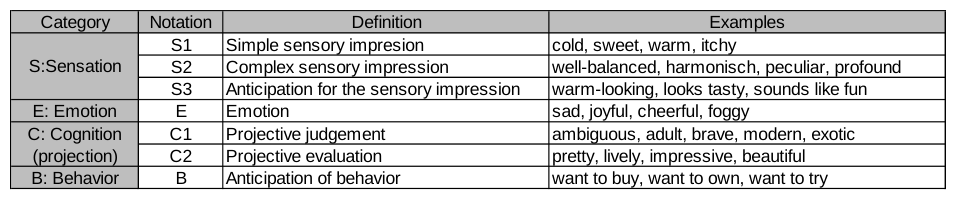
The classification using the KJ-method brought 4 major categories of sensation, emotion, Kansei and behavior as Table 1. In this table, Kansei is interpreted as a projective process where the word “projective” is used in the same meaning of the projective methods of clinical psychology. Every descriptive word of Kansei seems to be the quality characteristics of the artifact, but actually they are the projected image or impression of the human being and are seemingly the quality characteristics of the artifact. A typical example is the dark cloud in the sky. Objectively, it is simply the dark cloud, but for those who have the anxiety it seems to predict some unhappy things to occur. That is the crucial point in terms of the mental process of Kansei.
Table 1. Classification of Descriptive Words of Kansei
CONCLUSIONS
Now that the temporary set of descriptive words of Kansei was obtained, the next step is to check its validity of each words and the classification itself by conducting a large-scaled survey where participants will be asked to evaluate such experiences as follows containing both of the GOB and POB situations.
-I took a junk food at a dirty restaurant but it was unexpectedly tasty. -I could succeed to draw a graph using MS Excel. -The report could catch the deadline. -I was playing a game with a bit higher difficulty.
The result will show how the subjective quality characteristics can and should be expressed verbally.
REFERENCES
Hassenzahl, M. (2003). “The Thing and I: Understanding the Relationship Between User and Product.” in Blythe, M., Overbeeke, C., Monk, A.F., and Wright, P.C. (eds.) “Funology: From Usability to Enjoyment.” Kluwer, pp.31-42 ISO. (1998). “ISO9241-11:1998 Ergonomic Requirements for Office Work with Visual Display Terminals (VDTs)
-- Part 11: Guidance on Usability.” ISO. (1999). “ISO/IEC13407:1999 Human-Centred Design Processes for Interactive Systems.” ISO. (2010). “ISO9241-210:2010 Ergonomics of Human-System Interaction - Human-Centred Design for Interactive Systems.” Jordan, P. (2002) “Designing Pleasureable roducts” CRC Press Kawakita, J. (1967). “Method for Idea Generation – For the Development of Creativity (in Japanese)”. Chuo-Koron-
sha. Kurosu, M. & Hashizume, A. (2011). “Measures for Evaluating User Experience (in Japanese).” Proceedings of Japanese Psychological Association. Kurosu, M. (2012). “Usability and UX. Presentation given at Institute of Advanced Studies in Universal Design (in
Japanese).” Kurosu, M. & Hashizume, A. (2013) “Descriptive Words for Various Experiences” NES (Nordic Ergonomics Society) 2013 in Iceland Merholz, P. and Norman, D.A. (2007). “Peter in Conversation with Don Norman About UX & Innovation.” Affective and Pleasurable Design (2021) http://www.adaptivepath.com/ideas/e000862 Munechika, M. and Miwa, T. (2000). “The principle of selection regarding the evaluative words that can be used in the survey of Kansei quality (in Japanese)”. Hinshitsu 30(4), pp. 96-108. Nagamachi, M. (1989). “Kansei Engineering (in Japanese)”. Kaibundo Publishing. Norman, D.A. (1998). “The Invisible Computer – Why Good Products Can Fail, the Personal Computer is So
Complex, and Information Appliances are the Solution”. The MIT Press. Zeithaml, V.A., Parasuraman, A., and Berry, L.L. (1985) “Problems and Strategies in Services Marketing” Journal of Marketing 49 pp.33-46
LISTED IN THE AHFE DIGITAL BOOKSTORE CATALOGUE
Explore the complete digital volume
Advances in Affective and Pleasurable Design
Read this individual research paper free through the original publisher, or explore the full digital proceedings book.
ISBN 978-1-4951-2109-8
Explore this ISBN in the AHFE Bookstore ↗Listed in the July 2026 bookstore catalogue; search by ISBN to confirm current availability · Digital book purchase optional