Vivian Li, Peiyi Sun, Yihyun Lim (2024). Optimizing UX design to enhance user confidence in digital products. In: Human Factors in Design, Engineering, and Computing. AHFE Open Access, vol. 159, pp. 837–847. https://doi.org/10.54941/ahfe1005650
As digital products grow in prominence, the significance of user experience (UX) design becomes increasingly evident. A crucial outcome of strong UX design is user confidence, defined as a user’s trust in their ability to effectively interact with a product. Designs that foster user confidence reduce interface uncertainty and enhance user self-belief, leading to increased engagement and repeated interactions. Conversely, a lack of user confidence can drive users to seek alternative products. This study aims to uncover the underlying principles that enable users to navigate products with confidence, thereby providing design guidance for fostering long-term product loyalty. This study identifies five key design principles that enhance user confidence: 1) Creating familiarity with UI elements and interactions, 2) Balancing information accessibility and overload, 3) Providing clarity in action descriptions, 4) Offering feedback after decisive user actions, and 5) Enabling the reversibility of actions. To explore user confidence, the study employed three methods. In-depth user interviews were conducted to gather insights on user experiences with both digital and physical products. Afterward, a three-day immersion study (“UX diary”) was conducted to document users’ emotional interactions with everyday products. Finally, a series of generative workshops were hosted to validate the principles and explore their applicability in different product contexts, such as posting content on Reddit and placing an order on Amazon. Participants reported that these principles provided reassurance and facilitated ease of use. User confidence is a prerequisite for other UX design considerations. By focusing on these principles, designers can create products that foster confidence and satisfaction, ultimately leading to improved user engagement and retention.
Digital products are integral to nearly all of our daily activities today, from communication and collaboration to commerce, entertainment, travel, and more (Marion and Fixon, 2021; Jain et al., 2021). However, during critical tasks or unfamiliar interactions with digital products, users often experience moments of uncertainty that can significantly impact their overall experience. A common example is an online purchase, where a user might frequently double-check their delivery address, payment information, and item details to avoid potential errors. This cautious behavior, even in familiar processes, can be described as a lack of user confidence.
User confidence refers to the degree to which individuals trust their ability to navigate and interact with a product, characterized by reduced uncertainty within the interface and improved self-assurance (Corno et al., 2015). Our study examines the moments of uncertainty that users frequently experience with digital products. In this paper, we explore and identify principles that can be applied to design digital products that enhance user confidence. We aim to explore how user confidence impacts user experience and develop actionable guidelines that can be integrated into the design process to foster more reliable and engaging user interactions.
A lack of confidence in digital interactions often leads users to abandon a product and seek alternatives. On the other hand, good user confidence can influence “the pleasure of their use and the motivation to continue using them” (Tosi, 2020). By identifying causes of low user confidence and prescribing design improvements, product teams can reduce the likelihood of users feeling unsure or dissatisfied, thereby contributing to the overall success of a product.
RELATED WORK
User experience (UX) is a widely used terminology that refers to the overall experience a user has when interacting with a product, system, or service (Law et al., 2009). UX shifts the focus away from utilitarianism, instead encompassing usability, accessibility, and emotional responses, all of which contribute to how the user perceives and interacts with the product (Law et al., 2009). A crucial element of UX is user confidence—the trust and assurance users feel during their interaction. This confidence is shaped by intuitive design, clear feedback mechanisms, and the ability to recover from errors.
User confidence is a relatively novel concept, with select works examining its impact in specific use cases. Past studies have highlighted the importance of understanding confidence in interactions to enhance UX, particularly within agile development environments (Hellweger et al., 2015). In explorations of user confidence in intelligent environments, researchers identified understandability and predictability as key attributes of a system with high user confidence (Corno et al., 2015). Corno et al. describe how Norman’s principles in “The Design of Everyday Things” and Dix principles in “Human-Computer Interaction” can be extended from general design to the concept of user confidence. Guidelines from Corno et al. include “designing in a simple and emotional way,” and “design for uncertainty and copy with complexity.” Ruecker et al. (2007) asserts that aesthetics can influence trust, willingness, and satisfaction, which compose an overall effect of confidence. Several studies also explore the related idea of user confidence in machine learning outcomes (Zhou et al., 2018; Smith et al. 2018).
Yet these principles are abstract in nature, disconnected from the concrete questions of UX designers and product managers. Moreover, they are focused on general ideas of user-centered design. In this study, we seek to uncover insights and chart recommendations that are specific to digital product design in the modern technology industry.
Optimizing UX Design to Enhance User Confidence in Digital Products 839
RESEARCH METHODS To study user confidence in product interactions, we carried out three methods over the course of 9 weeks. We began with 30-minute user interviews with nine participants, followed by a three day immersion study with nine participants, and a 1.5 hour generative workshop with seven participants. Each method provided unique insight into user confidence across various product types and interactions.
Participant Selection Digital products have an undeniably broad target audience, since nearly anyone can use digital products in principle. Within the broader audience, we identified several core user segments to use for our study. Choosing specific segments also allowed us to create principles that apply with fewer exceptions. We defined the following three criteria: 1) technology adoption, which describes a user’s experience with digital products; 2) task frequency, which describes how often the user completes the given tasks; 3) task importance, which describes the potential for negative consequences if the user makes an error.
In our study, we chose to focus on improving user confidence in common consumer products. We describe our target use cases with the following criteria:
1. Medium to high technology adoption: users who have a relatively good understanding of technology and are comfortable trying out new apps. 2. High task frequency: tasks which are completed very frequently, such as daily or weekly. 3. Medium to high task importance: task in which incorrectly traversing the user flow could result in significant negative consequences.
Table 1. Criteria for selecting study participants.
Table available in the original PDF paper.
Level Technology Adoption Task Frequency Task Importance Low Little or no experience with apps
Completed only once or very infrequently Completed somewhat frequently, such as once per month
Making an error has minimal negative consequences Medium Familiar with some apps, but uncomfortable with new apps
Completed very frequently, such as daily or weekly
Making an error has minor or temporary negative consequences High Strong understanding of apps and comfortable with new apps
Making an error has significant or permanent negative consequences
This target use case serves as the basis for seeking out participants for our study. Prior to beginning the study, we distributed a survey to find participants who fit within the criteria. Participants were primarily university students or middle-aged individuals working in industries with strong
technology integration, including engineering and academia. Participants were evenly split between male and female genders, and they were between 18 and 49 years old. Across the three stages of the study, some participants participated in each activity, while other participants only participated in one of the three activities.
User Interview Study Method During our user interviews, we sought to address some of the broad initial questions, such as the purpose of user confidence, how lapses in user confidence arise, and how user confidence affects users. These curiosities guided our interview questions.
Based on our target user segments, we organized our interview questions into four sections as shown in Table 2.
Table 2. Interview sections and sample questions.
Table available in the original PDF paper.
Section Goal Sample Question “What are some products that you use, e.g. social media, online shopping, rideshare?”
Warmup Familiarizing with the interviewee, creating a comfortable space, and thoroughly defining the idea of user confidence Unconfident situations (high frequency) Understanding unconfident situations that arise from everyday tasks “What are some products that you use frequently or every day? Can you describe any interactions with these products where you felt uncertain? How did your emotions shape your future behavior?” Unconfident situations (high task Stakes)
Understanding unconfident situations that arise from a significant potential for negative impact
“In which scenarios are you most afraid to make an error? In these high-stakes scenarios, what is the worst outcome that could happen? Can you describe any interactions in these scenarios where you felt uncertain?” Confident situations
Understanding positive experiences that result from “confident” user interface design
“Can you describe any product interactions where you felt confident? What elements from this experience made you feel more confident?”
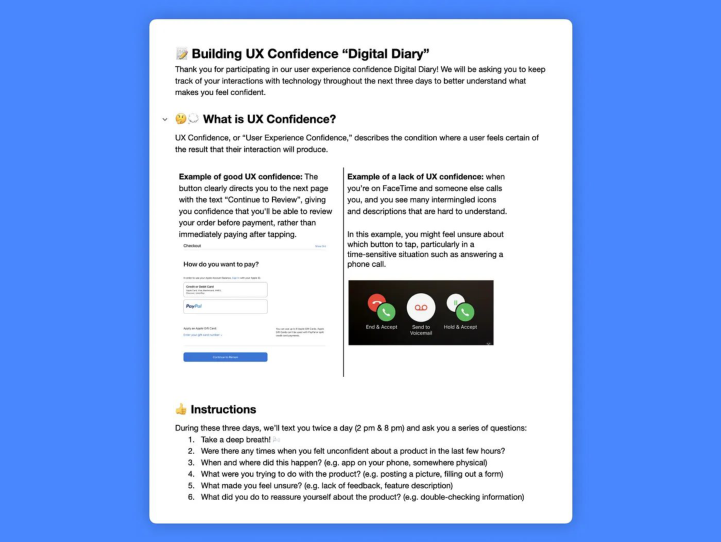
Digital Diary Study Method After conducting the user interview, we conducted a user diary study to track “smaller” moments in users’ everyday experiences. Over the course of three days, we used text messaging to prompt users to document any interactions with products that provoked uncertainty.
Optimizing UX Design to Enhance User Confidence in Digital Products 841
Prior to beginning the UX diary study, we distributed an information packet to users, describing the purpose and the process of the study. We defined user confidence and provided examples to guide participants in identifying suitable moments during their day. Three of the nine participants in the diary study also participated in the initial user interviews, and these conversations provided a strong basis for determining moments of uncertainty and confidence. For participants that had not participated in the interview, each author created a sample digital diary. In the information packet, we also outlined the questions that would be asked via text message twice per day (2 PM and 8 PM).
By providing six different submission opportunities over the course of three days, we sought to alleviate pressure that participants might feel, since there was no expectation to provide new accounts at each checkpoint. Moreover, a multi-day study offered participants the opportunity to take the first day or two to simply begin noticing moments of user confidence or uncertainty, since these experiences may have only passed subconsciously prior to the study.
We kept a log of user stories that were collected through these text message conversations, which we later used for qualitative analysis.
Figure 1: Information packet for digital diary study.
Generative Workshop Method and Goals Through the generative workshop, we sought to validate our initial findings about factors that would enhance user confidence in digital products. In this
workshop, participants could engage directly with these concepts through reflecting on popular digital products. The objectives of this workshop were twofold:
1. Validate the User Confidence Design Principles: Assess the effectiveness and relevance of the established principles in real-world settings. 2. Identify Additional Principles: Explore potential new principles that could further increase user confidence.
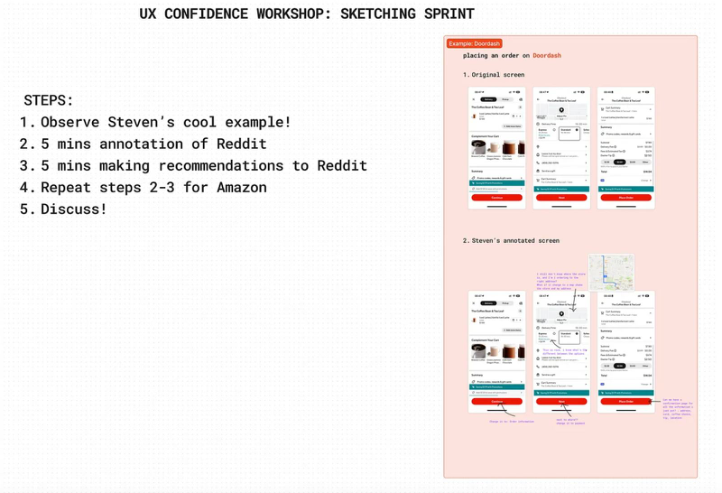
First, we introduced our five initial principles. Next, we asked participants to apply the principles on two chosen real-world applications: the Reddit posting page and the Amazon mobile checkout page. These platforms were selected based on their association with high-stakes tasks — public exposure on Reddit and financial transactions on Amazon. After each exercise, participants shared their annotations and discussed potential solutions. Finally, participants shared their broader takeaways from the workshop.
Figure 2: Tasks prepared for an online FigJam workshop.
RESEARCH RESULTS This study revealed both broad impressions of user confidence and detailed case studies of positive and negative user confidence. We present the findings in the order of our study phases, from user interviews, to the user confidence diary, to our generative workshop.
Optimizing UX Design to Enhance User Confidence in Digital Products 843
User Interview Results In these interviews, we focused on common scenarios where users feel uncertain, and categorized these scenarios based on task stakes. We asked users to identify scenarios that they consider high-stakes, where they would need extra assurance to feel confident. Three situations emerged from the interview responses: money, time, and public attention (Table 2). Approximately 60% of respondents indicated that situations involving money and time are considered high-stakes. Examples included ordering items on websites, online banking, and other financial transactions, where users often double-check information or slow down their interactions to boost their confidence. Additionally, 44% of participants noted that they seek extra confidence in scenarios involving public interaction, such as posting on social media, sending professional emails, and booking group travel.
Table 3. Situations where user confidence is particularly crucial.
Table available in the original PDF paper.
Situation Description Examples Money When an error can result in financial loss Ordering items on websites, online banking, and other financial transactions Time When an error can result in loss of progress and cost extra time to rectify
Signing legal documents and authorizing financial transactions Public attention
Posting on social media, sending professional emails, and booking tickets for a group
When an error can result in embarrassment or negative social factors
We also determined four design elements that can boost user confidence: Clarity: unambiguous content design for buttons, titles, descriptions, etc. Reversibility: a safety net to review and “undo” actions Familiarity: interactions consistent with existing actions in the app, or similar actions from other apps in the market Information Visibility: easy access to all details that the user would need
Diary Study Results After collecting the diaries, we categorized responses into the following causes: clarity, familiarity, error handling, lack of feedback, and information overload.
#Clarity: 12 responses mentioned a lack of confidence due to unclear UI. One participant cited the lack of clarity on LinkedIn, where the platform does not clearly communicate that it will send a notification to the person whose profile was viewed. The participant then felt unconfident using the platform, as they were afraid of unintentionally alerting another user.
#Familiarity: 8 responses mentioned unfamiliar interfaces. One participant experienced major confusion when using Shopify’s editing mode for the first time. Without an onboarding process or tutorial, the participant felt unconfident facing a brand-new interface.
#Error Handling: 8 responses mentioned a lack of proper error handling, where the app describes an error after a user makes a mistake. One participant mentioned their experience with Ryanair, where upon pressing the “purchase” button, the app gave a nondescript “something went wrong” error. They were only able to understand the error’s cause by manually disabling their ad blocker.
#Lack of Feedback: 5 responses mentioned a lack of feedback. One participant noted that while sending a print command on a Xerox printer, there would be no visual or audio feedback indicating whether the command was received. This uncertainty made the user feel unconfident while waiting.
#Information Overload: 5 responses mentioned information overload, where too much information is presented for users to process simultaneously. One example is the iPhone’s call screen, which displays multiple options such as “End & Accept,” “Send to Voicemail,” and “Hold & Accept”during a call. The participant reported that this overload of options led to confusion.
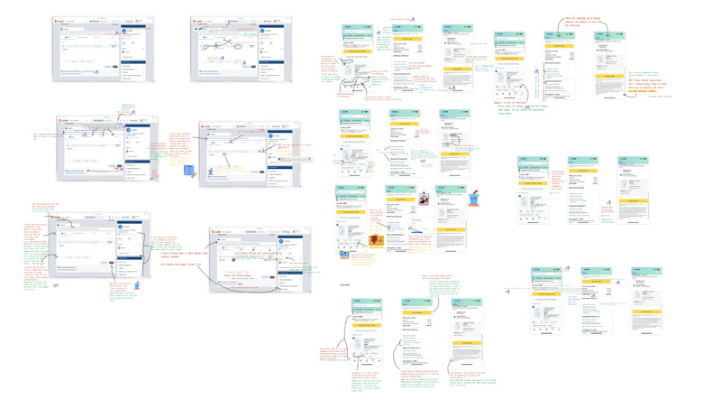
Generative Workshop Results During the workshop session, all participants successfully applied the design principles to the given product examples (Amazon and Reddit) and provided revision feedback that significantly improved user confidence in those examples. We encouraged participants to analyze their annotations and compare them with the user confidence principles. Below are a sample of the observations:
Reddit: Participants mentioned feeling confused by unfamiliar icons and unclear terminology on the page that did not have supplementary information near it. They also mentioned that some actions seemed to be repeated in multiple locations on the page, and this information overload hindered their experience.
Amazon: Participants mentioned feeling overwhelmed by information overload, where redundant and less relevant information crowded the page, and important information such as options to change payment and address or view order total were could have been more obvious.
The majority of these suggestions are closely aligned with our findings. Furthermore, we asked participants about whether the UX principles were easy to understand. All of the participants found the concepts straightforward and applicable, which assured us that the principles would be effective and relevant in practice.
CONCLUSION
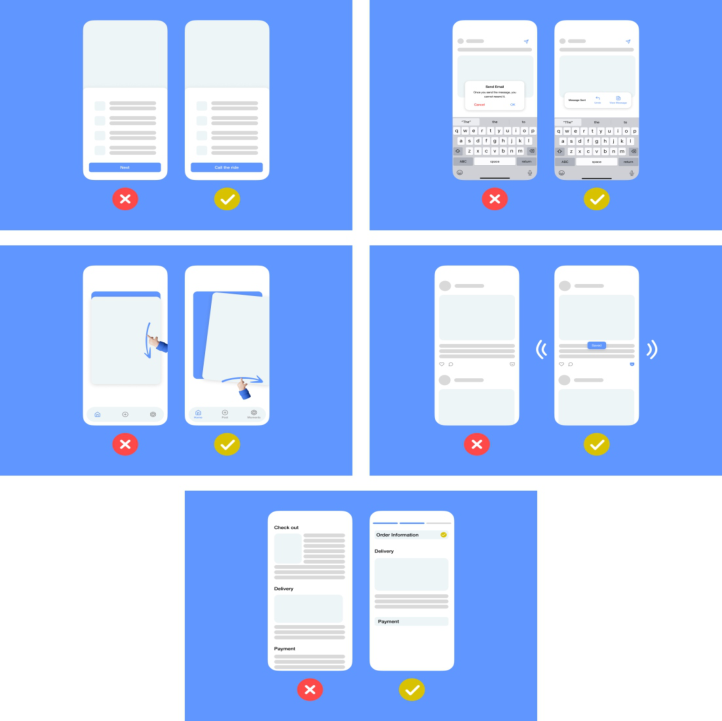
Our series of research methods yielded five UX principles to enhance user confidence:
1. Creating familiarity with UI elements and interactions, 2. Balancing information accessibility and overload, 3. Providing clarity in action descriptions, 4. Offering feedback after decisive user actions, and 5. Enabling the reversibility of actions.
Optimizing UX Design to Enhance User Confidence in Digital Products 845
Figure 3: Annotations from participants during the generative workshop.Figure 4: Illustrations that represent familiarity, information visibility, clarity, feedback, and reversibility (left to right, top to bottom).
With every rule, there are exceptions. As one of the first studies defining specific user confidence design principles, there are certainly limitations to our findings. While our principles primarily target consumer products, some products may have a user journey where confidence is less important. For example, enterprise and internal products are highly specialized with in-depth onboarding, and extensive function may be a higher priority than simplicity and broad usability.
This research primarily focuses on consumer products used by individuals with a moderate level of technological adoption, involving tasks of medium to high frequency and importance. Future studies could apply our concept to other user segments, such as studying other demographic groups that might have lower or higher technology adoption. Additionally, they could focus on the comparative differences between features for high-stakes and low- stakes tasks, or high and low frequency tasks. As the principles derived from this study are tailored to consumer products, their applicability to enterprise software or internal tools may differ and warrant further exploration.
Additionally, future work could explore user confidence in digital products beyond visual interfaces, such as those using artificial intelligence, voice recognition technology, or even brain-computer interfaces. What might familiarity, information overload, clarity, feedback, and reversibility look like beyond a screen interface?
As user confidence in products improves, we further bridge the gap with our daily digital devices. User confidence plays a fundamental role in seamless user experience and a user’s perception of the product, even subconsciously. As user confidence becomes a core design focus in the future, we will trust our device just as naturally as we trust our own bodies to carry out our precise wants.
ACKNOWLEDGMENT
The authors would like to acknowledge Byeongjun Moon for his contribution to the user interviews and digital diary study, Emily Wong for her contribution in hosting the generative workshop, and the USC Iovine and Young Academy for continued guidance and support.
REFERENCES
Corno, F., Guercio, E., De Russis, L., & Gargiulo, E. (2015). Designing for user confidence in intelligent environments. Journal of Reliable Intelligent Environments, 1(1), 11–21. https://doi.org/10.1007/s40860-015-0001-7 Hellweger, S., Wang, X., & Abrahamsson, P. (2015). The Contemporary Understanding of User Experience in Practice (arXiv:1503.01732). arXiv. https: //doi.org/10.48550/arXiv.1503.01732 Jain, V., Malviya, B., & Arya, S. (2021). An Overview of Electronic Commerce (e-
Commerce). The Journal of Contemporary Issues in Business and Government, 27(3), Article 3. Law, E. L.-C., Roto, V., Hassenzahl, M., Vermeeren, A. P. O. S., & Kort, J.
(2009). Understanding, scoping and defining user experience: A survey approach. Proceedings of the SIGCHI Conference on Human Factors in Computing Systems, 719–728. https://doi.org/10.1145/1518701.1518813
Optimizing UX Design to Enhance User Confidence in Digital Products 847
Marion, T. J., & Fixson, S. K. (2021). The Transformation of the Innovation Process: How Digital Tools are Changing Work, Collaboration, and Organizations in New Product Development*. Journal of Product Innovation Management, 38(1), 192–215. https://doi.org/10.1111/jpim.12547 Ruecker, S., Sinclair, S., & Radzikowska, M. (2007). Confidence, Visual Research,
and the Aesthetic Function. Partnership: The Canadian Journal of Library and Information Practice and Research, 2(1), Article 1. https://doi.org/10.21083/part nership.v2i1.193 Smith, J., Legg, P., Matovic, M., & Kinsey, K. (2018). Predicting User Confidence During Visual Decision Making. ACM Trans. Interact. Intell. Syst., 8(2), 10:1- 10:30. https://doi.org/10.1145/3185524 Zhou, J., Arshad, S. Z., Wang, X., Li, Z., Feng, D., & Chen, F. (2018).
End-User Development for Interactive Data Analytics: Uncertainty, Correlation and User Confidence. IEEE Transactions on Affective Computing, 9(3), 383– 395. IEEE Transactions on Affective Computing. https://doi.org/10.1109/TAFF C.2017.2723402
LISTED IN THE AHFE DIGITAL BOOKSTORE CATALOGUE
Explore the complete digital volume
Human Factors in Design, Engineering, and Computing
Read this individual research paper free through the original publisher, or explore the full digital proceedings book.
ISBN 978-1-964867-35-9
Explore this ISBN in the AHFE Bookstore ↗Listed in the July 2026 bookstore catalogue; search by ISBN to confirm current availability · Digital book purchase optional