Lance Chong (2024). Multi-Dimensional Nature of Human-Centered Design: An Autoethnographic Analysis of the Seiko Bell-Matic Wristwatch Using Information-Theoretic Methodologies. In: Human Factors in Design, Engineering, and Computing. AHFE Open Access, vol. 159, pp. 569–585. https://doi.org/10.54941/ahfe1005623
Publisher statistics will load when you open Metrics.
AHFE OPEN ACCESS OPEN ACCESS CONFERENCE PROCEEDINGS PAPER
Multi-Dimensional Nature of Human-Centered Design: An Autoethnographic Analysis of the Seiko Bell-Matic Wristwatch Using Information-Theoretic Methodologies
Human-Centered Design (HCD) emphasizes empathy to understand users' needs, yet the complexity of these needs makes HCD an evolving and open-ended objective. This paper uses Seiko’s Bell-Matic wristwatch as an autoethnographic case study to explore discrepancies between the intended design and dynamic user needs. Applying the Networked Two-way Communication Channels (NTCC) model reveals new insights into the interaction dynamics of the Bell-Matic's unique mechanical alarm feature. This study proposes a novel approach to modeling UI interactions as multi-dimensional communication processes, enabling comparisons between system functionality and user needs. Ultimately, the paper reinterprets HCD by evaluating the alignment of functional entropies between systems and users.
Human-centered design (HCD) originated during WWII to improve ergonomics and performance in military machinery and was formally named by Arnolds in 1958 (Wikipedia, 2023). Since then, HCD has expanded into consumer products and influenced diverse fields, including user interface (UI) design, healthcare, architecture, and urban planning. Its foundations are deeply rooted in classical ergonomics, cognitive psychology, and design principles, with ties to influential movements such as the Bauhaus. Despite decades of development, some HCD concepts—such as “intuitiveness”— remain challenging to define and predict, often emerging only through rigorous usability testing and iterative trial and error (McCay, 2018).
While traditional HCD methodologies have proven effective in many cases, they often struggle to address the growing complexity of user-system interactions, particularly as technologies evolve rapidly and serve increasingly diverse demographics. Recently, information-theoretic approaches have
introduced new models that provide more objective and abstract insights into the stochastic dynamics of user interactions, analyzing these within the broader context of a product’s performance and usability as perceived by the user.
This paper aims to further explore the stochastic dynamics in user-to- system interactions by applying Shannon’s information theory to the study of human-system interaction. Using Seiko’s Bell-Matic wristwatch as a case study, we explore how information-theoretic methodologies can offer new insights into UI design and the alignment of system functionality with user needs. By incorporating the Networked Two-way Communication Channels (NTCC) model into our analysis, this study seeks to deepen our understanding of the functional-level entropy alignments likely underpinning the concept of HCD.
BACKGROUND INFORMATION Human-centered design (HCD) is a framework dedicated to understanding and addressing the needs, behaviors, and experiences of people who interact with products or systems. Despite nearly a century of progress, HCD methodologies still face challenges in meeting the demands of modern, digital, and increasingly complex products, which are increasingly functional and context-dependent. Consequently, these methodologies often fall short of achieving genuine “human-centeredness.”
The core principles of HCD focus on empathetic design, encouraging holistic approaches that account for diversity in user demographics and needs. Influential theoretical foundations in HCD include cognitive ergonomics, participatory design, usability engineering, and experience design (XD). Established international standards, such as ISO 9241, ISO 13407 (updated as ISO 9241-210), and ISO/DTS 16710–1 (ISO, 2018, 2024), along with practical tools like the System Usability Scale (SUS) (Brooke, 1996), outline current best practices. However, these frameworks can be complex and overly subjective, with varied theoretical origins that contribute to a steep learning curve in the HCD process.
The Networked Two-way Communication Channels (NTCC) theory, developed by Chong (2023; 2024) addresses the stochastic interactions within the UI-system—the integrated system of both the user and the UI- hosting environment. NTCC focuses on modeling the dynamics of user- interface (UI) design and human-system interaction. Building on Claude Shannon’s information theory (Shannon, 1948), NTCC extends Shannon’s one-way communication model into a two-way framework, more effectively capturing the interactive nature of human-system communication. This theory has demonstrated reproducibility in academic contexts, particularly in analyzing UI design for consumer products.
AUTOETHNOGRAPHIC STUDY METHODOLOGY Autoethnographic studies are widely used by industrial designers and design researchers to investigate user experience, system interaction, design ideation,
Multi-Dimensional Nature of Human-Centered Design 571
and product testing. Many foundational design theories and frameworks emerged from structured or spontaneous autoethnographic observations by practitioners and scholars, including pioneers like Henry Dreyfuss (Dreyfuss, 1955) and Don Norman (Norman, 1988). To bring fresh, firsthand insights and re-examine human-centered design (HCD), we conducted a loosely structured autoethnographic study on a product category unfamiliar to the researcher: the mechanical alarm wristwatch, a niche product that gained popularity in the 1960s and early 1970s.
Study Overview The Bell-Matic autoethnographic study consisted of three stages:
1. Direct Observation and Discovery: This initial stage focused on observing and interacting with the vintage Seiko Bell-Matic mechanical alarm watch. Chosen for its engineering reliability, performance stability, and distinctive analog interface, the Bell-Matic differs fundamentally from modern digital devices. Equipped with a miniaturized mechanical alarm, it replicates the functionality of a traditional desktop mechanical alarm clock. As a product from the pre-digital era, it provided a unique perspective on practical, theoretical, and philosophical aspects of UI/UX design. 2. Empirical Analysis: The second stage used a classical design analysis approach to summarize observations from the first stage, forming hypotheses about potential design issues or benefits. This analysis combined logical reasoning with open-ended associations to hypothesize causes for identified design challenges or advantages. This hybrid approach—common in industrial design and architecture yet less frequent in contemporary UI/UX research—allowed us to approach the analysis in a flexible, real-world manner. 3. Application of NTCC Methodology: In the final stage, the NTCC methodology was applied to reinterpret the hypotheses developed in stage two. This step involved creating mathematical models to explain both the design challenges found in the Bell-Matic and generalize these insights to other user-interface system interactions. Through NTCC, we aimed to uncover deeper insights into the underlying factors of human-centered design (HCD) and explore previously hidden correlations that contribute to a design’s “human-centeredness.”
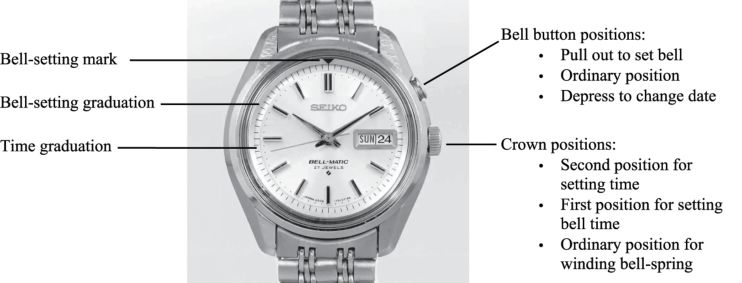
The Seiko Bell-Matic: History and Design The Seiko Bell-Matic (see Figure 1), introduced in the late 1960s, occupies a unique place in Seiko’s history as one of the few wristwatches to incorporate a fully mechanical alarm system within a compact, standard watch design. While not the first of its kind, the Bell-Matic was a groundbreaking innovation in an era before quartz and digital watches became widespread. The watch allows wearers to set a mechanical alarm that emits a buzzing sound at a designated time. However, due to its mechanical nature, the alarm- setting and activation process can be prone to user errors, often resulting from limited feedback and occasional lapses in user memory or attention.
572 Chong
Frequent use of the Bell-Matic’s alarm function can lead to gradual wear on essential components, particularly the crown and bell button, which affects the control and winding mechanisms over time. This progressive, usage-driven wear provides an intriguing opportunity for ergonomic and human-centered design (HCD) analysis.
For the autoethnographic component of this study, two identical Bell- Matic models featuring Seiko 4006 automatic mechanical movements were sourced from the second-hand market. Although the watches differed in lug materials, they were otherwise identical in control layout, display interface, and overall design. Each watch exhibited different levels of wear, providing a valuable basis for comparative analysis. Observations were conducted over six weeks of daily use, with the watches alternated to support the study’s evolving focus.
Figure 1: Diagram of the user interface layout and operational instructions. Instructions sourced from an original 1960s Seiko Bell-Matic user manual.
Key Observations in Autoethnographic Study During the initial two weeks, several key findings emerged, especially during a 12-hour intercontinental flight where the watches were tested in unfamiliar environments. These observations were subsequently validated over the remaining study period. Below is a summary of the most pertinent findings related to the technical and theoretical aspects of this paper:
1. Wear and Tear: The gold-plated Bell-Matic showed significant wear, particularly on its crown, followed by the lug corners and the bell button, due to the softer brass material used. This material choice led to accelerated wear, especially on the crown, the most frequently used component of the watch’s control interface. 2. Accidental Deactivation: When the bell button was pulled out to activate the alarm, it could easily be pushed back inadvertently during everyday activities, such as putting the (left) hand in a pocket, removing a backpack, or fastening a seatbelt—often without the wearer noticing. 3. Inconsistent Alarm Timing: The Bell-Matic’s alarm-setting system lacked precision, often activating about 10 minutes earlier than the set time.
Multi-Dimensional Nature of Human-Centered Design 573
This early activation was likely an intentional feature to prevent delayed alarms, though it may confuse users unfamiliar with the watch, particularly those who expect the alarm to sound at the exact time indicated. 4. Alarm Volume and Environment: While the alarm was designed for quiet environments, such as offices, it was challenging to hear in noisier settings (e.g., on an airplane), particularly when the watch-wearing hand was away from the wearer’s ear or muffled by clothing. 5. Unpredictable Alarm Duration and Volume: The Bell-Matic’s mechanical bell lacked feedback on how fully it was wound, leading to alarms that were sometimes too brief or too quiet, which risked the wearer missing the alert. 6. Limited Effectiveness for Sleep: The alarm’s volume was insufficient to wake someone from deep sleep, though it was adequate for quieter settings like offices or meetings. Its volume diminished over the duration, creating an impression of low urgency—a limitation likely stemming from the trade-offs engineers faced when miniaturizing the alarm mechanism for a wristwatch.
Conclusion of Key Observations These observations reveal that while the Seiko Bell-Matic stands as an impressive engineering accomplishment, it falls short in fully addressing users’ diverse needs in unpredictable environments. The primary limitations stem from the challenges of miniaturizing mechanical components while balancing control, automation, and feedback within a compact design. The autoethnographic study highlighted not only technical limitations but also the adaptive role of users—recently characterized by certain UI designers as the “user-fudged experience.” This concept provides a fresh perspective on human-centered design by underscoring how users creatively navigate product limitations, further illustrating the importance of the user’s adaptability in the context of successful UI design.
User experience is inherently shaped by individual perspectives and adaptive responses. Similarly, the designer’s intent is also mediated through the system interface, positioning the user and designer on opposite sides of the UI-system. This separation often results in misalignments of expectations, interpretations, and interactions. Consequently, it is plausible to hypothesize that a perceived “lack of human-centeredness” frequently stems from these misalignments between designer intent and user expectations or understanding.
USING NTCC IN DESIGN ANALYSIS The Bell-Matic watch was a successful product, ergonomically designed and precision-engineered like many other Seiko automatic mechanical watches of its era. The design issues identified in our autoethnographic study reveal subtle imperfections in what was otherwise an impressive feat of engineering and design by Seiko, particularly given the challenge of miniaturizing a mechanical alarm function to fit within the confined space
574 Chong
of a wristwatch. Rather than relying solely on subjective opinions about the possible causes and potential solutions for these design issues, this study applies NTCC theory to objectively model the Bell-Matic’s UI and system-to-user interactions, enabling more precise reasoning.
The TCC Model and the UI As a generalization of Shannon’s information theory, all products that interact with users can be viewed as collective user interfaces, given that Shannon’s theory applies universally across contexts. Building on this foundation, the Bell-Matic’s user interface can be considered a communication channel within Shannon’s framework. Furthermore, by applying the NTCC framework (Chong, 2023; 2024), the Bell-Matic—and other consumer products likewise—can be modeled in various ways to suit specific use case analysis applications.
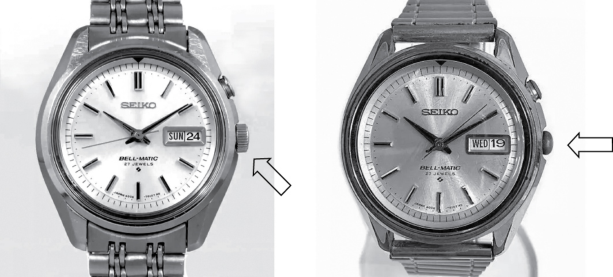
For example, Item 1 from the observation list reveals that a design choice may have unintentionally reduced the durability of the Bell-Matic’s UI control mechanism, as evidenced by wear on the crown as shown in Figure 2. Yet, this wear also indicates that the alarm feature was frequently used, underscoring its value and effectiveness despite certain design flaws. This association is reminiscent of the famous WWII survival bias study on British warplanes, where engineers reinforced undamaged areas after observing that planes with specific damage patterns still returned safely. Similarly, wear on the Bell-Matic’s crown illustrates how users, through creative improvisation and adaptability, continued to rely on the alarm feature. This principle, often overlooked in HCD, suggests that user-centered design thrives when it views users as active participants who creatively engage with and adapt products to meet their needs, rather than as passive recipients of a designer’s intentions.
Figure 2: Comparison of the Bell-Matic’s crown and bell button. The stainless-steel model (left) shows minimal wear compared to the gold-plated version (right), which exhibits pronounced wear on its crown.
The same logic applies to Items 3 through 6 in the observation list. Each feature of the Bell-Matic was designed with the intent of meeting user needs, particularly the need for an alarm function in a mechanical watch—an essential technology at the time. However, these “human-centered” design
Multi-Dimensional Nature of Human-Centered Design 575
intentions faced various technical limitations, which may not have been fully appreciated by consumers, who likely perceived them merely as design shortcomings. Users may not have been aware of the technical constraints Seiko’s designers faced, creating a disconnect between design intent and user functional purpose and experience.
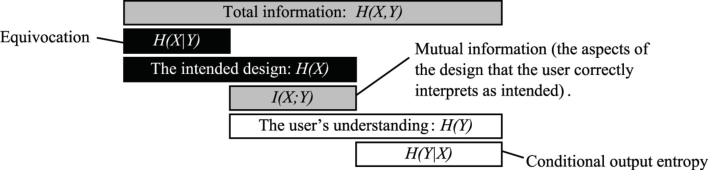
Applying the NTCC model to the Bell-Matic’s UI design allows us to schematically visualize these miscommunications. We can describe the underappreciated design efforts as “equivocation” H(X|Y) representing the designers’ input that was not fully communicated to or understood by users. Similarly, users’ misinterpretation of the designers’ intentions can be represented as conditional entropy H(Y|X), reflecting the unpredictable environmental factors and usage patterns that designers could not fully anticipate (see Figure 3).
Figure 3: Gantt chart illustrating the Bell-Matic watch as a communication channel within Shannon’s information theory. In NTCC theory, Shannon’s original one-way channel is expanded into a two-way communication channel (TCC) to represent UI-based interactions.
Functional Entropies and Multi-Dimensional Sub-Channels in NTCC In NTCC theory, identifying the user’s functional purposes lies outside the system and its UI, represented by the output conditional entropy H(X|Y) within the UI-system (see Figure 3). This concept underpins the interconnectivity between TCC nodes in an NTCC network (Chong, 2023; 2024). In this study, we use this foundation to represent both the user’s functional purposes and the functional goals behind specific design features of the Bell-Matic.
NTCC modeling can potentially span the entire product, encompassing all UI features and design elements by categorizing them as Actionable Interface Options (AIOs) or Uncertain Actionable Interface Options (UAIOs) (Chong, 2023). This method can focus on a few design features or cover a broader array of AIO and UAIO elements. For simplicity, we denote Actionable Interface Options (AIO) as AIO, Uncertain Actionable Interface Options (UAIO) as AIOu, and Certain Actionable Interface Options (CAIO) as AIOc.
For Items 1, 3, and 6 from the observation list, it is reasonable to assume that Seiko’s engineers faced strict technical constraints in material choices, costs, and the challenges of miniaturizing mechanical systems. Balancing these limitations required consideration of performance, durability, feedback, acoustics, marketing, and Seiko’s design philosophy. The Bell-Matic’s final design likely represents an optimal balance among these factors. However,
576 Chong
users in real-world contexts may always have had specific functional needs that Seiko’s designers could not anticipate.
In an NTCC model, these two sets of functional needs —those of the designers and those of the users—can be represented quantitatively. The designers’ limitations and trade-offs are modeled as equivocation H(X|Y), while the user’s functional needs and their impact on real-world performance are reflected in the output conditional entropy H(Y|X) (see Figure 3 and 4).
It’s important to note that identifying and analyzing functional entropies requires domain-specific insight and can be subjective. Accurate modeling depends on thorough knowledge of both the product’s design and user interaction. Identifying functional entropies within an NTCC network or TCC channel node can then be adapted for specific design or analytical needs.
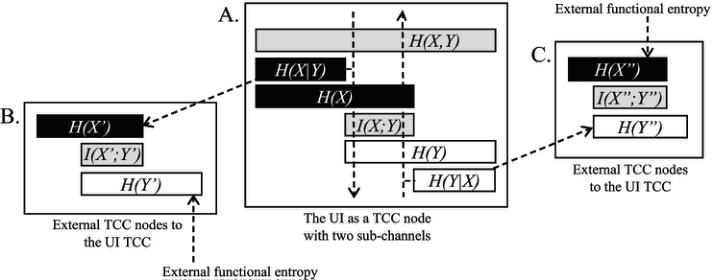
Figure 4: A TCC node in an NTCC network can be viewed as containing multiple sub- channels or sub-systems. The information flow form H(X) to H(Y) and from H(Y) to H(X) each represent a sub-channel. The NTCC network is formed based on these sub- channels. In this diagram, node A represents the original TCC channel for the UI. The entropic connections from node A to TCC node B and from node A to node C can be understood as two distinct sub-channels.
By connecting functional entropies H(X|Y) and H(Y|X) across TCC nodes in an NTCC network, each link between functional conditional entropies and counterpart sources or target entropies in an external TCC node can form sub-channels (see Figure 4). This technique enables a multi-dimensional approach, integrating various function-related factors across stakeholders within the NTCC model. It also supports the dynamic expansion or reconfiguration of the NTCC network to fit a project’s specific needs, provided the approach is justified and accurately represents the UI-system of concern.
REFRAMING “HUMAN-CENTEREDNESS” VIA VIRTUAL CHANNELS The concept of “human-centered design” has long guided designers and engineers in creating systems that better serve users. However, this ideal is inherently limited, as the “human” or “user” is a complex and diverse entity. No single design can fully meet the needs of all users across varied contexts, nor is it feasible to center each individual in design solutions.
Multi-Dimensional Nature of Human-Centered Design 577
Our autoethnographic observations of the Bell-Matic reveal that the primary issue lies in a misalignment between the system’s functional objectives and the user’s practical needs, underscoring limitations in traditional human-centered design (HCD). This misalignment is mediated by the product’s UI, which functions as the central TCC communication channel node within the NTCC framework. For mass-produced products intended for diverse demographics, HCD might benefit from shifting its focus away from centering on any single user or group. Instead, it could prioritize assessing and accommodating the probabilistic alignment of system goals with the varied functional needs of its target users.
NTCC theory provides a structured framework for analyzing the complexities of system-to-user interactions. This paper introduces a deterministic virtual channel (VC) within an NTCC network, allowing for a clearer comparison between the system’s conditional (functional) entropy and the user’s conditional (functional) entropy. Unlike Shannon’s communication model, which was developed for real-world communication systems like telegraphy and treats these entropies as unrelated, the NTCC model can incorporate virtual channels that enable a more dynamic and flexible analysis of arbitrarily selected entropies. The deterministic virtual channel used in this study is not constrained by the physical limitations of Shannon’s model, allowing for mutual information values that may exceed either of its marginal entropies. This approach supports more detailed and dynamic examinations of system-to-user interactions, and the following sections outline the integration of this virtual channel into the NTCC model.
Preparations for Functional Entropies Alignment Analysis To simplify the theoretical modeling for exploratory and demonstration purposes, we will assume that, for the remainder of this paper, the conditional entropies H(X|Y) and H(Y|X) represent only functional entropies, disregarding other contingent factors affecting channel A. This assumption enables a clearer comparison of system functional entropy. For ease of reference, we introduce the following intermediary steps:
1. Defining the primary TCC node: We define the primary TCC node of a UI-system as channel A, with the following denotations:
The equivocation of channel A as HA(X|Y)
The output conditional entropy of channel A as HA(Y|X)
The input entropy of channel A as HA(X)
The output entropy of channel A asHA(Y), and so on.
2. Conditional Entropy as Sets: In NTCC theory, when applied to a UI- system, both conditional entropies can also be viewed as sets, each consisting of Uncertain Actionable Interface Options (UAIO) elements. As noted above, a UAIO entropic element can be denoted as AIOu. 3. Functional (Conditional) Entropies: For abbreviation in the following sections, we denote the two functional (conditional) entropies of channel
578 Chong
A as α and β:
Equations and mathematical formulas are available in the original paper PDF.
4. Defining Proxy Conditions: We introduce two proxy conditions, P and U, defined as follows:
Condition P refers to any AIOu element in α or β (i.e., in HA(X|Y) or HA(Y|X)) that is not in conflict with any AIOu elements in α (i.e., not in conflict with α given β and α).
Condition U refers to any AIOu element in α or β, that is not in conflict with any AIOu elements in β (i.e., not in conflict with β given α and β).
The two deterministic proxy conditions, P and U, served as intermediary reference values for describing and evaluating a wide range of possible alignment and misalignment states among the AIOu elements within the conditional (functional) entropies α and β. The specific values, terms, or conditions of P and U need to be accurately defined by the researchers to represent the actual situations in the UI use case.
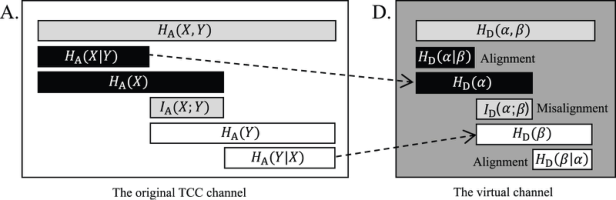
The Deterministic Virtual Channels (VC) in NTCC Building on the previous preparations, we now introduce a deterministic virtual channel (VC), referred to as channel D (see Figure 5), which measures or communicates the level of alignment or misalignment between α and β. This misalignment is determined by the functional purpose alignment sub- relationships among the AIOu elements in the conditional entropies α and β via the intermediary proxy determinations of P and U. The formulations as follows:
5. Channel D, as a deterministic virtual channel, incorporates the two conditional entropies α and β from channel A as its marginal entropies:
The mutual information in channel V can therefore be denoted as: X
X
HD(AIOu
αi, AIOu
βi)misaligned
i
i
Where AIOu
αi and AIOu
βi are the uncertain actionable interface options (AIOu elements) within α and β, respectively; HD(AIOu
αi, AIOu
βi)misaligned represents the entropy contribution of each pair of AIOu elements that are misaligned according to the conditions P and U.
The mutual information ID (α; β) represents the amount of entropy shared between the conditional entropies in α and β in cases that are either not opposed to P but opposed to U, or opposed to P but not opposed to U. In other words, the mutual information of channel D reflects the total entropy
Multi-Dimensional Nature of Human-Centered Design 579 from all AIOu elements in α and β that are not aligned by comparing to the alignment conditions mediated by proxy values P and U.
6. Logically derived from the above mutual information ID (α; β), the conditional entropies HD(α|β) and HD(β|α) in channel D can be used to measure the aligned or neutral AIOu elements in α and β. The total conditional entropy in channel D is given by:
X
X
HD(AIOu
αi)aligned
i i X X
HD(AIOu
βi)aligned
i i X X
HD(AIOu
αi, AIOu
βi)aligned
i
i
This entropic quantity measures the AIOu elements in α and in β that are either not opposed to P and U, opposed to both P and U.
This interpretation suggests that, after accounting for misalignments in ID (α; β), the remaining entropy between α and β pertains to AIOu elements that are fully aligned or neutral with respect to conditions P and U. These are the elements that are either aligned, unrelated, or exert no conflicting effects on the system’s functional entropy HA(X|Y) or the user’s functional entropy HA(Y|X) in channel A (i.e., α and β).
In the context of NTCC within the virtual channel D, HD (α|β) represents the AIOu element in α that are either aligned with or neutral to all AIOu element in β; similarly, HD (β|α) represents the AIOu element in β that are either aligned with or neutral to all of the AIOu element in α. In channel A, the AIOu elements either in system functional entropy HA(X|Y) or in the user’s functional entropy HA(Y|X) are not in conflict with their respective counterpart conditional entropy.
Figure 5: Channel A represents the original TCC channel for the UI, while Channel D serves as the deterministic virtual channel used to assess functional entropy alignments between the system and the user.
580 Chong
Functional Entropy Alignments Exemplified in Bell-Matic To demonstrate functional entropy alignment analysis using virtual channels, let’s examine Item 2 from the autoethnographic observations. The observed design flaw—where the Bell-Matic’s alarm activation button is frequently deactivated by accident during daily use—can be modeled within the NTCC framework using a virtual channel (VC).
First, we define channel A as the primary TCC node representing the Bell-Matic’s UI-system, encompassing both the system and the user. For simplicity in our demonstrations, let’s assume there is only one AIOu element in HA(X|Y) and in HA(Y|X) each, representing Seiko’s functional purpose of “reducing production costs.” Similarly, the user’s functional purpose is to have “a reliable activation state for the alarm button after winding the alarm spring and setting the alarm time”:
We define two proxy conditions P and U as follows:
Condition P refers to any AIOu element in both α or β that does not conflict with any AIOu elements in α; in other words, it is either supportive of or neutral to Seiko’s “cost reduction” objective.
Condition U refers to any AIOu element in both α or β that does not conflict with any AIOu elements in β; in this case, it is either supportive of or neutral to the user’s need for a “secure alarm button when the alarm is activated.”
We then introduce the deterministic virtual channel D, which evaluates the mutual information ID (α; β) in a way that may differ from the standard calculation for a Shannon communication channel: ID (α; β) = HD (α) + HD (β) −HD (α, β)
In our case the mutual information ID (α; β) measures the amount of entropy shared between α and β that is either:
Pro or irrelevant to P but against U; in other words, beneficial for or neutral to Seiko’s “cost reduction” needs but not helpful in ensuring a “reliable alarm activation state,” or
Against P but pro or irrelevant to U; meaning it is helpful for or neutral to the user’s need for a “reliable alarm activation button” but contradicts Seiko’s goal of “reducing production costs.”
In real-world scenarios, rather than using abstract placeholders, specific functional purposes or design features would fill these conditional entropies. For example, consider a conditional entropy related to “reducing the size of the alarm button.” This could represent a design choice by Seiko (reflected in α) that wasn’t communicated to the user, or it could be an improvement desired by the user (reflected in β) that Seiko never considered. In either case, this conditional entropy highlights a miscommunication between the Bell-Matic’s system and the user.
Multi-Dimensional Nature of Human-Centered Design 581
Suppose “designing a smaller alarm button” could reduce material costs slightly, thereby aligning with Seiko’s functional goal. From the user’s perspective, however, a smaller alarm button might reduce the likelihood of it catching on clothing but could also make it less accessible and less visible, negatively impacting its function as a clear visual indicator. In this scenario, the conditional entropy associated with “reducing the alarm button size” aligns with P but conflicts with U, meaning it will contribute to the mutual information ID (α; β) in channel D. It would not, therefore, fall under the total conditional entropies HD (α|β) + HD (β|α) within channel D, indicating a misalignment between the designer’s and user’s functional goals for this potential design change—a clear conflict of interest. Adopting such a change would violate the human-centered ideal.
Now let’s consider another example. If the conditional entropy involves “changing the alarm activation method from pulling the button out to pushing it in,” this could represent a design solution considered by Seiko (reflected in α) but not communicated to the user, or it could reflect a user’s desired improvement (reflected in β) that Seiko had not considered. Using virtual channel D and the intermediary conditions P and U:
Suppose that reversing the “push-pull” activation mechanism has little impact on production costs and might even slightly reduce them. In this case, the conditional entropy would be neutral or supportive of Seiko’s functional purpose.
From the user’s perspective, this change could make the alarm button less prone to accidental deactivation when in the active state, as it would be more secure when pushed into its default position, protected by the Bell-Matic’s lug. Even if the alarm is accidentally activated while in the deactivated state, there would be no significant consequence, as the alarm spring would likely remain unwound. This change, therefore, aligns with the user’s functional purpose.
Since this conditional entropy supports both P and U, it would also be included in channel D’s total conditional entropies HD (α|β) + HD (β|α), indicating alignment between Seiko’s and the user’s functional goals. This suggests a beneficial design improvement for future iterations of the product.
These examples use single conditional entropy values to demonstrate the application of functional entropy evaluations via a deterministic virtual channel. In practice, a TCC node and a virtual channel can evaluate multiple AIOu elements in α and β. It is also possible to introduce multiple virtual channels, each tailored for specific evaluation purposes.
Key Situations and Trends in Entropy Alignments The alignment and misalignment of conditional entropies α and β can range from a minimum value of 0 to a maximum value of α + β. We can examine different scenarios of alignment and misalignment modeled using virtual channel D.
In the case of full alignment, all UAIO elements (AIOu) are either supportive of or neutral to both P and U, or opposed both. There are no
582 Chong
misalignments between α and β; the conditions are either both fully not against or both fully against each of the proxy conditions P and U. The conditional entropies in channel D represent these aligned AIOu elements from α and β. In this scenario, the mutual information will be at its minimum, the total conditional entropies will be maximized. The resulting mutual information and total conditional entropies in virtual channel D will be:
In the case of complete misalignment, all AIOu elements of concern are either aligned with P but opposed to U, or aligned with U but opposed to P. In this scenario, all AIOu elements within α and β are fully misaligned, indicating that each AIOu element is caught in the conflict between the functional interests of the counterpart stakeholders, represented respectively by the conditions P and U. Consequently, the mutual information in virtual channel D will reach its maximum, as both α and β comprise misaligned AIOu elements. Due to this full misalignment, there will be no aligned information to contribute to the conditional entropies HD (α|β) and HD (β|α), resulting in the total conditional entropy minimizing to zero. The resulting mutual information and conditional entropies in channel D will therefore be:
In mixed or intermediate scenarios, virtual channel D will contain (and/or process) a combination of aligned and misaligned AIOu elements as marginal entropies. Some AIOu elements will be aligned (i.e., either not opposed to both P and U, or opposed to both), while others will be misaligned (i.e., not opposed to P but opposed to U, or not opposed to U but opposed to P). In this mixed scenario, the mutual information in virtual channel D and the total conditional entropy will assume intermediate values:
0 < ID (α; β) < α + β 0 < HD (α|β) + HD (β|α) < α + β
The proxy conditions P and U mediate the functional interests represented by α and β; thus, these relationships need to be accurately modeled to reflect the actual situation. Analyzing trends in possible alignments between P and U is also essential, as the degree of alignment between P and U will influence alignment outcomes in α and β. This influence is observable through the values of ID (α; β) and HD (α|β) + HD (β|α):
When P and U fully overlap or are unrelated, meaning they are fully aligned, all AIOu elements will either are not opposed to P and U, or opposed to both P and U. In this case, no misalignments exist, resulting in full alignment:
Multi-Dimensional Nature of Human-Centered Design 583
When P and U are entirely opposite, meaning that the system’s functional entropy and the user’s functional entropy are completely misaligned—the following results are observed:
When P and U partially overlap, they share some common elements but also have differences. In this case, some AIOu elements will be aligned (do not oppose to P and U, or oppose to both), while others will be misaligned (do not oppose to P but oppose to U, or do not oppose to U but oppose to P). In such scenarios, both ID (α; β) and HD (α|β) + HD (β|α) will assume intermediate values.
0 < ID (α; β) < α + β 0 < HD (α|β) + HD (β|α) < α + β
Interestingly, when P and U are completely unassociated, the functional entropy alignment may yield the same results as when P and U fully overlap. Specific contributing factors and comparative outcomes depend on the characteristics of the actual AIOu elements in α and β. Such scenarios provide opportunities to address the diverse functional needs of counterpart stakeholders—namely, the system and the user in this context—without compromise. Additionally, creative approaches may allow updates to the proxy terms to benefit the functional purposes of the other party.
DISCUSSIONS: HCD AS SYSTEM-TO-USER FUNCTIONAL ENTROPY ALIGNMENT As observed, the logical relationship between the AIOu elements in the system’s functional entropy α and the user’s functional entropy β influences the values of mutual information ID (α; β) and the conditional entropies HD (α|β) and HD (β|α) in virtual channel D. These alignments are further shaped by the deterministic proxy values P and U. Modeling such entropic alignments and misalignments was achieved by introducing an additional dimension to the TCC channel node, associating the two equivocations HA (X|Y) and the conditional entropy HA (Y|X) in an arbitrarily created dimension, which subsequently formed virtual channel D.
By comparing the functional entropies of the system and the user, we effectively modeled the UI-system in a multi-dimensional framework. The mutual information mechanism in virtual channel D functions analogously to an XOR gate, where information aligns with P but not U, or with U but not P. Conversely, the conditional entropy mechanism in channel D operates like an XNOR gate, where information aligns with both P and U, or
584 Chong
with neither. This comparison between the system’s and the user’s functional needs allows us to theoretically reframe “human-centered design” (HCD) as a quantitative—and simultaneously qualitative—analysis of alignment and misalignment between the functional needs of both system and user, bridging gaps that have been challenging to communicate effectively.
Based on an autoethnographic study of the Bell-Matic alarm wristwatch, and using NTCC modeling with deterministic virtual channel (VC) techniques in entropic analysis, we developed a fresh perspective on HCD. This method may also provide an efficient way to reframe the “human-in- the-loop” concept in automation and system design in a quantitative form that is designed for practical applications. Given its strong foundation in Shannon’s original information theory, the NTCC theory, together with the new VC technique, potentially applies to all system-based UI and UX analyses, extending beyond digital interfaces. Using the Bell-Matic as a case study highlights the potential for universal application.
The NTCC theory offers a promising way forward in advancing beyond traditional understandings of HCD. However, two critical aspects require further validation and exploration: the binary normalization of UI elements and the AIO-based UI modeling methodology. While these ideas align with established industrial and UI design practices, they still require rigorous testing through scientific experiments. Such research will likely reveal new insights into the foundations of this novel information-theoretic approach to UI design and research.
CONCLUSION
All frameworks are simplified representations of the systems they seek to emulate, reflecting George Box’s well-known observation: “All models are wrong” (Box, 1976). Yet, it remains our professional responsibility to make the models we design as “useful” (Box, 1976) as possible.
Box’s insight applies directly to our concept of “human-centeredness” in design. If a theoretical model of ours is ill-fitting or ambiguous for today’s digital interfaces, we may benefit from reframing it within models that provide more effective and more dynamic guidance. By drawing on information theory and NTCC, we propose a preliminary reinterpretation of human-centered design (HCD), seeing it as a flexible, multi-dimensional model. This approach builds on the foundational work of Boltzmann (1877) and Shannon (1948), whose groundbreaking theories not only propelled scientific and technological progress but also reshaped how we perceive physical reality.
As UI design remains a relatively young, rapidly advancing field, it is essential to acknowledge the limitations of our current understanding and practices. With technology for human-to-system interaction advancing at an unprecedented rate, we have a rare opportunity to revisit and refine our foundational philosophies and methods. Using information theory and thermodynamics as conceptual frameworks for UI/UX design and research may open a productive new path forward.
Multi-Dimensional Nature of Human-Centered Design 585
The pursuit of “human-centeredness” in design remains ambitious. Our evolving theoretical model might serve as a new kind of treasure map—still being charted, yet already beginning to show its potential to assist future UI/UX design and research efforts with fresh coordinates and newly defined cardinal points.
REFERENCES
Boltzmann, L. (1877). On the relation between the second fundamental theorem of the mechanical theory of heat and probability calculations regarding the conditions for thermal equilibrium. Translated by K. Sharp, F. Matschinsky. Entropy 17(4) 2015 pp. 1971–2009. Box, G. (1976). Science and statistics. Journal of the American Statistics Association
71(356) pp. 791–799. Brooke, J. (1996). SUS—A quick and dirty usability scale. Usability Evaluation in Industry. CRC Press pp. 189–194. Chong, L. (2023). Temperature entropy and usability: The theoretical and practical
resemblances between thermodynamics and user interface design. Proceedings of HCII International 2023, Copenhagen, Denmark. Chong, L. (2024). The Relevancy of Knowledge and the Knowledge of Relevancy: An Information-Theory-Based Quantitative Methodology for Evaluating UI Design and Usability. In: Tareq Ahram and Christianne Faicao (Eds.) Usability and User Experience. AHFE (2024) International Conference. AHFE Open Access vol. 156 AHFE International USA. Dreyfuss, H. (1955). Design for People. Simon and Schuster Inc. New York, NY. ISO. (2018). Ergonomics of human-system interaction – Part 11: Usability: Definitions and concepts (ISO 9241-11:2018). International Organization for Standardization, International Electrotechnical Commission, Geneva. ISO. (2024). Ergonomics methods – Part 1: Feedback methods—A method to
understand how end users perform their work with machines (ISO/DTS 16710- 1). International Organization for Standardization, International Electrotechnical Commission, Geneva. Norman, D. (1988). The Psychology of Everyday Things. Basic Books New York, NY. McCay, E. M. (2018). Intuitive Design: Eight Steps to an Intuitive UI. Black Watch Publishing Saint Albans Bay, Vermont. Shannon, C. E. (1948). A mathematical theory of communication. Bell Systems
Technical Journal 27 pp. 379–423, 623–656. Wikipedia contributors. (2023). Human-Centered Design. Wikipedia.org. Retrieved October 14, 2024. Weblink: https://en.wikipedia.org/wiki/Human-centered_ design
LISTED IN THE AHFE DIGITAL BOOKSTORE CATALOGUE
Explore the complete digital volume
Human Factors in Design, Engineering, and Computing
Read this individual research paper free through the original publisher, or explore the full digital proceedings book.
ISBN 978-1-964867-35-9
Explore this ISBN in the AHFE Bookstore ↗Listed in the July 2026 bookstore catalogue; search by ISBN to confirm current availability · Digital book purchase optional