Vivian Lotz, Eva-Maria Schomakers, Martina Ziefle (2022). Acceptance of app based interaction between automated micro vehicles (AMV) and their users. In: Human Factors in Transportation. AHFE Open Access, vol. 60, pp. 172–183. https://doi.org/10.54941/ahfe1002447
In the current paradigm of rapid urban growth and with the growing number of daily delivered goods, it is indispensable to develop new mobility solutions, ensuring sustainable, safe, and reliable inner-city logistics. This paper examined Duck-Train, an automated, electric Follow-Me micro vehicle concept (Follow-Me AMV). More specifically, we took a closer look at the communication between the vehicles and their users.We created an app prototype to enable potential users to interact with AMVs and initiate maneuvers. Afterward, we conducted a bilingual (German and Turkish) online survey (N = 202) containing four interaction tasks. After solving the tasks via the survey-integrated prototype, participants were asked to evaluate the app.Data were analyzed regarding the interface acceptance, the influence of the queried factors on acceptance, and the moderating effect of culture. The relationship between factors was examined using structural equation modeling (SEM). Results show that the app was overall well assessed. Moreover, acceptance of interaction concepts for in traffic communication is, on the one hand, affected by the interfaces' perceived usefulness, the hedonic motivation, and the users' trust in the system. On the other hand, user characteristics also influence the evaluation.
The increase of delivery traffic in cities, due to the growth of e-commerce and continuing urbanization, puts pressure on the limited urban infrastru- cture and contributes to the low air quality and high carbon emissions of the mobility sector (Digiesi et al., 2017). New mobility concepts are needed, especially for the urban last mile where the space in traffic is scarce and ever more delivery vans lead to more traffic congestion (Allen et al., 2018). One promising approach is the use of automated and electrified micro-vehicles (AMVs) for delivery (Baum et al., 2019; Patella et al., 2021). These are veh- icles that weigh less than 350kg (~772 lbs) and drive at a limited speed of 45kph (~28 mph) (Baum et al. 2019). Their small size enables the use of non- road infrastructure to relieve traffic burdens. Most AMVs developed today require either remote control or the reference to a person, e.g., a cyclist whom the AMV follows through sensor technology (Follow-Me concept).
Acceptance of App-based Interaction Between Automated Micro Vehicles 173
When introducing new mobility concepts, public and user acceptance are critical for successful implementation (Baum et al., 2019). However, much remains unknown about the users’ requirements for the interaction with AMVs. For Follow-Me AMVs, the user is the reference person that the veh- icle follows at every turn. Despite the automatic connection, the user must still exhibit some control over the vehicle (e.g., initiate automated maneu- vers). Particularly if used in dense urban road traffic – where AMVs exploit their full potential – the ease of using and controlling the AMVs is para- mount. However, the interaction with AMVs is not fully comparable to in-car interactions or interaction with robots in other contexts.
Therefore, this research focuses on the acceptance of human-machine inter- faces (HMIs) for follow-me AMVs and the drivers of acceptance. While various HMIs for AMVs are conceivable, e.g., voice interfaces, touch displays (Baum et al., 2019), we start by evaluating a smartphone app as an exem- plary HMI. As an examplary vehicle, we used Duck-Train, an automated, Follow-Me micro vehicle concept for the urban last mile (Ducktrain, 2021). To study user acceptance and drivers and barriers of adoption, we develop a conceptual AMV acceptance model and analyze it using partial least squares structural equation modeling (PLS-SEM).
Our research contributes to understanding this new type of vehicle-user- interaction and the factors that drive acceptance.
RELATED WORK
Deciding whether or not to use app-based interaction in a new application context, such as the human-vehicle interaction in dense urban road traffic, is a complex decision and depends upon various factors. As there were various attempts in research to conceptualize the adoption and use of new technolo- gies, leading to many different models, we first introduce relevant constructs, theories, and empirical findings.
Modeling Acceptance. Relying on the earlier work from Fishbein and Ajzen (Fishbein & Ajzen, 1977), Davis formulated a conceptual model of how people come to accept and use computer information systems: the Tech- nology acceptance model (TAM) (1989). The TAM, suggests that the use of a technological (computer) system can be predicted by Perceived Ease of Use (PEOU), Perceived Usefulness (PU), and Behavioral Intention (BI). Here, BI is assumed to be the major predictor of system use so that user acceptance is in research often operationalized equated with BI. BI, in turn, is hypothe- sized to be sufficiently explained by PEOU (how easy the system is perceived regarding the required physical and mental effort) and PU (the users’ belief that using the system enhances their performance). The TAM is a parsimoni- ous, robust, and widely applied model in research (e.g., Venkatesh & Davis, 2000). The initial TAM model was extended in later alterations to obtain a gre- ater explanatory power by adding more direct and anteceding factors (e.g, TAM 2 (Venkatesh, 2000; Venkatesh & Davis, 2000), TAM 3 (Venkatesh & Bala, 2008), and the Unified Theory of Acceptance and Use of Technology
(UTAUT 1-2) (Venkatesh et al., 2003, 2012). All extensions add various external variables (e.g., Hedonic Motivation and Computer Anxiety).
As the TAM and its succeeding models were initially developed for Infor- mation and Communication Technologies (ICT) applications in an office context and research showed that the perception of technologies varies accor- ding to task type (Goodhue & Thompson, 1995), researchers from other fields adapted the initial models for their own fields. A relevant model in the context of autonomous follow-me vehicles is the Autonomous Vehicle Acceptance Model (AVAM) (Hewitt et al., 2019), which is an adaptation of the UTAUT (Venkatesh et al., 2003) and the Car Technology Acceptance Model (CTAM) (Osswald et al., 2012).
Additional Empirical Insights. Research regarding last-mile delivery inno- vations is still scarce. Only a few studies pay attention to the acceptance of autonomous delivery vehicles as an option for last-mile deliveries (Kap- ser et al., 2021; Kapser & Abdelrahman, 2019; Marsden et al., 2018) or the design of user-AMV interaction and the acceptance of various kinds of interaction concepts. Research in this context mainly focuses on pedestrian- vehicle interactions (Lanzer et al., 2020). To our knowledge, there is to date no study investigating the interaction between users and Follow-Me micro vehicles. However, research from related fields emphasizes, on the one hand, the applicability of established TAM variables. On the other hand, three addi- tional factors occur recurringly: (dis-)trust, privacy concerns, and the role of user diversity.
While (dis)-trust was found in various studies (Choi & Ji, 2015; Gefen et al., 2003) to be a crucial influencing factor for human-automation rela- tionship and thus, for the acceptance of and reliance on such autonomous systems, none of the established models explicitly contains this variable. For the interaction with digital technologies, privacy beliefs and privacy concerns also need to be considered as they can be a barrier to the acceptance of digital technologies (Belanger & Xu, 2015; Schomakers et al., 2021) and conne- cted driving (Brell, Biermann, et al., 2019; European Union, 2020). Whether privacy concerns also hinder the acceptance and use of an app to control AMVs needs to be studied further. Different groups of users typically have different needs to be met by a product, expectations, and mental models of how a product works. In line with this, they may judge a product differently regarding its suitability and acceptability. This influence of user factors (e.g., culture, (Straub, 1994; U˘gur, 2017) on the appraisal of and preferences for technologies is well documented in research.
RESEARCH MODEL AND METHODOLOGY Research Model and Hypotheses
Since the existing theories and models used to understand, predict, and explain acceptance are rather domain-specific, we adapted them to our con- text. We include PEOU and PU, the core TAM constructs (Davis, 1989) which have been recurrently proven to be pivotal in most reviewed resea- rch. Since automated driving and automation, in general, is often regarded with a certain degree of societal skepticism due to a variety of factors, a.o.,
Acceptance of App-based Interaction Between Automated Micro Vehicles 175
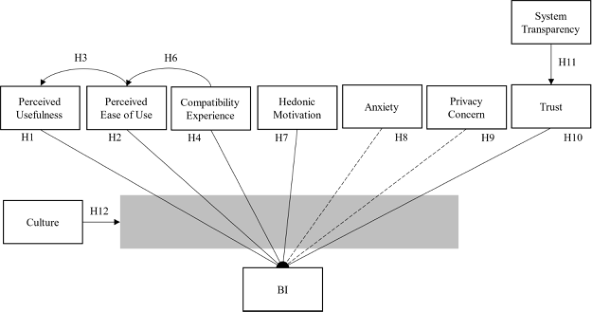
Figure 1: Synthesized research model with an indication of assumed relationships (hypotheses H 1-12). Dashed paths signify assumed negative relationships.
perceived road safety issues or unclear liabilities (Brell, Philipsen, et al., 2019; Kyriakidis et al., 2015), we included the construct Anxiety also used in the AVAM (Hewitt et al., 2019). Moreover, we added the dimension of com- patibility from innovation research (Agarwal & Karahanna, 1998; Rogers, 2010), which has been repeatedly found to be essential for technology acce- ptance (Agarwal & Prasad, 1997; Taylor & Todd, 1995). We assume that a technology that is perceived as compatible with a users’ prior experiences will evoke feelings of familiarity and, thus, positively influence BI. Moreo- ver, we assume that the more consistent a new technology is with previous experience, the less learning effort required to use it and the easier it is perceived.
In line with insights from User Experience research (Hassenzahl, 2003; Nielsen & Norman, 2014), we assume that goal-oriented quality measures and hedonic criteria must be met to appeal to the user. Thus, we included the Hedonic Motivations.
As trust showed to be an essential factor for human-automation relati- onships, we added elements from the trust construct (Choi & Ji, 2015). In addition to general trust beliefs, we included System Transparency. Furth- ermore, we added a Privacy Concern construct as with more sophisticated sensor technologies, concerns about data use and handling become increa- singly important to users and may hinder acceptance (Belanger & Xu, 2015). Lastly, we modeled the respondents’ cultural background as a moderating factor. The hypothesized relationships are visualized in Figure 1.
Study Design – Measurement Instrument An online questionnaire was developed containing two central parts: (1) the scenario-based testing of an app prototype and (2) the evaluation of this app. First, as a warm-up, soziodemographic questions (age, gender, education) and the use of digital technologies and apps, and the affinity for technology inte- raction (Franke et al., 2019) were assessed. After introducing the exemplary AMVs (Ducktrains), the initial usage intention for app-based interaction was assessed. After that, all participants were asked to solve four interaction tasks
Table 1. Explanation of the tasks in the app prototype testing.
Table available in the original PDF paper.
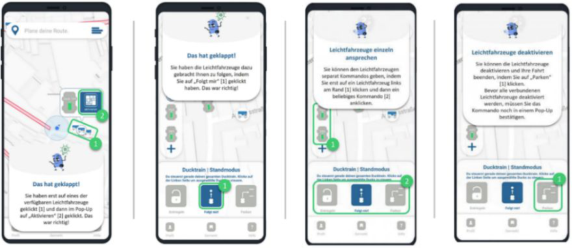
Task Connect Follow-Me Select 1 Duck Deactivate Description of Task Connect any Ducks to the app
Start the follow mode for an already connected Duck
Select one of the already connected Ducks to command it Click on “Follow me!”
Click on button “Park”
Deactivate and switch off all Ducks of a connected Ducktrain How to solve?
Click on one duck and click”activate”
Click a Duck on the left side of the screen
Figure 2: Screenshots of the app with the visual feedback to each of the four tasks.
via the integrated app prototype (cf. Table 1 and Figure 2). In the next part, the participants evaluated the acceptance factors included in the model (cf. Table 3) and their behavioral intention to use the app with the app prototype in mind.
The questionnaire was conducted in two languages: German and Turkish. Original items were translated and adapted to the use of the app to control an AMV. Comprehensibility was checked with pre-tests in both languages.
Throughout the questionnaire, items were answered consistently on 6- point Likert Scales ranging from 1 “I don’t agree at all” to 6 “I fully agree”, but for system transparency which was modeled as semantic differential to shorten the reading time and provide some variety in the questionnaire.
Sample The questionnaire was distributed online in the social circles of the authors and through snowball sampling. Participation was voluntary with no incen- tives given. After a quality check (criteria: completion, no speeders (< 50% of median length)), 202 participants were included in the sample, of which 129 (64%) were German, and 73 (36%) were Turkish. All in all, the sample was relatively young (M = 31,9 years, SD = 13,79, Range: 15-66), female (69% women), and highly educated (41% university degree).
ICT usage was rather high in the sample. The average self-reported ICT use was 3.96 hours (SD = 2.54) on a workday and 5.11 hours (SD = 2.61) on a day off. On average, the participants use their smartphones for 3.69
Acceptance of App-based Interaction Between Automated Micro Vehicles 177
Table 2. Descriptive statistics for constructs: mean M, and standard deviation SD.
Table available in the original PDF paper.
Construct M SD System Transparency 4.39 1.233 Perceived Ease of Use 4.27 1.159 Perceived Usefulness 4.25 1.044 Hedonic Motivation 4.08 1.106 Trust 3.88 1.022 Compatibility Experience 3.36 1.249 Anxiety 3.32 1.040 Privacy Concerns 3.04 1.123
hours of the day (SD = 2.34), and 62 participants (30.7%) use smartphone apps to control other devices, which corresponds to a relatively high mean affinity for technology interaction (M = 3.88, SD = 1.03).
Data Analysis Differences between the behavioral intention to use an app before and after testing the prototype are analyzed using a paired samples t-test. The acce- ptance driving factors are determined by testing the research model using Partial Least Squares structural equation modeling (PLS-SEM). PLS-SEM is suited to explore and test new models (Hair, 2017). First, the measurement model is evaluated regarding reliability and validity following the guideline by Hair et al. (Hair, 2017) before the structural model is reported and, the- reby, the relationships between acceptance factors and behavioral intention are studied.
RESULTS
Acceptance Both Behavioral Intention before trying the app prototype (M = 4.37, SD = 0.978) and after experiencing it (M = 4.16, SD = 1.036) indicate that app-based interaction is generally acceptable in the queried context. How- ever, a paired samples t-test shows a significant difference between both scores, whereas the usage intention after using the prototype was slightly lower (t(201) = 3.217, p = .002, dz = .226).
On average, respondents agreed with most of the constructs measured. (cf. Fehler! Verweisquelle konnte nicht gefunden werden.). Here, System Tran- sparency and PEOU were evaluated most positively. In contrast, Privacy Concerns and Anxiety showed relatively low scores, indicating that respon- dents were neither particularly concerned about their data nor about traffic safety when using the app to interact with an AMV.
Model Evaluation Quality assessment of the measurement model is done based on the guide- lines by Hair (2017). All measures are reported in Table 3.The final model
was sufficient in terms of internal consistency reliability (composite relia- bility > 0.7) and indicator reliability (outer loadings > 0.708). The validity evaluation included an assessment of convergent validity (AVE > 0.5) and discriminant validity via the Fornell-Larcker criterion. Additionally, we tested for collinearity issues using the variance inflation factor (VIF < 5).
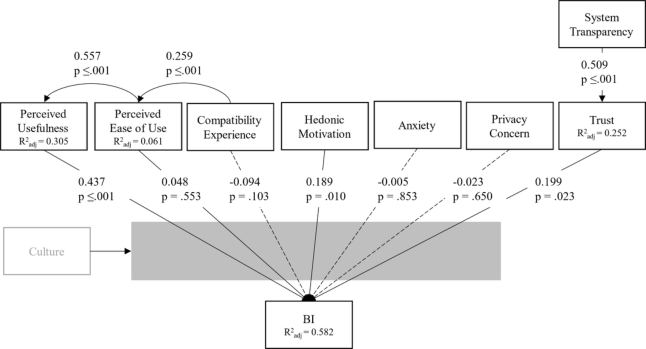
Hypothesis Testing The resulting conceptual model, including path coefficients, is visualized in Figure 3. To check the significance of the path coefficients, bias-corrected and accelerated bootstrapping with 10000 subsamples was used.
The results revealed that only the three constructs, Perceived Usefulness, Hedonic Motivation, and Trust, had a significant relationship with Behavi- oral Intention. However, these three constructs accounted for 58% of the variance in BI, which can be interpreted as a moderate in-sample explana- tory power (Hair, 2017). Here, PU was the strongest predictor, displaying a medium effect size (H1: β = 0.437, p ≤.001, f2 = .174). In comparison, Hedonic Motivation (H7: β = 0.189, p = .010, f2 = .046) and Trust (H10:
Acceptance of App-based Interaction Between Automated Micro Vehicles 179
Figure 3: PLS-SEM with path coefficients and significance based on bootstrapping and explained variance R2. (N = 202). Dashed lines signify a negative path coefficient.
β = 0.199, p = .023, f2 = .051) showed slightly weaker links to BI, with only small effect sizes. None of the other constructs (i.e., Perceived Ease of Use, Compatibility Experience, Anxiety, and Privacy Concern) showed to be a significant predictor of BI. Thus, H2, H4, H8, and H9 remain unsupported.
As hypothesized PU was positively predicted by PEOU (H3: β = 0.557, p ≤.001, f2 = .447), Trust by System Transparency (H11: β = 0.509, p ≤.001, f2 = .344), and PEOU by Compatibility Experience (H6: β = 0.259, p ≤.001, f2 = .070). The effect sizes were large, medium, and weak, respectively. The in-sample explanatory power was medium for PU and weak for Trust and PEOU (cf. Figure 3).
Moderating effect of culture. Differences in the strength of path coeffici- ents stemming from culture were calculated using PLS-Multi Group Analysis. There was a significant difference regarding the relationship between Percei- ved Usefulness and Behavioral Intention (β = 0.532, p = .014) which was significant for the German sample (β = 0.673, p ≤.001) but not for the Turkish (β = 0.120, p = .408). In the same vein, the relationship between Compatibility Experience and Perceived Ease of Use was moderated by cul- ture (β = 0.541, p = .004). Here the relationship was also significant for the German sample (β = 0.421, p ≤.001) and not for the Turkish (β = -0.140, p = .415).
DISCUSSION
This study aimed to examine factors affecting the acceptance of app-based human-AMV interaction. To this end, we queried and assessed eight acce- ptance factors in an online survey with 202 valid responses. The proposed research model was validated using PLS-SEM.
While we did not find evidence for all hypothesized relationships, the model performed well in terms of explanatory power. According to our results, the most pronounced driver of usage intention is high perceived use- fulness – at least for our German public. Besides PU, high hedonic motivation
and high trust also had a significant positive effect on usage intention, both of which are unsurprising as this mirrors the results of prior research (Choi & Ji, 2015; Gefen et al., 2003; Kapser et al., 2021). These results demonstrate the importance of considering not only functional but also non-functional, affective aspects when designing interactive and automated technologies.
Surprisingly we did not find any significant relationships between usage intention and the remaining factors in our model. First, although perceived ease of use at least indirectly related to usage intention as it showed to be a significant predictor of perceived usefulness, it did not significantly and dire- ctly contribute to usage intention. However, this missing or weak relationship between PEOU and usage intention is seen in other studies (e.g., Choi & Ji, 2015; King & He, 2006). Admittedly, due to its limited functions and focus on only a small set of commands, the prototype was relatively easy to use, as indicated by the high evaluation of system transparency and ease of use. Moreover, all respondents owned a smartphone and were thus, practiced in its handling. Therefore, system complexity might not be a relevant acceptance barrier for the examined sample as they are mostly confident in handling app interfaces. Second, compatibility beliefs were only relevant by weakly altering ease of use. This weak linkage might be because compatibility to prior expe- riences is rather difficult to judge after only a short period of testing. Finally, it should also be noted that the used questions were only loosely based on the source material as they had to be adapted for the specific context. As a result, only two of the three items could be included in the analysis. Therefore, it may be necessary to revise them. Third, privacy concerns did not exhibit a significant effect on usage intention. As with the ease of use, this could be linked to the fact that all participants owned and regularly used smartpho- nes and other ICT technologies. Thus, using this specific app might not add any additional privacy threat. Lastly, anxiety also had no significant effect on usage intention. As with the compatibility beliefs, it might be hard for the respondents to judge how risky the actual interaction with the vehicle via an app on the road is. For future assessments, on-site usage experience should be considered.
Overall, the respondents evaluated the app and all queried acceptance factors positively, implying that the app was generally perceived as suitable – even if there remains room for improvements as indicated by a lowered usage intention after trying the prototype.
As mentioned before, the study design could be improved by more realistic testing conditions where the respondents can feel how manageable the intera- ction with the actual AMV via the interface is. However, the approach chosen in this study has the advantage that feedback from a large sample can be obtained rapidly. Especially for PLS-SEM sample sizes of 10 times the num- ber of assessed structural paths directed at one construct are recommended (Hair, 2017). There are some further limitations regarding the generaliza- bility of our findings as we used convenience sampling. For example, most participants were rather well educated and ICT-affine. Apart from the sam- pling method, it should be noted that we did not measure actual behavior but intention to use. Still, this link between intention and behavior is well docu- mented in research (May et al., 2017; Venkatesh & Davis, 2000). Regarding
Acceptance of App-based Interaction Between Automated Micro Vehicles 181
future research, it may be necessary to examine the influence of additional user factors (e.g., usage experience or age), and validate the obtained results for other and more innovative HMI variants (e.g., speech control or in air gestures).
Based on our findings, we suggest that interaction concepts for Follow- AMVs should emphasize functional aspects as well as elements that contri- bute to user trust and fun in the design of HMIs. Furthermore, the designs have to be carefully evaluated against the background ofuser factors. While in some cultures, usefulness is paramount, this aspect might be nearly incon- sequential for other cultural groups. Overall, understanding why and under which conditions interaction concepts for emerging vehicle technologies are accepted is vital to ensure the system’s adoption by those who would benefit most from such systems. It is mandatory to balance the trade-off between various user requirements as well as technological and legal limitations. For this, users must be an integral part of the design process, starting from the early concept phase to realize safe, trustworthy, fun, and practical user-AMV interaction.
ACKNOWLEDGMENT
The authors would like to thank all study participants and Zeynep Arslan for research assistance. This research was funded by the Ministry of Culture and Science of the state of North Rhine-Westphalia with the funding code 321-8.03.07-127598.
REFERENCES
Adams, D. A., Nelson, R. R., & Todd, P. A. (1992). Perceived usefulness, ease of use, and usage of information technology: A replication. MIS quarterly, 227–247. Agarwal, R., & Karahanna, E. (o. J.). On the multi-dimensional nature of compati-
bility beliefs in technology acceptance. 22. Agarwal, R., & Prasad, J. (1997). The Role of Innovation Characteristics and Perceived Voluntariness in the Acceptance of Information Technologies. Decision Sciences, 28(3), 557–582. Allen, J., Piecyk, M., Piotrowska, M., McLeod, F., Cherrett, T., Ghali, K., Nguyen, T.,
Bektas, T., Bates, O., Friday, A., Wise, S., & Austwick, M. (2018). Understanding the impact of e-commerce on last-mile light goods vehicle activity in urban areas: The case of London. Transportation Research Part D: Transport and Environment, 61, 325–338. Baum, L., Assmann, T., & Strubelt, H. (2019). State of the art—Automated microvehicles for urban logistics. IFAC-PapersOnLine, 52(13), 2455–2462. Belanger, F., & Xu, H. (2015). The role of information systems research in shaping
the future of information privacy. Information Systems Journal, 25(6), 573–578. Brell, T., Biermann, H., Philipsen, R., & Ziefle, M. (2019). Conditional Privacy: Users’ Perception of Data Privacy in Autonomous Driving: Proceedings of the 5th International Conference on Vehicle Technology and Intelligent Transport Systems, 352–359. Brell, T., Philipsen, R., & Ziefle, M. (2019). sCARy! Risk Perceptions in Autonomous
Driving: The Influence of Experience on Perceived Benefits and Barriers. Risk Analysis, 39(2), 342–357.
Cho, Y., Park, J., Park, S., & Jung, E. S. (2017). Technology Acceptance Modeling based on User Experience for Autonomous Vehicles. Journal of the Ergonomics Society of Korea, 36(2), 87–108. Choi, J. K., & Ji, Y. G. (2015). Investigating the Importance of Trust on Adopting
an Autonomous Vehicle. International Journal of Human-Computer Interaction, 31(10), Davis, F. D. (1989). Perceived Usefulness, Perceived Ease of Use, and User Acceptance of Information Technology. MIS Quarterly, 13(3), 319–340. Digiesi, S., Fanti, M. P., Mummolo, G., & Silvestri, B. (2017). Externalities reduction
strategies in last mile logistics: A review. 2017 IEEE International Conference on Service Operations and Logistics, and Informatics (SOLI), 248–253. Ducktrain. (2021). Trailerduck. ducktrain. https://ducktrain.io/?lang=de European Union. (2020). Special Eurobarometer 496: Expectations and Concerns from a Connected and Automated Mobility. European Union. Fishbein, M., & Ajzen, I. (1977). Belief, attitude, intention, and behavior: An
introduction to theory and research. Philosophy and Rhetoric, 10(2). Gefen, D., Karahanna, E., & Straub, D. W. (2003). Trust and TAM in Online Shopping: An Integrated Model. MIS Quarterly, 27(1), 51–90. https://doi.org/10.2307/ 30036519 Goodhue, D. L., & Thompson, R. L. (1995). Task-Technology Fit and Individual
Performance. MIS Quarterly, 19(2), 213–236. Hair, J. F. (Hrsg.). (2017). A primer on partial least squares structural equation modeling (PLS-SEM) (Second edition). Sage. Hassenzahl, M. (2003). The thing and I: understanding the relationship between user
and product. In M. A. Blythe, K. Overbeeke, & A. F. Monk (Hrsg.), Funology: From Usability to Enjoyment (Human-Computer Interaction Series) (S. 31–42). Kluwer Academic Publishers. Hewitt, C., Politis, I., Amanatidis, T., & Sarkar, A. (2019). Assessing public perception of self-driving cars: The autonomous vehicle acceptance model. Proceedings of the 24th International Conference on Intelligent User Interfaces, 518–527. Kapser, S., & Abdelrahman, M. (2019). Extending UTAUT2 to Explore User
Acceptance of Autonomous Delivery Vehicles. AMCIS 2019 Proceedings. Kapser, S., Abdelrahman, M., & Bernecker, T. (2021). Autonomous delivery vehicles to fight the spread of Covid-19–How do men and women differ in their acceptance? Transportation Research Part A: Policy and Practice, 148, 183–198. King, W. R., & He, J. (2006). A meta-analysis of the technology acceptance model.
Information & Management, 43(6), 740–755. Kyriakidis, M., Happee, R., & de Winter, J. C. F. (2015). Public opinion on automated driving: Results of an international questionnaire among 5000 respondents. Transportation Research Part F: Traffic Psychology and Behaviour, 32, 127–140. Lanzer, M., Babel, F., Yan, F., Zhang, B., You, F., Wang, J., & Baumann, M. (2020).
Designing Communication Strategies of Autonomous Vehicles with Pedestrians: An Intercultural Study. AutomotiveUI. Marsden, N., Bernecker, T., Zollner, R., Submann, N., & Kapser, S. (2018).
BUGA:Log – A Real-World Laboratory Approach to Designing an Automated Transport System for Goods in Urban Areas. 2018 IEEE International Conference on Engineering, Technology and Innovation (ICE/ITMC), 1–9. May, K. R., Noah, B. E., & Walker, B. N. (2017). Driving Acceptance: Applying Structural Equation Modeling to In-Vehicle Automation Acceptance. Proceedings of the 9th International Conference on Automotive User Interfaces and Interactive Vehicular Applications Adjunct, 190–194.
Acceptance of App-based Interaction Between Automated Micro Vehicles 183
Nielsen, J., & Norman, D. (2014). The definition of user experience. Nielsen Norman Group. Osswald, S., Wurhofer, D., & Tr, S. (2012). Predicting information technology usage
in the car: Towards a car technology acceptance model. 8. Patella, S. M., Grazieschi, G., Gatta, V., Marcucci, E., & Carrese, S. (2021). The Adoption of Green Vehicles in Last Mile Logistics: A Systematic Review. Sustainability, 13(1), 6. Paul A. Pavlou. (2003). Consumer Acceptance of Electronic Commerce: Integrating
Trust and Risk with the Technology Acceptance Model. International Journal of Electronic Commerce, 7(3), 101–134. Rogers, E. M. (2010). Diffusion of Innovations, 4th Edition. Simon and Schuster. Schomakers, E.-M., Lidynia, C., & Ziefle, M. (2021). The Role of Privacy in the Acceptance of Smart Technologies: Applying the Privacy Calculus to Technology Acceptance. International Journal of Human–Computer Interaction, 0(0), 1–14. Schrepp, M., Hinderks, A., & Thomaschewski, J. (2014). Applying the User
Experience Questionnaire (UEQ) in Different Evaluation Scenarios (S. 392). Straub, D. W. (1994). The Effect of Culture on IT Diffusion: E-Mail and FAX in Japan and the U.S. Information Systems Research, 5(1), 23–47. https://doi.org/ 10.1287/isre.5.1.23 Taylor, S., & Todd, P. A. (1995). Understanding Information Technology Usage: A
Test of Competing Models. Information Systems Research, 6(2), 144–176. U˘gur, N. G.(2017). Cultural Differences and Technology Acceptance: A Comparative Study. Journal of Media Critiques, 3(11), 123–132. Venkatesh, V. (2000). Determinants of Perceived Ease of Use: Integrating Con-
trol, Intrinsic Motivation, and Emotion into the Technology Acceptance Model. Information Systems Research, 11(4), 342–365. Venkatesh, V., & Bala, H. (2008). Technology acceptance model 3 and a research agenda on interventions. Decision sciences, 39(2), 273–315. Venkatesh, V., & Davis, F. D. (2000). A Theoretical Extension of the Technology
Acceptance Model: Four Longitudinal Field Studies. Management Science, 46(2), 186–204. Venkatesh, V., Morris, M. G., Davis, G. B., & Davis, F. D. (2003). User Acceptance of Information Technology: Toward a Unified View. MIS Quarterly, 27(3), 425–478. Venkatesh, V., Thong, J. Y., & Xu, X. (2012). Consumer acceptance and use of
information technology: Extending the unified theory of acceptance and use of technology. MIS quarterly, 36(1), 157–178. Yuen, K. F., Cai, L., Qi, G., & Wang, X. (2021). Factors influencing autonomous vehicle adoption: An application of the technology acceptance model and innovation diffusion theory. Technology Analysis & Strategic Management, 33(5), 505–519.
LISTED IN THE AHFE DIGITAL BOOKSTORE CATALOGUE
Explore the complete digital volume
Human Factors in Transportation
Read this individual research paper free through the original publisher, or explore the full digital proceedings book.
ISBN 978-1-958651-36-0
Explore this ISBN in the AHFE Bookstore ↗Listed in the July 2026 bookstore catalogue; search by ISBN to confirm current availability · Digital book purchase optional